Last week I shared with you the miniature world of the sea slugs, so this week I’ll super-size things and bring you some big fish. Silly-season reports of Great-white sharks often hit the headlines in Cornwall, but I prefer rock-pool giants; they’re not made up, and you can get close to them without having your leg bitten off!
Cornwall is brilliant in all sorts of ways, our network of local, grassroots marine conservation groups being just one of them. The public launch, last week, of the new Three Bays Wildlife Group brought experts and volunteers together and gave me a chance to explore some new beaches in the St Austell area.
Judging by the squeals of excitement from the children and adults alike, the crabs, pipefish, prawns and anemones we found at the main rockpool ramble on Portmellon beach near Mevagissey went down well. By the end of the day, the local group had recruited lots of potential new volunteers.
Green shore urchin adorned in seaweed. Portmellon beach.
It’s the middle of the night and I’m convinced there’s something wrong with my eyes. I’ve unplugged my phone, tried blinking several times but I’m still seeing flickering lights and flashes. Finally I twig what’s going on and open the curtains to reveal incessant sheet lightning.
My first thought is that it had better stop by the morning, else no-one will turn up to my first rock pooling event at Porth Mear with Fox Club, the junior branch of the Cornwall Wildlife Trust. As a child, I was a keen member myself so I’ve been looking forward to this for months.
By the morning the lightning storm has given way to wind and rain, but conditions are less than inspiring. It’s amazing anyone shows up for rock pooling, but a few hardy well-wrapped-up folk do, as does a lovely volunteer assistant. (more…)
Next month, 50 years will have passed since the Torrey Canyon tanker ran aground off the Isles of Scilly, releasing a 700 square km oil slick. On the last day of 2016, I visited Porth Mear to learn how a long-term survey has revealed the secrets of the beach’s fragile recovery, and to see if the St Piran’s hermit crab (Clibanarius erythropus)has managed to make more than a temporary comeback.
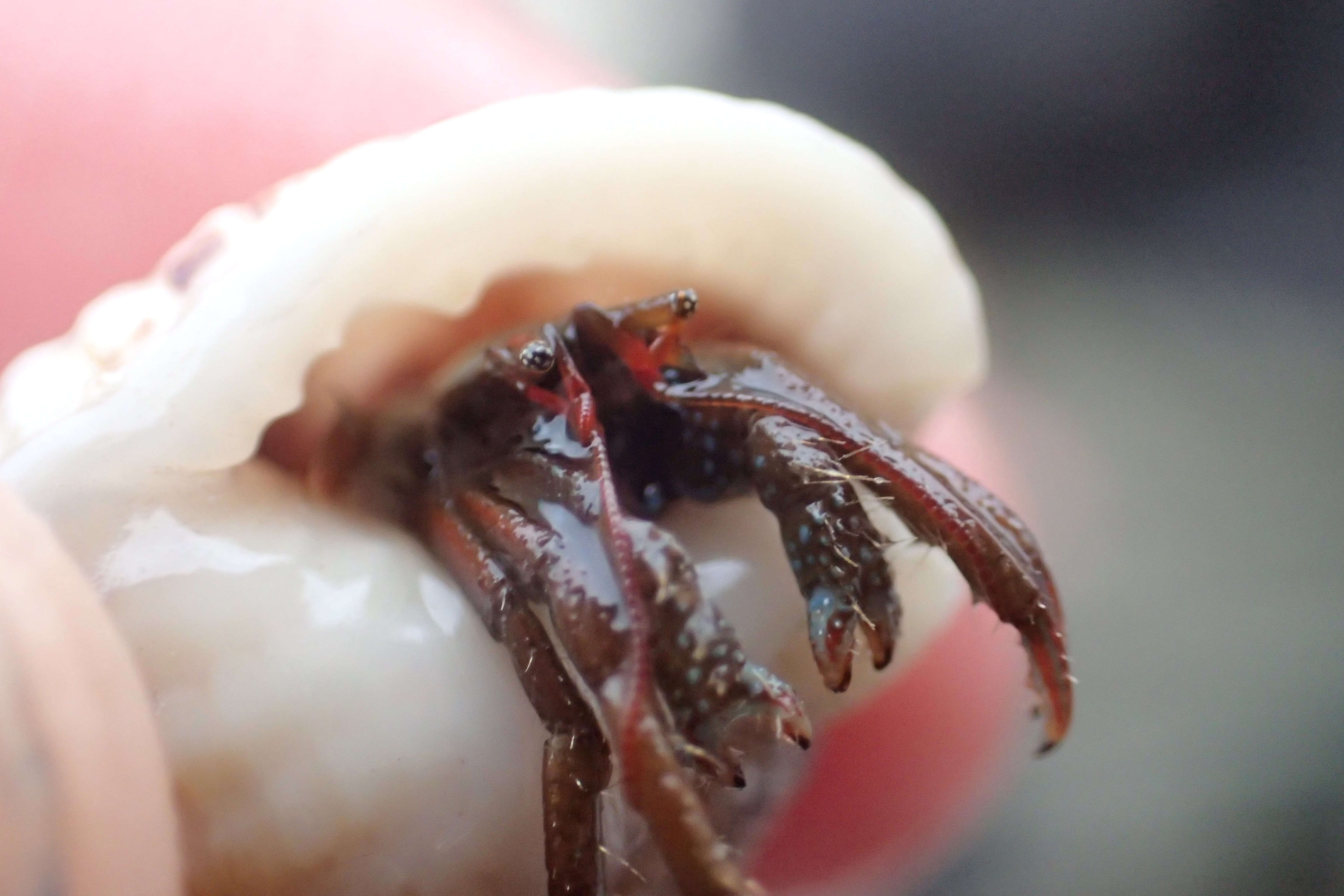
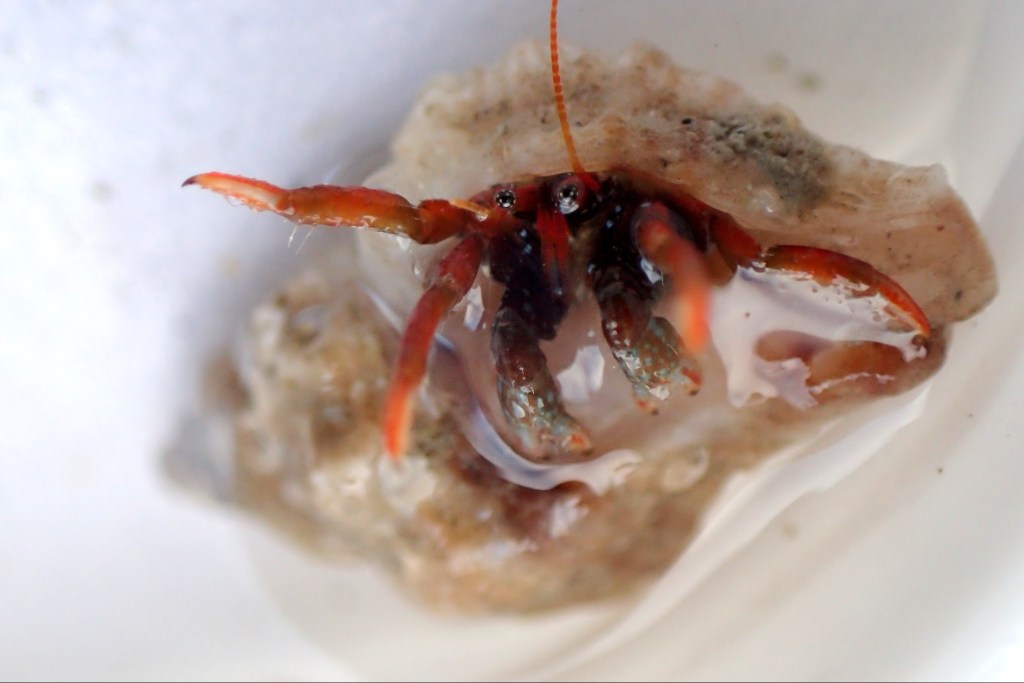
Clibanarius erythropus – A red legged hermit crab making a comeback in the Cornish rock pools this year.
When the Torrey Canyon hit rocks in February 1967, its cargo of oil ended up on the Cornish, Breton and nearby coasts. The oil, along with huge quantities of solvent emulsifying chemicals used in an attempt to disperse it, decimated seabird populations and marine wildlife.
Concerned by the impact on his local beach, biology teacher, Richard Pearce, decided to monitor the wildlife on the shore three times a year. He’s been doing his survey without fail ever since.
I wasn’t born when Richard first marked out his quadrats on Porth Mear beach, but I grew up hearing stories of the horror people felt at the sight of the thick black tide, the pervasive smell of the oil, and the woefully unprepared volunteers attempting to shift the cloying oil with garden tools. Decades later, lumps of tar were still washing onto our beaches after every storm.
I’ve always wondered what the process of recovery looked like, so I jumped at the chance to join Richard at Porth Mear for survey number 150.
Survey 150…
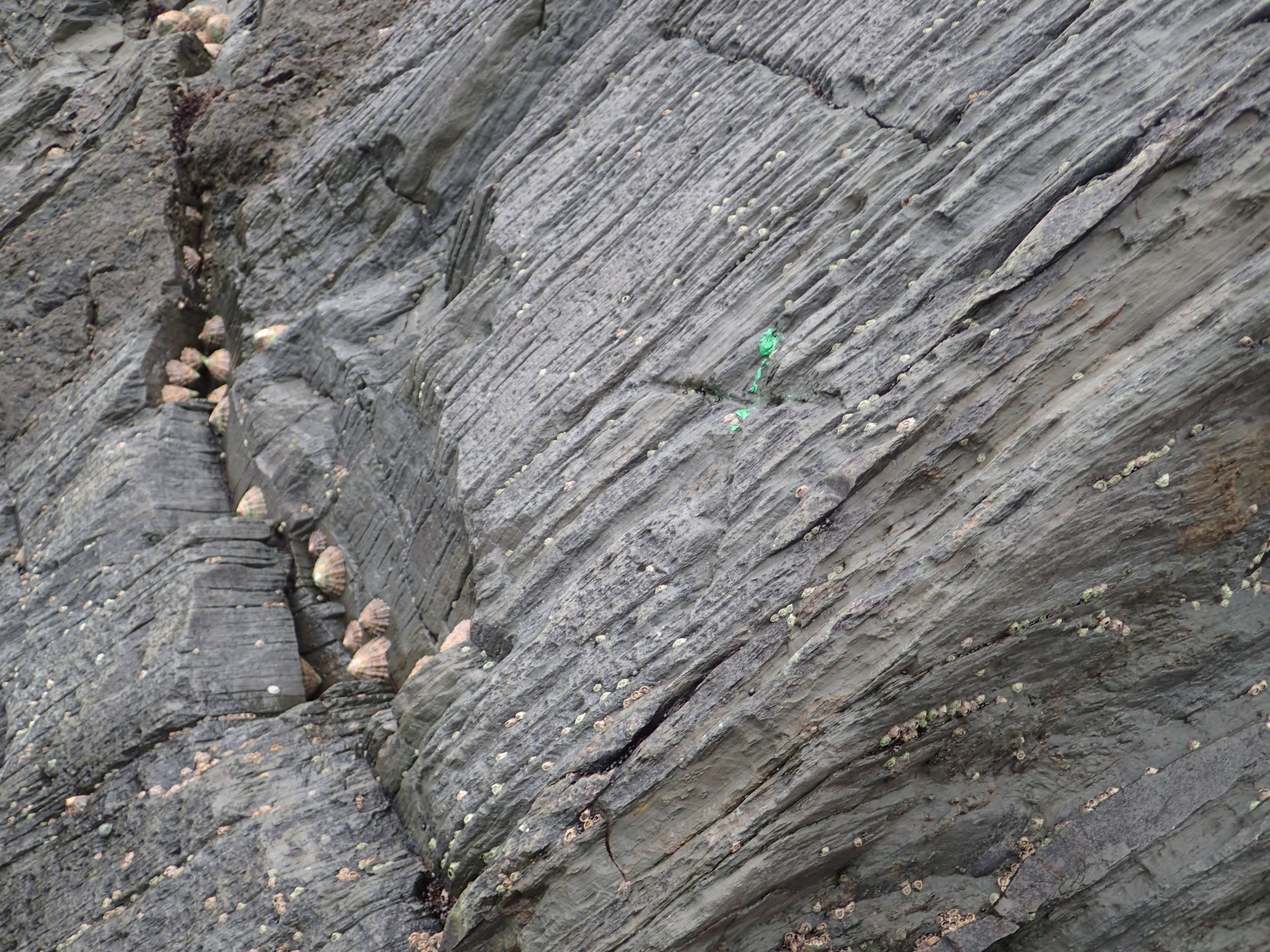
It’s clear, after many surveys, that Richard knows the beach well. So well, in fact, that even when the gouged crosses and splodges of green paint that mark the survey quadrats have worn away or been covered up by seaweed, he still knows exactly where they are.
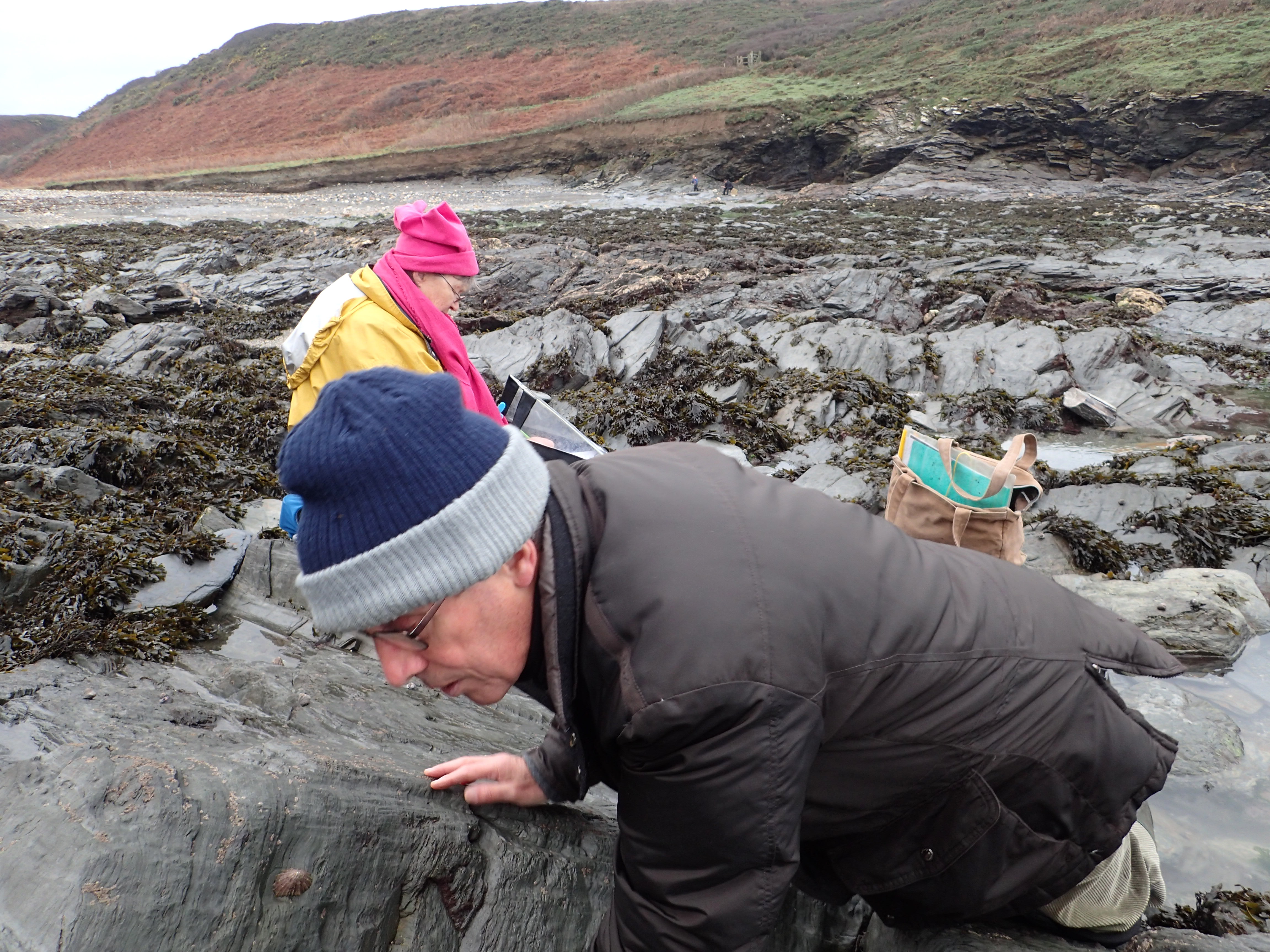
Richard examines a quadrat while Chris notes the data
As he shows me his method, calling out the presence and coverage of seaweeds, barnacles and molluscs to his partner, Richard tells me how after the Torrey Canyon disaster the green seaweeds were the first to flourish. With many of the grazing molluscs wiped out by the oil and the chemicals used to disperse it, the seaweeds soon took over. After this other animals gradually returned.
Crosses in the rock and paint marks show the quadrat boundaries – now on his 150th survey Richard knows just where they all are!
Over the years, Richard has seen many changes. Some are seasonal or weather related, others are harder to explain but may be due to warming seas. Why one pool that was once crammed with mussels now has almost none and why limpets are doing particularly well this season is hard to say, but the data he is collecting reveals changes that would otherwise go unnoticed.
Not for the faint-hearted – Richard has to scrabble down steep rocks and wade knee-deep to reach some of his quadrats.
The tide drops and, while Richard is knee-deep examining a quadrat alongside a long deep pool, I explore the lower shore pools, determined to find out whether the St Piran’s crab is still here. After an absence of more than 30 years, this equal-clawed hermit crab started to reappear around Cornwall in 2016 and we had one record on this beach in the spring. Although past records are too patchy to be sure, it’s thought that pollution from the Torrey Canyon played a role in the loss of this species, so 50 years on it would be lovely to find it re-establishing.
Every time I see a shell move, I leap on it, looking for the red legs and spotty eyes, but every one is a common hermit crab (Pagurus bernhardus).
The disappointment mounts… I find lots of common hermit crabs (Pagurus bernhardus) – the right claw is much chunkier than the left with lots of raised bumps on top.
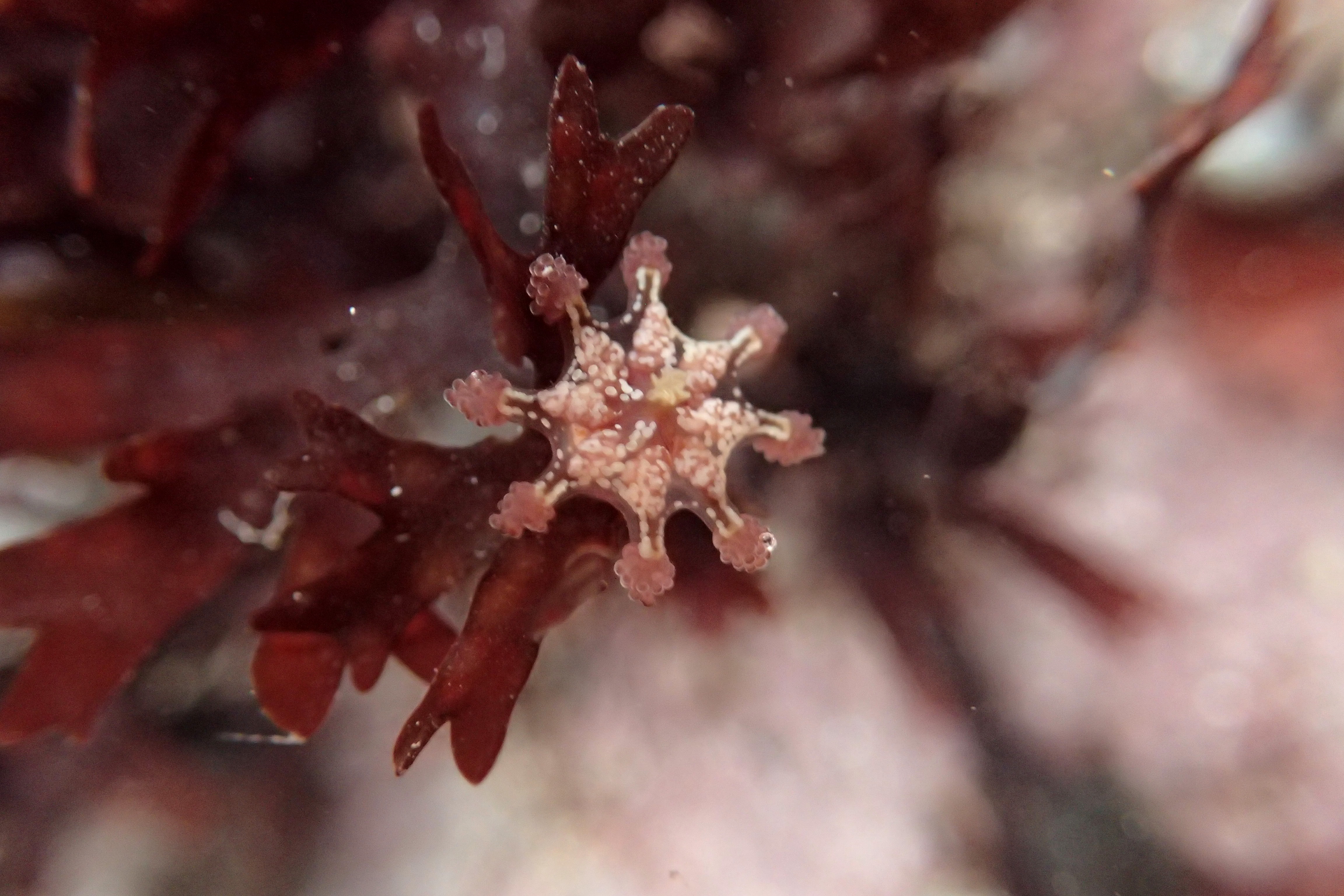
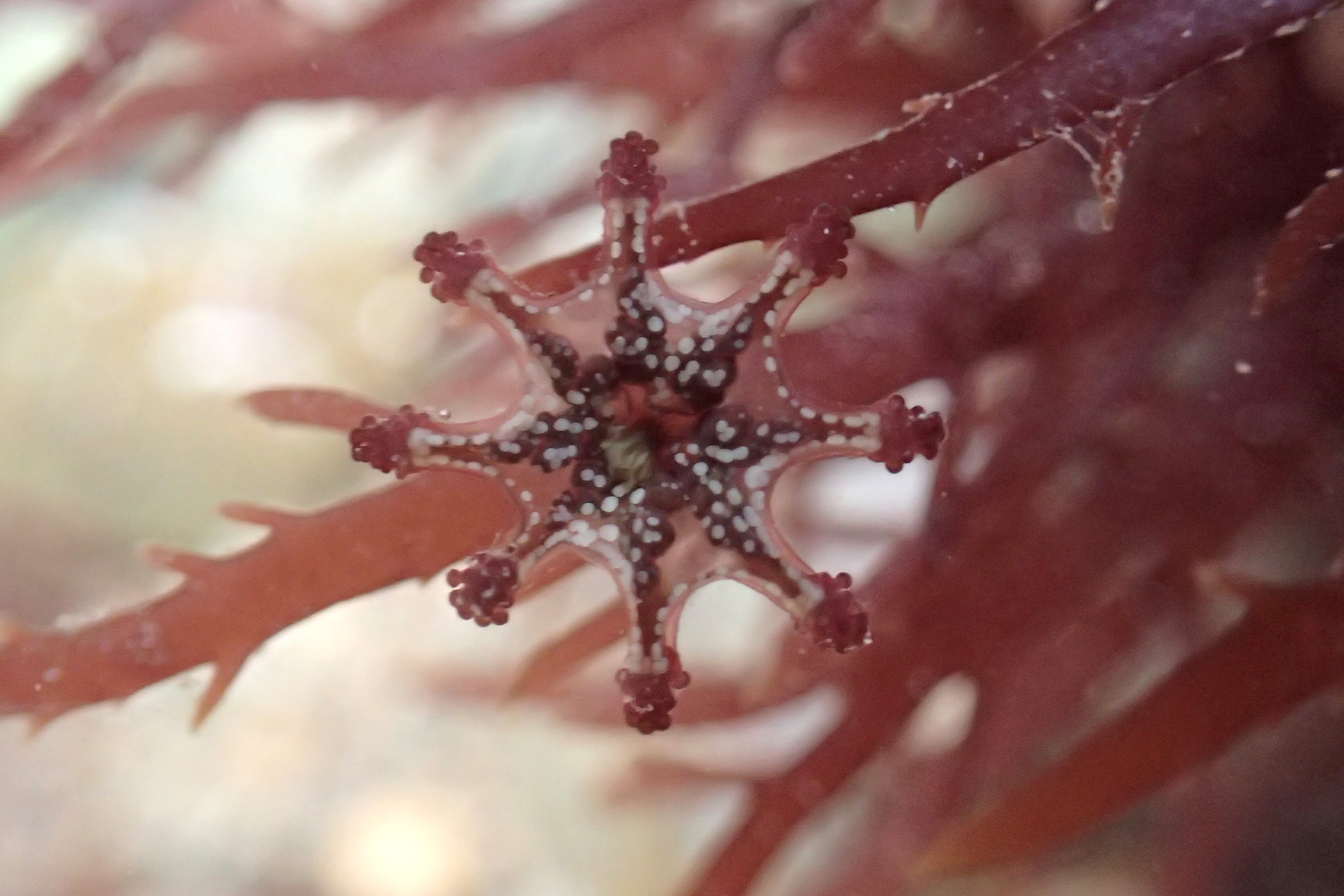
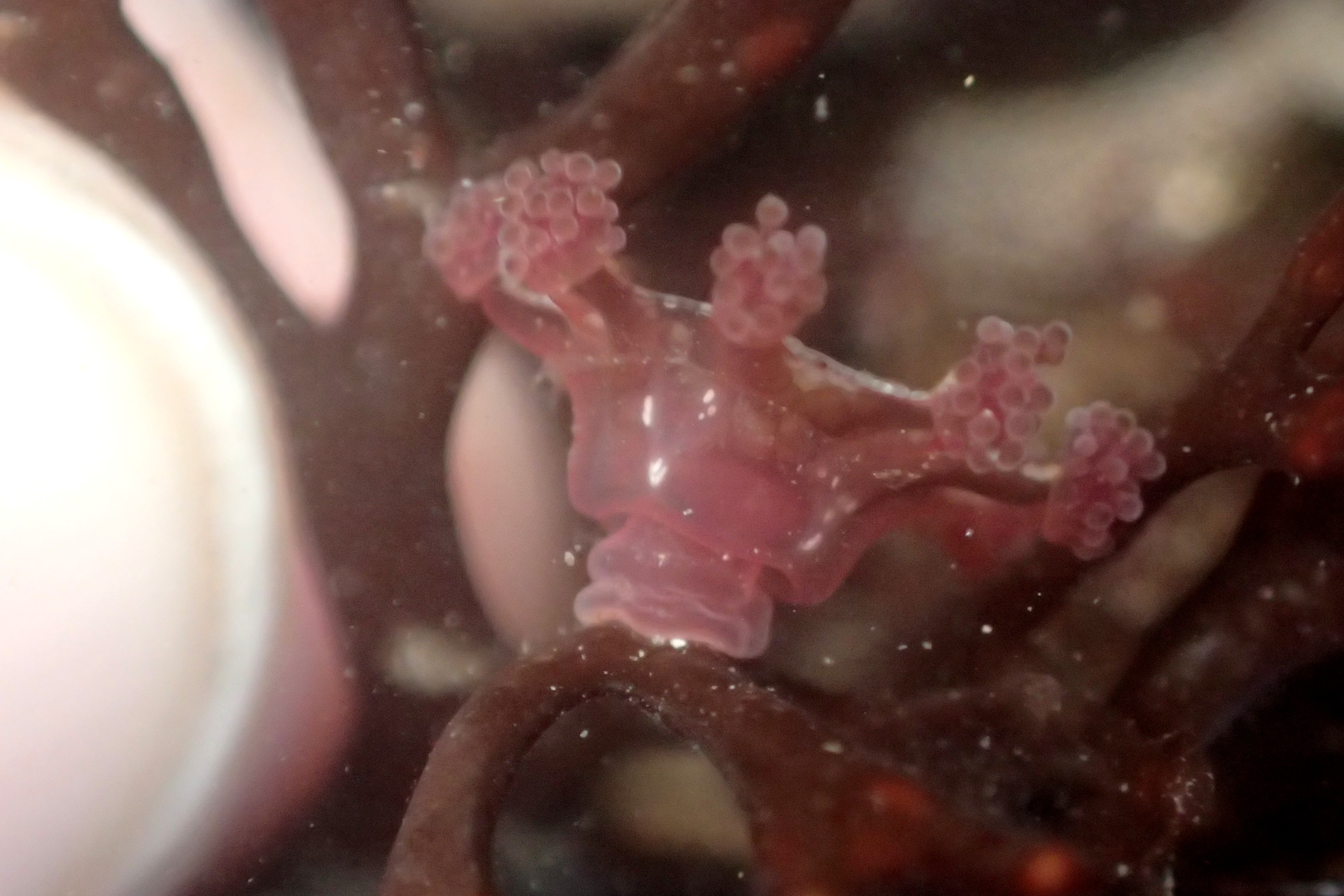
Rooting around in the pools always reveals some unexpected treasures. I make my first record of a stalked jellyfish (Calvadosia cruxmelitensis) at this site.
Stalked jellyfish – Calvadosia cruxmelitensis – at Porth Mear
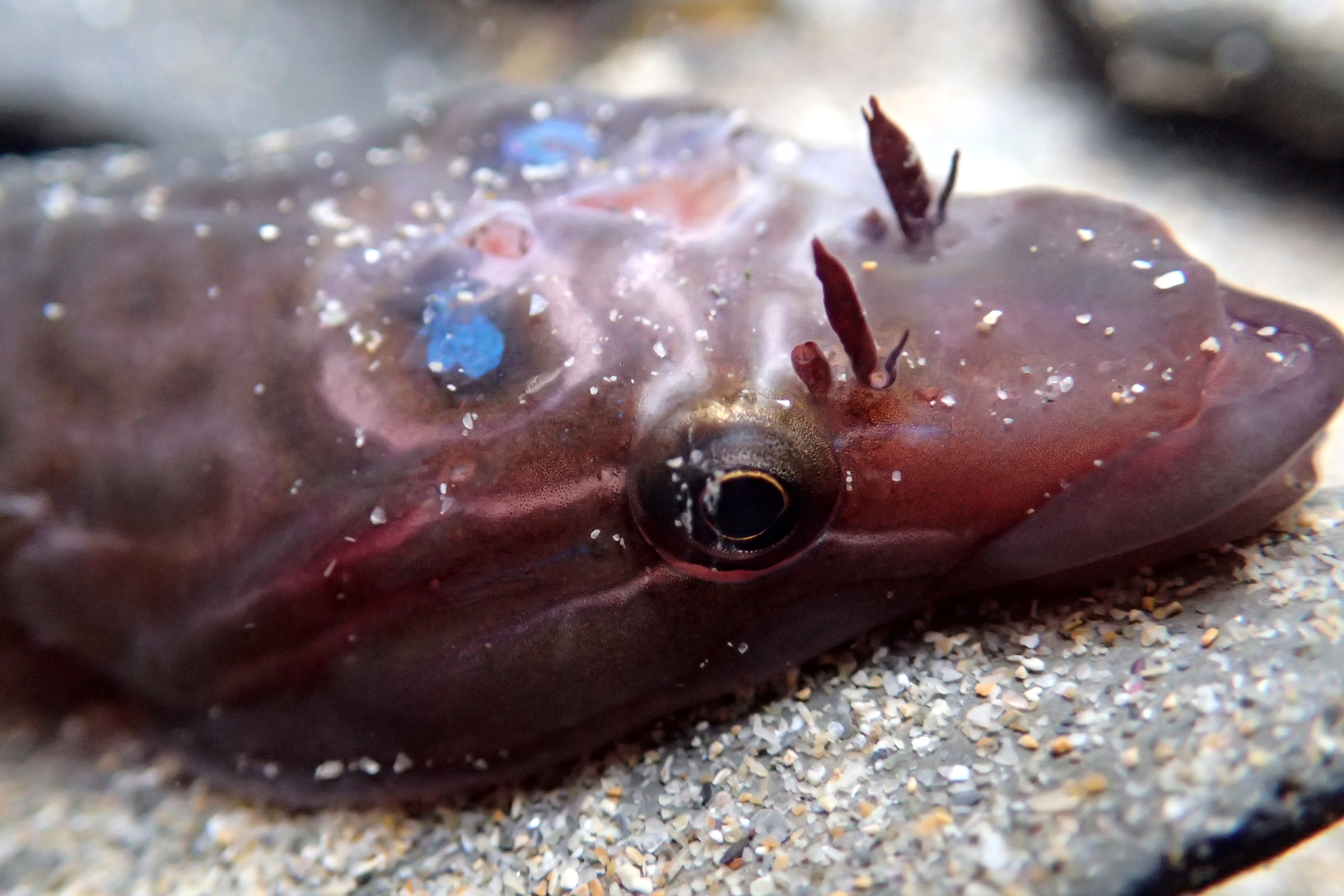
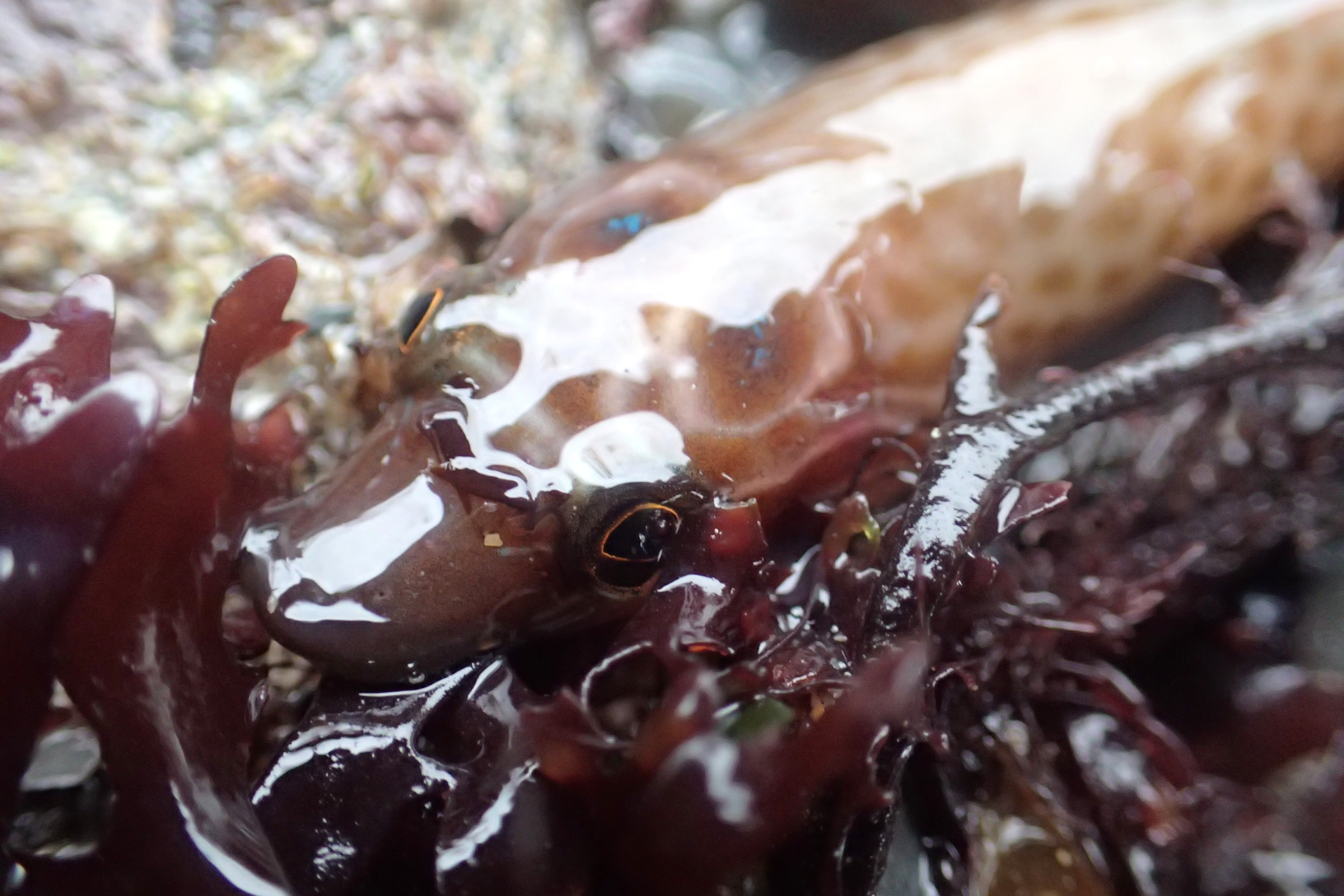
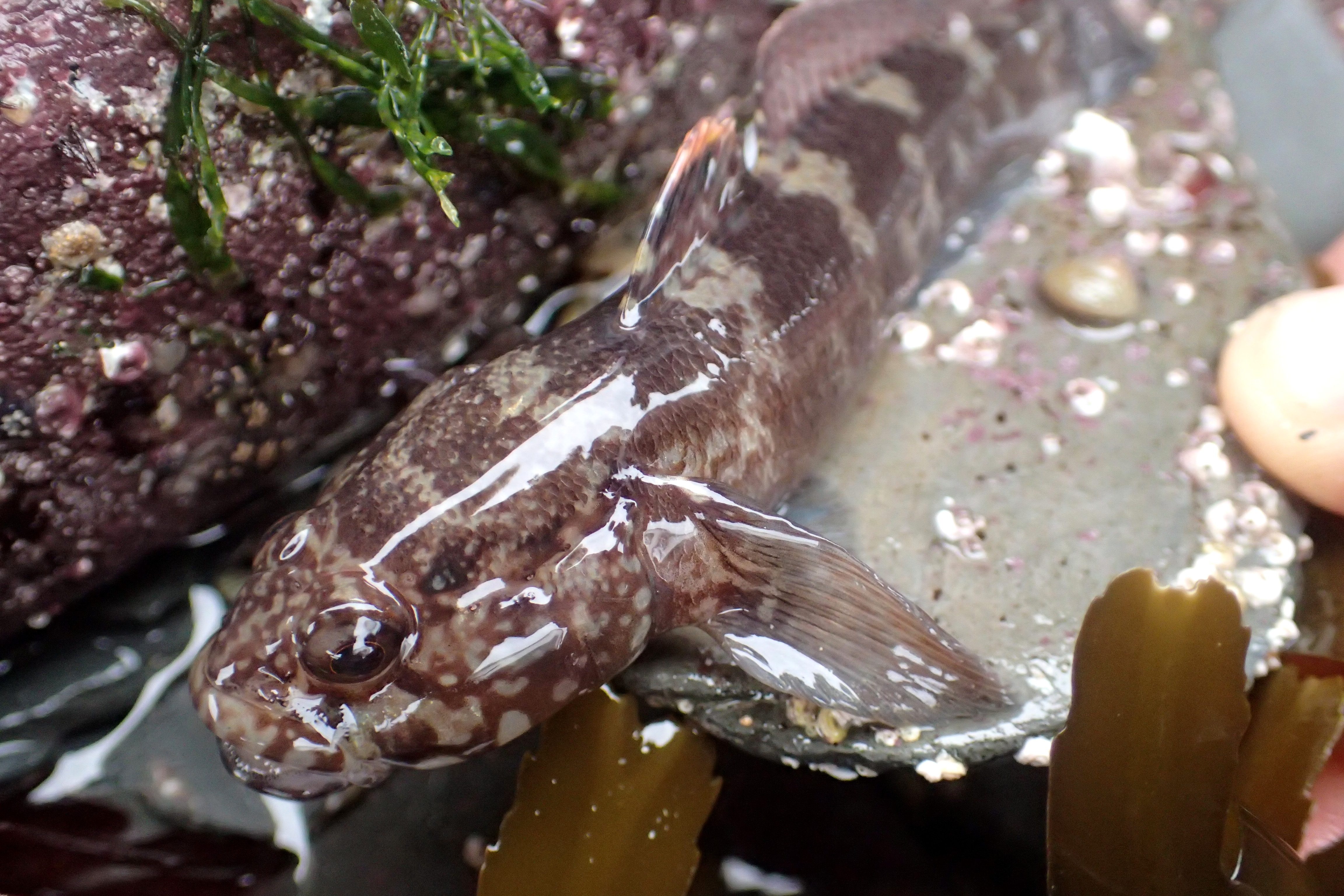
This is always a good beach for finding Cornish clingfish, and the rocks of the lower shores don’t disappoint. In one small area I find a dozen of these stunning little duck-faced fish, some with iridescent blue spots on their heads.
Cornish clingfish at Porth Mear
And another Cornish clingfish…
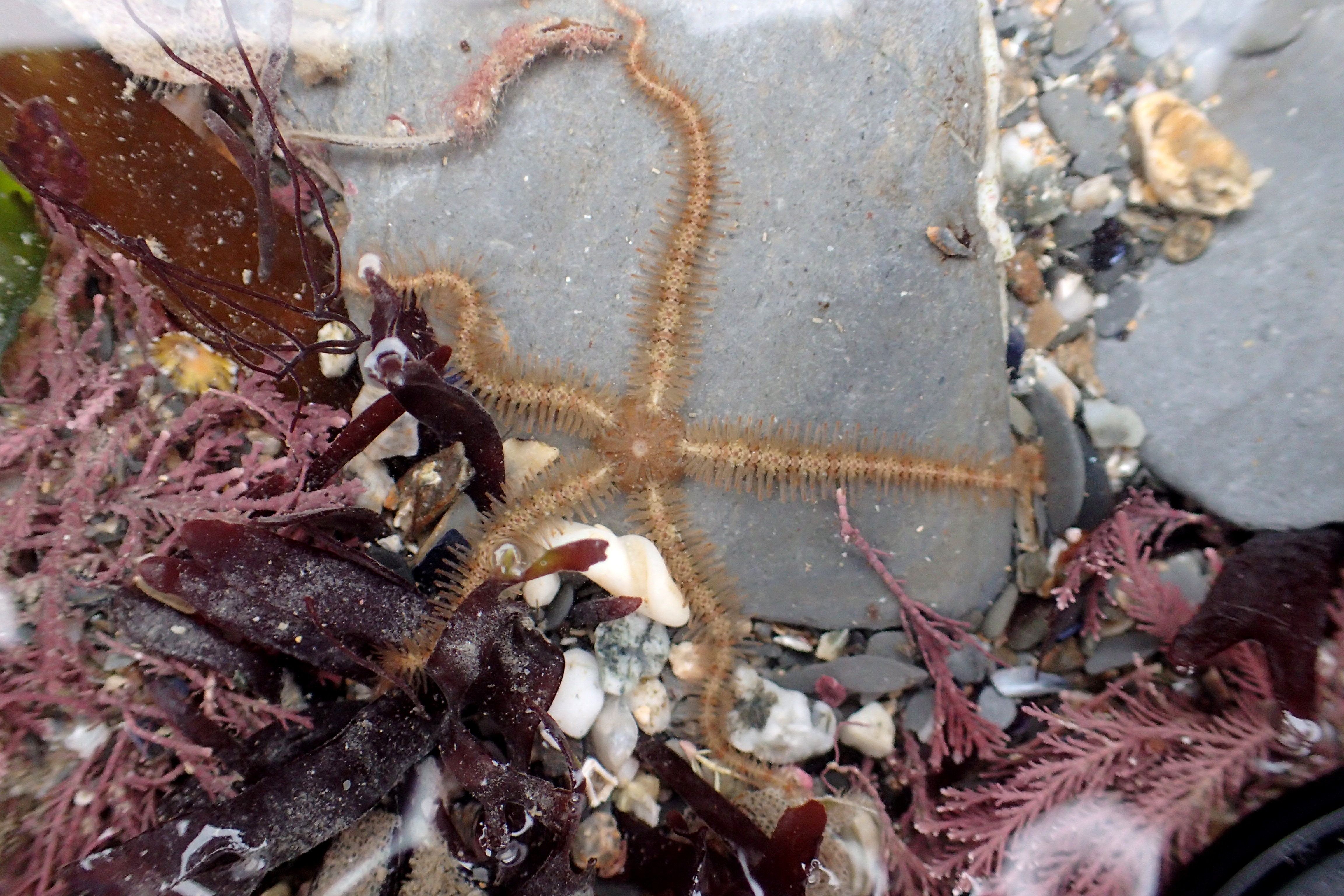
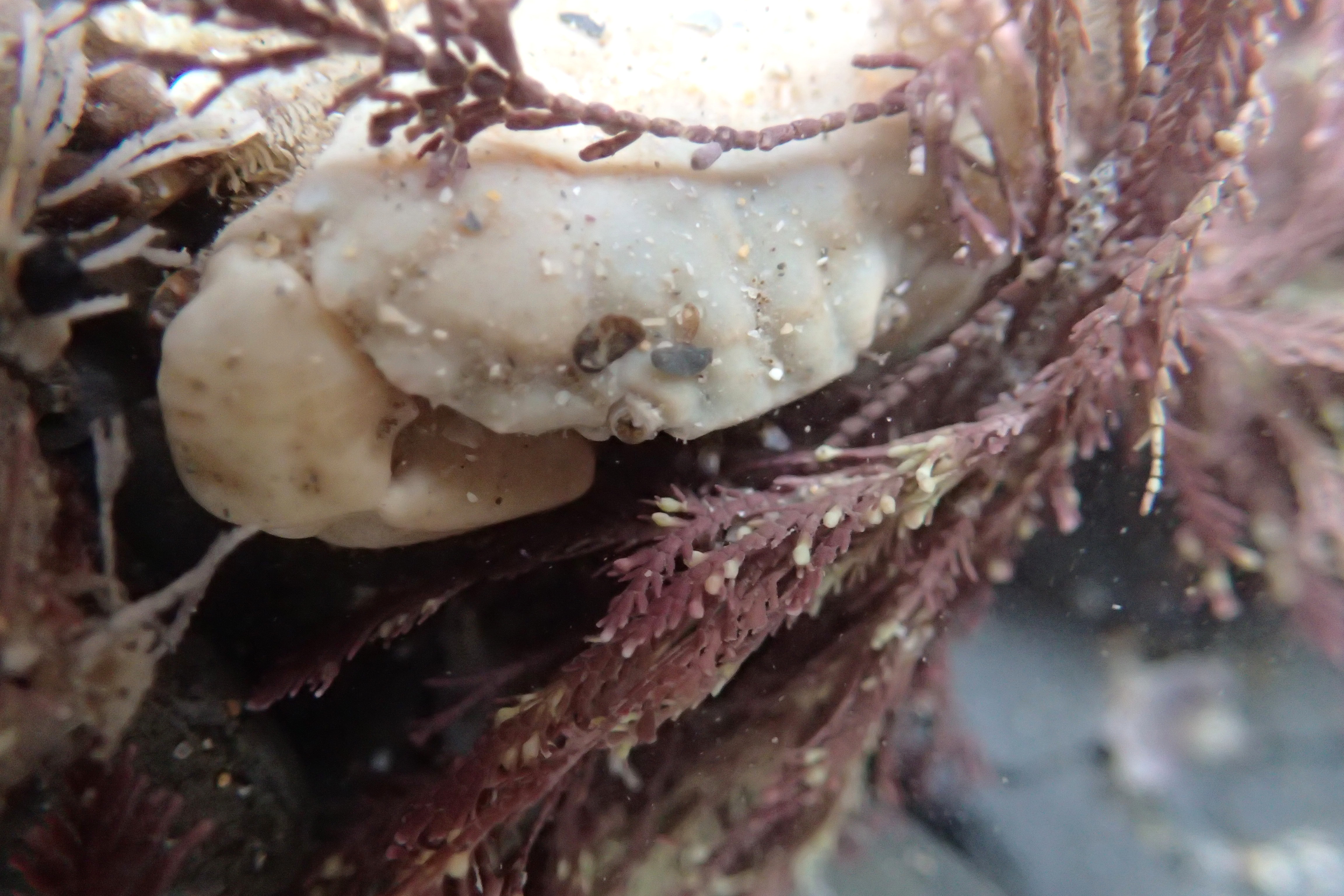
As I follow a gully across the shore I find several scorpion fish lurking among the rocks. Brittle stars lurch away into the seaweed and Xantho pilipes crabs close up, pretending to be pebbles.
My other half and Junior join me, hunting for crabs and fish. Every thirty seconds I remind them that we need to look for little hermit crabs and they ignore me as they should. They’re used to me and my missions.
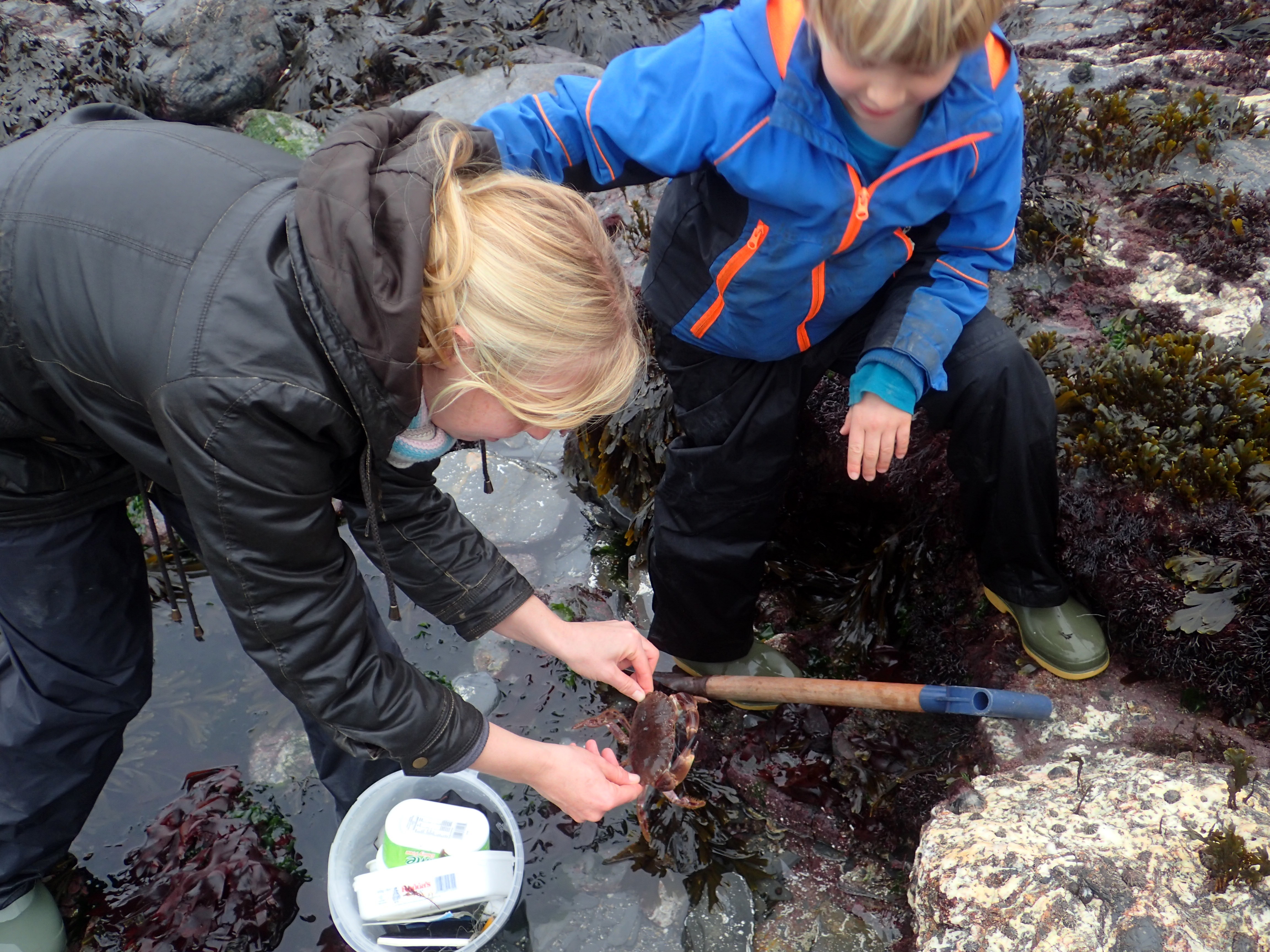
Not a hermit crab… a feisty male edible crab at Porth Mear.
Junior at least keeps pointing out suitable pools. He knows they like the ones with pink coralline seaweed and there are lots here. I barely have time to glance at one before he’s trying to drag me to the next.
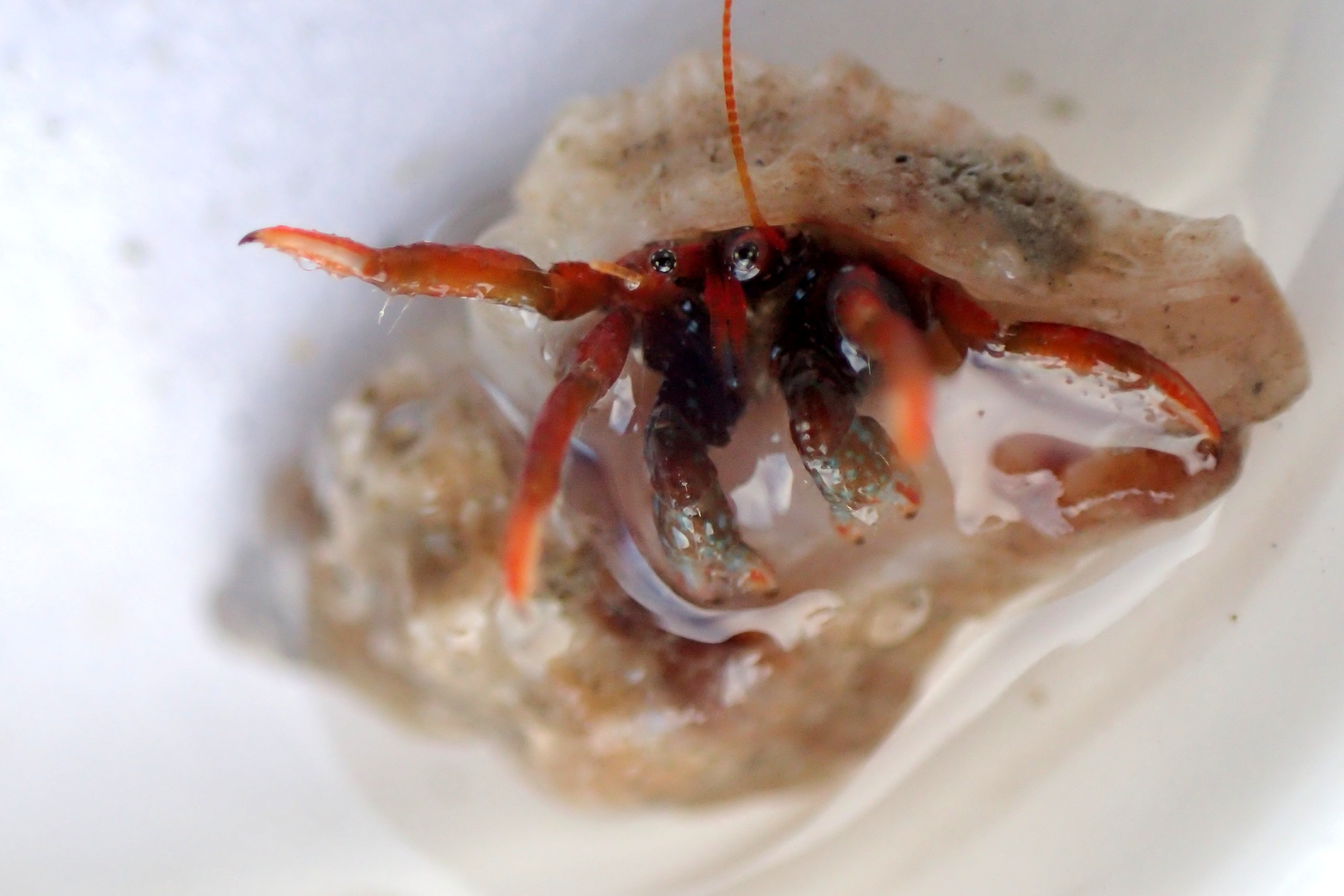
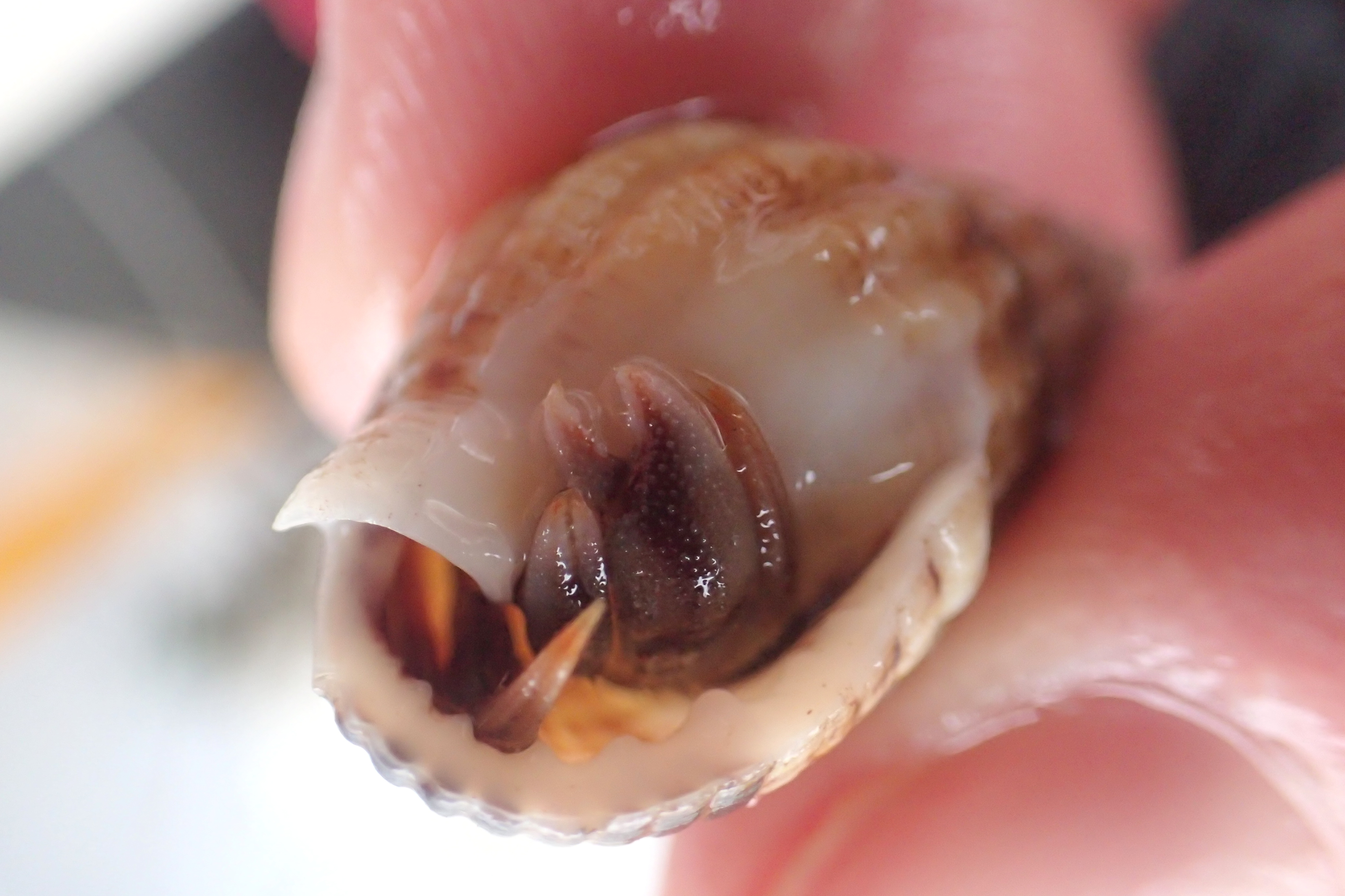
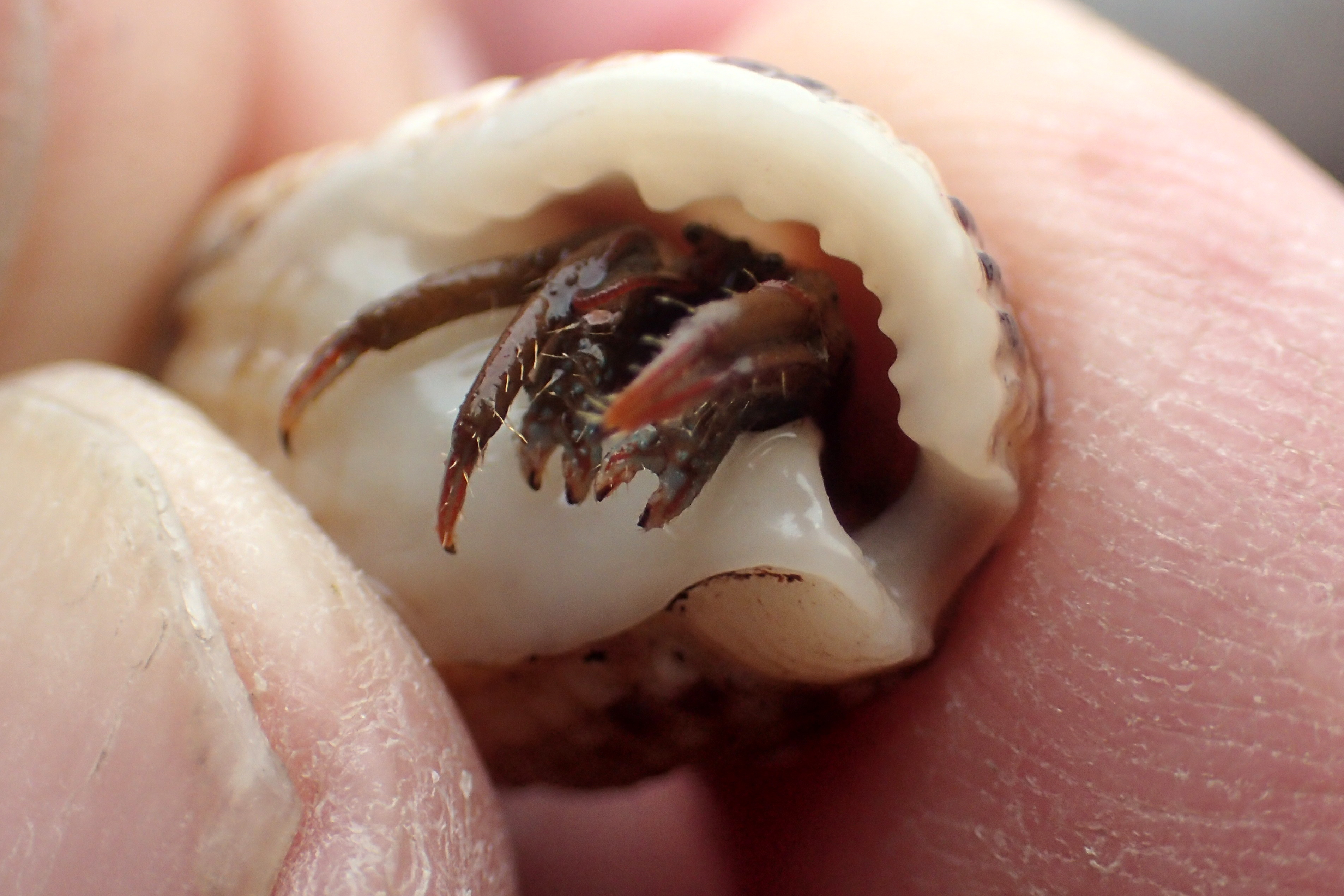
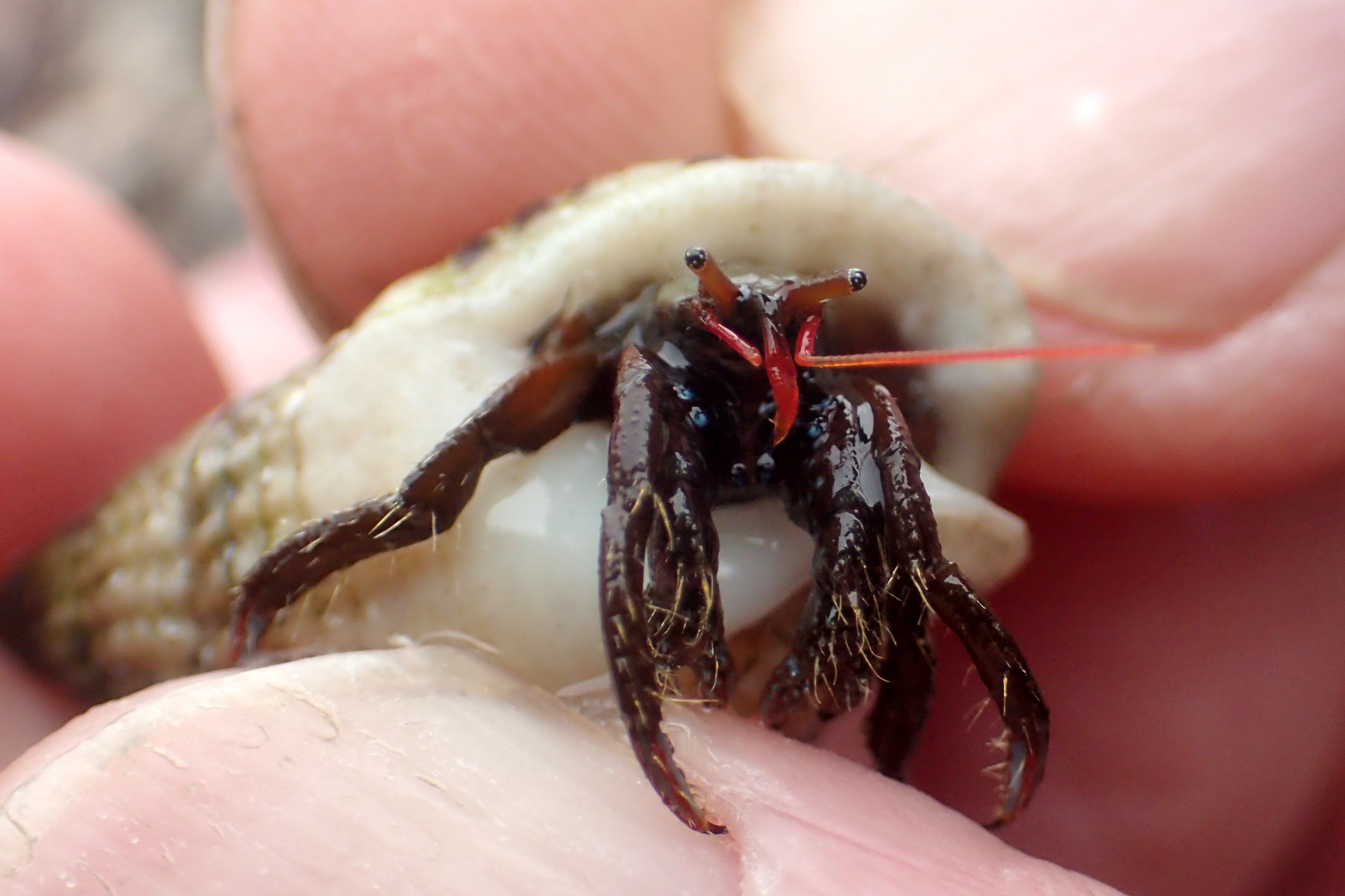
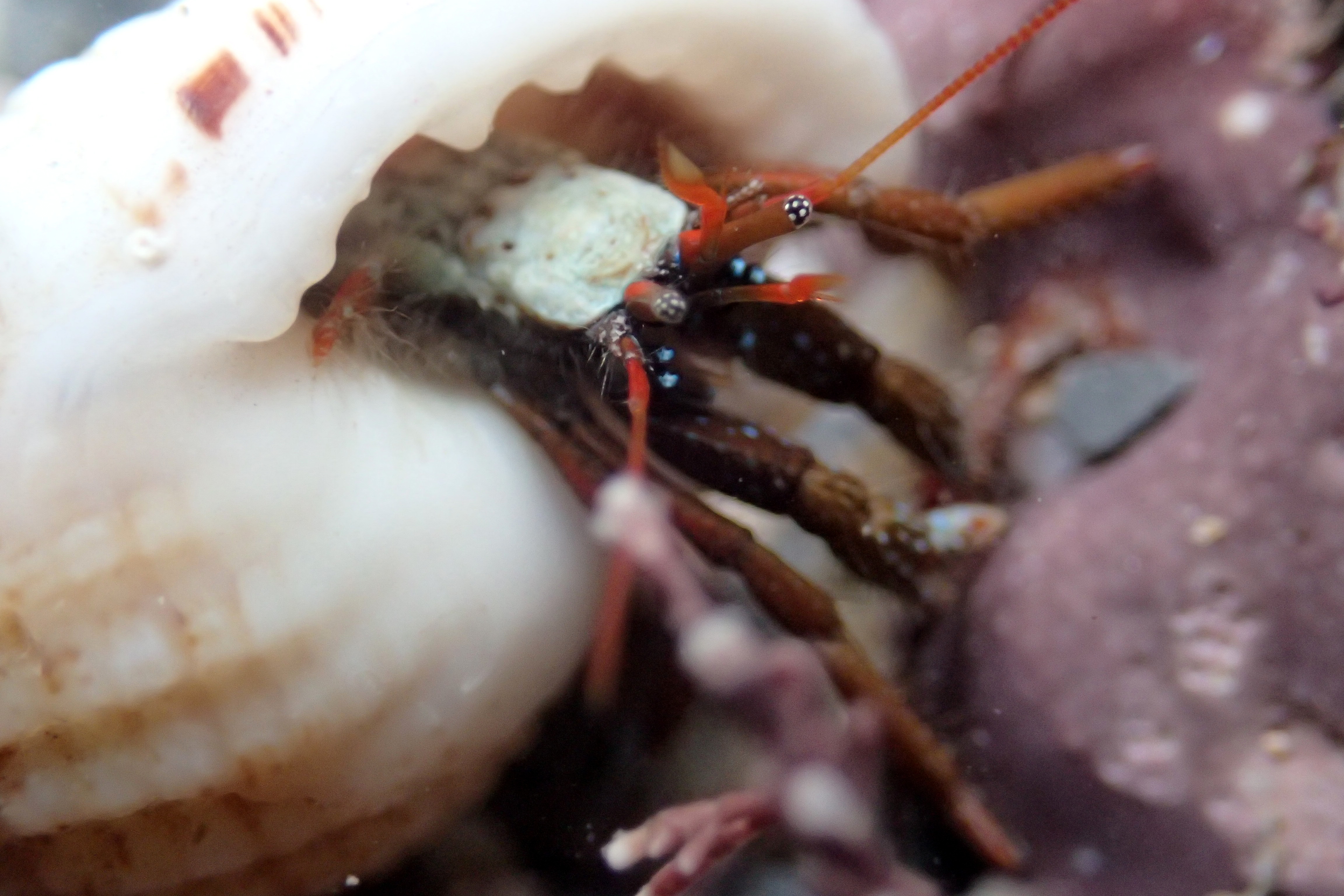
And then it happens. A shell moves and as soon as I pick it up I know. The legs are red, the shape’s wrong for the common hermit crab.When the crab extends its claws there can be no doubt, they’re hairy and pretty much equal sized. This is a St Piran’s crab.
When I see the red legs and equal-sized claws I know – a St Piran’s hermit crab at Porth Mear
I yell like I’ve won a golden ticket. Under my camera it’s easy to see the black and white spotty eyes of the crab. We all gather to look and as I take an underwater photo, I see other shells moving.
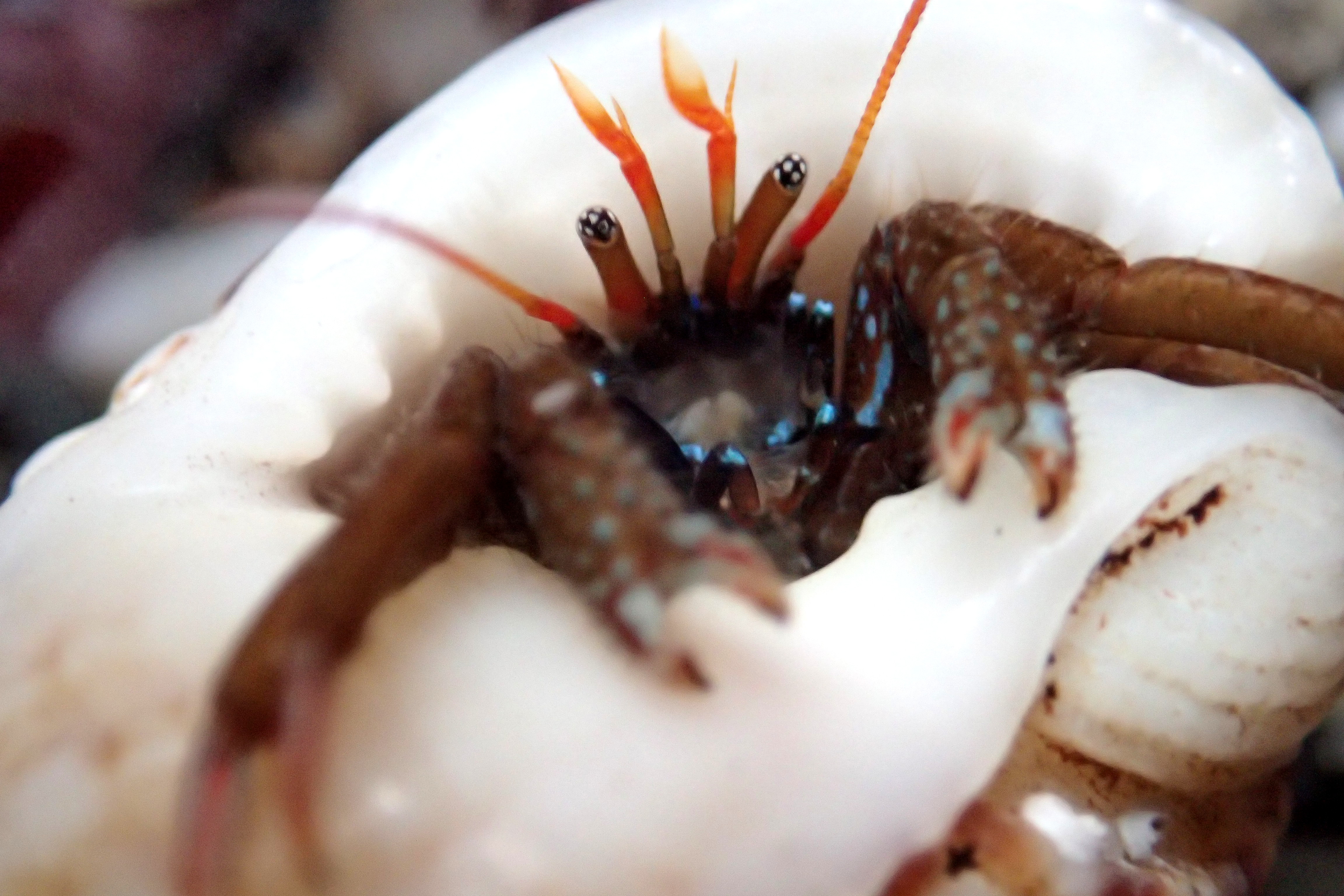
The long eye-stalks with black and white-spotted eyes are distinctive too – a St Piran’s crab at Porth Mear
Sure enough, this next shell has a St Piran’s crab in it, and the next, and the next. While I’m taking photos in the pool, Richard is examining shells on the rock by a small overhang. “There are nine more here,” he says. Soon we’ve counted at least fourteen. They’re all larger than the one found here earlier in 2016.
A St Piran’s hermit crab in the pool at Porth Mear
Whether there are other groups of St Piran’s crabs on this beach is hard to say. The tide is surging in now so we’ve run out of time to search.
A St Piran’s crab foraging in the pool at Porth Mear
The existence of the St Piran’s crab is a fragile one; storms, temperature change, pollution and disturbance threaten our shore wildlife now more than ever. Richard’s survey provides an incredible conservation tool with its wealth of data about what’s here and how it changes.
50 years on from the Torrey Canyon disaster, the confirmation of the St Piran’s crab’s comeback is an uplifting way to complete this survey (and the year).
A Scorpion fish at Porth MearA rock gobyA brittle star on the move at Porth Mear.Xantho pilipes crab pretending to be a pebble at Porth MearAs the last tide of 2016 rushed in, I had to say au revoir to this little St Piran’s hermit crab. Hopefully they’ll be sticking around in 2017. Happy New Year!
I doubt anyone in Looe can have missed it – the moment today when Cornish Rock Pools Junior found his first stalked jellyfish. His scream of, “I’ve actually found one!” rang across the beach and echoed off the hillside.
Cornish rockpool junior’s first stalked jellyfish – Calvadosia cruxmelitensis
His first find was closely followed by his second, next to which was a third. A volunteer from Looe Marine Conservation Group found a fourth. The Natural England team found some more and by the time we were done we recorded a whopping 26 Stalked jellyfish.
Calvadosia campanulata stalked jellyfish
As all our records today were of two species (Calvadosia cruxmelitensis and Calvadosia campanulata) I’m feeling hopeful that they may soon be added as recognised features of the Looe and Whitsand Bay Marine Conservation Zone.
Looe Marine Conservation Group volunteer, Dawn, finds her first Stalked jellyfish on our survey
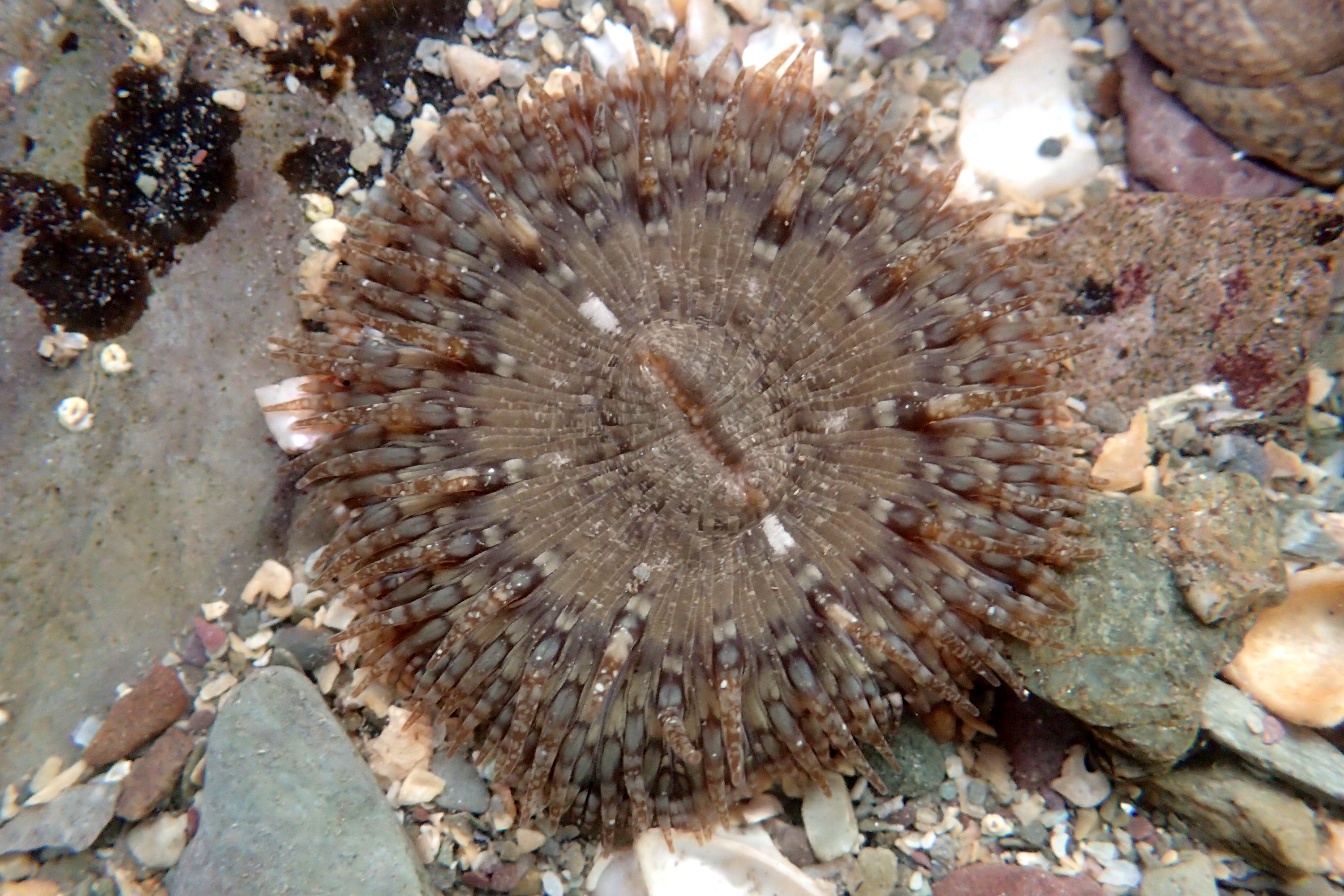
In December, good tides, mild temperatures and low winds coincide about as often as it snows on the Cornish coast (i.e. about once every ten years). Amazingly, today was one of those rare occasions and the rockpools were in impressive festive colours. What could be more Christmassy than this Dahlia anemone?
Festive colours in the Cornish rock pools – a Dahlia anemone
We were doing so well with our stalked jellyfish survey that I didn’t feel too bad about getting distracted. When I spotted a wriggling piece of seaweed, I chased it across the rocks.
If a piece of seaweed runs off, it’s probably a spider crab
As I suspected, under the seaweed decorations was a small spider crab species. This one was a Macropodia deflexa, a long-legged spider crab.
A Macropodia deflexa crab – covered in seaweed decorations
Relying on their camouflage, scorpion fish were lying still among the seaweed, allowing us to come right up to them.
A scorpion fish hides among the seaweed
It was a huge relief that everything turned out so well for our Stalked jellyfish survey. Had the conditions been less favourable we’d have been more likely to find none at all. 26 was an amazing total.
I needed my hot chocolate afterwards, but it was an afternoon well spent with some fabulous people. And tomorrow the forecast is even better… I’ll let you know what I find!
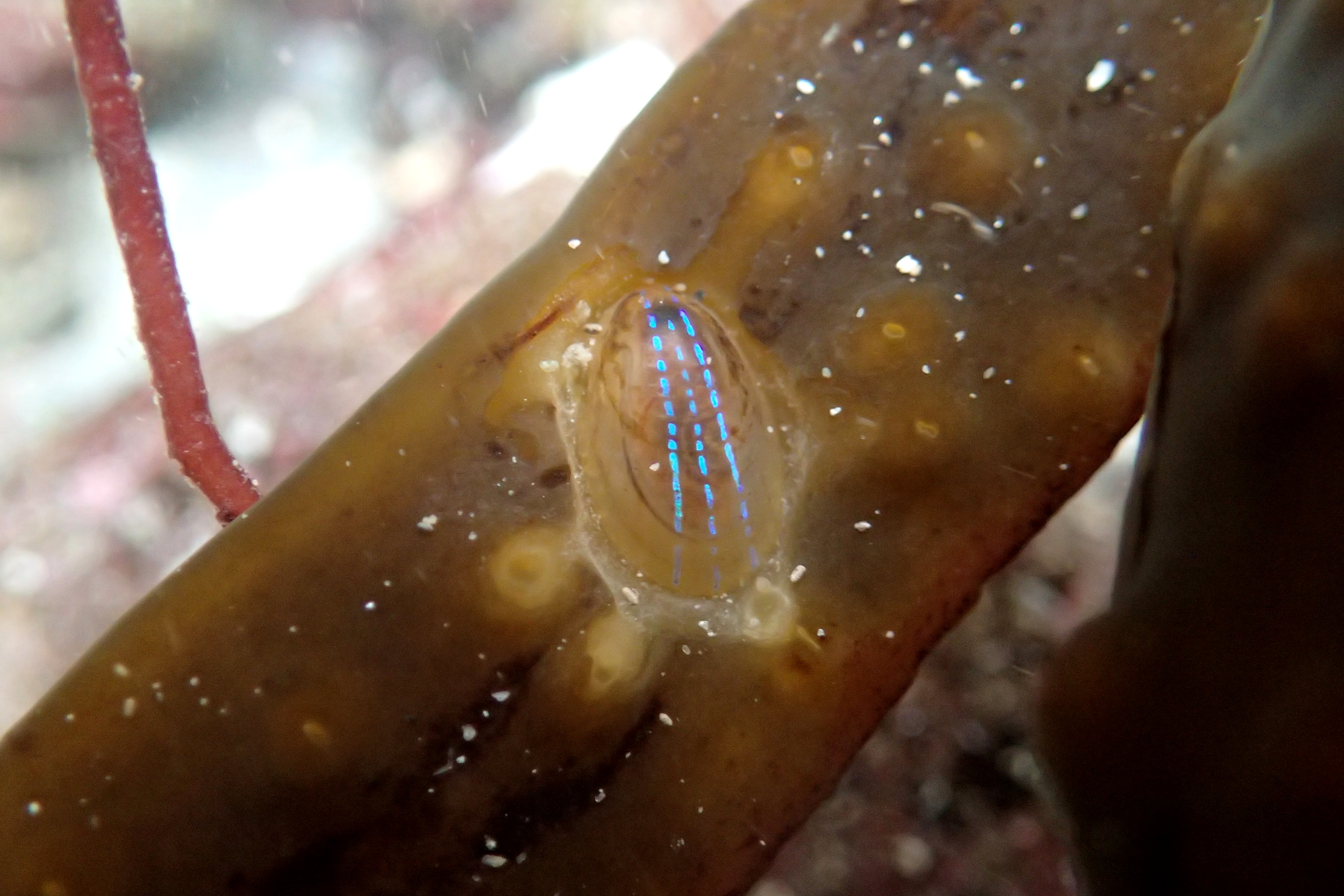
Another Christmas sea-flower – the Daisy anemone. In full bloom at Hannafore, LooeLike a string of Christmas lights – the Blue-rayed limpetOur Stalked jellyfish survey at Hannafore Beach, West Looe
My local area is special and it’s partly down to some fabulous little jellies we find here.
Looe and Whitsand Bay was one of the first to be designated a Marine Conservation Zone (MCZ) three years ago. Apparently Ocean quahog (a clam shell), pink sea fans, pink sea fan anemones and a stalked jellyfish species (Haliclystus sp.) can all be found here.
As you’d expect, stalked jellyfish have a stalk which attaches to seaweed so they don’t float around like other jellies. They have eight arms with tentacles on the end.
I’m hoping we can add more species to that list. There have been some local records of giant gobies, which are one of the MCZ ‘feature’ species and we’ve found three other species of stalked jellyfish on our beaches.
The problem with stalked jellyfish is that they’re tiny and seaweed coloured. In theory, the winter die-back of seaweed makes them easier to see, but Cornish winters don’t often provide the calm conditions you need to spot stalked jellies. Consequently not many people see them and even fewer people record their discoveries on ORKS – so please, please do share your finds!
In a quest to add more evidence that these species are present in significant numbers, I take Cornish Rock Pools Junior for a wander through the pools at a quiet local bay.
Grey herons like fishing in this quiet bay – Plaidy beach, East Looe
I find it’s best to focus on nothing else if I’m going to find stalked jellies. The problem is, as anyone who’s seen me in the vicinity of a chocolate hobnob will know, that I have no willpower. So, I spend the first half hour snapping this gorgeous strawberry anemone as it stretches its tentacles towards the last of the autumn sunshine. (more…)
As soon as I heard the yell of excitement, I guessed what it might be. This is the species that everyone recording rockpool wildlife in Cornwall has been watching out for. For me, it was especially exciting that this one, found by Jan of Coastwise North Devon, had just turned up in one of my favourite coves, Porth Mear.
Meet Clibanarius erythropus. Nope, none of us could remember that name either, though we knew it certainly was one. Jan decided to name little hermit crab Sydney to make things easier.
Clibanarius erythropus is a distinctive (if unpronounceable) crab. Most species of hermit crab have one claw that is considerably larger than the other – most are ‘right clawed’. This species is almost unique in having two fairly equal sized claws.
The white spots on its eyes and its striking red legs are also a good aid to identification.
Clibanarius erythropus – A red legged hermit crab making a comeback in the Cornish rock pools this year.
If you find one, please take a photo and send your record to ORKS, the Cornwall and Isles of Scilly online recording system -it’s quick and easy to do.
This warm-water species, relatively common in the Channel Islands and around the French coast, is at its northerly limit in Cornwall. It used to be found occasionally on our shores, but has rarely been recorded here since the 1967 Torrey Canyon oil spill in 1967. The last recorded sighting was in 1985.
But this year it has reappeared. There have already been at least three records from various locations around Cornwall in 2016. Could these hermit crabs be making a comeback?
One explanation for the reappearance is the high water temperatures of the last couple of years. In 2015 warm currents arrived early in the year bringing a massive bloom of the giant barrel jellyfish. These conditions could have been right for the hermit crab plankton to survive and settle on our shores.
So now we have to wait and find out whether the conditions remain favourable for this little hermit crab to become a long-term resident in our rock pools.
Cornish rock pools junior says David Cameron is his arch-enemy. He says David Cameron doesn’t like nature and he just can’t understand it. Attributing everything to one person may not be right, but I can see where he’s coming from.
Like most kids his age, Cornish rock pools junior loves nothing better than running wild in the woods and clambering between rock pools. He’s a den-building, dam-making, butterfly-chasing, wave-splashing kind of child – is there any other kind? You could argue that his fierce love of nature is down to my influence, but I don’t think that’s the whole story. He’s very sure of his own mind.
In the last few years in our small coastal town we’ve lost our community bus, seen library opening hours slashed and lost access to some of the few public green spaces. Right now, diggers are tearing up the playground and park at the end of our road in order to build houses. Another application is being discussed to build on one of the two remaining public green spaces.(more…)
Rockpooling in stormy winter weather can be a risky business here in Cornwall, so my advice is … don’t. At best you get blown over on the slippery rocks and soaked by rain that seems to come in horizontally and go right up your nose. At worst you could end up in the path of the fierce waves and currents. It’s not worth it.
When there’s a calm moment and a good tide (I’m hoping tomorrow will be such a day), there’s plenty to see in the rockpools. Between times, stick to the strandline, where the sea throws up all sorts of treasures and unexpected visitors.
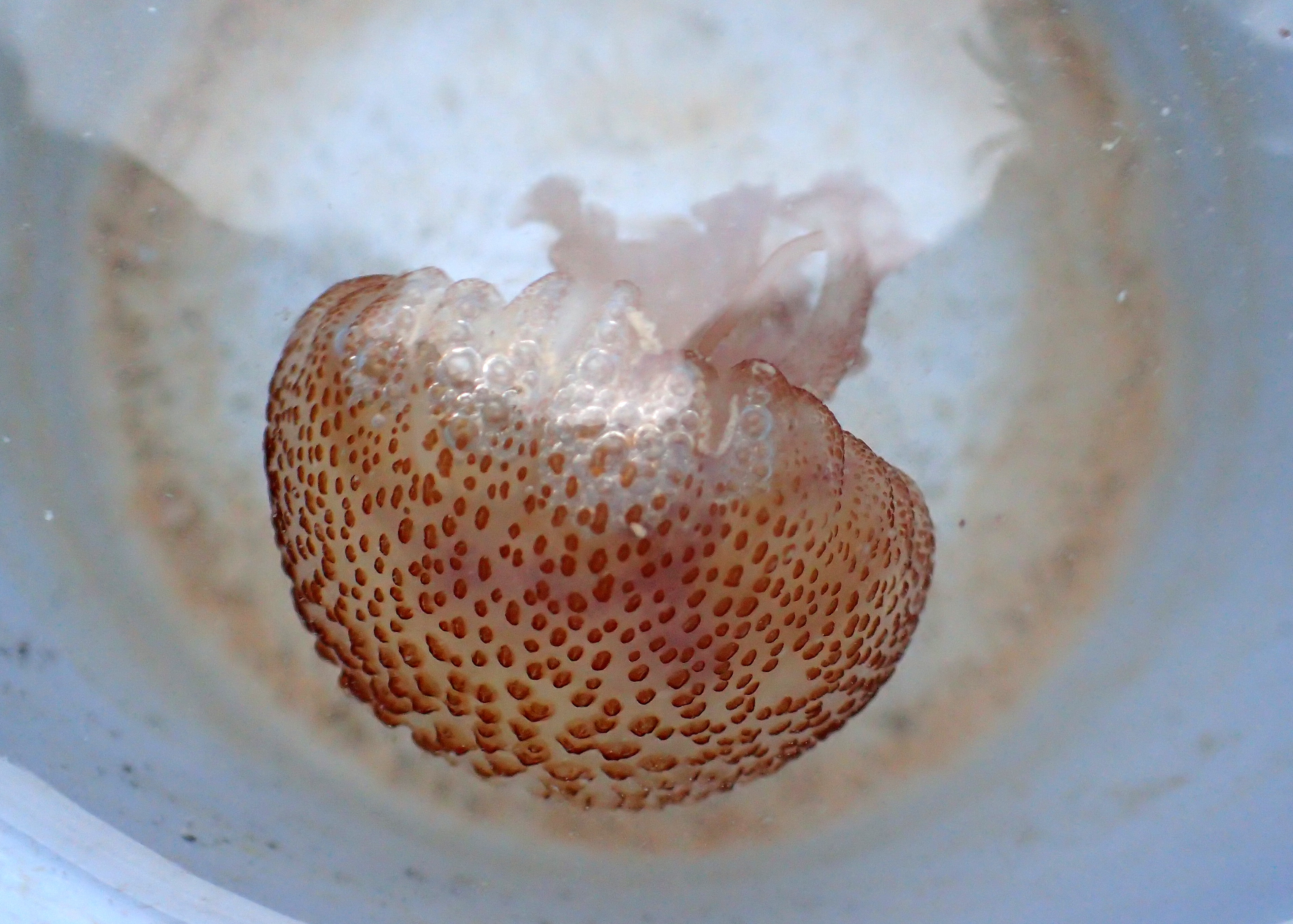
Mauve stinger jellyfish (Pelagia noctiluca) at Mawgan Porth
One of my favourites this year was the swarm of mauve stinger jellyfish (Pelagia noctiluca). They look small and inoffensive, measuring up to 10cm across their bell. The spotted pattern that gives them their name is distinctive and rather pretty. They can also glow in the dark – noctiluca means night light. (more…)
There are lots of benefits to having a summer birthday; the sun usually shines, the rock pools shimmer and it’s just about warm enough to put my snorkel on and jump in. The beach has lots of presents in store for me today, including a huge greater pipefish, a cousin of the sea horse, and a rare sea slug. No unwrapping required.
A juvenile Aplysia depilans – a rare sea hare in UK waters.
It’s holiday season , but a little planning and some walking is all that is needed to find a peaceful cove. We set off to Port Nadler in perfect, calm conditions loaded with wetsuits, buckets and an ample picnic.
A typical rock pool at Port Nadler near Looe
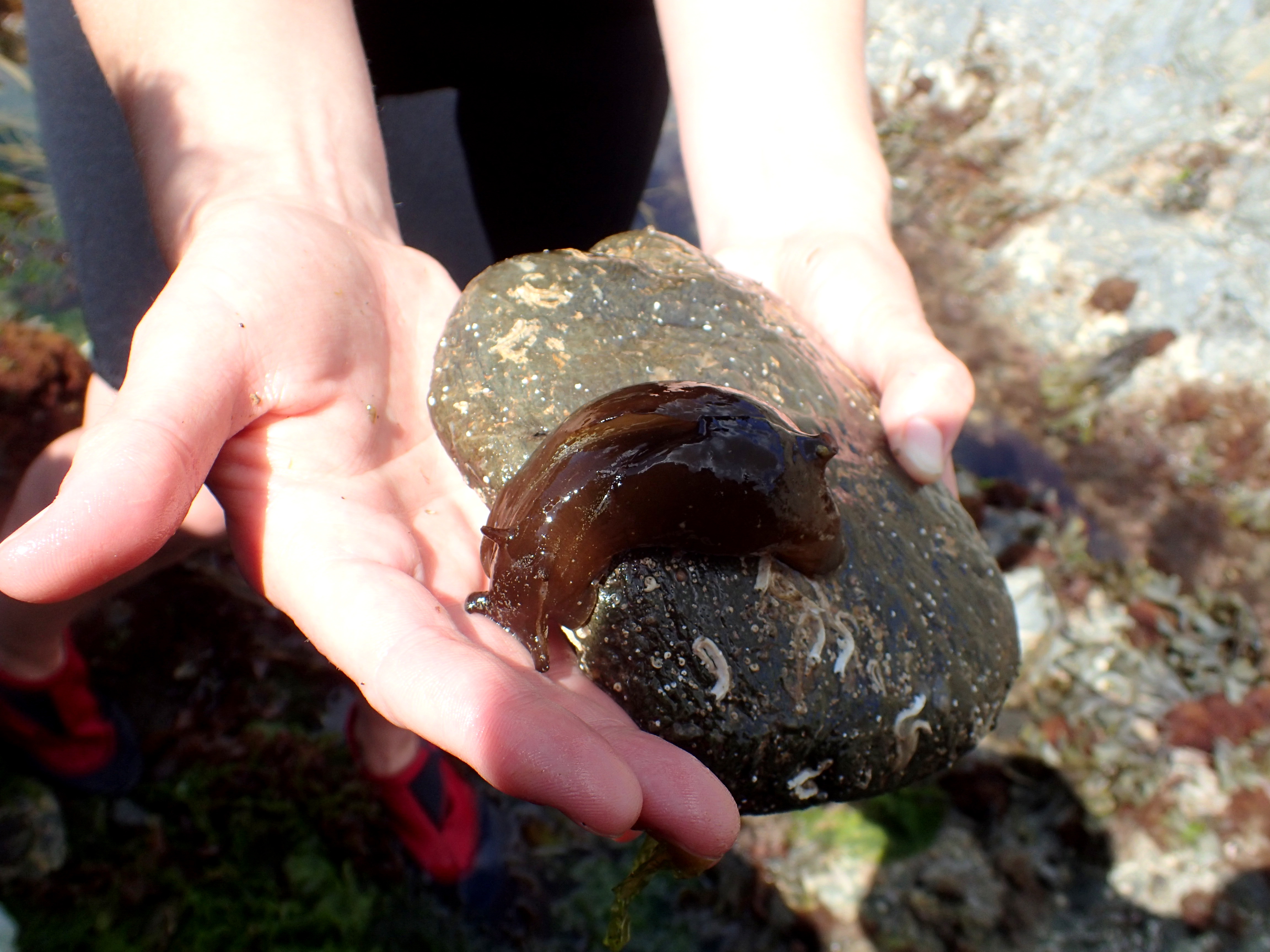
Under a rock I spot what I think is a very large anemone, but it looks odd. I’m still trying to puzzle it out when it crawls away, unfurling long ear-like tentacles from its head. It’s a sea hare but more bulky than the ones I normally see (Aplysia punctata).
I think I’ve found a strange anemoneSurprise! It turns into a sea hare.
As it oozes towards me across the rock I’m struck by its face, more like a hippo than a hare with wide flapping ears and a broad snout. Very occasionally larger sea hares, Aplysia depilans, have been found around the southern shores of the UK, and I begin to wonder.
Aplysia depilans – looking more like a sea hippo than a sea hare
I contact experts who have seen them before and they confirm it is a juvenile Aplysia deplians – a rare find and a species I’ve never seen before. Happy birthday to me!
It’s still cold for snorkelling and I only last about a quarter of an hour before my teeth start to chatter, but it’s worth it. After several minutes of seeing nothing but kelp, silt and the occasional two-spot goby, a long snake-like body catches my eye. It’s the unmistakeable shape of a greater pipefish (Syngnathus acus).
The greater pipefish looks out from the weeds
These fish grow to about arm length and have a hexagonal cross-section. This one hardly moves, relying on camouflage for defence, its long nose stretching out over the sand.
Greater pipefish – a cousin of the seahorse
I drift back into shore, and find a compass jellyfish (Chrysaora hysoscella) stranded in the shallows. It takes its name from the beautiful markings on its back, but I don’t go too close – sea nettle is its other common name.
Compass jellyfish – showing its distinctive markings
Back on the shore, I huddle on the sand, wrapped in jumpers and towels, shivering and eating cake. Birthdays don’t get any better than this.
This snakelocks anemone looks like it’s had a fright – the tentacles were being picked up by the current
Up close to a red-eyed velvet swimming crab (Necora puber)
Cornish clingfish eggs – little eyes and noses visible insideA snorkel-scape. Thong weed at Port Nadler near Looe
It’s not quite warm enough for shorts yet, but there’s sunshine aplenty and a good turnout for Looe Marine Conservation Group’s first summer rockpooling session of the year. As always, the Cornish rock pools don’t disappoint.
My first find of the morning – a ‘plumed Bertha’ Berthella plumula – a sea slug with a small internal shell.
The big creatures are always the star attractions of public events. Today we are lucky enough to find several magnificent spider crabs.
Spider crabs come into the Cornish rock pools in early summer.
These large crabs with their characteristic spiky shells live out at sea for most of the year, but venture into shallower water in the early summer to breed. They get their names from their long, spindly looking legs – although, being crabs, they have ten legs, not eight like the spiders.
Edible crabs can be large and powerful, but are usually placid
Some sizeable edible crabs lurk at the bottom of buckets, but it is the velvet swimming crab that causes the most gasps. These red-eyed crabs, which my son calls devil crabs, are feisty to say the least and as today’s rockpool leader, Matt, goes to pick one up, it raises its claws in defiance.
Velvet swimming crabs are quick to attack.
Matt takes several attempts, but eventually manages to lift it from the bucket and hold it in front of the upturned faces of a circle of children. He points out the paddle-shaped legs that help it to swim and the smooth velvet surface of the shell before swiftly returning it and moving on to more placid creatures.
This rock goby was easier to handle – the yellow top to its fin can clearly be seen here.
Our local vicar has become a staunch regular on these jaunts and, as always, he’s brimming with smiles and enthusiasm. He makes one of the best finds of the day, although only a few of us make it to the tide’s edge over slippery rocks to see the stalked jellyfish.
Lucernariopsis cruxmelitensis – a stalked jellyfish.
This little jelly is in an awkward position to photograph and the tide is rushing in, but we manage to get some pictures. Lucernariopsis cruxmelitensis – it’s a mouthful to say, but I think it’s the most beautiful of our stalked jellies with its wide open profile and delicate decoration of white nematocysts around each arm.
Lucernariopsis cruxmelitensis – the hand in this shot shows just how small these stalked jellies are. One of my favourite Cornish rock pool creatures.
The next jellyfish we find is a little larger, but still only a few centimetres across. It’s so transparent, I can’t tell most of it is there until I feel the curve of it against my fingers.
This week’s mystery jelly – probably an aequorea species – crystal jellyfish.
From the shape and the faint radiating lines around the base of the bell, I think it may be an aequorea species, also known as the crystal jellyfish. We’ve found these before in Looe, but they’re not a common species – or maybe they are but they’re so transparent they’re hard to spot.
Holding the transparent jelly (aequorea/ crystal jelly?)
It’s wonderful to spend a whole morning on the shore without my fingers becoming painfully cold or having to rush home to counteract early signs of hypothermia with hot baths and drinks. I might even risk going out without a coat soon.
Looe’s vicar doing some quality rockpooling.
Summer is definitely on its way and if you’re heading for the shore, group events like this one are the best way to discover the fantastic Cornish rock pools.
See my links page for lovely groups who run events all through the year. Follow Cornish Rock Pools on Facebook for updates.
Privacy & Cookies: This site uses cookies. By continuing to use this website, you agree to their use. To find out more, including how to control cookies, see here: Privacy and Cookies Policy.















 Cornish Rock Pools