
Even my family look at me strangely when I suggest rock pooling in this weather. The Met Office reckons it’s going to turn out fine, but the wind is flinging water straight into our faces and the beach is deserted. We huddle down on some damp rocks and rush to eat our pasties before the rain turns the pastry soggy.
“I wonder if people realise what you go through to put pretty pictures on your blog?” Other Half says.
I nod, watching the waves crashing onto the shore and thinking that it’s worse than that. In these conditions I’m unlikely to find much, let alone manage pretty pictures.
Fortunately, I’m wrong.

After a quarter of an hour of staring into holes in the rock, taking lots of rain-blurred photos and a few passable ones of common crab and barnacles species, I’ve established that my waterproofs are anything but waterproof. If it’s possible, the rain is getting heavier.

Cornish Rock Pools Junior and his dad have wandered off and are probably reaching their tolerance limit. I find a stalked jellyfish and think that’s likely to be the most exciting find of the day.

I lift the edge of one last stone. There are some thick yellow sponges and the rock is crusted over with bryozoans. Broad-clawed porcelain crabs are scuttling along and there are little banded chink shells. On the far side is a spot, maybe half a centimetre across. It’s hard to make it out, but it has a blue-ish tinge and a lined appearance, like an anemone out of the water.
I think it’s a sea slug, but it’s far too delicate to pick off the rock and even if I do there’s nowhere to put it. I need to see it in water otherwise it’s just a blob of jelly. There’s no chance of that here at the base of the gully where the waves are pounding in, so I heave the boulder up the shore and lower the side with the slug into the nearest pool.
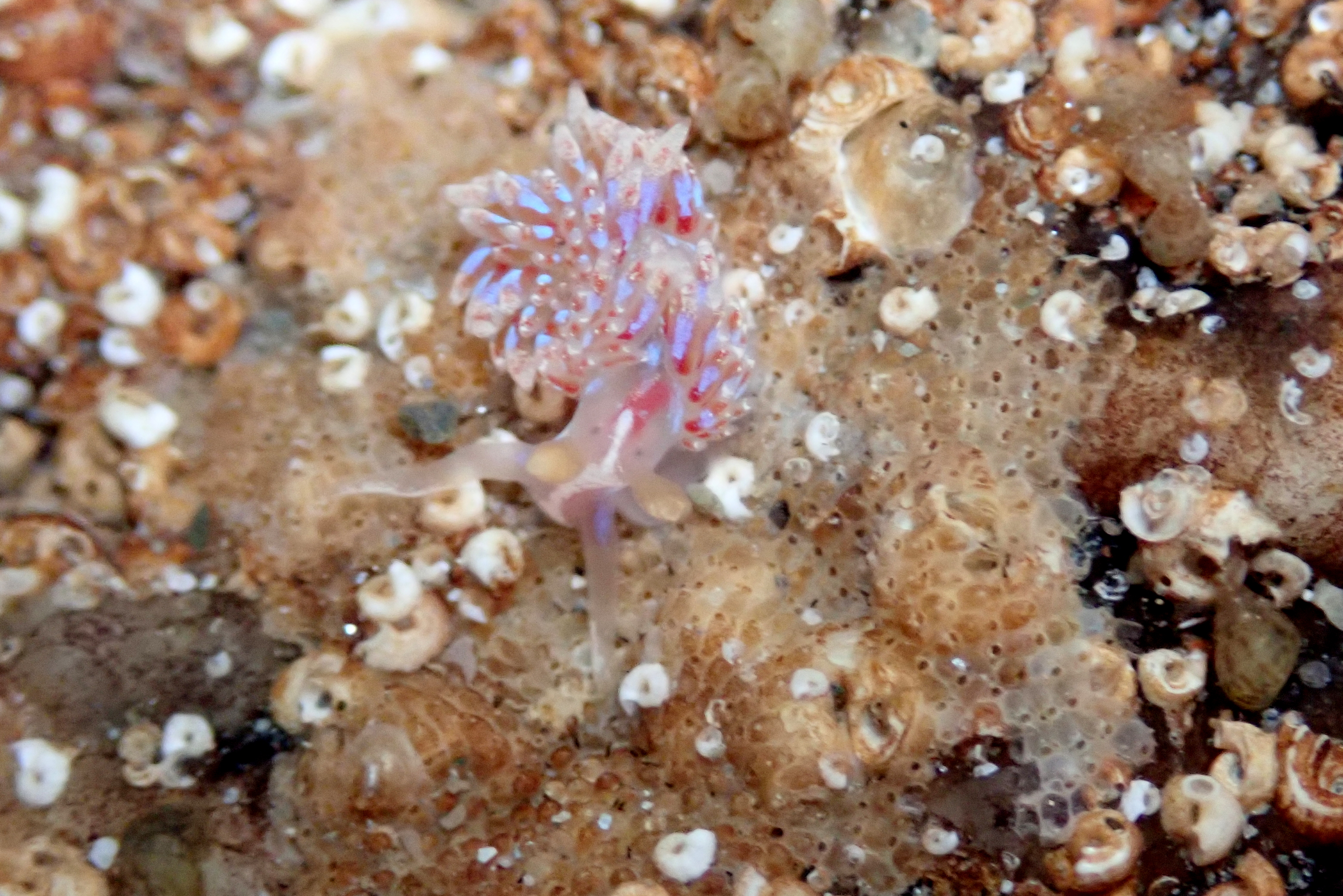
Shelter’s hard to come by. The surface of the pool distorts with every gust of wind and the rain goes up the back of my coat and into my ears as I lean over to hold the rock in position. Straight away, I know this is definitely a sea slug. In the water, its cerata pop up all over its back and long tentacles and rhinophores unfurl around its head.
This is the sort of colourful, beautiful slug that I’m always hoping to find and only rarely do. Under the camera it has striking red lines and markings up its cerata, white stripes down its head and an iridescent blue sheen that changes as it moves.

This is a new slug to me and I can’t wait to look it up when I get home to check the exact species. In the meantime, I take as many photos as I can before hauling the rock back to the same spot where I found it. That done, I rush up the beach to tell my Other Half, Cornish Rock Pools Junior and everyone else I see that day about how amazing my sea slug was.

Thanks to my pile of identification books and the quick responses of the hugely knowledgeable members of the NE Atlantic Nudibranchs forum on Facebook, I soon have it confirmed as Facelina auriculata (previously known as Facelina coronata).
This slug is found around many coasts of the UK, and is meant to feed on hydroids, although I didn’t see many in the vicinity of this one. I’m very lucky to find it intertidally on such an average tide.
If you think rock pooling isn’t a normal sort of thing to do in January, I can understand that. You’re probably right and I think my family would agree with you, but you never know what’s going to turn up next in the Cornish Rock Pools.
Sometimes it’s worth braving the horizontal rain just in case.


 Cornish Rock Pools
Leave a reply to Gillian Osborne Cancel reply