Tag: sea slug

  • We’re going to find… a rainbow sea slug!

    We’re going to find… a rainbow sea slug!

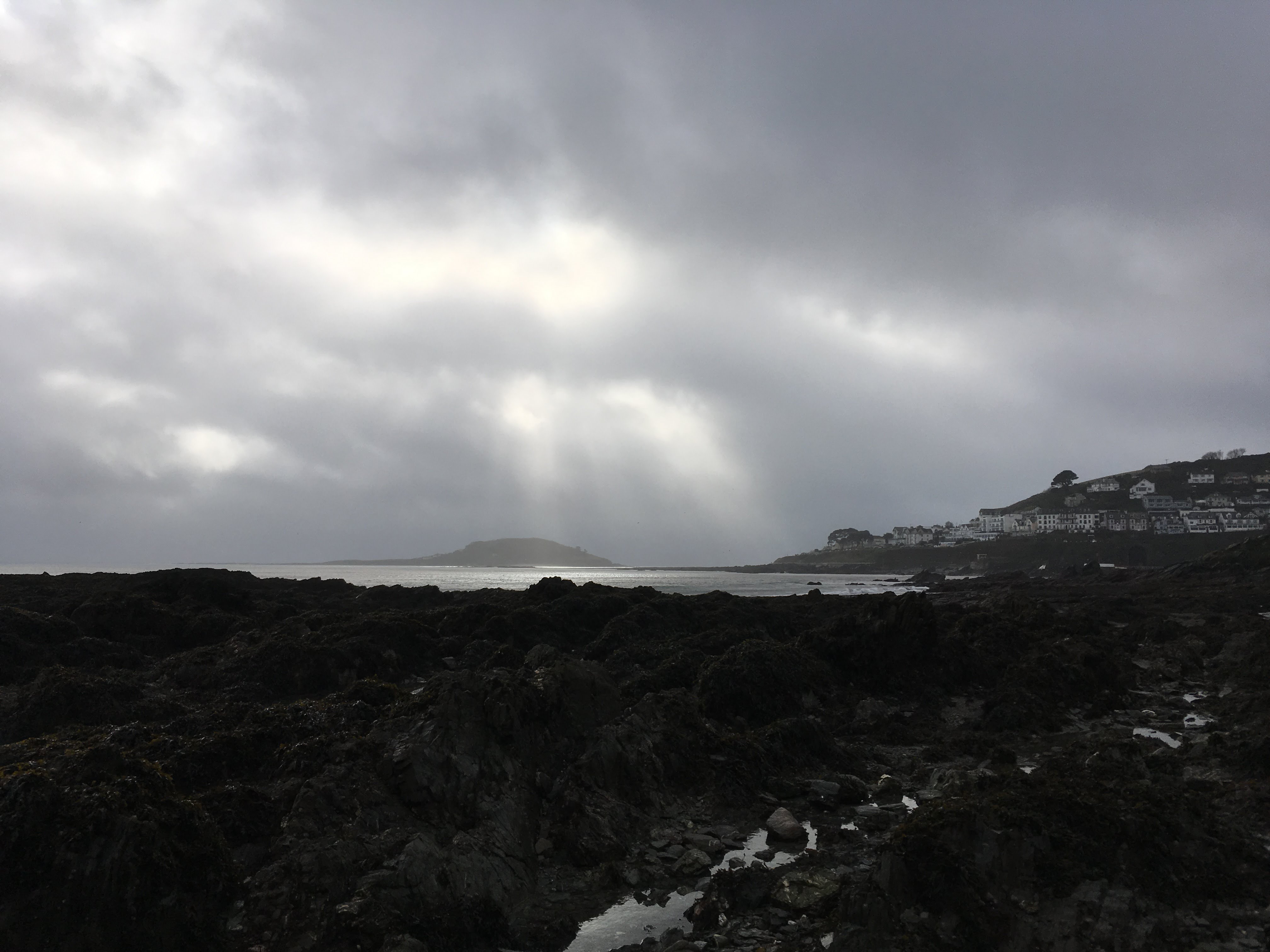
    Back in March, Junior and I had the opportunity, together with our fabulous home education group, to explore the shore in Looe on one of the lowest tides of the year. For these keen rock poolers, searching for rainbow slugs was the perfect challenge.
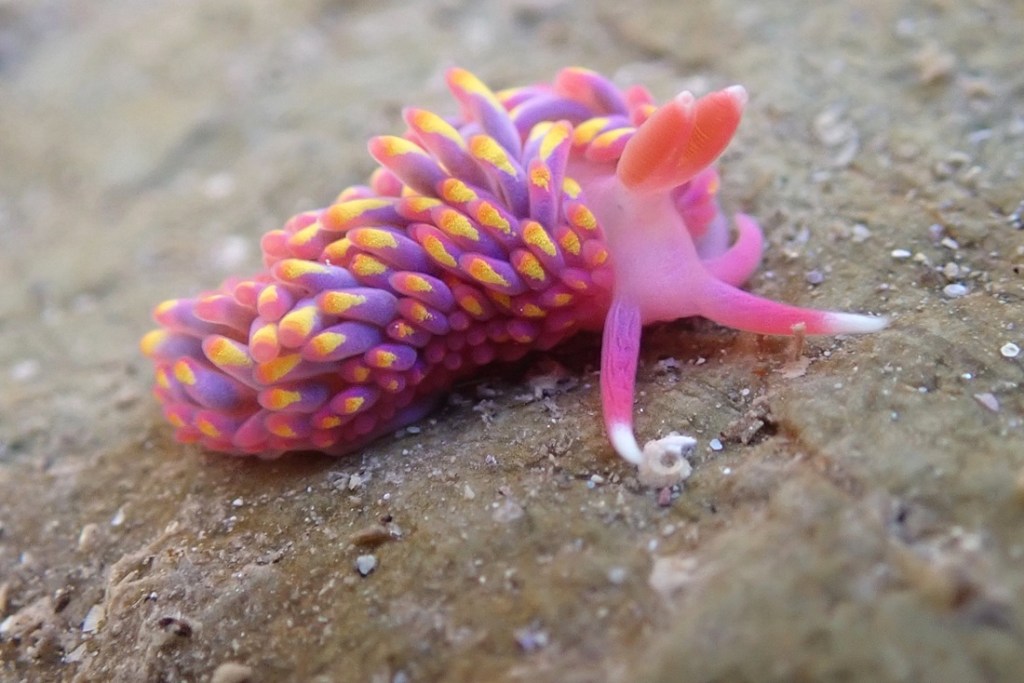
    Brightly coloured pink purple and yellow sea slug.
    Rainbow sea slug, Babakina anadoni

    “So, what does a rainbow sea slug look like?” asks one of the children. A good question.

    I admit I have never seen one in real life.

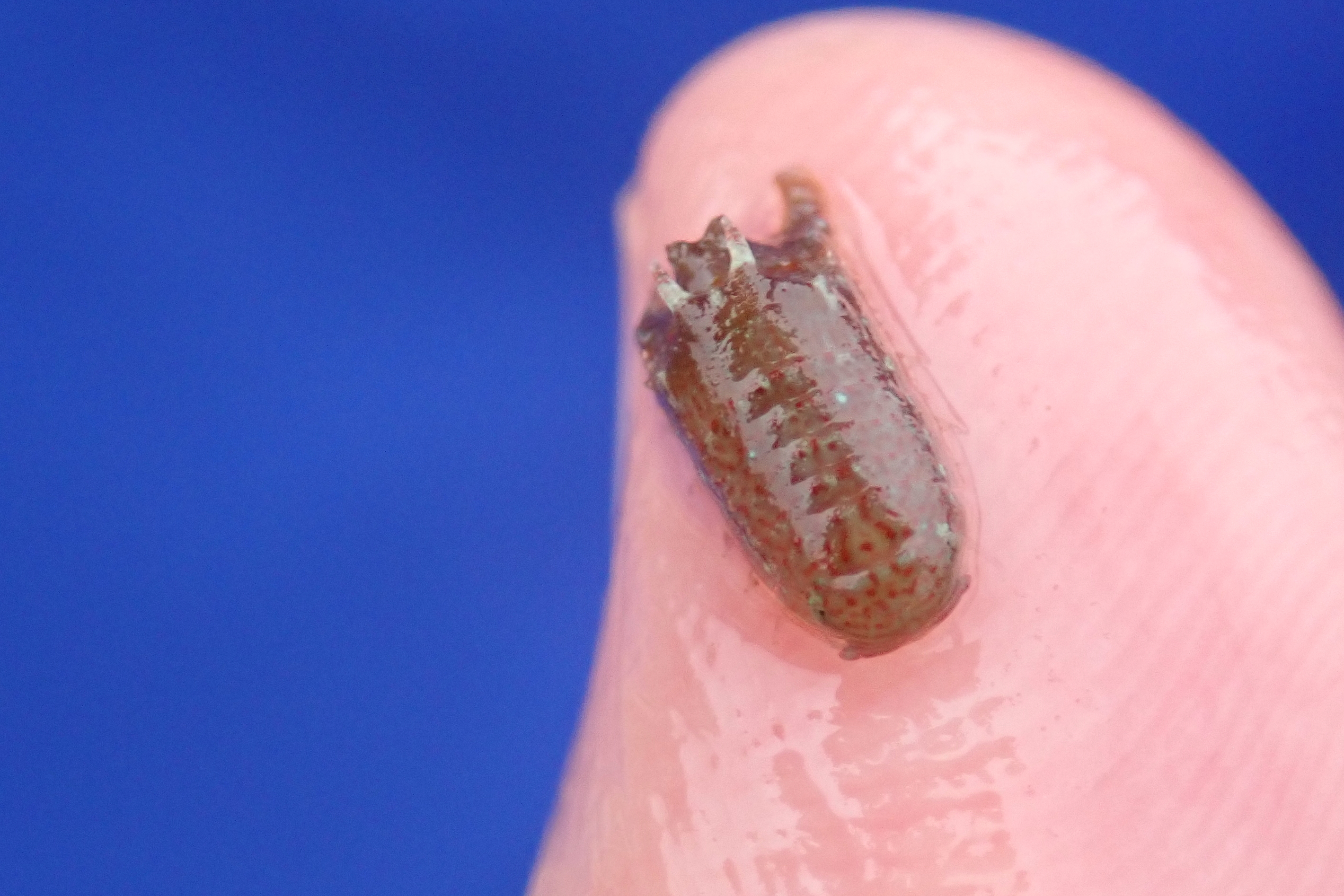
    “It’s tiny, so you’ll have to look closely,” I say. “Maybe the length of my little fingernail?”

     I hold my fingernail out for inspection and the group gathers round.

    “If you find this slug, you’ll know,” I assure them. “It might be tiny, but it’s a fluffy rainbow, with the brightest colours.”

    Since the first UK sighting off the Isles of Scilly in 2002, the rainbow sea slug, Babakina anadoni, has been found increasingly frequently, including in several locations around Cornwall. Needless to say, I have been looking for it. Everywhere. Endlessly.

    The general view is that this species feeds on hydroids, in particular the rather odd looking (and giggle-inducing) Candalabrum cocksii.

    Most hydroids live in delicate, feathery colonies. Described by the naturalist Cocks 1854 (and previously by Gosse in 1853), Candelabrum cocksii looks more like a blobby worm and, to complete the look, it can even wriggle vigorously.
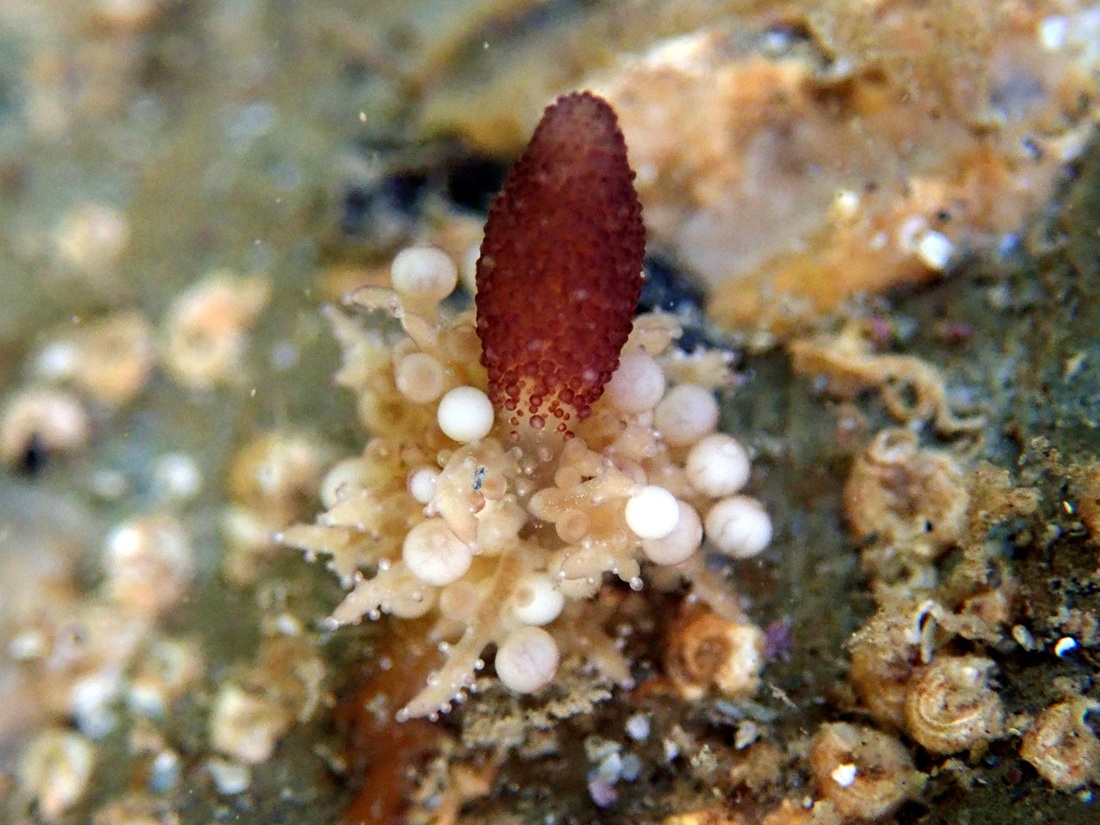
    Candelabrum cocksii hydroid with red body sticking up and a mass of white balls and frilly tentacles at the base. On a rock in the sea.
    Candelabrum cocksii hydroid: believed to be the favoured food of the rainbow sea slug.

    You can just about see why Cocks compared this little animal to a candle-holder. The main, burgundy-red body of the animal often sticks upright like a candle, with the animal’s mouth at the top, and seems to be propped in place by its rounded base, comprising many tiny white balls, and frilled tentacles. Hydroids use stinging cells in their tentacles to fire paralysing toxins into passing prey in the same way as other cnidarians like anemones and jellyfish.

    Underneath the base is a “foot”, which secures the animal to the rock, but can also extend when it wants to move. In fact, the whole animal is highly extendable and transforms in appearance when it puts out its short, round-ended tentacles.

    Candelabrum cocksii hydroid in horseshoe shape on rock, with mass of branched tentacles on right and short tentacles extended all over body.
    Candelabrum cocksii hydroid – showing how it can extend its body and tentacles.

    To make itself seem even longer, it can also connect to other Candelabrum cocksii, forming a pseudo-colony.
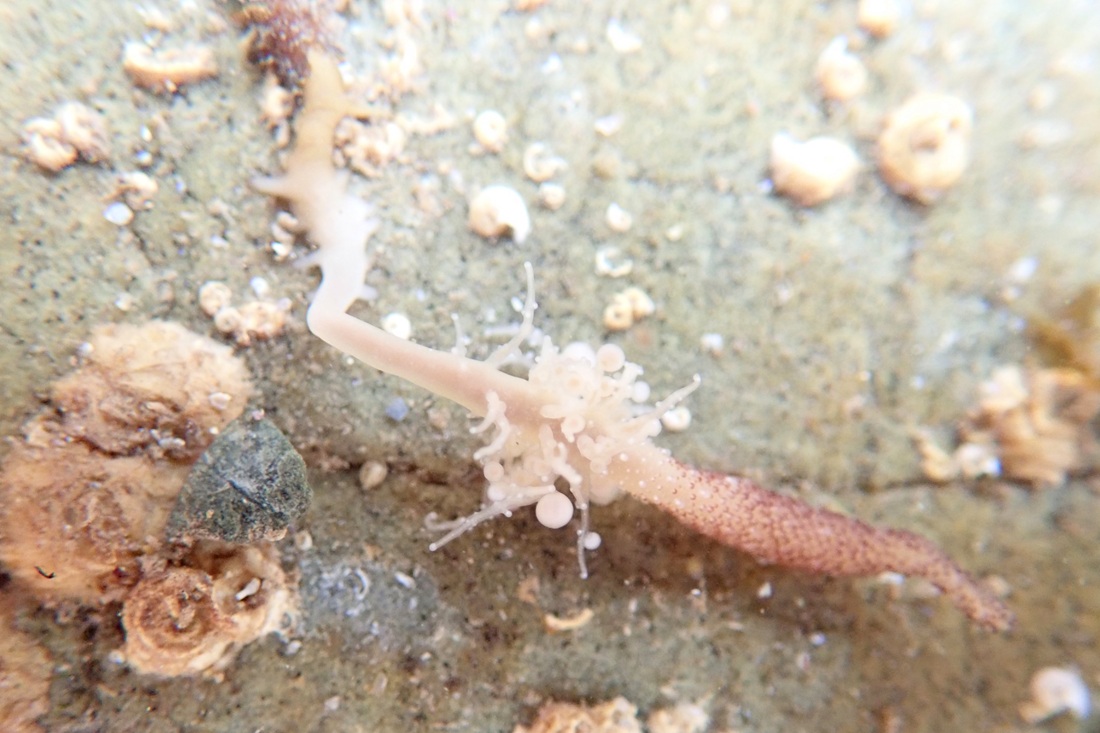
    Extended worm-like Candelabrum cocksii hydroid(s) on grey rock.
    A very extended, worm-like Candelabrum cocksii, with another at the other end.

    To my mind, lots of Candalabrum cocksii hydroids should equal lots of well-fed rainbow sea slugs. Sadly, as so often happens, the slugs don’t seem to have read the same articles as me. After many months of looking, I still haven’t found one.

    Fortunately, Junior’s home education group have good form. We have set out several times with a particular mission, most recently to find baby sharks . Each time, they succeed. Therefore, today we are going to find a rainbow slug.

    Conditions on the shore are beautiful. For once, we have sunshine, very light winds and a calm sea. Not only that, but there is a perfect spring low tide forecast. We follow the retreating sea towards an emerging rocky reef, checking everywhere along the way.

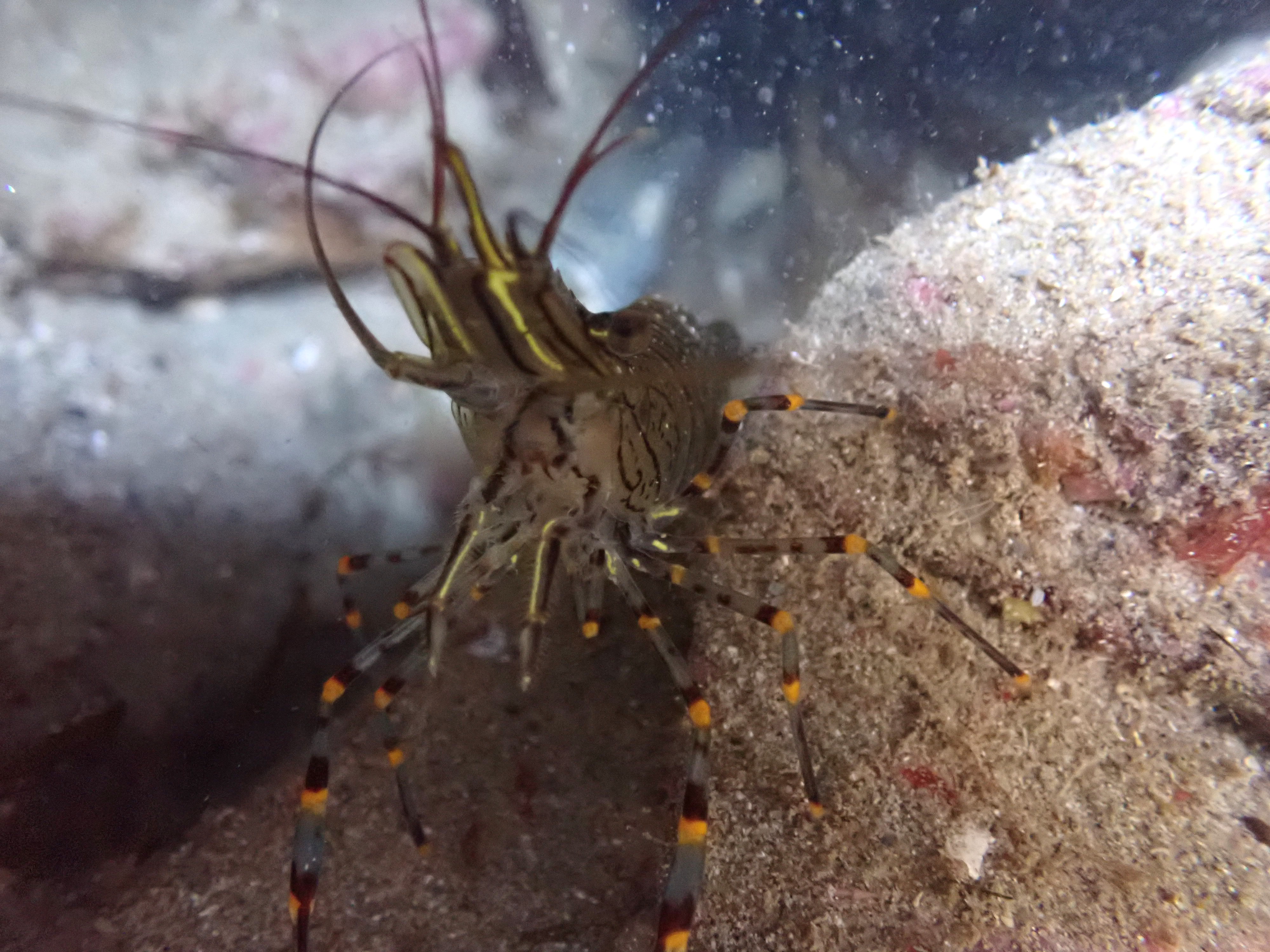
    There are lots of fabulous crabs, fish, squat lobsters, anemones and more, but no rainbow slugs.

    Small headed clingfish over pebbles in rock pool
    Small headed clingfish

    As low tide approaches, I am delighted to bump into the legendary (and also very real) Dr Keith Hiscock of the Marine Biological Association in Plymouth, who is enjoying his own marine explorations. We catch up briefly before I am called away to see another exciting find by the children: a catshark egg case that appears to be on the brink of hatching.

    I keep up my increasingly frantic search for a rainbow sea slug without success. There’s a little Jorunna tomentosa slug and a beautiful red Rostanga rubra. I’m also happy to see a young snake pipefish, but there’s no sign of rainbow slugs.
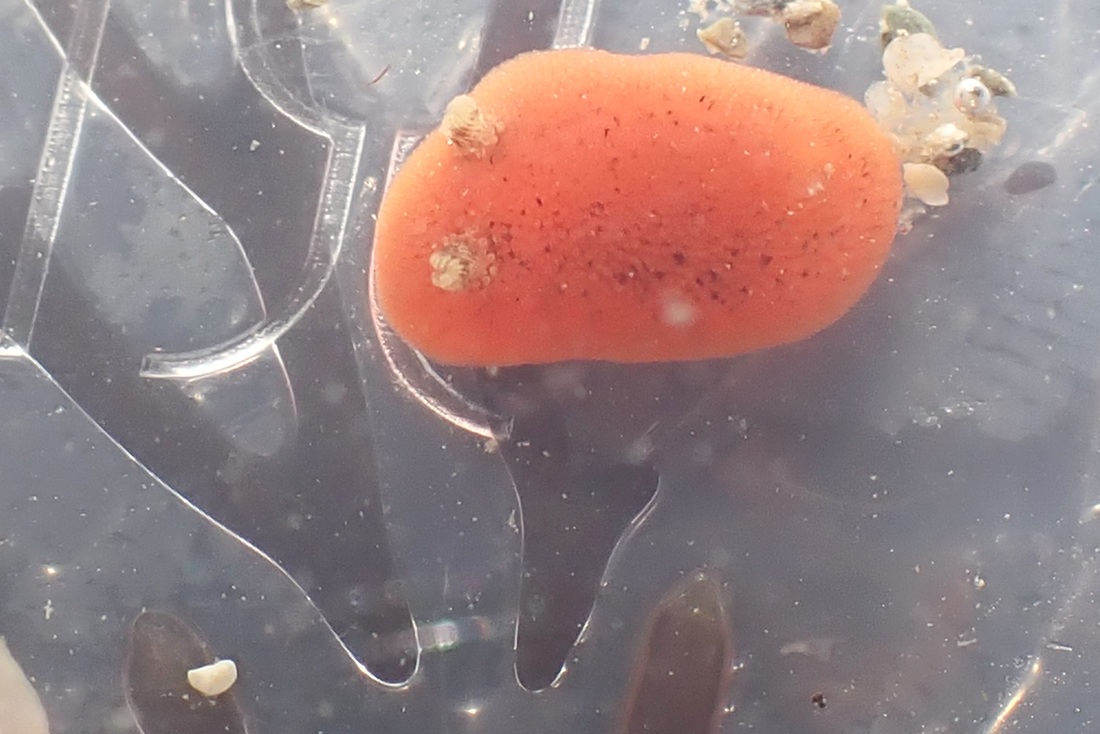
    Rostanga rubra - a bright orange sea slug with light-brown rhinophores
    Rostanga rubra – a slug that feeds on orange and red sponges
    Jorunna tomentosa. A cream coloured sea slug with small brown spots and a furry look. Slug is crossing a rock covered in short green seaweed.
    Jorunna tomentosa – I call these “Dalmatian” slugs as they always have little brown spots.
    Juvenile snake pipefish, showing the long snout and dark mask-like marking over the eye. Fish is in the sea over pebbles.
    Juvenile snake pipefish, showing the long snout and dark mask-like marking over the eye.

    I am taking some photos of a gorgeous little Anapagurus hyndmanni hermit crab, when Junior calls over to say that Keith found a rainbow slug. For a moment I think he’s pulling my leg, but Junior knows that slugs are a serious matter.
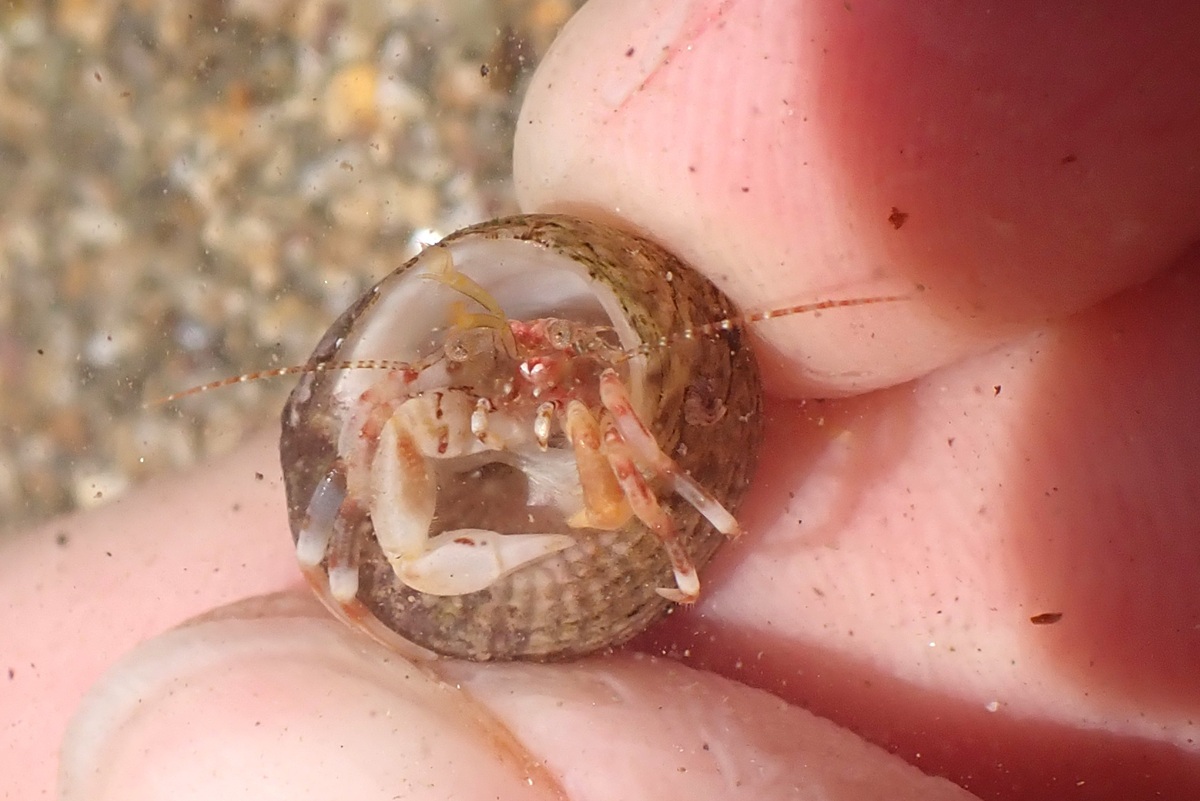
    Anapagurus hyndmanni small hermit crab with large white right claw in topshell.
    Anapagurus hyndmanni. These small hermit crabs have a larger right claw, which looks like a white boxing glove. They also have lovely striped antennae.

    “He found it earlier,” he says. “Over there somewhere.” He points to the opposite side of the lagoon.

    My heart leaps and sinks at the same time. There’s a rainbow slug! However, it’s unlikely to be more than 2cm long and is somewhere among many square metres of rocks and seaweed.

    I slosh through the water to where Keith is exploring and he tells me he has marked the place. Fantastic! I call the kids over and, together, we start hunting for a rock marked with a piece of kelp.

    Inevitably, the tide is already turning and time is against us. We find one rock with kelp on it and search all around to no avail. Then we try another place. Nothing.

    Keith to the rescue! With a little hunting around (rocks and kelp are incredibly plentiful on this part of the shore), he identifies the right area. The first rock we gently turn is slug free and we place it back, glancing nervously at the edge of the sea, which is visibly flowing in our direction.

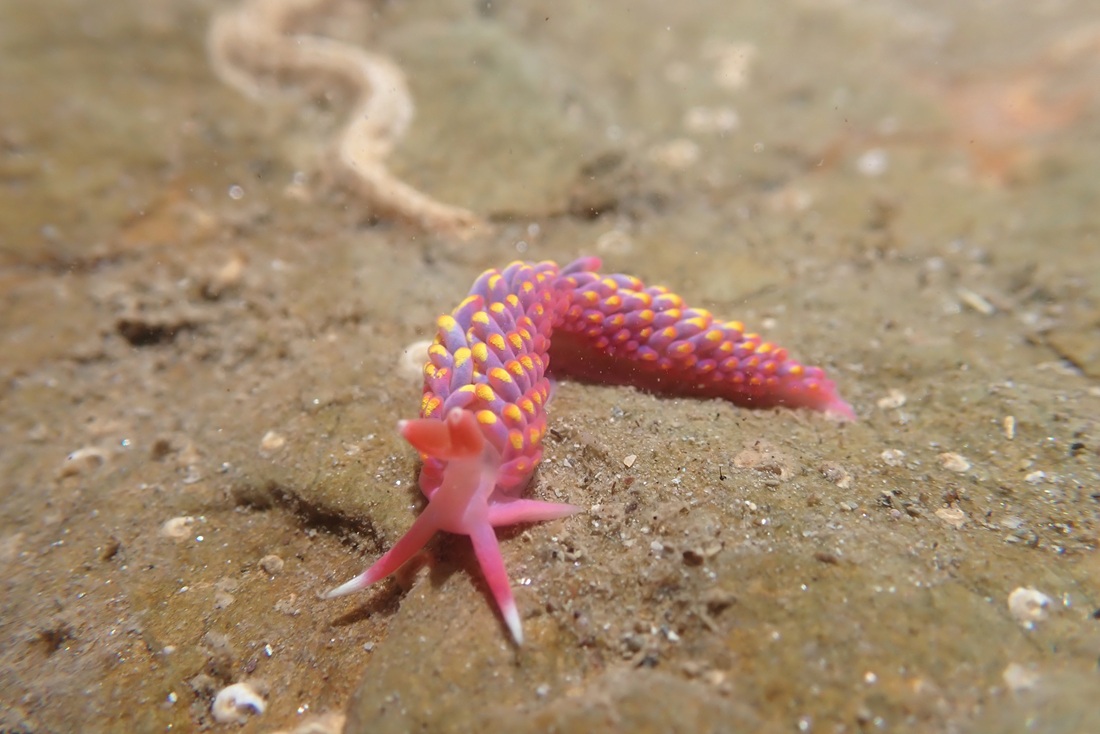
    When we turn the second rock, the children gasp in excitement. Yes, it’s small, but there is nothing disappointing about this slug. The pinks, purples and yellows are virtually glowing.

    Brightly coloured pink purple and yellow sea slug.
    Rainbow sea slug, Babakina anadoni

    “It’s like a Pokémon!”

    The children have a point. With its bright pink headgear and multicoloured mane of cerata along its back, this creature would not look out of place on a trading card.

    Brightly coloured pink purple and yellow sea slug.
    Rainbow sea slug, Babakina anadoni

    Vivid colours like this often announce to any would-be predators that an animal is toxic. Many sea slugs retain toxins from their food, or even stinging cells, which they keep in their cerata (the sticky-up bits on their backs). My books neither confirm nor deny that Babakina anadoni does this, but I imagine that few creatures would be foolish enough to chance a bite.
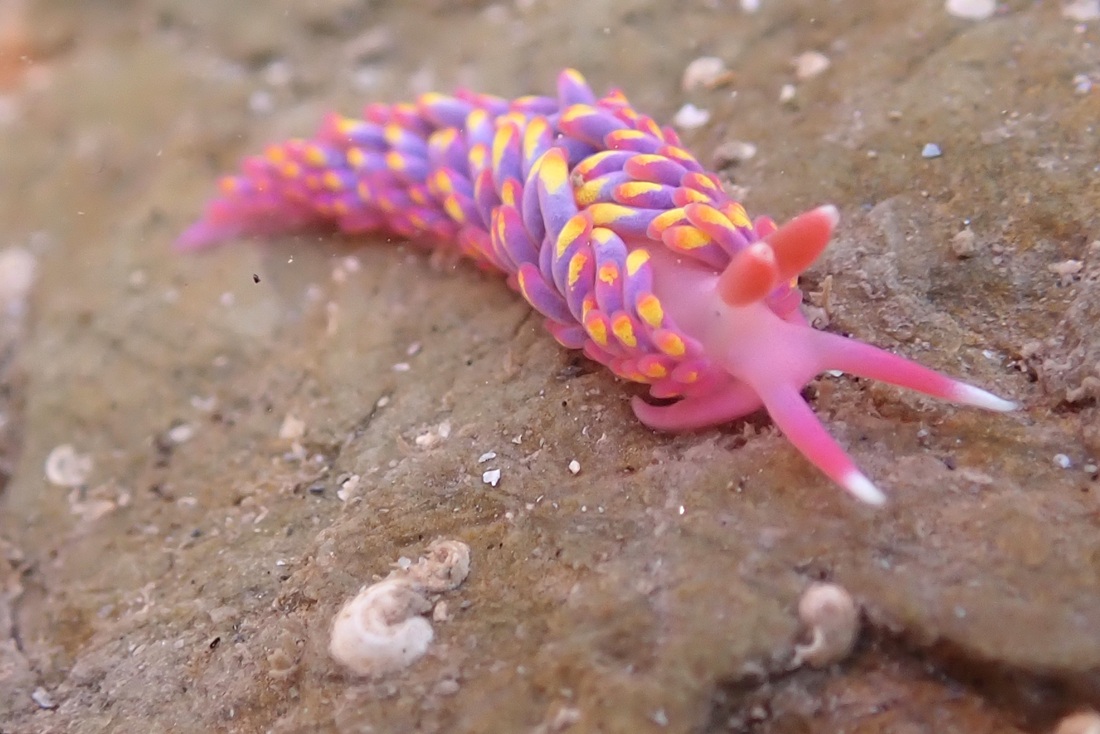
    Brightly coloured pink purple and yellow sea slug.
    Rainbow sea slug, Babakina anadoni

    Excitingly for me, the rainbow slug is not at all camera shy. It keeps changing its pose on the rock, allowing us to take some excellent shots from all of its best sides.

    Amid the appreciative chatter and my own delighted squeals, I do my best to do justice to this slug’s stunning appearance.
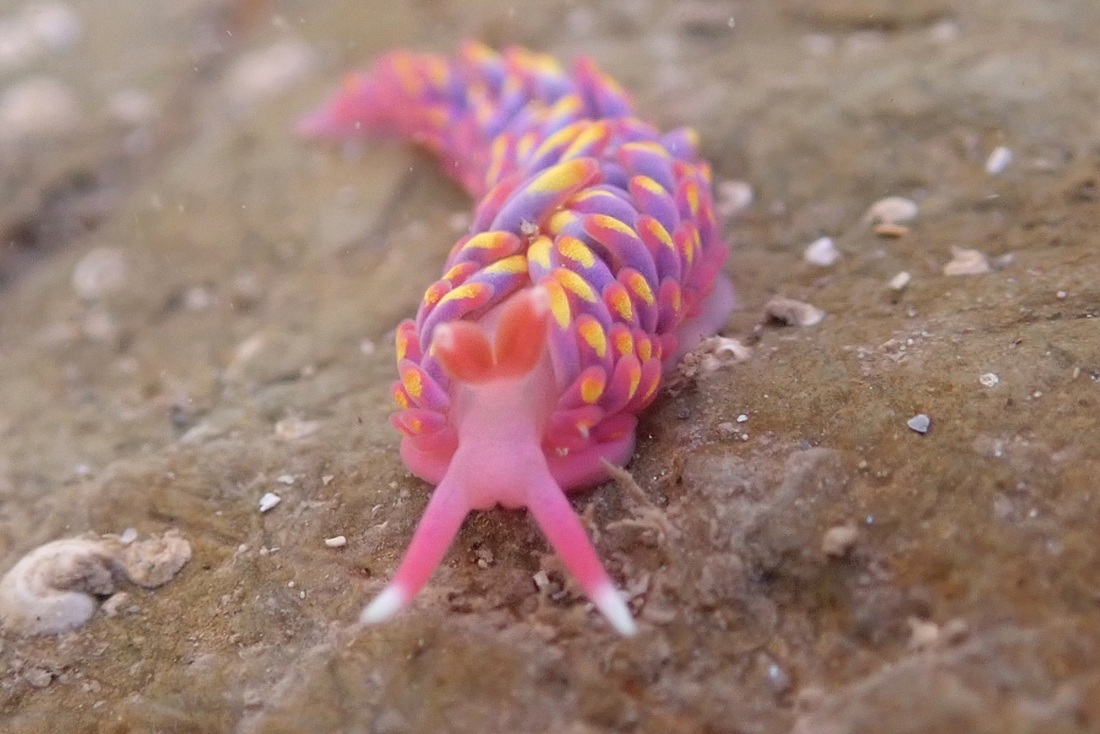
    Brightly coloured pink purple and yellow sea slug.
    Rainbow sea slug, Babakina anadoni

    Also on the rock is a Candelabrum cocksii hydroid – possibly slightly chewed by the slug.
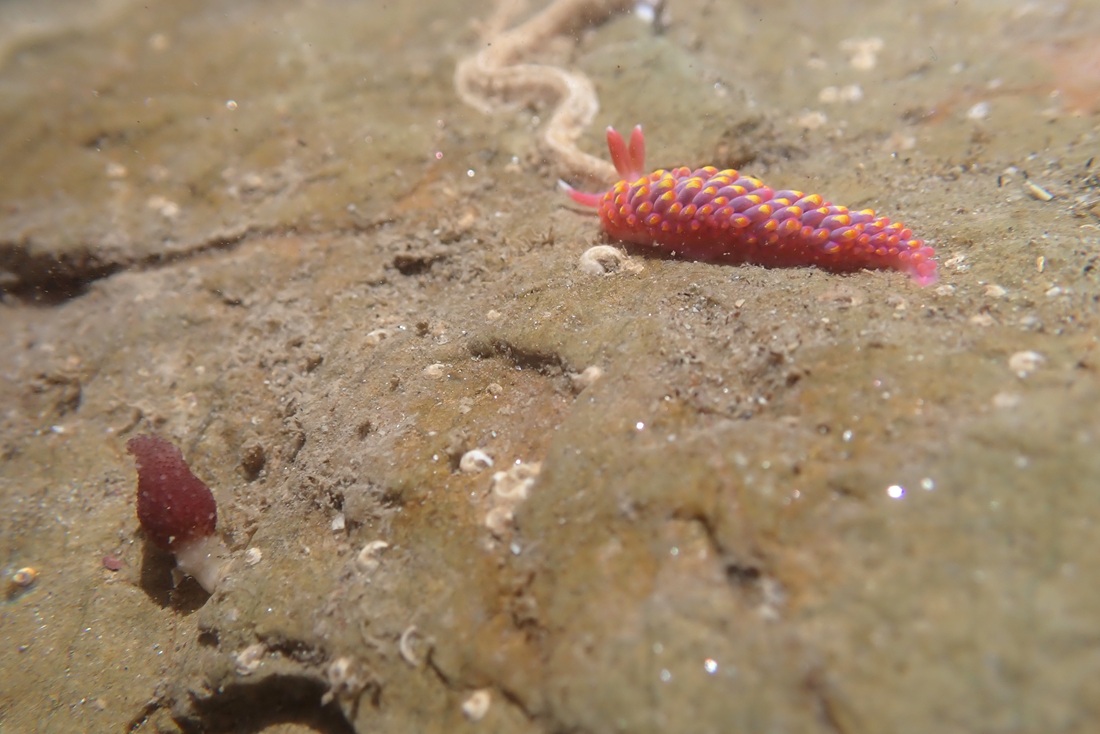
    Brightly coloured pink purple and yellow sea slug.
    Rainbow sea slug, Babakina anadoni with a Candelabrum cocksii hydroid (bottom left) – possibly nibbled!

    I cannot thank Keith enough for sharing his discovery with us all. What an incredible experience for all of us. There may well be some budding marine biologists among the group!

    Brightly coloured pink purple and yellow sea slug.
    Rainbow sea slug, Babakina anadoni

    With the tide pushing at our heels, we retreat to the top of the shore to relax and eat a celebratory ice cream, still buzzing about the beautiful slug and its amazing colours.
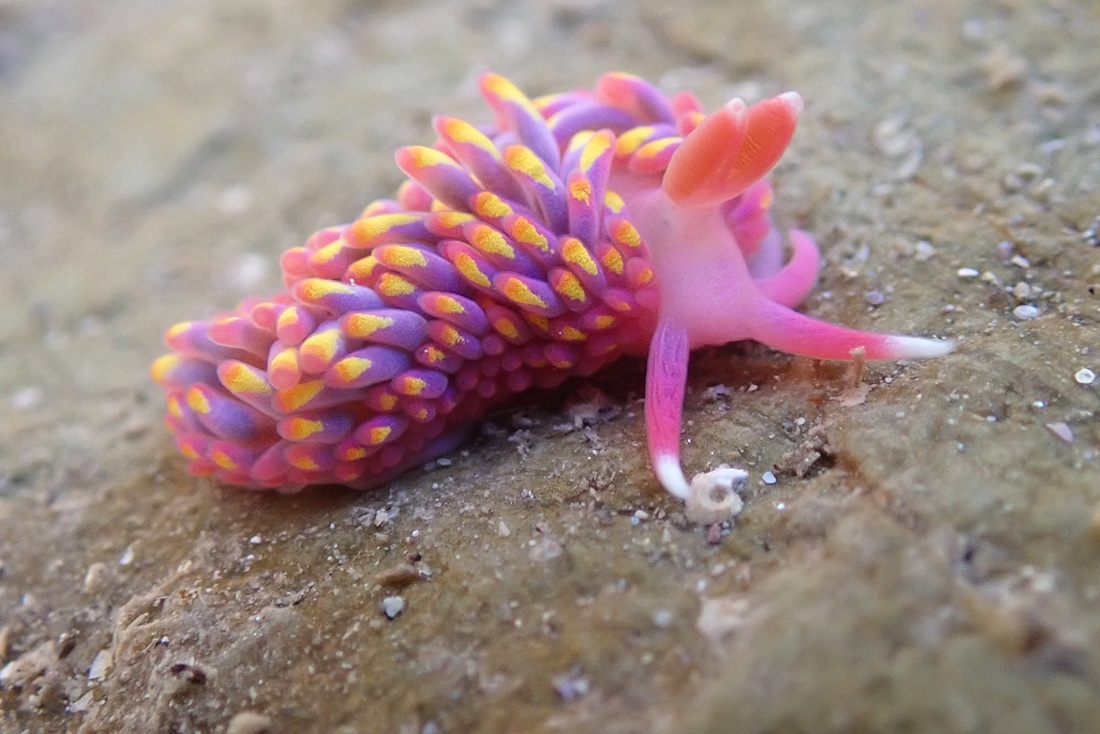
    Brightly coloured pink purple and yellow sea slug.
    Rainbow sea slug, Babakina anadoni… strutting its stuff!

    The intertidal rocky shore is a fragile environment that we can all help to protect. If you are heading out to look at the wildlife, join a local expert-led event if possible and be sure to follow my rock pooling tips to help you to look after the wildlife and stay safe.

    This website is a labour of much love and the content is available for free to everyone. My wonderful readers often ask if there is a way to support my work. You can now ‘buy me a coffee’ through my Ko-fi.uk page. (Just click donate and you can set the amount to pay by PayPal). Thank you!

    Buy Me a Coffee at ko-fi.com

  • Rock Pool Bingo – Searching for Southerly Species (Part 2 – North Coast)

    Rock Pool Bingo – Searching for Southerly Species (Part 2 – North Coast)

    With our bingo cards of southerly species part-filled after an exciting day on the south coast, our visitors from Wales still had quite a wish list left to accomplish. To find cup corals and Celtic sea slugs, a trip to a more exposed coast would be needed. Naturally, I suggested my favourite beach: Porth Mear.

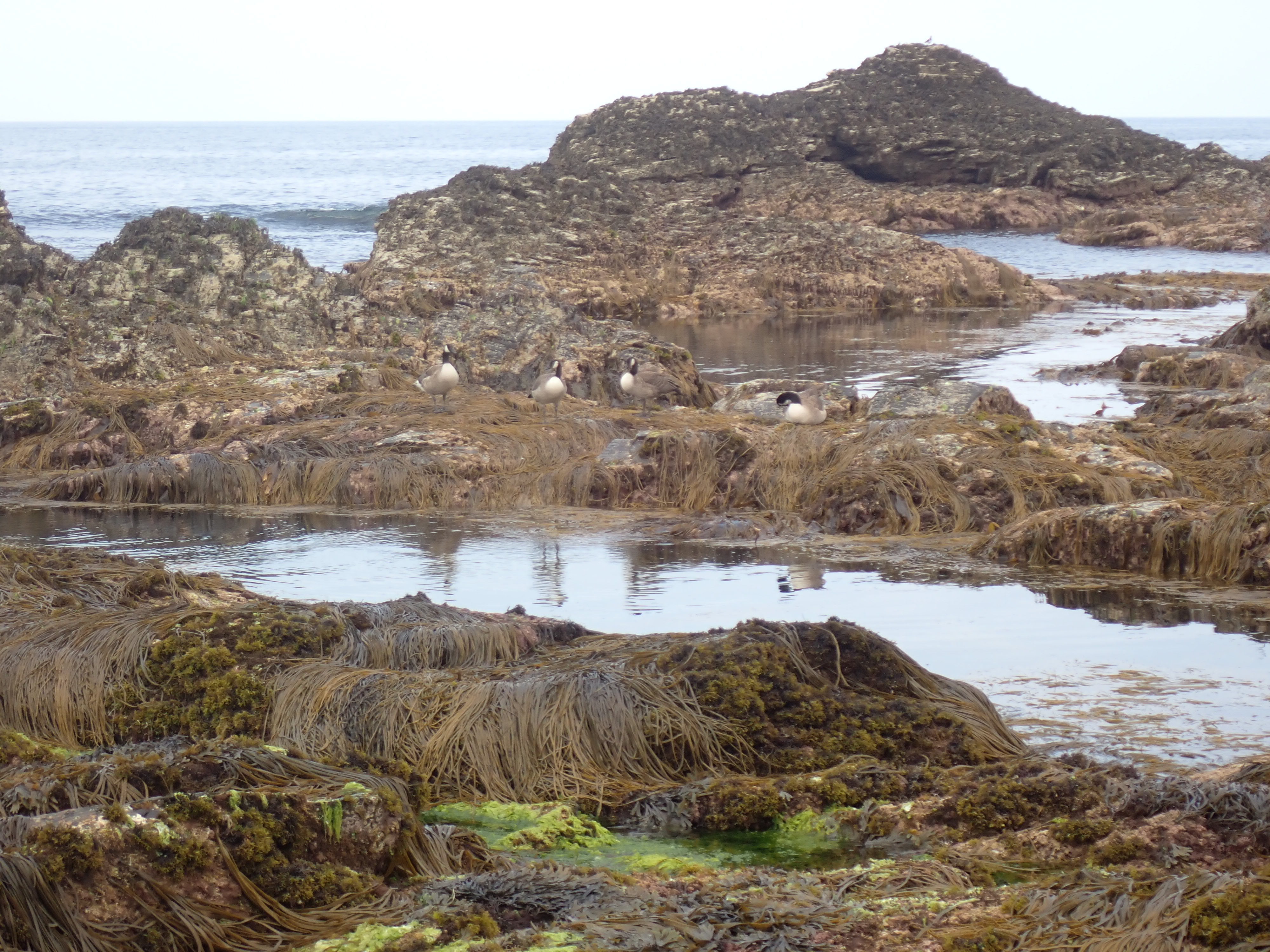
    A flock of geese joined us on the shore at low tide.

    The weather was on our side, taking a break between the endless storms that have characterised the summer holidays. So, with swimmers and beach shoes at the ready, we walked down a valley alive with tortoiseshell butterflies to where the bluest sky met the bluest sea. Even the pools at the top of the beach churned with trapped young mullet, scurrying shore crabs and bright anemones. While one of our friends stayed looking at the upper shore pools and gathering shells, Junior and I led our other friend on a long slip and slide across the rocks to reach our goal.

    With two hours to go until low tide, we could safely allow ourselves a few distractions on the way. I couldn’t resist stopping to take photos of this wonderful Montagu’s blenny, which let me creep ever closer with my camera as it sheltered under a limpet shell. Blennies are able to move their eyes independently and this one kept an eye on me while scanning the surface of the pool with the other.

    Montagu’s blenny looking two ways at once. This blenny has a single head tentacle.

    My friend was delighted. Although it hadn’t appeared on our bingo card, the Montagu’s blenny is another southerly species which he had never seen in North Wales. This was too easy!

    We had met some St Piran’s hermit crabs at Hannafore the previous day, but the colony here was well worth a look too. We found scores of these crabs in and around the pools along a couple of rocky overhangs, living in a range of sizes of shell. This species is doing well here, towards the northerly limit of its known range.

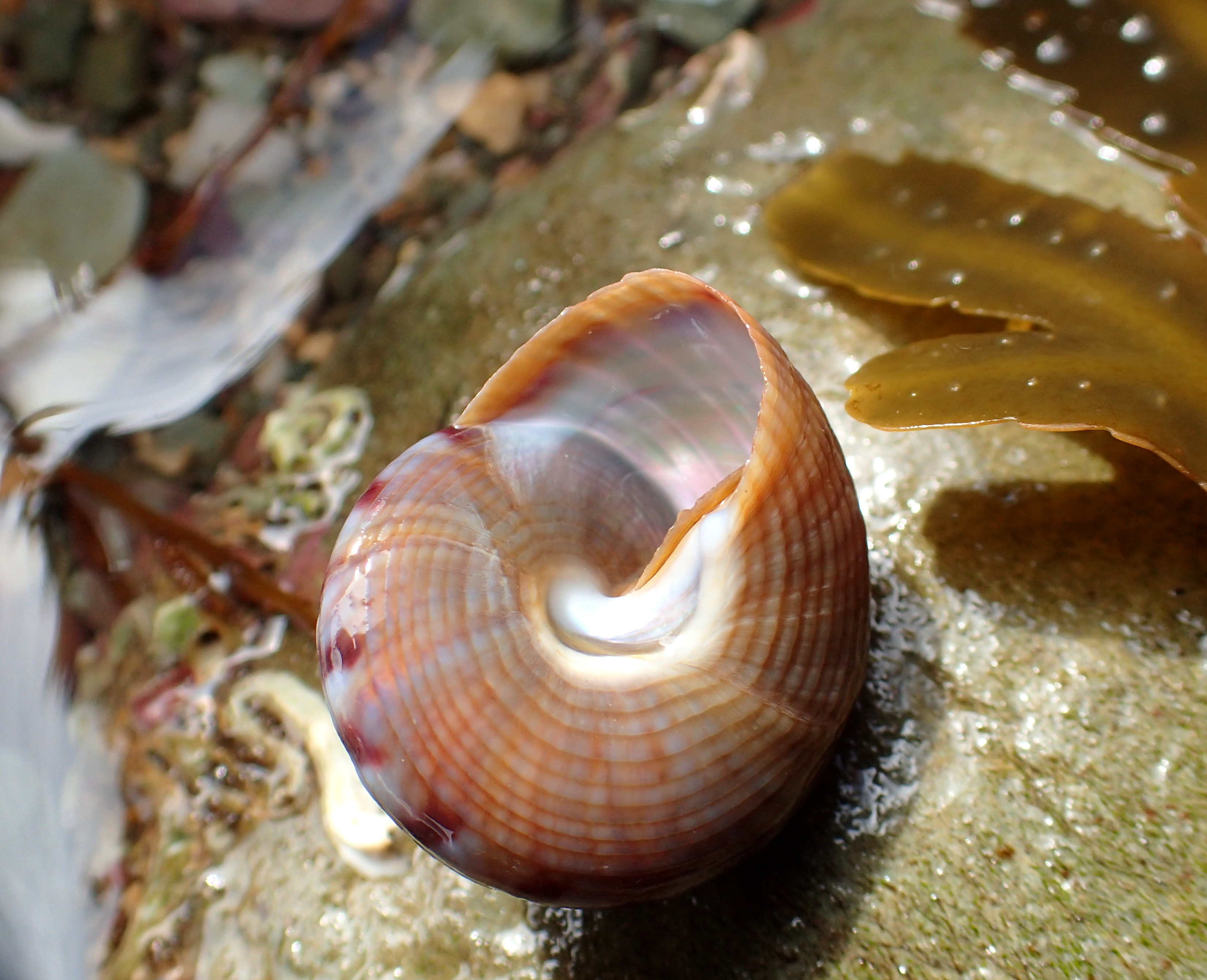
    The painted top shells on this beach are always especially pink and beautiful, perhaps because in this more exposed location, they tend to accumulate less silt and micro-algae on their shells. We stopped to take plenty of photos.

    A typically bright pink painted top shell at Porth Mear.

    Although it can be hard to find stalked jellyfish in the summer when the beach is thick with the seaweeds they attach to, we were determined to tick one or two off the list, especially Haliclystus octoradiatus. This may not be a particularly southerly species, but it occurs frequently around Cornish coasts. After much searching we found a very small blob that was probably a juvenile, but I could only confirm that by looking at photos afterwards.

    This tiny juvenile Haliclystus octoradiatus stalked jellyfish was only a few milimetres long, but in the photos, its primary tentacles are visible.

    As the tide dropped further, we picked up our pace and clambered towards a wave-battered gully. This area is only accessible on the lowest tides and, even then, is often out-of-bounds due to the huge swells that pound these rocks for much of the year. Today, the calm conditions were perfect and we could explore in relative safety while keeping an eye on the time.

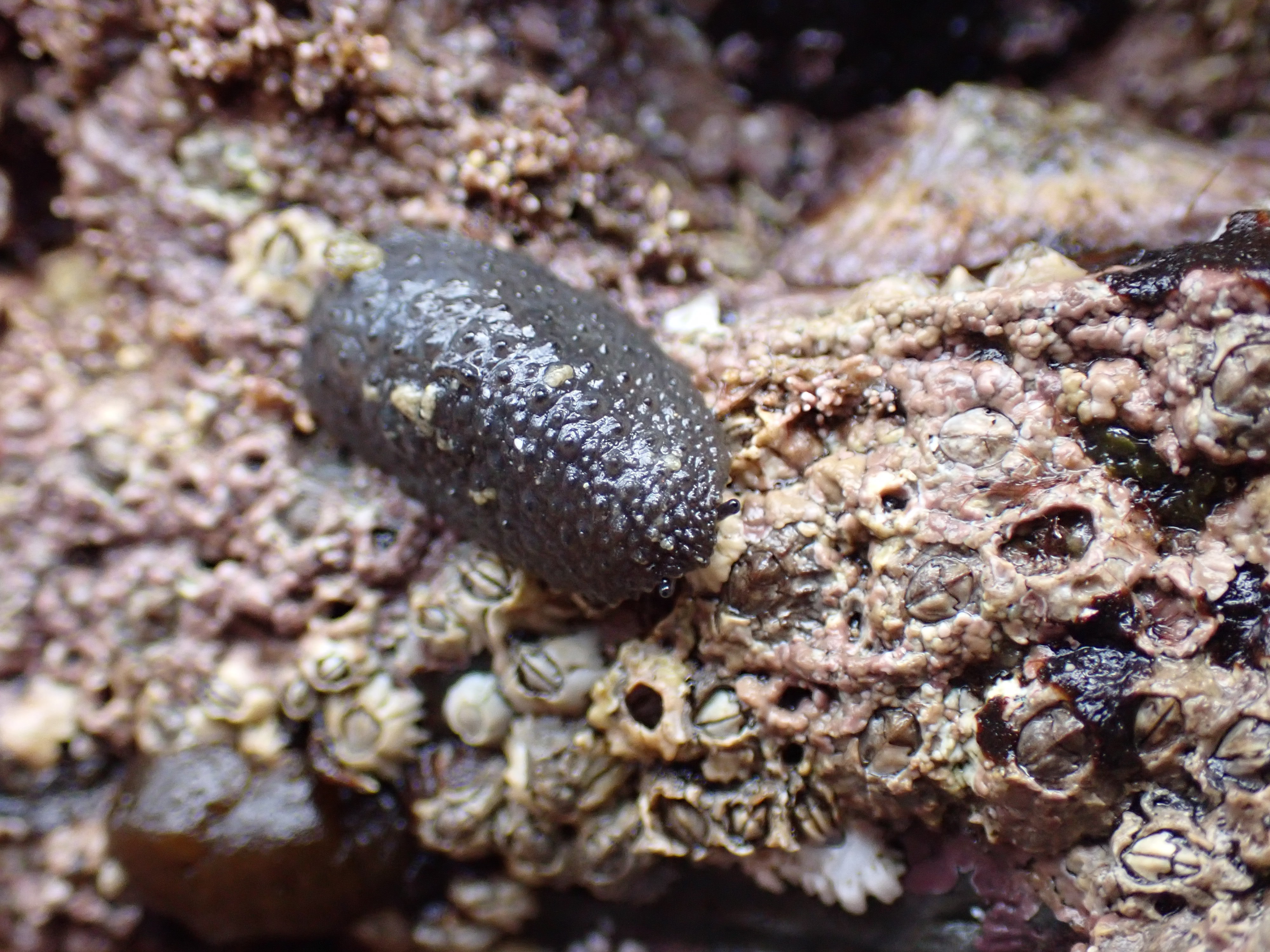
    Junior made straight for the high rocks, where he quickly found the first Celtic sea slug, out in the open among the barnacles and mussels.

    Celtic sea slug

    These strange black lumps always remind me of armoured cars. This is mainly a very southerly species which is found widely around exposed Cornish coasts, but it has been recorded as far north as the Farne Islands and Scotland.

    Celtic sea slugs may not be the most classically pretty slugs, but they are incredible animals. They are able to survive on these rough shores in terrifying conditions and they don’t even have gills. They breathe air and hide away in cracks in the rock when the tide comes in, staying alive by keeping an air pocket sealed inside their bodies and breathing through their skin when needed.

    If there is one Celtic sea slug, there is usually a whole colony and we found dozens more on the rocks all along the gully.

    Celtic sea slug foraging on tiny micro-algae and other micro-organisms.

    Our next stop was a deep overhang with a pool at its base where we knew we would be able tick off another species from our bingo card, the scarlet and gold cup coral.

    We had to kneel and lie at strange angles on rocks encrusted with sharp barnacles, but we were soon rewarded with the brilliant glow of many corals.

    Scarlet and gold cup corals

    These tiny orange and yellow corals open their transluscent tentacles in the water here and always astound me. Their delicate soft bodies encase a spongy, fragile exoskeleton, none of which looks like it could stand up to a gust of wind, let alone the fierce, pounding seas that rage through this gully on a daily basis. Despite their soft appearance, scarlet and gold cup corals, like the Celtic sea slugs, thrive in these wild places.

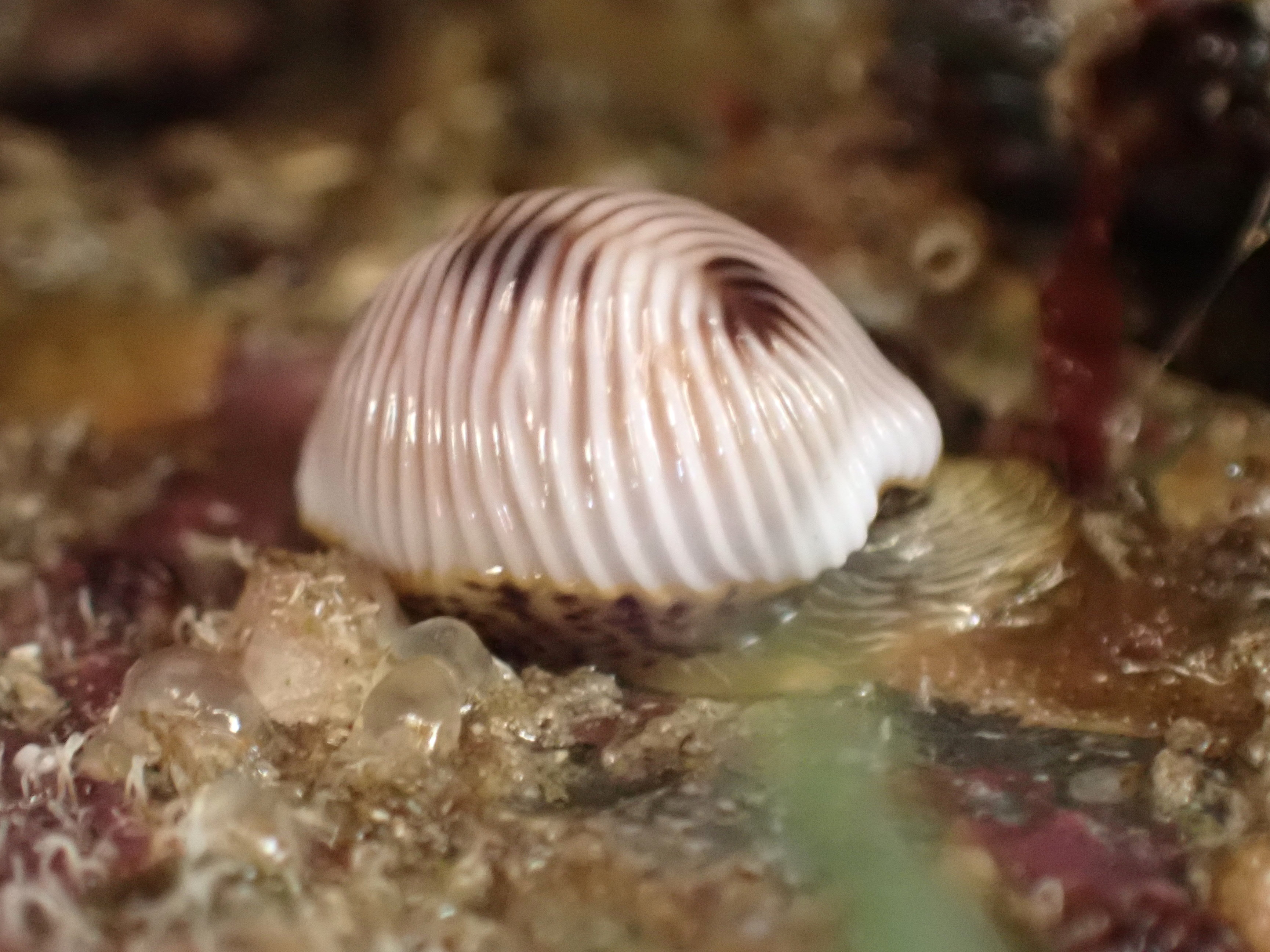
    It was a good thing we had left ourselves plenty of time to explore this rock pooler’s paradise. Between deep pools packed with enormous snakelocks anemones and prawns as big as my hand, we scrambled and stared at the huge diversity of species in front of us. Arctic and three-spot cowries moved across the damp surfaces encrusted with pink seaweeds and colourful sea squirts. Groups of light-bulb sea squirts seemed to shine out from the dark water and so much life abounded on every surface that we moved with great caution for fear of accidentally treading on creatures.

    3-spot cowrie

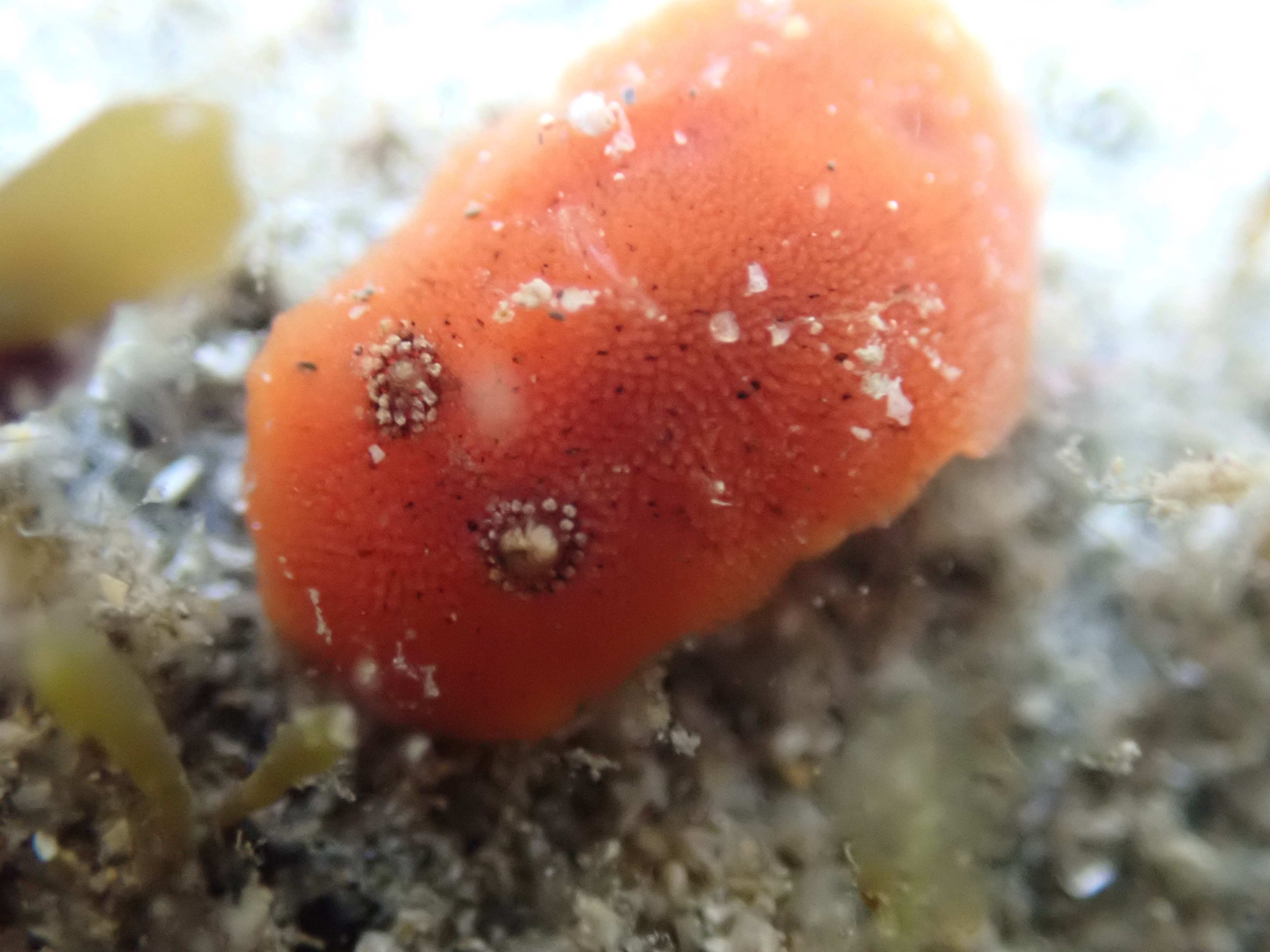
    The underside of a large boulder at the head of the gully was coated in a red sponge. A quick inspection revealed a small white coil of sea slug sponge. It took me longer to find the slug, which matched its background flawlessly. Rostanga rubra are a common find on these sponges but this was another first for my friend who is almost as obsessed with slugs as I am. He was so delighted with this little find that he took some persuading to move away from the gully before the tide turned.

    Rostanga rubra sea slug
    Rostanga rubra sea slugs feed on orange and red sponges such as Ophlitaspongia papilla. As they feed they take in the colour from the sponge, which makes them perfectly camouflaged.

    On our way out of the gully, we waded through a pool, up to our waists in the water and no longer caring how wet we were. Hidden at the back of the pool we discovered a deep hole in the rock that harboured dozens of scarlet and gold cup corals and many large snakelocks anemones. I spotted a leg sticking out from underneath this one and uncovered this Leach’s spider crab (Inachus phalangium) sheltering there.

    Inachus phalangium living in the shelter of a snakelocks anemone’s stinging tentacles. This crab also grows sponge on its carapace for camouflage.

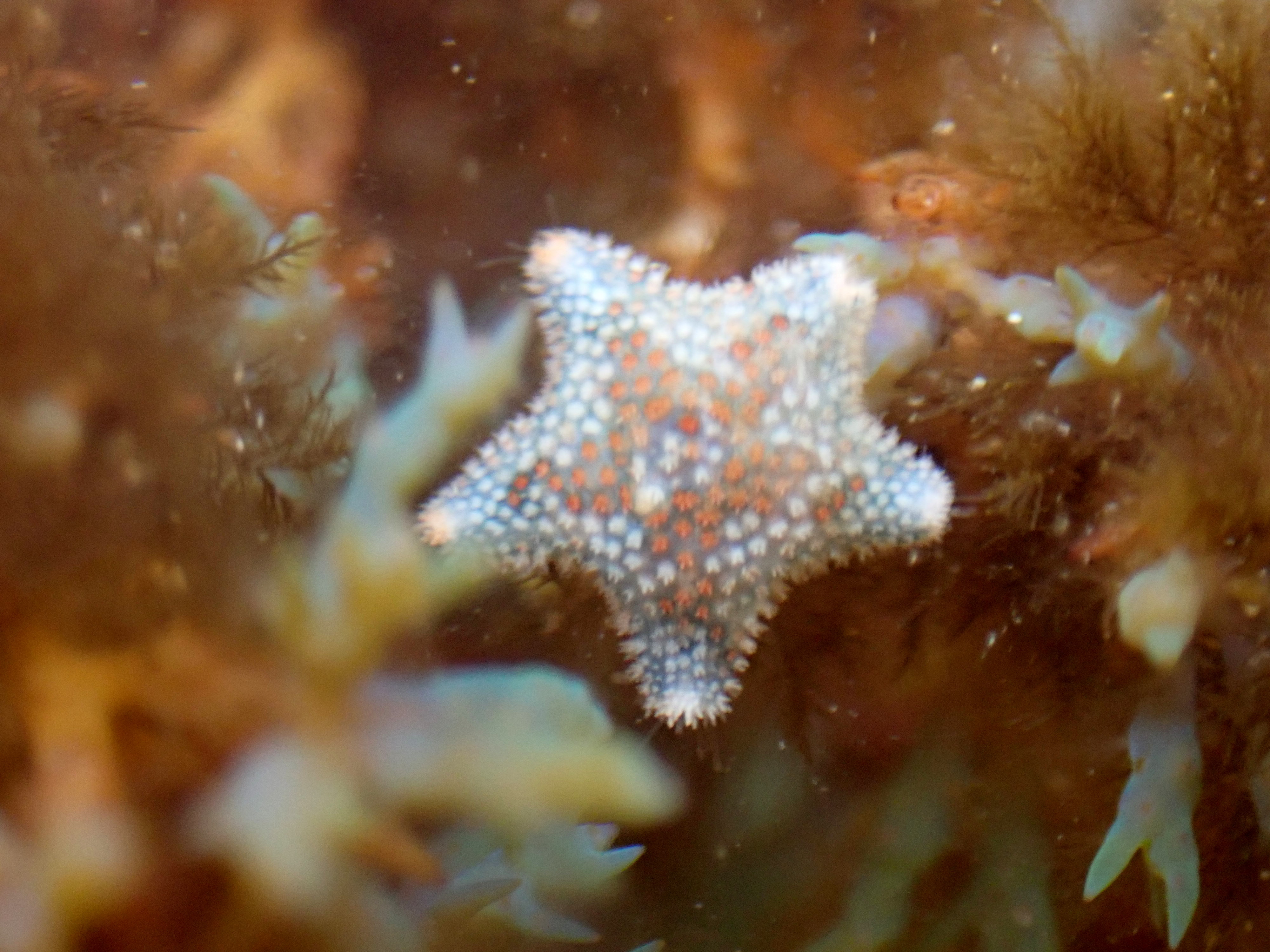
    A shallow pool nearby was dotted with tufts of rainbow weed. To our surprise, these harboured many Asterina phylactica – a small species of starfish. A nearby clump of codium seaweed was also home to several Elysia viridis sea slugs.

    Asterina phylactica – a small species of cushion star.

    On our way back across the beach, my friend found a clump of seaweed with half a dozen stalked jellyfish growing on it. This time, the blobs of the primary tentacles between the arms were easy to spot and we could be sure that these were Haliclystus octoradiatus.

    A white Haliclystus octoradiatus stalked jellyfish

    With most of our bingo card of southerly species complete and with another day of rock pooling to try to find the remaining species, my friend set off up the beach to rest and enjoy a well-earned picnic.

    Junior and I lingered in the sunny pools, exploring further into the slippery masses of thong weed and kelp until the tide turned.

    To celebrate the rare August sunshine, we finished the day with a visit to the vast rock pool where I used to swim as a child. Plunging into the cool waters, I experienced the familiar feelings of wonder and trepidation at the thought of what might lurk in the depths.

    We splashed and floated between the rocky walls, finding starfish, prawns, star ascidians and sponges as we swam, side by side. Time might move on, but this beach never loses its magic.

    Sea hare, Aplysia punctata, at Porth Mear
    A blue-rayed limpet on kelp at Porth Mear
    A yellow form of the Scarlet and gold cup coral.
    A huge prawn checks out my camera!
    A shanny (common blenny) hiding in a crevice waiting for the tide to come in at Porth Mear.
    Light bulb sea squirts at Porth Mear.
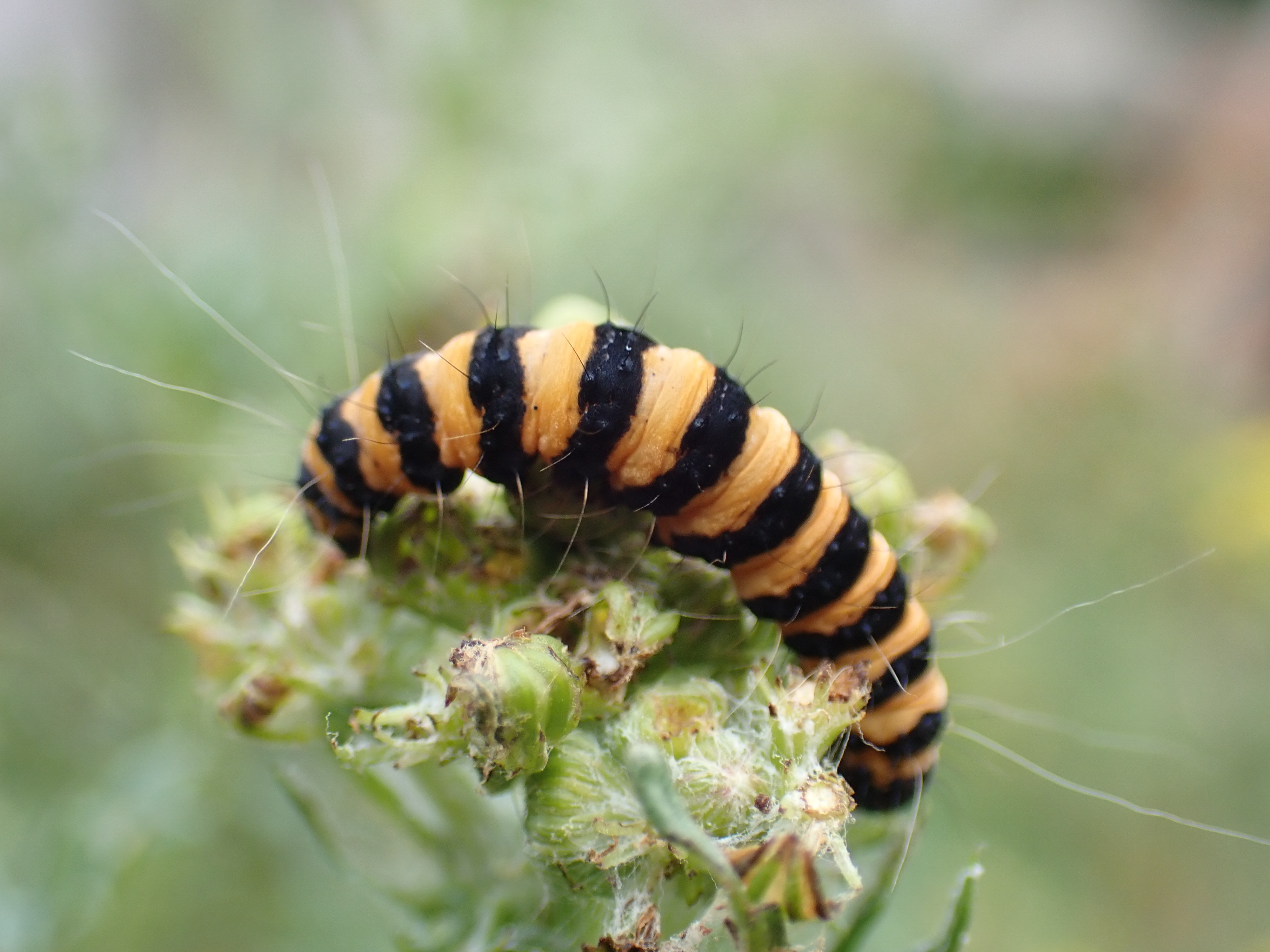
    The walk to and from Porth Mear is always a wonderful part of the adventure – Junior spotted lots of cinnabar moth caterpillars on our way back.
  • Dolphins and discoveries

    Dolphins and discoveries

    There’s no more auspicious start to an afternoon’s rock pooling than a dolphin display while you’re munching your pasty.

    Jan from Coastwise North Devon, Junior and I were treated to an incredible leaping, spinning pod of dolphins at the start of our last Looe rockpooling foray, which could only be a good sign.

    We were far too busy watching the dolphins to take any good photos - but some distant fins here just to prove there really were dolphins.
    I was too busy watching the dolphins to take any good photos, but here are some distant fins.

    Following a busy summer season, it was magical to have the beach to ourselves. Despite a keen wind that made it difficult to see into the more exposed pools, the sheltered gullies were full of colour.

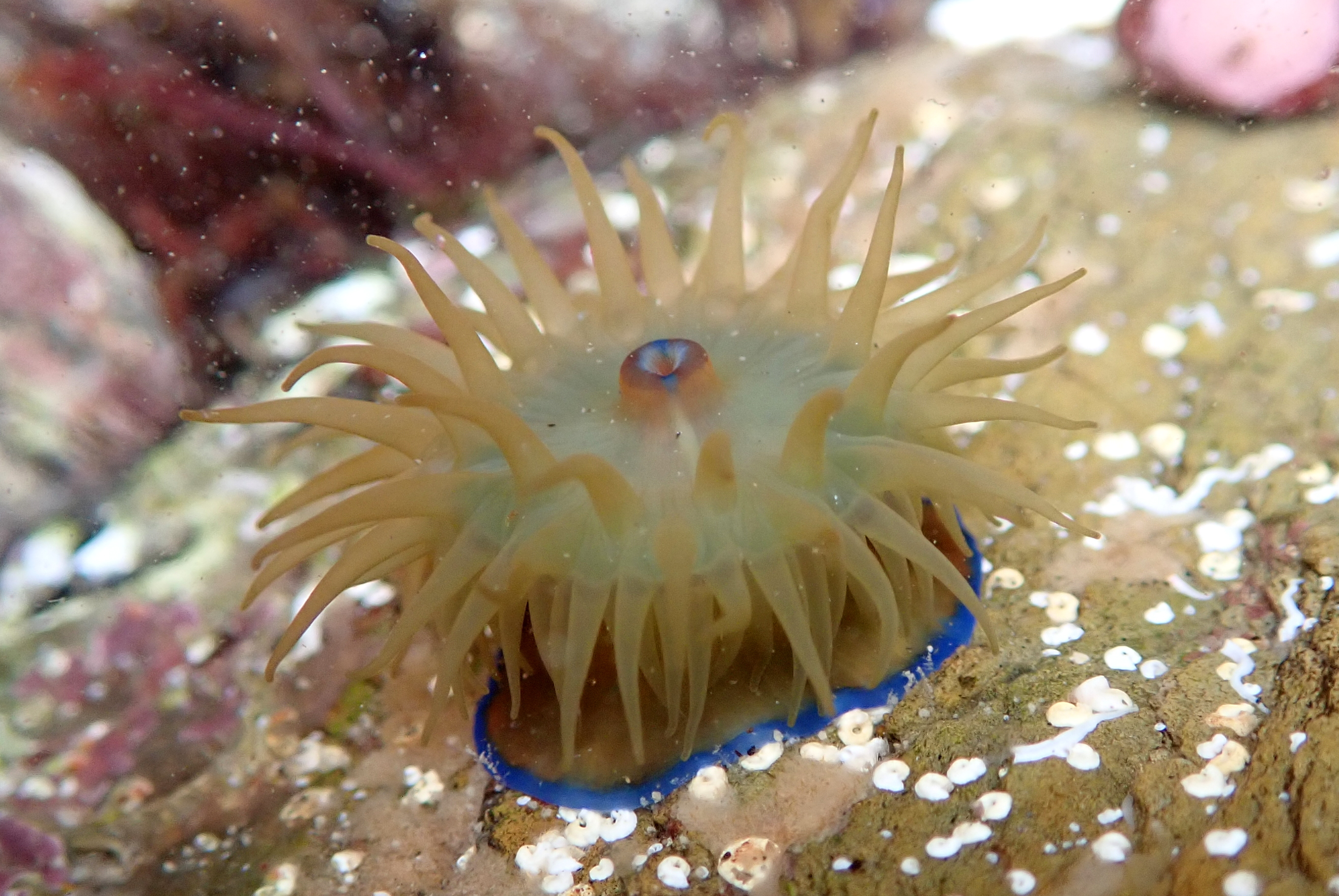
    Every colour variant of the beadlet anemone was on display in one short stretch of pools. These common anemones are often red, but here they showed off their full traffic-light range of shades. Some splayed open a shower of bright tentacles, while others were retracted, showing nothing but the distinctive blue circle at the base of their columns.

    A rather green beadlet anemone with blue markings around its base and on its mouth.
    A rather green beadlet anemone with blue markings around its base and on its mouth.

    A closed-up orange beadlet anemone
    A closed-up orange beadlet anemone

    Junior’s sharp young eyes were focused on the task and he brought us several isopods to identify. These minute woodlouse-type creatures swam around our pot-lids at high speed while we tried to photograph their tails. All of them had two prongs on their backs, so were male Dynamene bidentata.

    One of Junior's isopods - a Dynamene bidentata
    One of Junior’s isopods – a Dynamene bidentata

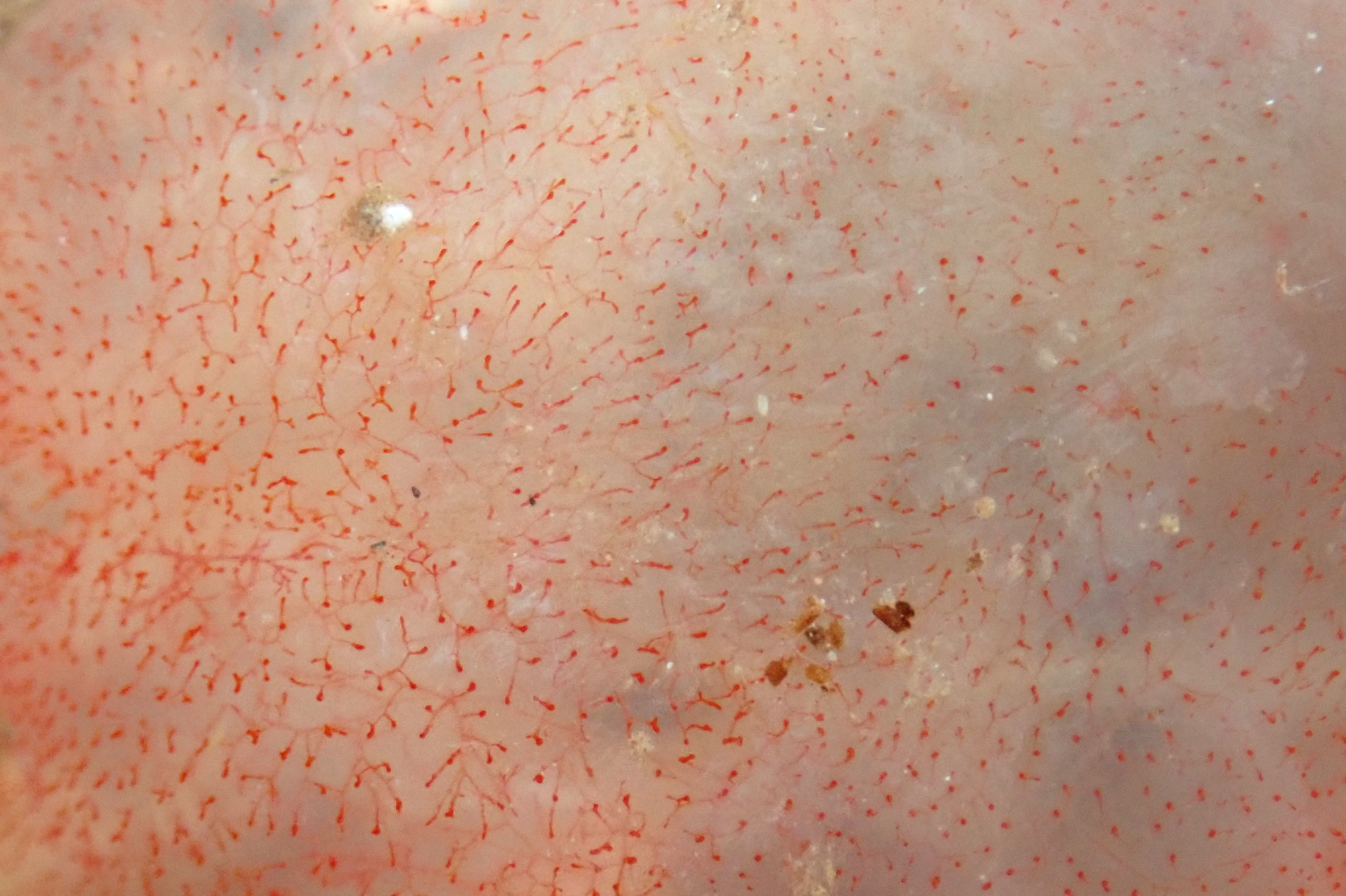
    We used our cameras to focus in on the blob-like bodies of the Ascidia mentula sea squirts, which we found attached to several rocks. From a distance, they have a pink tinge. Close-up, they seem to be gearing up for fireworks night, with bursting patterns of red sparks along their sides.

    Pink fireworks - patterning on an Ascidia mentula sea squirt.
    Pink fireworks – patterning on an Ascidia mentula sea squirt.

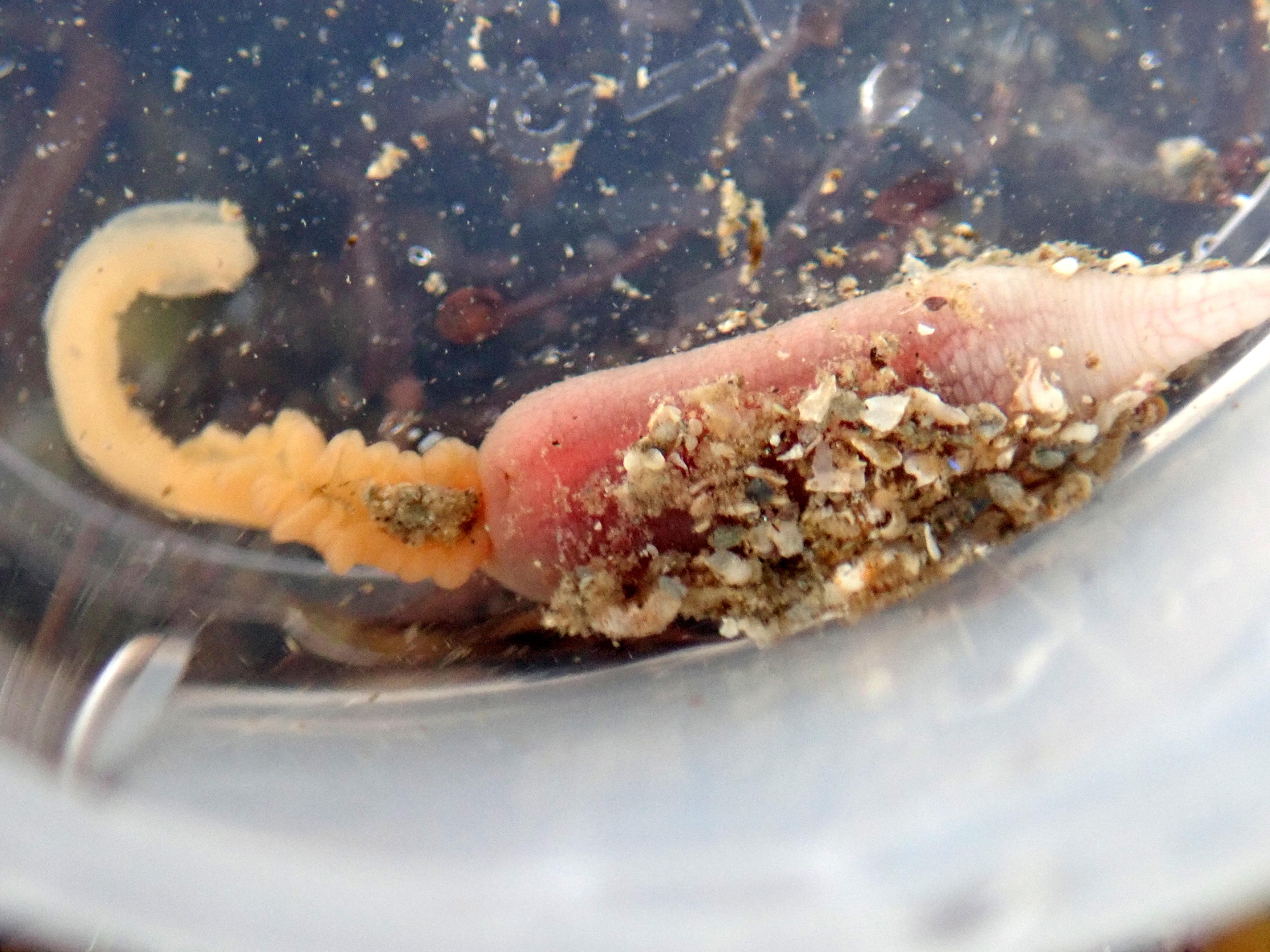
    Lurking inside the sediment-filled layers of a fractured rock, was a colony of Thalassema thalassema spoon worms. These wonderfully alien creatures have plump pink bodies like an overfed grubs, with an extendible, frilled proboscis.

    One of many contenders for the 'strangest animal in the rock pools' award - the echurian worm Thalassema thalassema
    One of many contenders for the ‘strangest animal in the rock pools’ award – the echiuran worm Thalassema thalassema

    Unlike many other marine worms that speed around on bristly legs or swim with paddles, Thalassema thalassema seems to have no efficient means of locomotion.  Instead, it rolls contentedly in the muddy sand, feeding on detritus.

    These worms alarm me with their indolence. I always suspect that, like most vulnerable-seeming marine animals, they must have some secret defence. Many worms have a impressive set of biting jaws, but despite my wariness this species is safe to handle. I think.

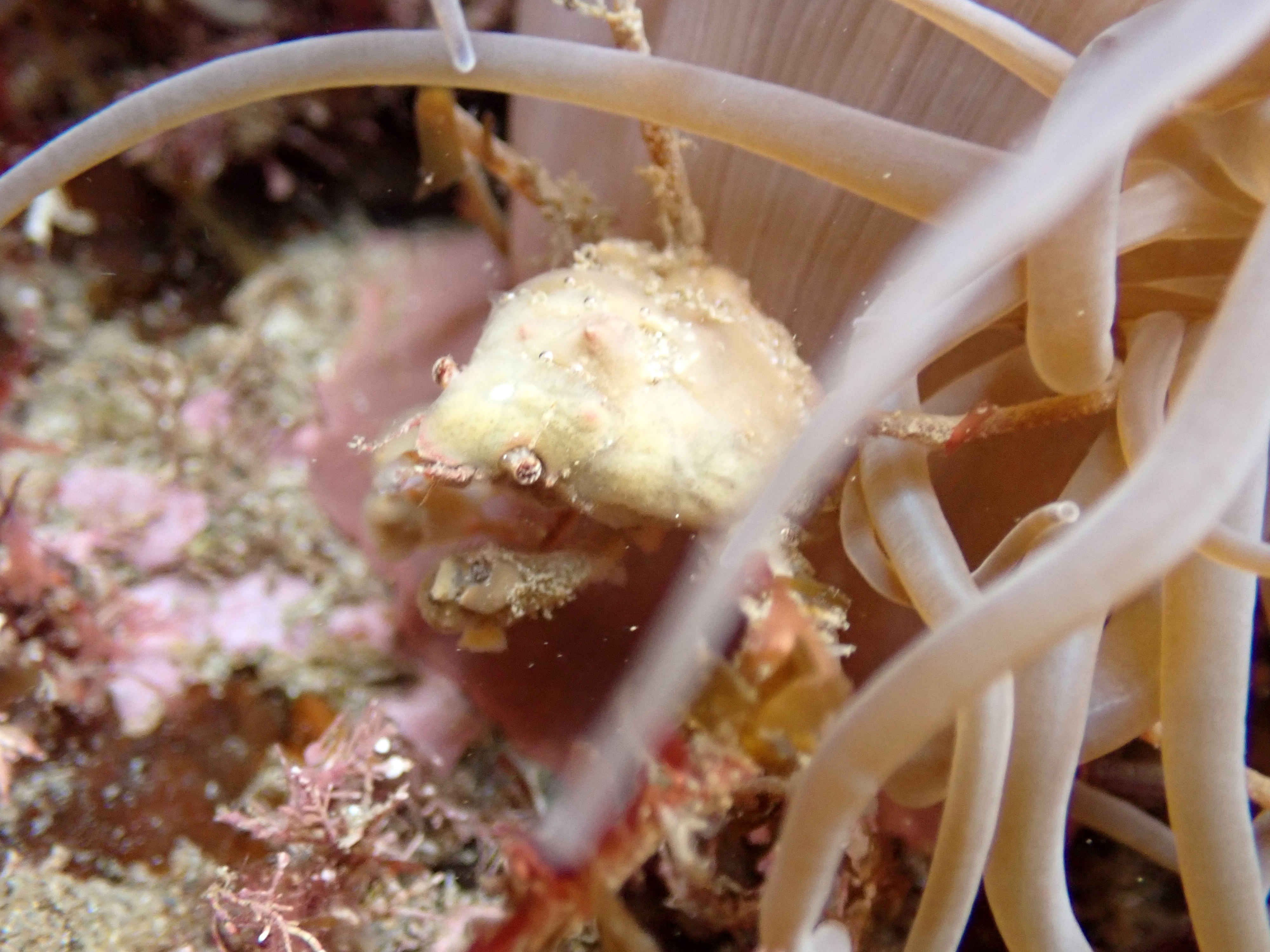
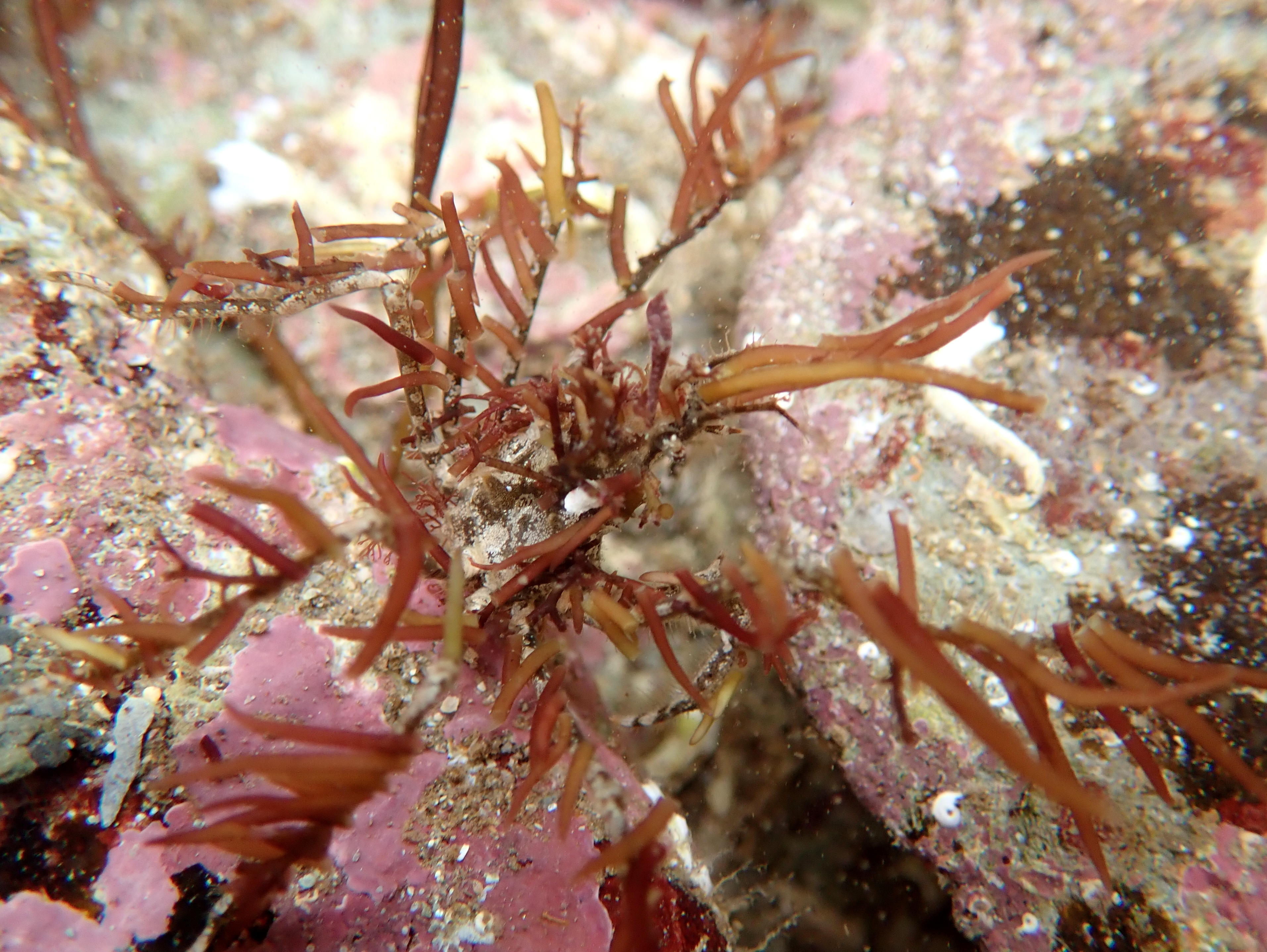
    Among the dense carpet of animal colonies, among them sponges, sea squirts, bryozoans and hydroids, we found a smart small species of spider crab, probably Macropodia sp. It was perfectly camouflaged to hide among the seaweeds.

    A perfectly decorated small spider crab (Macropodia sp.) at Hannafore
    A perfectly decorated small spider crab (Macropodia sp.) at Hannafore

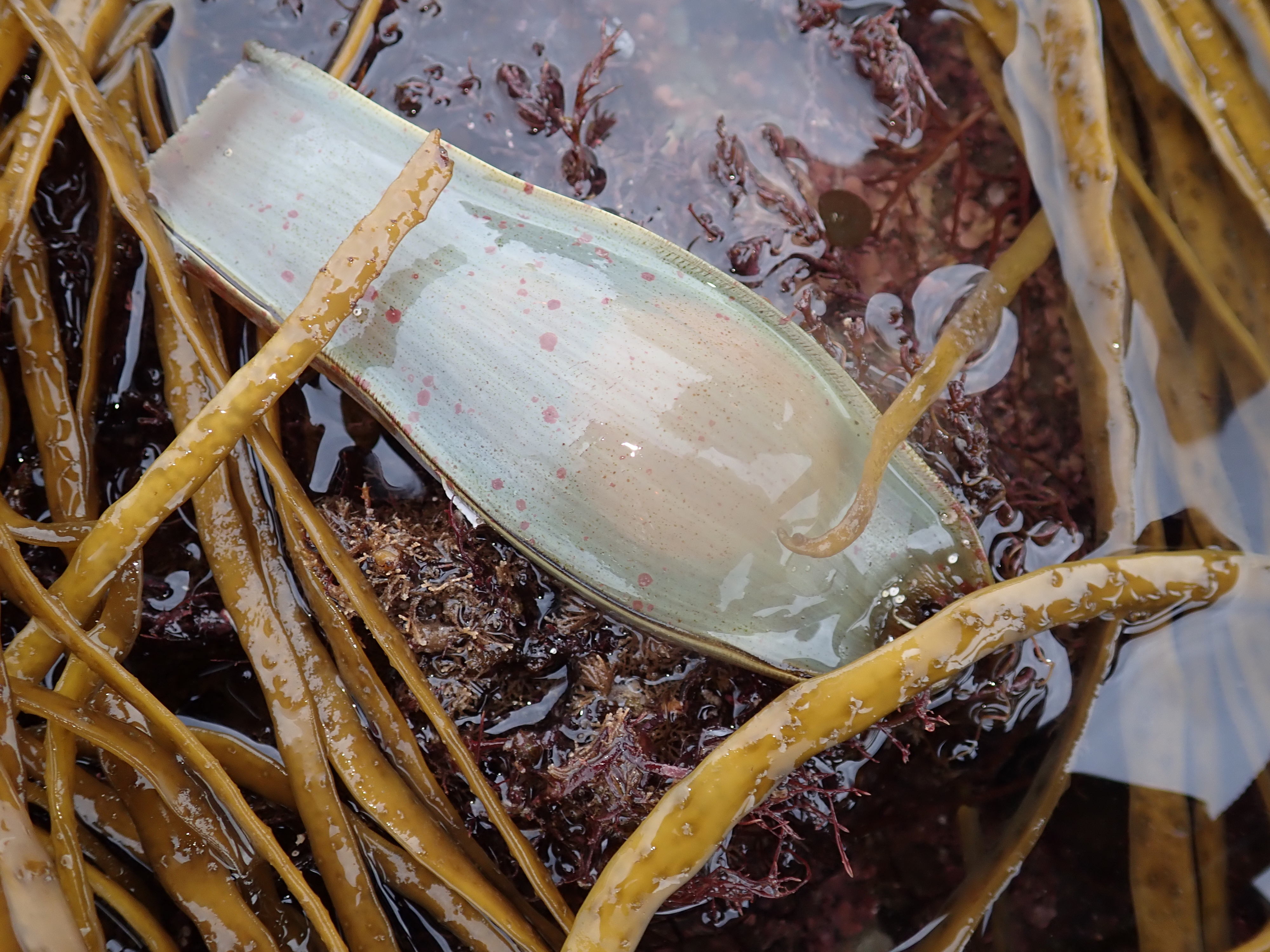
    Further out in the lagoon, near a seagrass bed, we found several egg cases of the greater spotted catshark, Scyliorhinus stellaris. In some we could see the fresh yolk, in others the baby was forming while some were already hatched and thickly encrusted with life.

    A fresh Greater spotted catshark (Scyliorhinus stellaris) egg case showing the yolk.
    A fresh Greater spotted catshark (Scyliorhinus stellaris) egg case showing the yolk.

    By the time we reached the rocky outcrop at the far side of the lagoon, the tide was at its lowest and we could only stay a few minutes.

    Inevitably, the finds rolled in just as the tide was turning. Junior was delighted with the yellow colour of this common brittle star, Ophiothrix fragilis, which is more usually pink in colour when we see it further up the shore.

    Junior's yellow brittle star
    Junior’s yellow brittle star

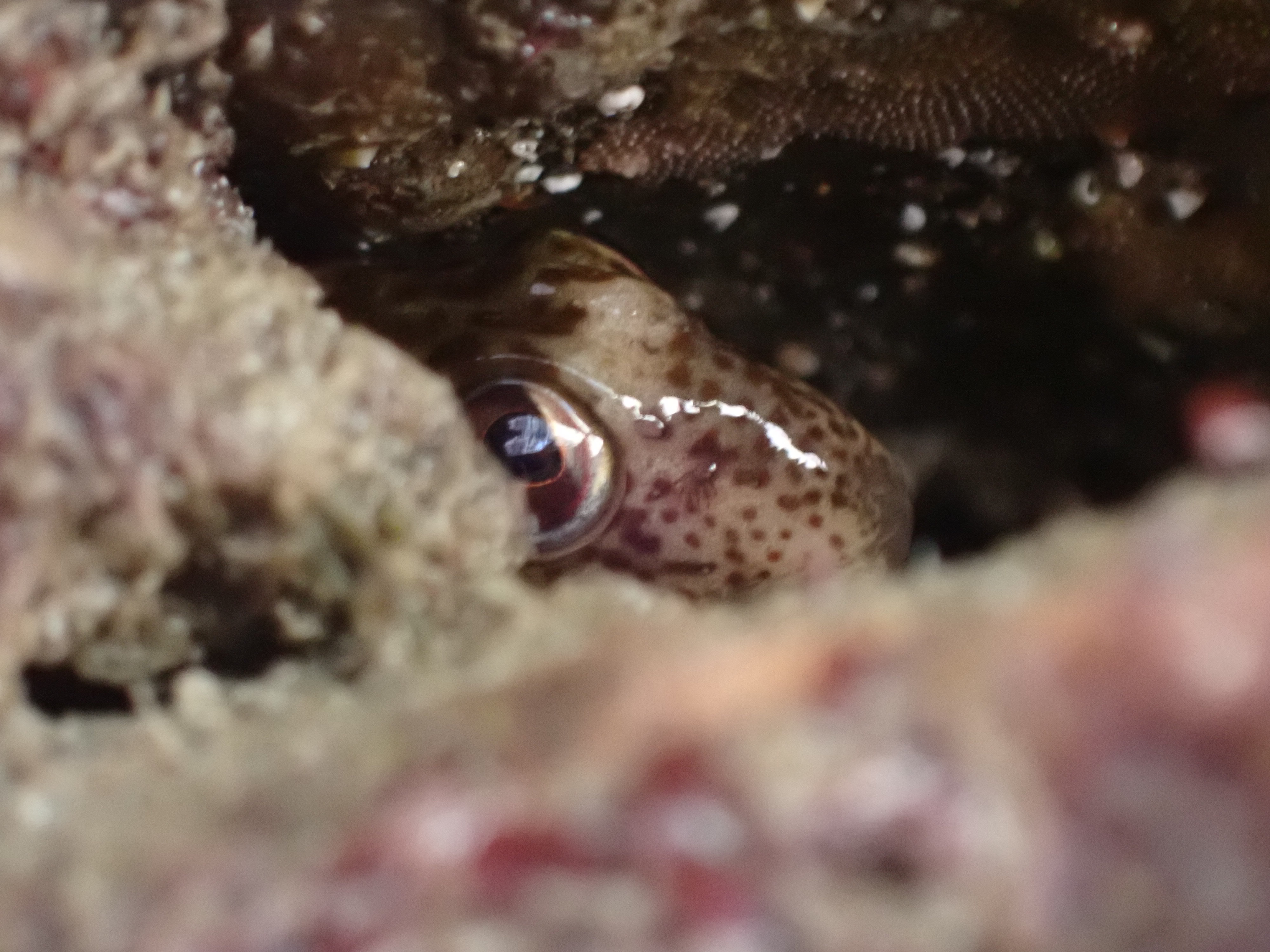
    Under one stone was a faint lattice pattern marking the spot where, earlier in the season, a clutch of clingfish eggs had been attached. Although they seemed to be long-since hatched, the site was still being watched by what was probably an anxious parent.

    Cornish clingfish - Lepadogaster purpurea, Looe.
    Cornish clingfish – Lepadogaster purpurea, Looe.

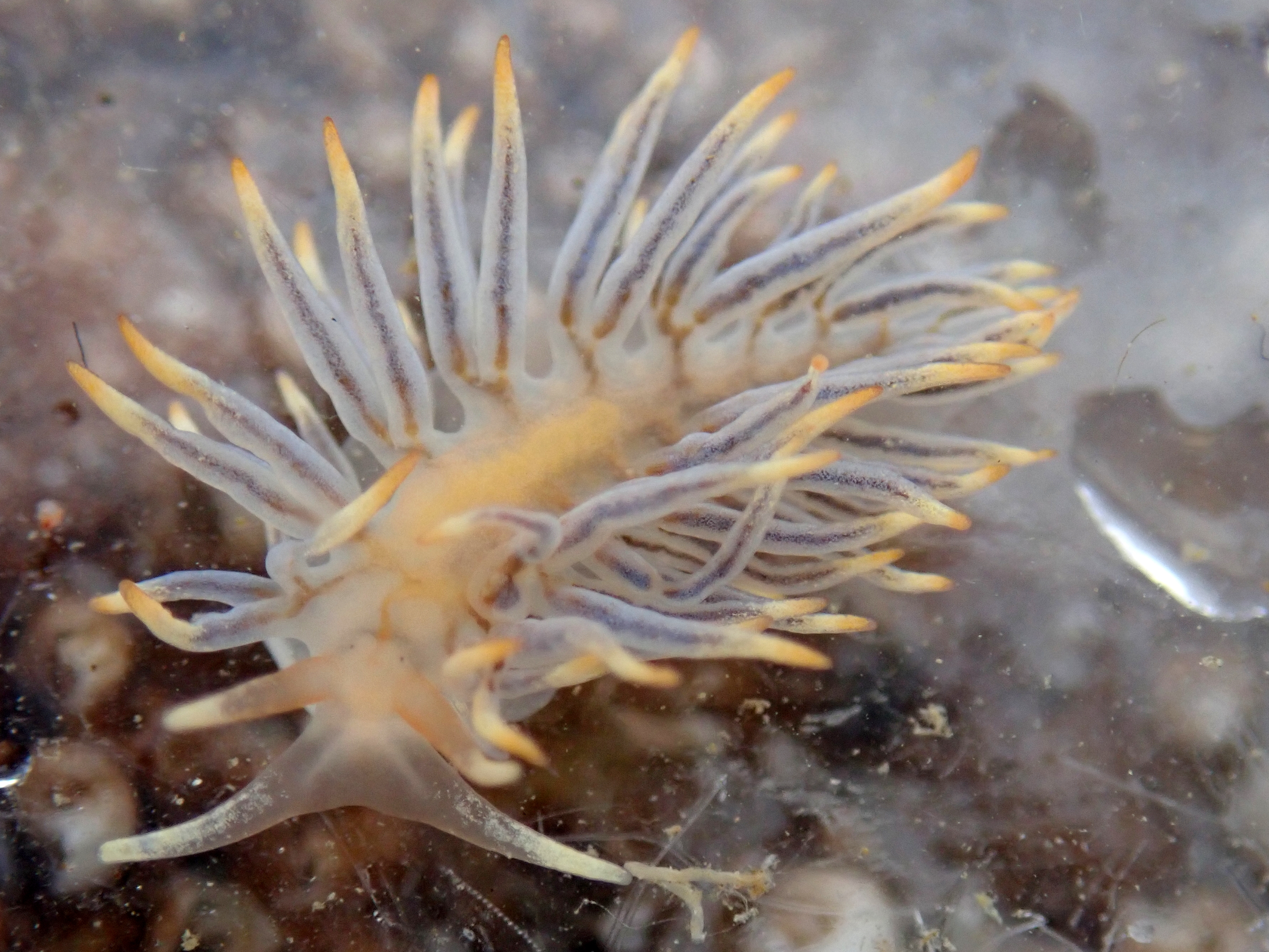
    A speck of blue on the rock concealed a good cause for any clingfish parent to be concerned: a Calma glaucoides sea slug. Despite the elegance of its long blue cerrata, flashing their golden tips as they waved in the water, this slug could well have destroyed the entire brood of eggs, which are its food.

    Calma glaucoides - a sea slug (nudibranch) that feeds on clingfish eggs.
    Calma glaucoides – a sea slug (nudibranch) that feeds on clingfish eggs.

    We could easily have knelt around the pool for longer, wondering at this tiny creature, but a change in the wind and a stirring of the kelp out towards the island meant that the race was on.

    We sploshed and slid our way back over hidden rocks and through tangled weed that grabbed at our ankles, watching the flow of water growing by the second as the powerful tide raced in. Behind us, the water was working fast to submerge the slugs, shark eggs, anemones and brittle stars, closing the door on the watery world.

    We made it back without over-topping our wellies; wishing, as always, that there was a little more time between the tides.

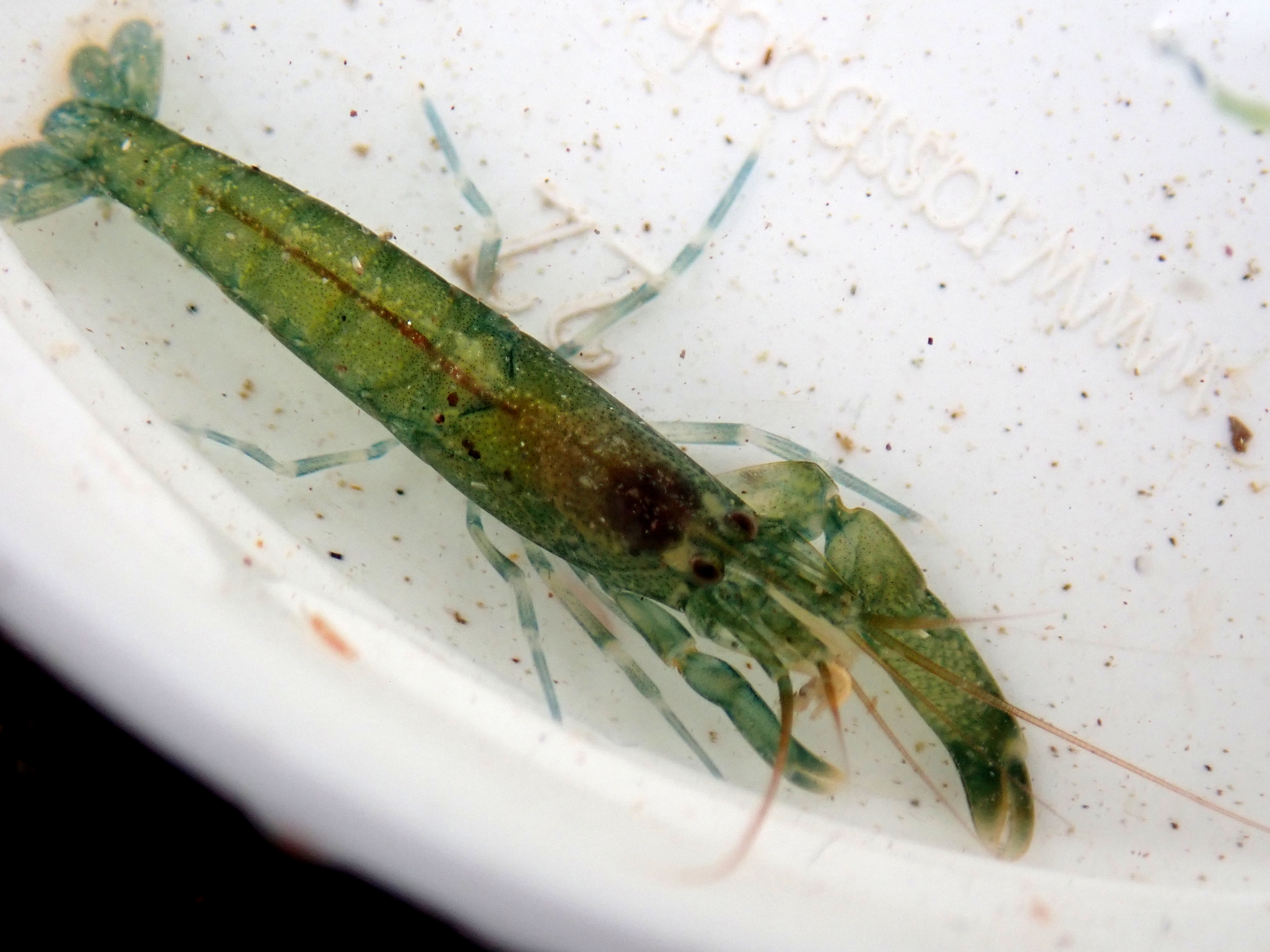
    On the way to the shore we found this vivid green prawn with a huge left claw - at first we thought it might be a snapping prawn, but it turned out to be an unusual colour variant of the more familiar hooded shrimp.
    On the way off the beachwe found this vivid green prawn with a huge left claw – an unusual colour variant of the more familiar hooded shrimp.


  • A Surprise Sea Slug

    A Surprise Sea Slug

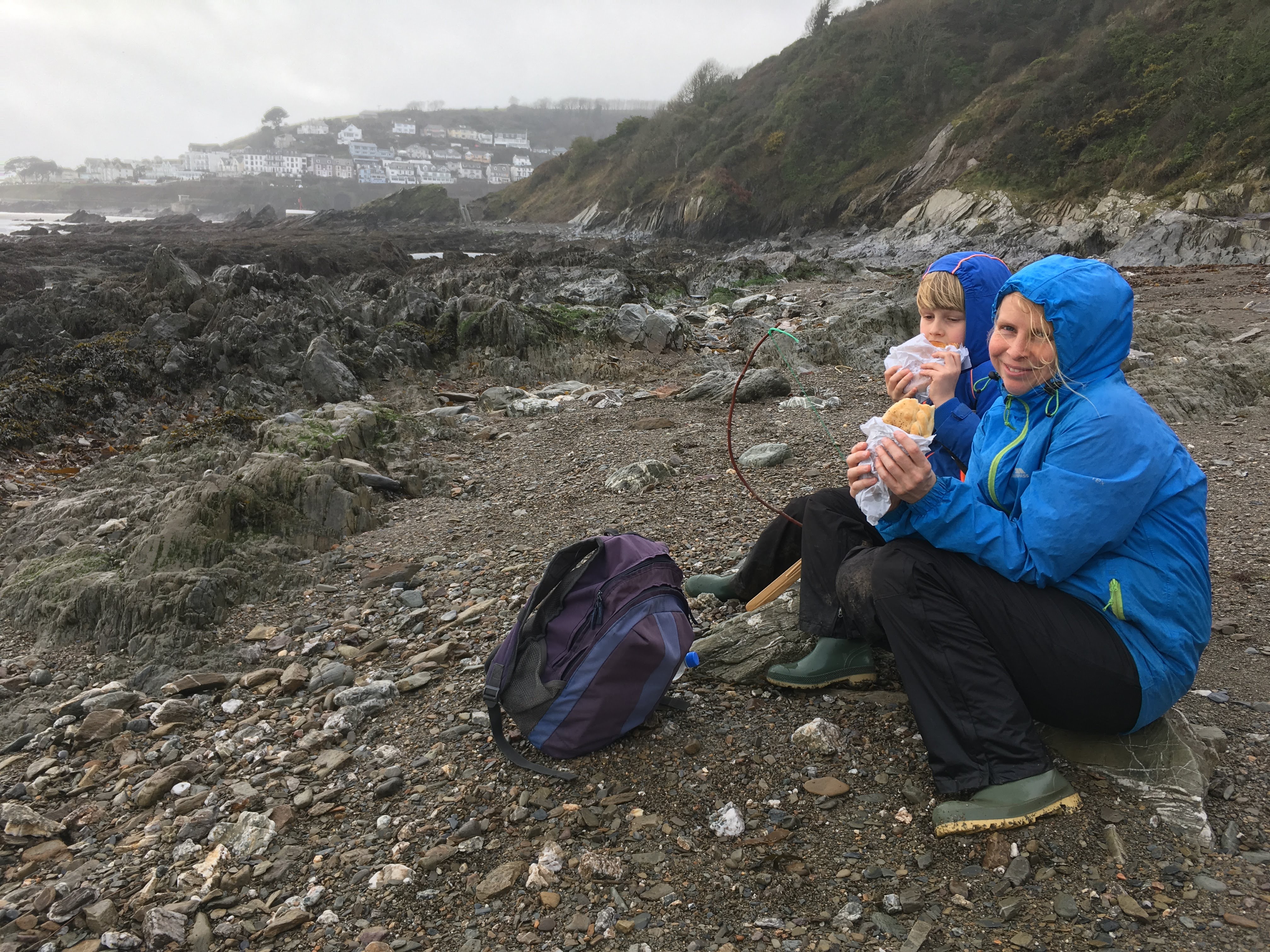
    Even my family look at me strangely when I suggest rock pooling in this weather. The Met Office reckons it’s going to turn out fine, but the wind is flinging water straight into our faces and the beach is deserted. We huddle down on some damp rocks and rush to eat our pasties before the rain turns the pastry soggy.

    “I wonder if people realise what you go through to put pretty pictures on your blog?” Other Half says.

    I nod, watching the waves crashing onto the shore and thinking that it’s worse than that. In these conditions I’m unlikely to find much, let alone manage pretty pictures.

    Fortunately, I’m wrong.

    Cornish Rock Pools in Looe - fuelled by rain-soaked pasties
    Cornish Rock Pools in Looe – fuelled by rain-soaked pasties

    After a quarter of an hour of staring into holes in the rock, taking lots of rain-blurred photos and a few passable ones of common crab and barnacles species, I’ve established that my waterproofs are anything but waterproof. If it’s possible, the rain is getting heavier.

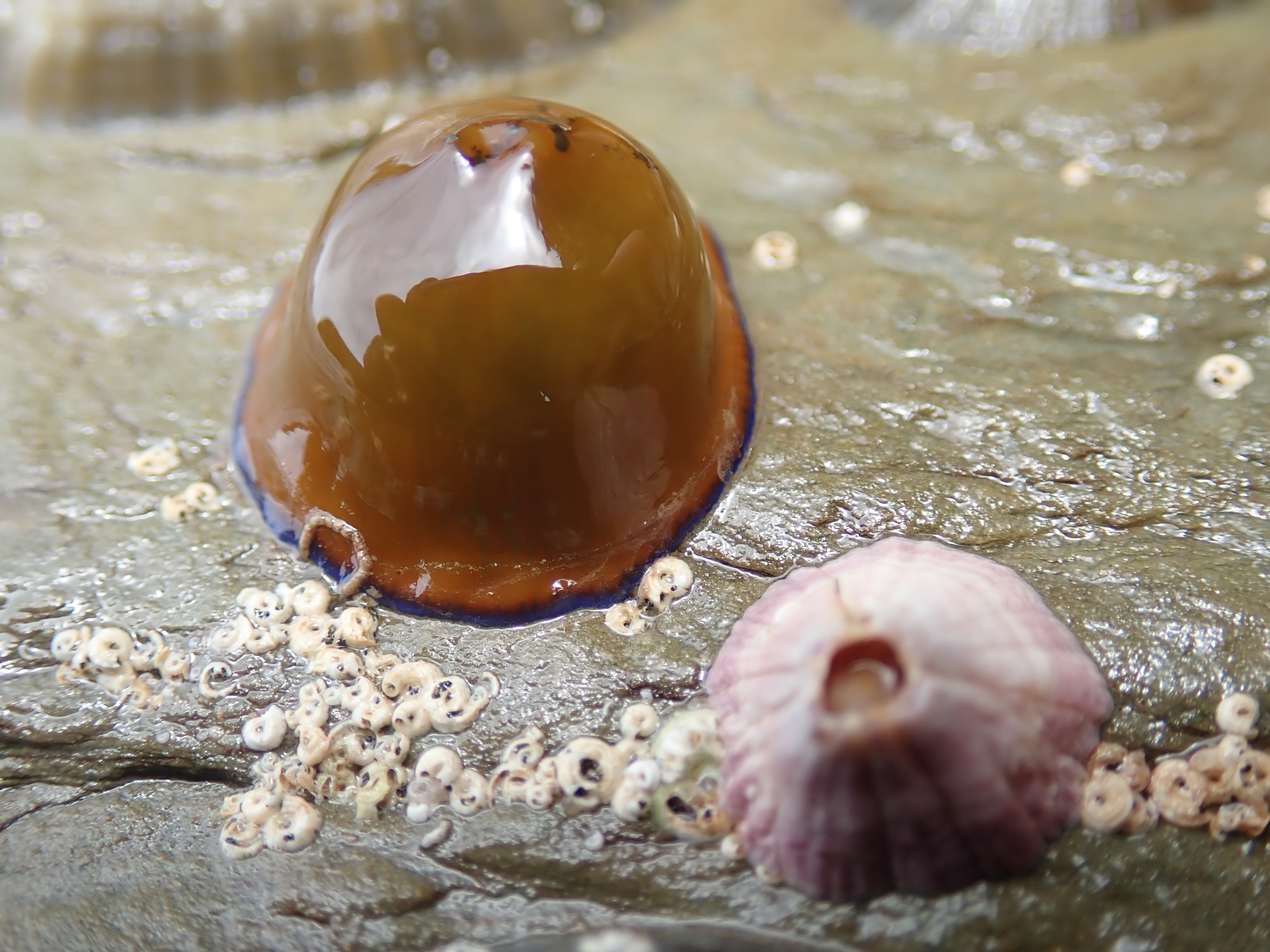
    Volcano barnacle
    Volcano barnacle

    Cornish Rock Pools Junior and his dad have wandered off and are probably reaching their tolerance limit. I find a stalked jellyfish and think that’s likely to be the most exciting find of the day.

    A stalked jellyfish (Calvadosia cruxmelitensis) in a pool
    A stalked jellyfish (Calvadosia cruxmelitensis) in a pool

    I lift the edge of one last stone. There are some thick yellow sponges and the rock is crusted over with bryozoans. Broad-clawed porcelain crabs are scuttling along and there are little banded chink shells. On the far side is a spot, maybe half a centimetre across. It’s hard to make it out, but it has a blue-ish tinge and a lined appearance, like an anemone out of the water.

    I think it’s a sea slug, but it’s far too delicate to pick off the rock and even if I do there’s nowhere to put it. I need to see it in water otherwise it’s just a blob of jelly. There’s no chance of that here at the base of the gully where the waves are pounding in, so I heave the boulder up the shore and lower the side with the slug into the nearest pool.

    Facelina auriculata sea slug unfurls its tentacles and cerrata in the water.
    Facelina auriculata sea slug unfurls its tentacles and cerata in the water.

    Shelter’s hard to come by. The surface of the pool distorts with every gust of wind and the rain goes up the back of my coat and into my ears as I lean over to hold the rock in position. Straight away, I know this is definitely a sea slug. In the water, its cerata pop up all over its back and long tentacles and rhinophores unfurl around its head.

    This is the sort of colourful, beautiful slug that I’m always hoping to find and only rarely do. Under the camera it has striking red lines and markings up its cerata, white stripes down its head and an iridescent blue sheen that changes as it moves.

    Facelina auriculata - the red patch behind its head is the oesophagus
    Facelina auriculata – the red patch behind its head is the oesophagus

    This is a new slug to me and I can’t wait to look it up when I get home to check the exact species. In the meantime, I take as many photos as I can before hauling the rock back to the same spot where I found it. That done, I rush up the beach to tell my Other Half, Cornish Rock Pools Junior and everyone else I see that day about how amazing my sea slug was.

    Facelina auriculata sea slug - from different angles the colours seem to change.
    Facelina auriculata sea slug – from different angles the colours seem to change.

    Thanks to my pile of identification books and the quick responses of the hugely knowledgeable members of the NE Atlantic Nudibranchs forum on Facebook, I soon have it confirmed as Facelina auriculata (previously known as Facelina coronata).

    This slug is found around many coasts of the UK, and is meant to feed on hydroids, although I didn’t see many in the vicinity of this one. I’m very lucky to find it intertidally on such an average tide.

    If you think rock pooling isn’t a normal sort of thing to do in January, I can understand that. You’re probably right and I think my family would agree with you, but you never know what’s going to turn up next in the Cornish Rock Pools.

    Sometimes it’s worth braving the horizontal rain just in case.

    See - it's lovely out there! Looe rock pooling in January.
    See – it’s lovely out there! Looe rock pooling in January.

    A Xantho pilipes crab - they vary in colour but always have hairy back legs.
    A Xantho pilipes crab – they vary in colour but always have hairy back legs.

    And did I mention I found a sea slug? So excited...
    And did I mention I found a sea slug? So excited…

  • A predator among the fish eggs: Calma gobioophaga sea slug

    A predator among the fish eggs: Calma gobioophaga sea slug

    If you read this blog regularly, you’ve probably noticed a pattern: I bimble about the Cornish rock pools looking for an exciting creature, fail completely, then find something unexpected. Well, hopefully you like the format because this week is no exception. I go on a quest to find fish eggs and discover this rare sea slug.

    (more…)

  • A guided rockpooling tour

    A guided rockpooling tour

    We all love spending time with likeminded people, don’t we? So, when a keen diver from Newquay contacts me to request a guided rockpooling tour, I can’t resist. Unusually for a bank holiday weekend, the sun pushes the clouds away and leaves behind a perfect, calm shore ready for us to explore.

    We’ve barely known each other a minute before we’re enthusing about the joys of going slowly and taking the time to look for underwater life. We discover our shared love of nudibranchs (sea slugs – read on, they’re lovely, really!). I assure my new friend that we’ll find plenty of wildlife, including some species few divers ever see, and all with minimum kit, no buoyancy control and a limitless supply of air.

    The underside of a painted top shell showing the mother-of-pearl lining
    The underside of a painted top shell showing the mother-of-pearl lining

    Despite being familiar with edible crabs and velvet swimming crabs from diving, there are several species of intertidal crabs that are new to my guest. (more…)