Our home educating days are coming to an end as Junior prepares to try out life at college. With this momentous change approaching, this year has been all about cramming in local, national and international adventures and travels to make the most of this precious time. Our visits to the rock pools – and my posts about them – may have been less frequent than usual in recent months, but it will not surprise you that we have still packed beach trips in between our travels and I have amassed lots of fabulous finds to share with you.
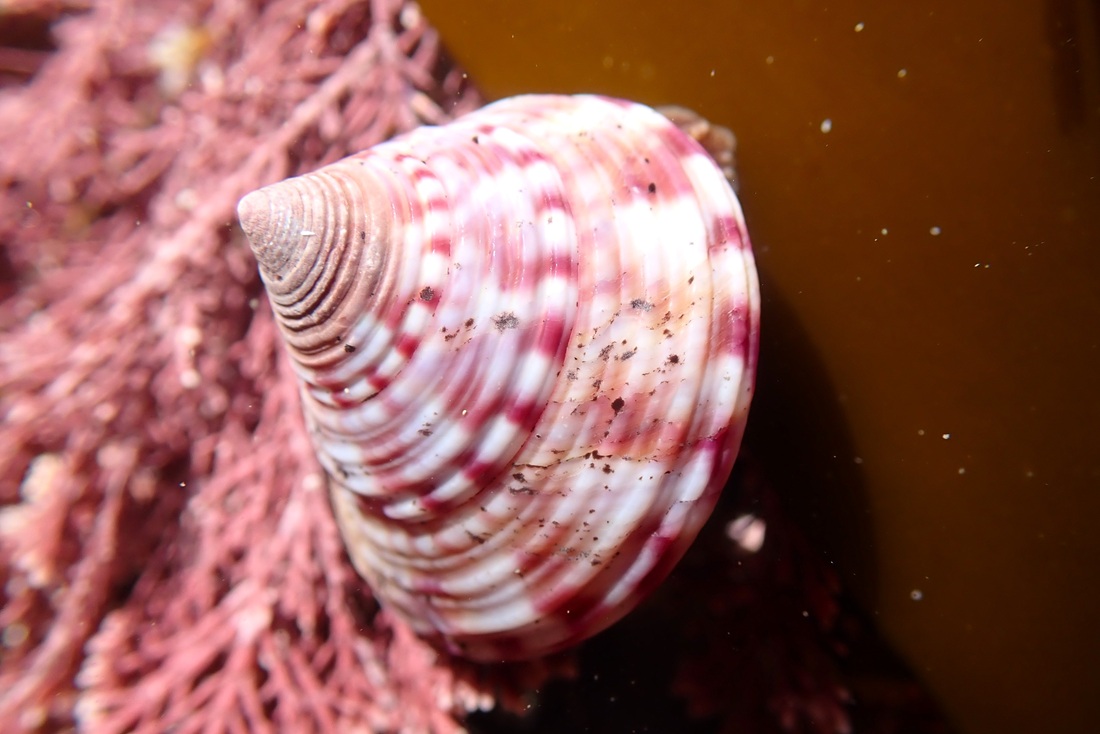
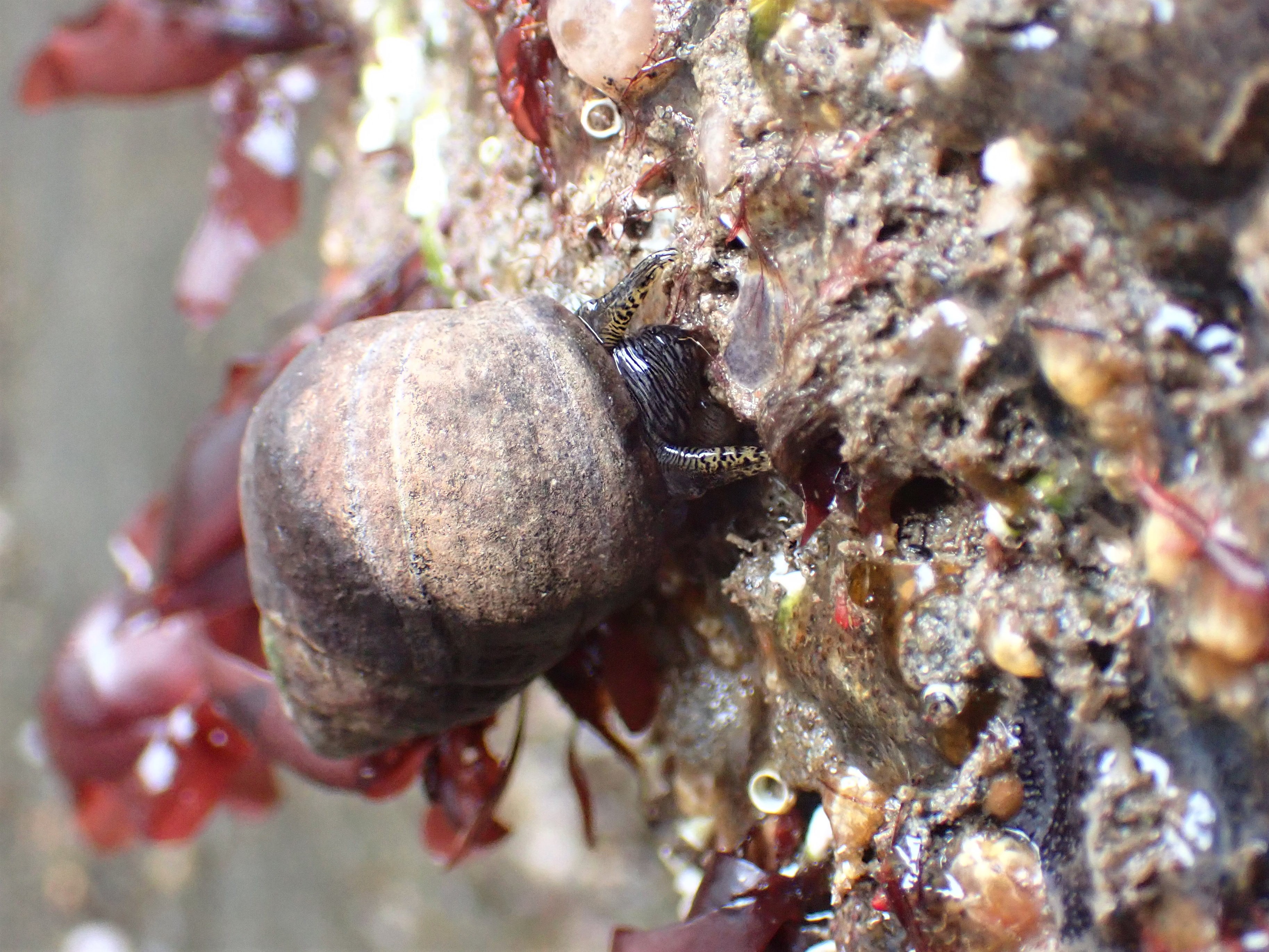
Painted topshell at Porth Mear – the colours at this beach are always especially vivid.
This trip back to my favourite childhood rock pooling beach at Porth Mear with Junior and Other Half was a reminder of what makes this place so special.
There’s a hint of blue sky and the waves are only breaking around the edges of the rocky islands offshore, rather than bursting over the top as they so often do. With the tide set to fall to a low of less than 0.1m, this is set to be a perfect day.
In my happy rock pooling world, there is nothing more auspicious than finding a nudibranch sea slug in the very first place I look. Admittedly, I know this pool well and have good reason to hope, but this very tiny, citrus-yellow Doris ocelligera is the happiest omen. With its rhinophores held tall and proud, it is such a lemon-burst of joy that I spend many minutes crouched by the water watching it through my camera.
Doris c.f. ocelligera – a small sea slug, which feeds on sponges. On its favourite sponges, it is perfectly camouflaged, but against the rock it it strikingly bright yellow.
Since I have lived on the south coast of Cornwall, I have come to appreciate how wonderfully clear and un-silty the water is here on the north coast. Whether it is down to this transparency that allows more light through or something else about the conditions, the colours of the shells and anemones often appear more vivid here.
An open strawberry anemone at Porth Mear.
Strawberry anemones, which are bigger than beadlets, are especially photogenic whether they are open or closed. The pale red tentacles catch the sun beautifully, but the yellow flecks on the shiny red columns are also stunning.
As I move down the shore, I come across some less commonly seen species, including some that are harder to idenitfy.
This anemone is well hidden under an overhang and completely closed up, showing just the tips of white tentacles. The translucent column with pale stripes, but no suckers, suggests that it could be a sandaled anemone (Actinothoe sphydodeta). In my photos, you can see that the column is packed with curly white threads. These are the acontia and are packed with stinging cells. If something attacks the anemone, it can eject large numbers of these in defence.
This anemone was less than 2cm across and well hidden in a dark gulley. I think it is a sandaled anemone.
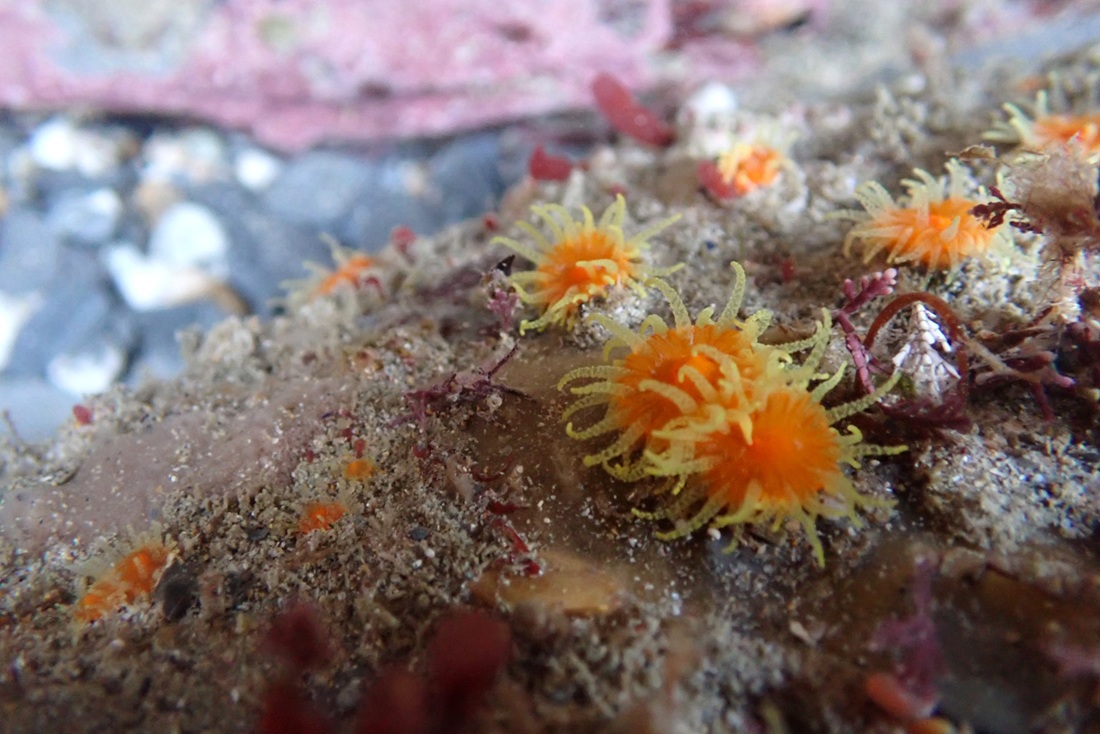
Nearby, the population of scarlet and gold cup corals is looking radiant. They live on the lower shore in areas of very high current and wave action, so most days they are completely inaccessible. Even on a relatively calm day like today, I keep nervously glancing up at the rocks behind me, expecting the waves to break over the top.
Scarlet and gold cup corals.
In another pool, I come across an even more mysterious anemone. It is hugely extended, like a long worm, when I first see it. I am amazed at how transparent it is, its organs clearly visible inside. It quickly retracts into a squat blob, with a few pale yellow striped tentacles. It has nothing stuck to the column and no obvious coloured spots, but there are some brown markings around the base of the tentacles in the disc. There are a few possibilities, but I will need to consult experts to see if anyone can narrow this one down.
An anemone yet to be identified (centre). The same anemone as above – with the column retracted, showing its stripy tentacles.
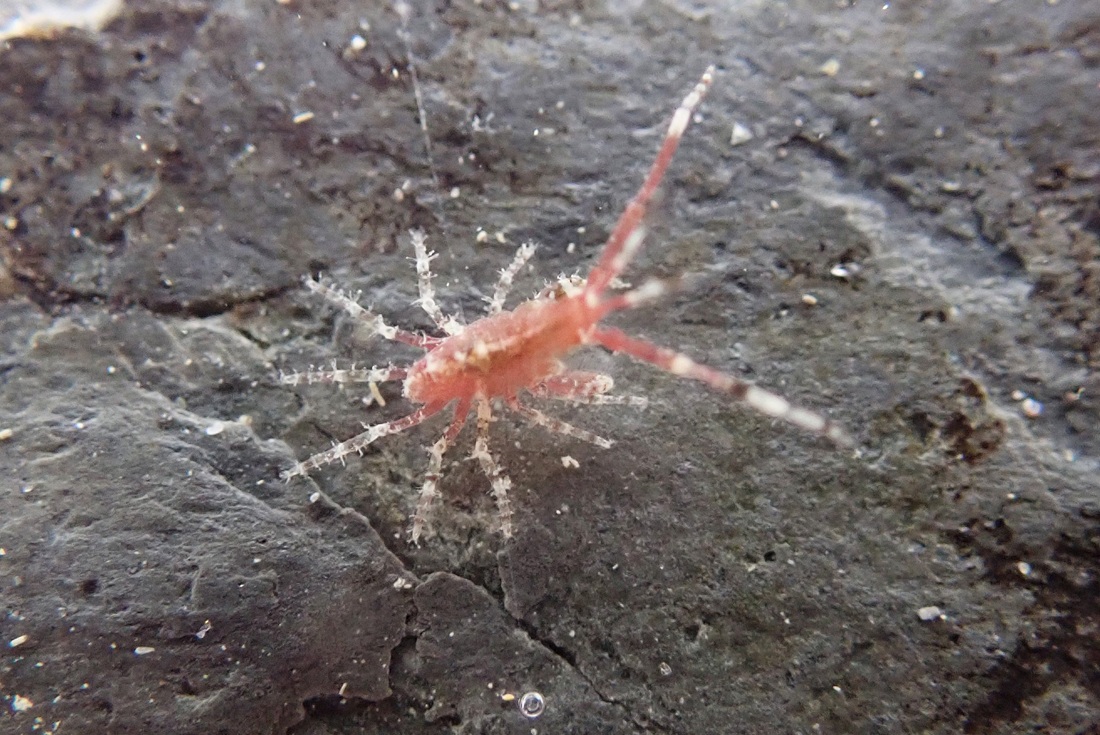
Another pool, another mystery creature. This time, a minute crustacean is making its way across a stone at the base of the pool. It is almost impossible to make out anything except the bright pink colour and the long antennae with the naked eye, but under my camera, I can see it has fabulously hairy legs.
A new (to me) amphipod sp. … possibly Podocerus variegatus. Another one to check!
These animals are often only identifiable under a microscope and are tricky even then… so I take a few photos and carry on enjoying the shore, sharing finds with Junior.
I am nearly fainting with hunger before I realise I haven’t had lunch yet. Other Half and Junior have long since had their picnic, but I keep going with the tide stalking me as I move up the shore. After all, there are more sea slugs to be found, along with hairy crabs, St Piran’s hermit crabs and plenty of colourful variants of other common rockpool creatures.
Take a look at all the slugs we see!
Aeolidiella alderi – the white ruffed sea slug
Berthella plumula group
Elysia viridis – the solar powered sea slug
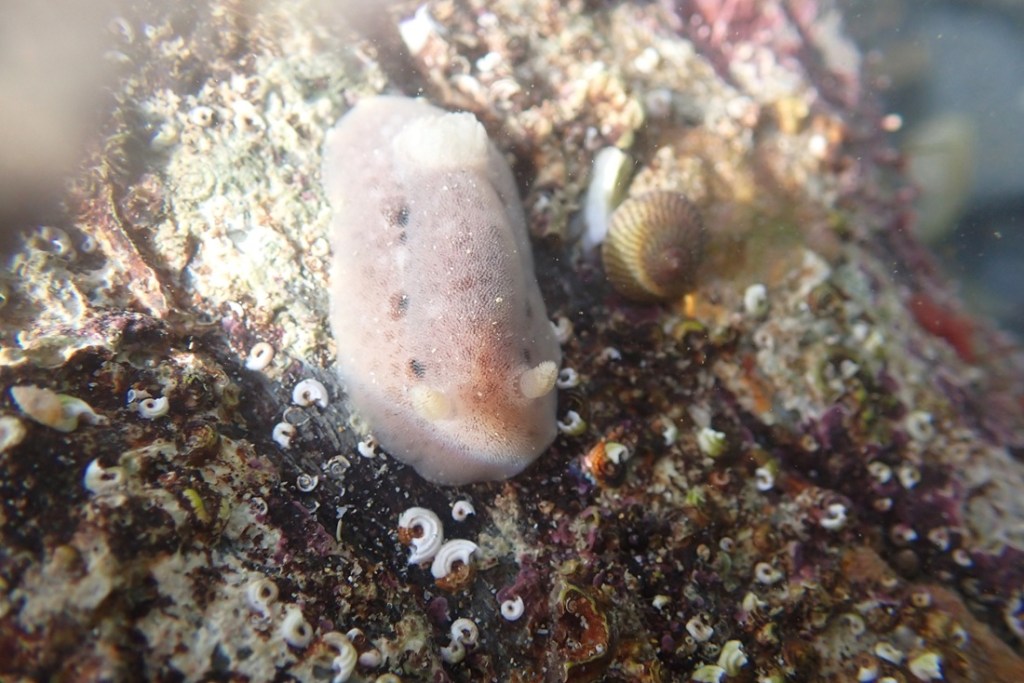
Geitodoris planata
Geitodoris planata saying hello to a Berthella plumula
Aeolidia filomenae
Jorunna tomentosa – looking lovely and fluffy
Limacia clavigera – the yellow clubbed sea slug
A hairy crab showing off some smart hair tufts on its shell and legs.
As a family, we have always spent time together on this beach, yet there are still new things to discover. Junior may be growing up, but I hope that we will often return here, to these familiar pools and to the springy-turfed paths of the wild cliffs that always feel like home.
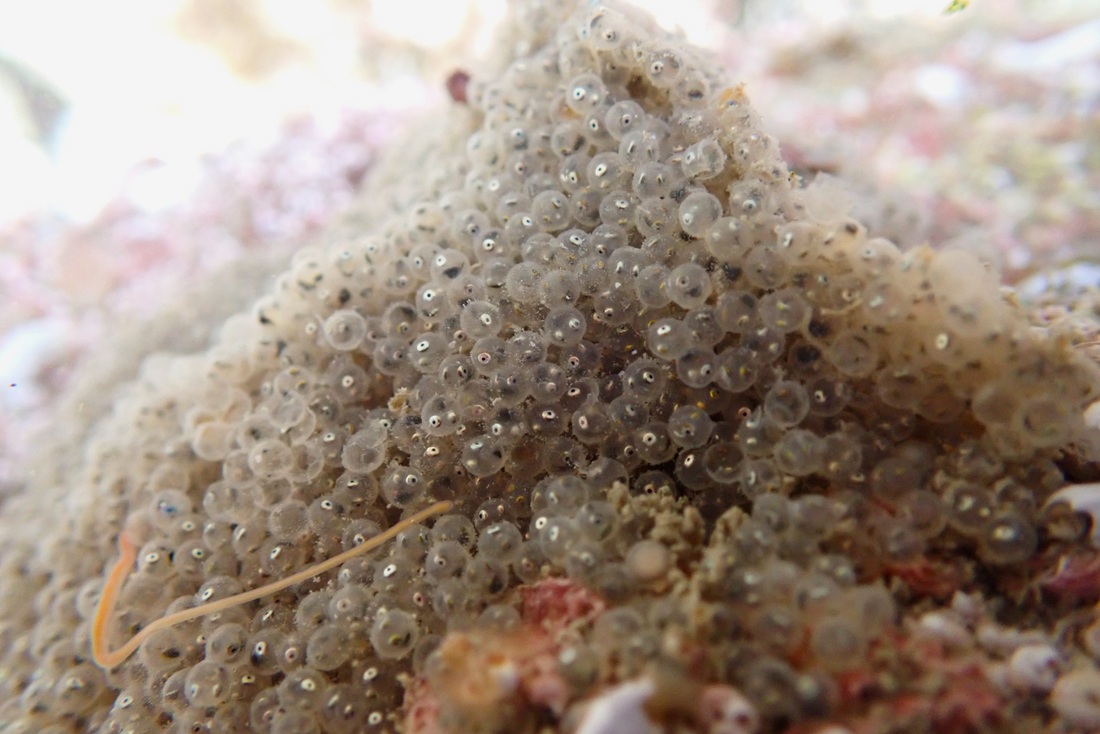
An impressive pyramid of long-spined sea scorpion fish eggs that are close to hatching (these fish lay their eggs early in the year).A very white colony of star ascidian sea squirts – with an invasive non-native red-ripple bryozoan colony on the left.Asterina phylactica cushion starfish.
It’s not exactly tropical, but we’re as far south as you can go on the UK mainland. The sun is shining and the clear water gives us a perfect view into the pools. After a morning of geological exploration at Kynance Cove, my family are treating me to some low tide rock pooling here at Lizard Point.
Rock pools at Lizard Point
Apart from the chatter of seabirds and a distant hum of voices from the cafés perched on the cliffs, the beach is still, expectantly waiting for the tide to turn. Out in the bay, a bull grey seal rests upright in the water. He is ‘bottling’, his broad snout raised to the sun, keeping half a sleepy eye on the female that is snoozing closer to the shore. There are no boats here to disturb the seals, so they nap peacefully on and on, barely moving with the gentle rise of the swell.
The colours in the pools are as vivid as a royal procession. Neon green snakelocks anemones jostle for space with dusky pink coralline algae, yellow sea squirts and iridescent blue seaweed. Tiny rainbows play across the rocks.
A colourful pool at Lizard Point – Snakelocks anemone
Looking closer, we begin to notice other rock pool wildlife that is less keen to stand out, adopting the same bold colours as the seaweeds and encrusting animals to hide from predators. Tiny Elysia viridissea slugs are everywhere, but they match the deep green of the codium seaweed perfectly.
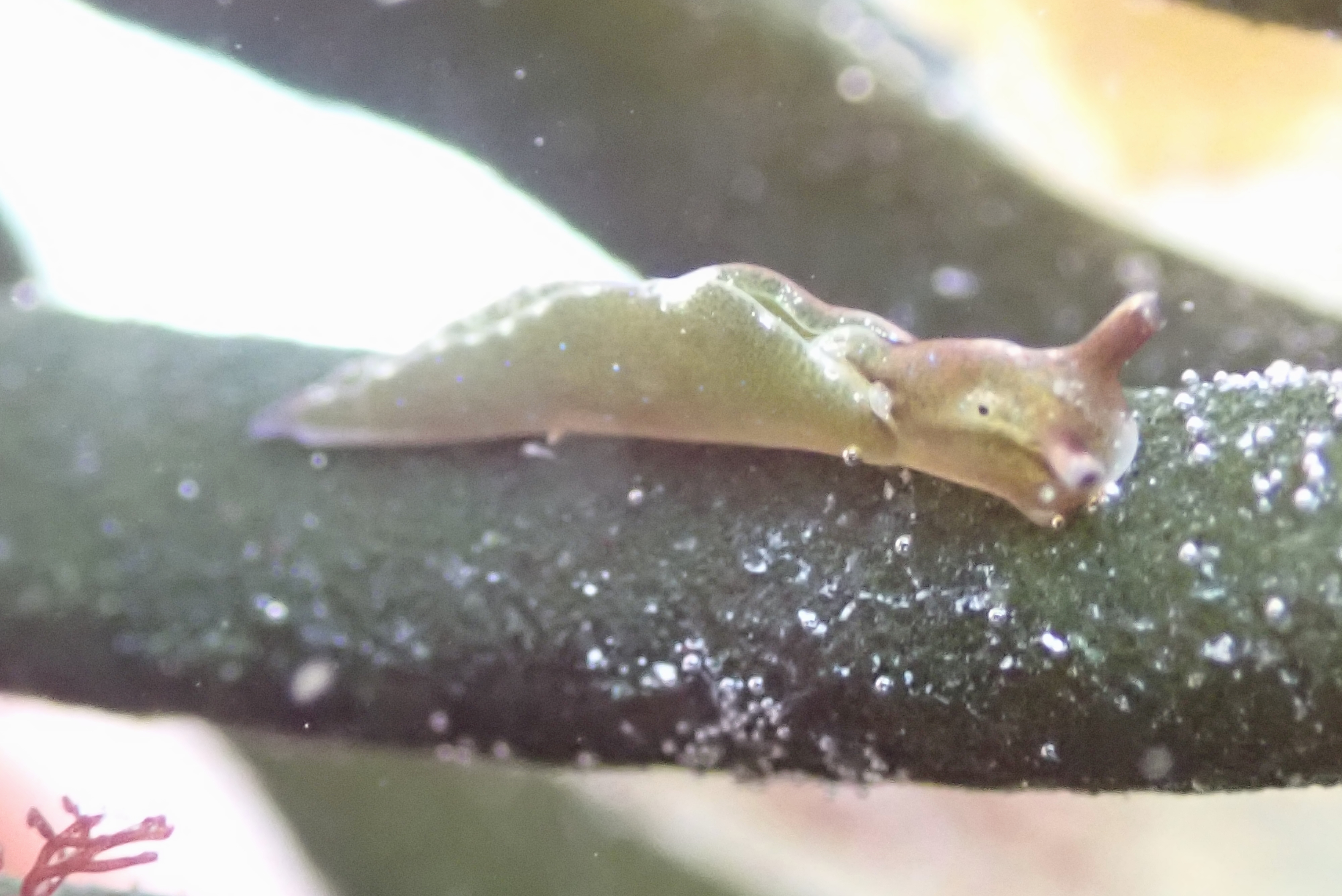
Elysia viridis on codium seaweed.
These are the ‘solar powered’ sea slugs. They retain the seaweed’s chloroplasts, which carry on photosynthesizing in their bodies, making glucose to supplement the slugs’ diet.
Elysia viridis sea slug stretching out to make the most of the sunlight. Spot the second slug!
A variety of animals are resplendent in shocking pinks and oranges, which allow them to disappear among rocks adorned in pink paint seaweed and forests of other red seaweeds. A European 3-spot cowrie (Trivia monacha) is roaming the rocks looking for sea squirts to eat.
Trivia monacha – the European 3-spot cowrie at Lizard Point. It feeds on sea squirts like the blue star ascidian to the left of the photo.
With its sunset-orange proboscis fully extended and its spotty mantle draped over most of its shell like a (fake) fur cape, it has the air of a glamorous Dalek.
European 3-spot cowrie (Trivia monacha) doing a Dalek impression
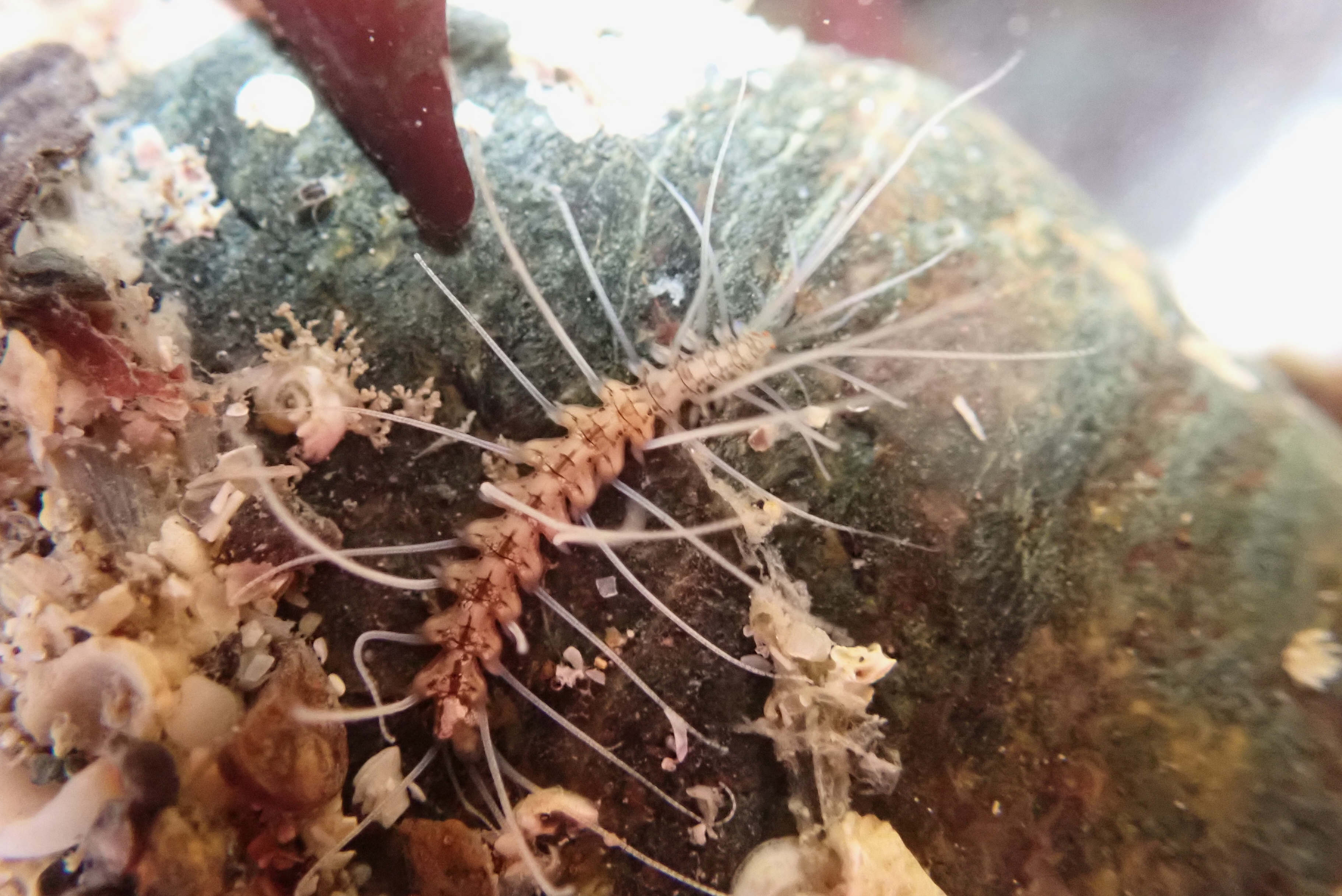
Not to be outdone by the molluscs, there are some stunning worms in the pools. My favourite is this syllid worm, gliding across the rock with its enormously long, whisker-like appendages stretching and curling in all directions at once.
Syllid worm. Amblyosyllis sp. looking spectacular. Lizard Point, Cornwall.
This feels like a spot that sea slugs should like. There is a variety of food on offer and no shortage of hiding places among the pools and boulders. Sure enough, under one rock I find two species hanging out together. They look like friends, but they are on separate missions. The great grey sea slug (Aeolidia filomenae) feeds on anemones, while the Berthella plumula – or feathered Bertha as I like to call it – eats sea squirts or sponges.
A quick hello in passing – Great grey sea slug (Aeolidia filomenae) and Berthella plumula sea slugs.
Junior, who excels at gathering people to look at things, has collected up an excited young boy and his grandfather to show them the pools. We all find things to show them – solar powered sea slugs, hermit crabs and a stalked jellyfish. While Junior is explaining barnacles to his fascinated audience, I wander down the shore, thinking I might find a starfish for him to show his new friend.
Stalked jellyfish (Haliclystus octoradiatus) on codium seaweed at Lizard, Cornwall. Photo by Cornish Rock Pools Junior
Sheltering under a small stone is a neat five-armed cushion star, but close to it, even more excitingly, there is a slender little Aeolidiella sp. sea slug.
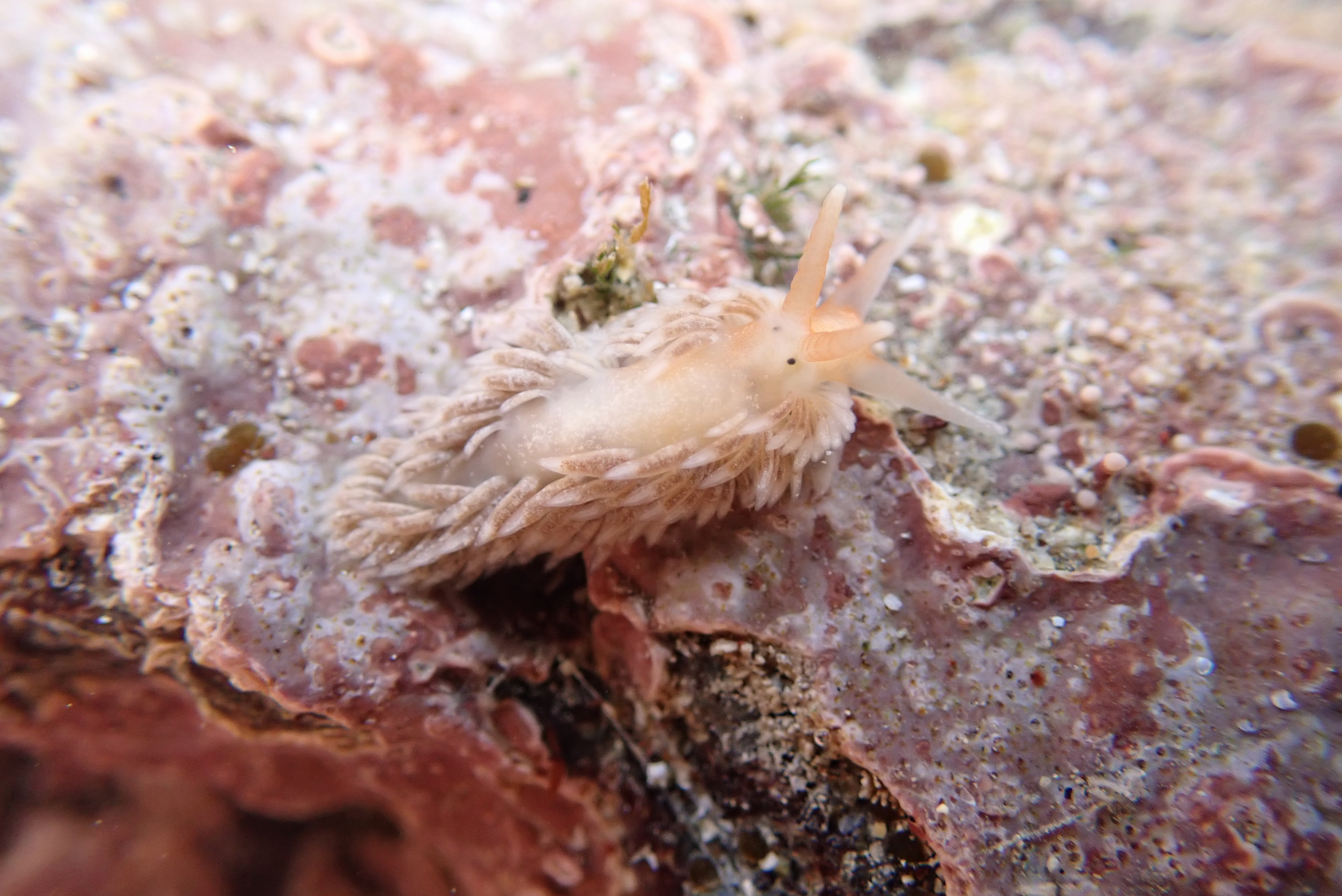
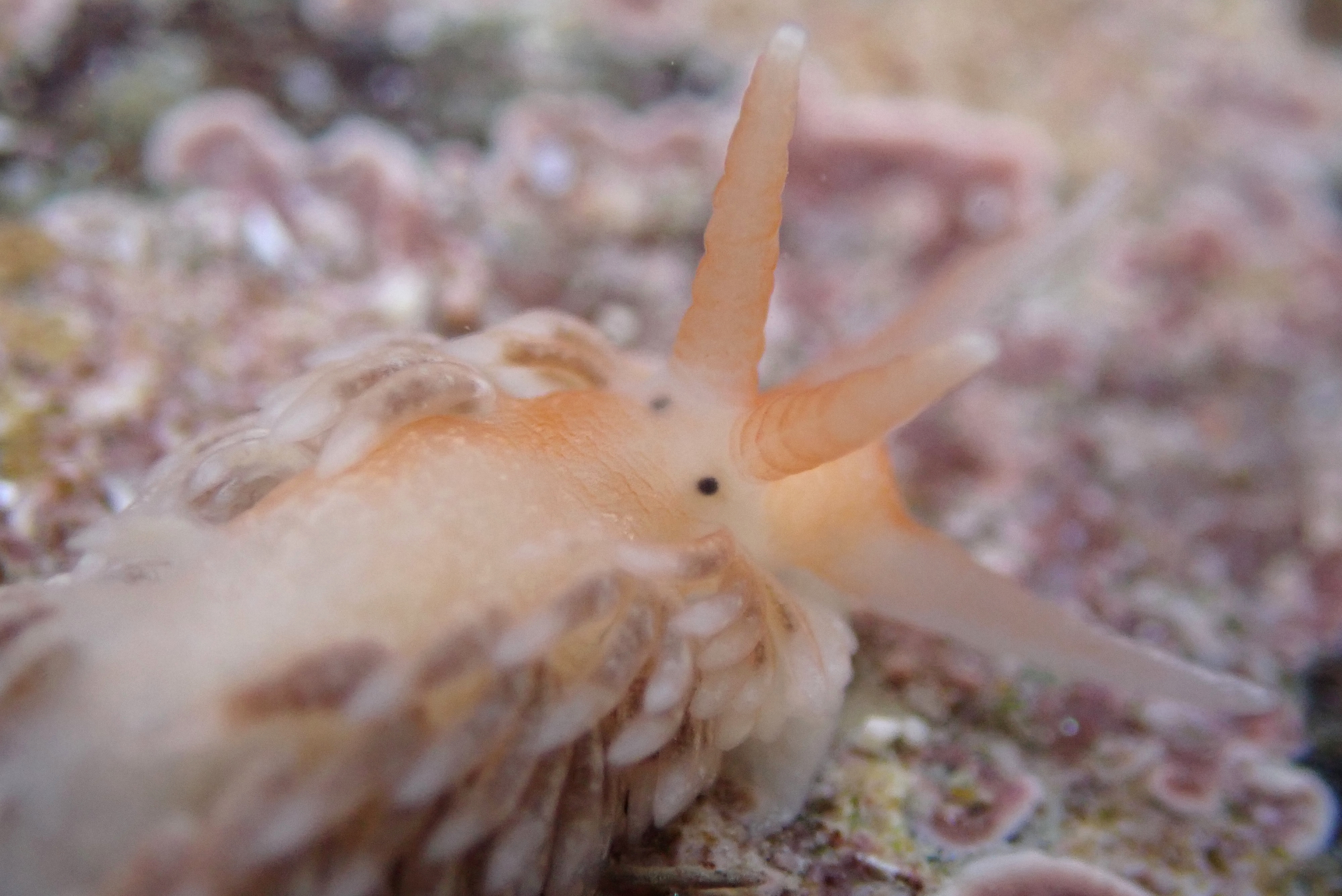
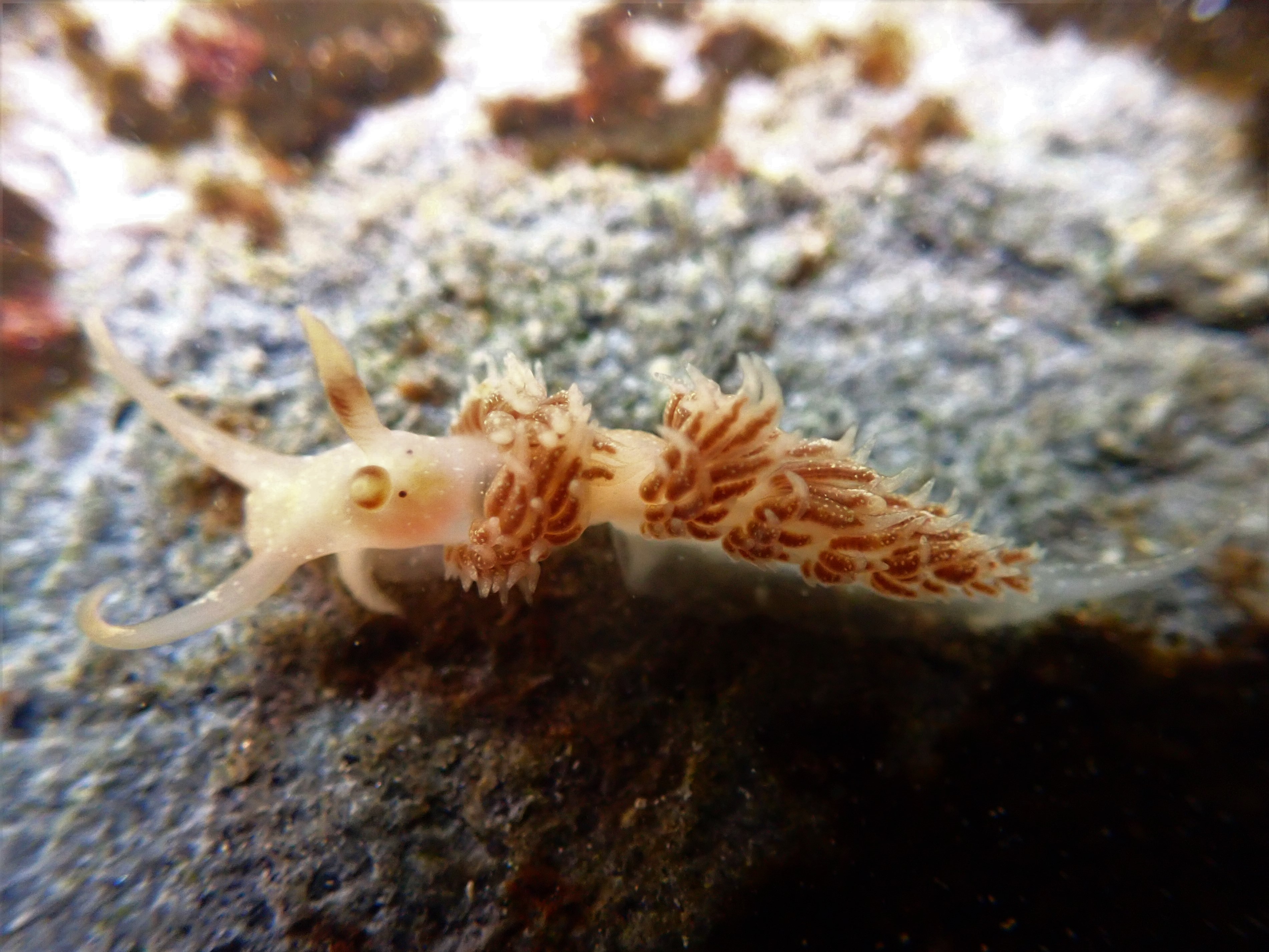
This slug looked a little different: Aeolidiella glauca
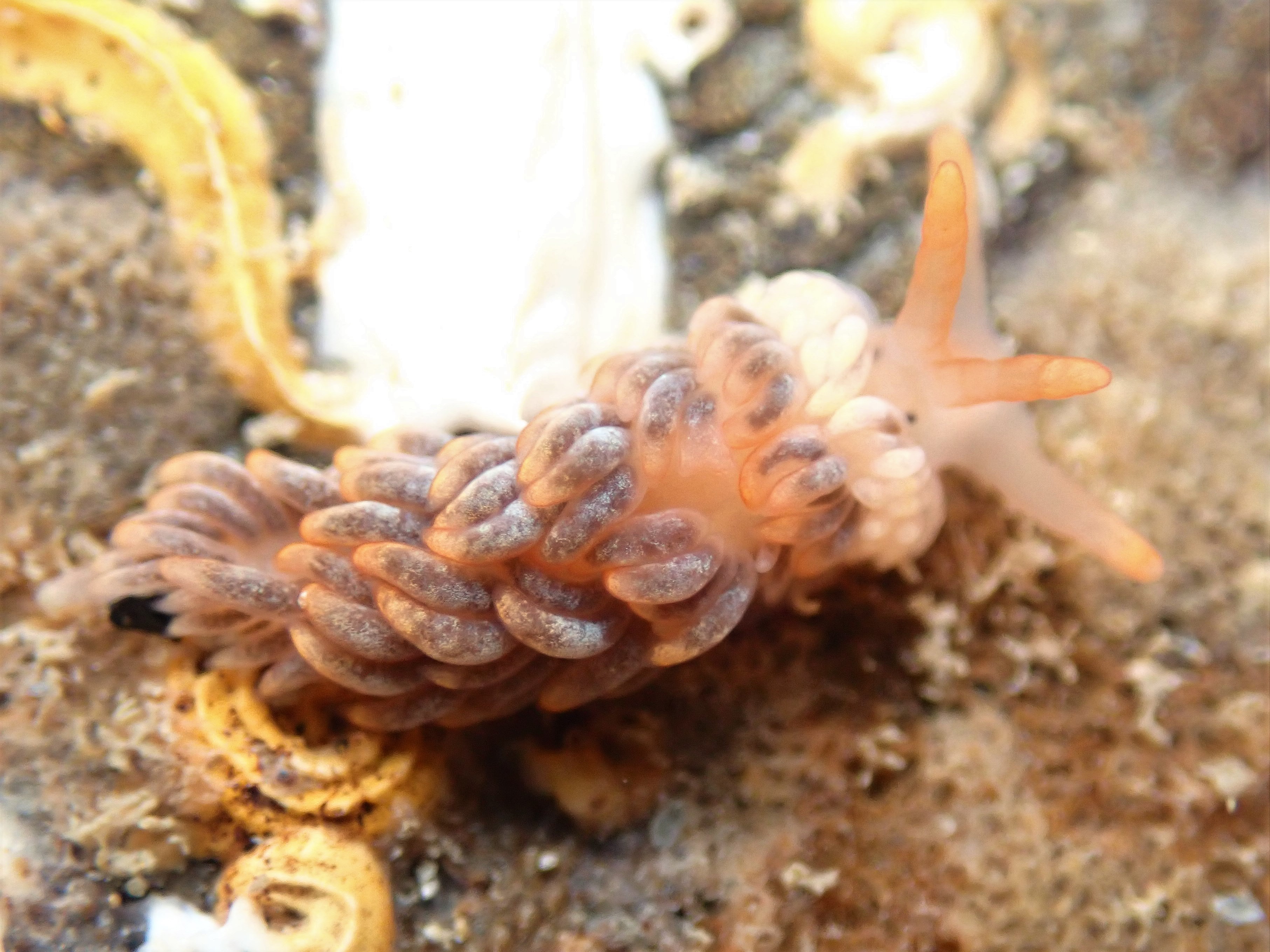
Aeolid slugs vary in colour depending on what they have eaten, but there is something unusual about this one that I can’t place. It has a bit of a white ruff behind its head, but I’m not convinced it is the white-ruffed sea slug (Aeolidiella alderi) that I frequently see.
Aelolidiella alderi (pictured near Falmouth) is the more common species locally. It is often white or grey, but can take on bright colours like this after eating anemones.
I take some photos. Zooming in, I soon ‘spot’ the difference; the difference is the spots! There are tiny white flecks on the slug’s body. I take photos in the pool before ensuring it is returned safely back under its stone.
Aeolidiella glauca sea slug, Lizard, Cornwall
Despite my rush to identify the slug (which I suspect is an Aeolidiella glauca) there are even more important things to do on the way home: like stopping for a saffron bun and ice creams at Roskilly’s, and visiting friends in Gweek.
Thanks to the wonders of expert Facebook groups and also the brilliantly helpful David Fenwick of Aphotomarine, I have confirmation the same day. Aeolidiellaglauca has occasionally been recorded in this area before, but it’s a first for me. It may be more common in northern waters, but marine creatures rarely follow the rules. There are surprises everywhere and that is exactly what makes rock pooling so fabulous.
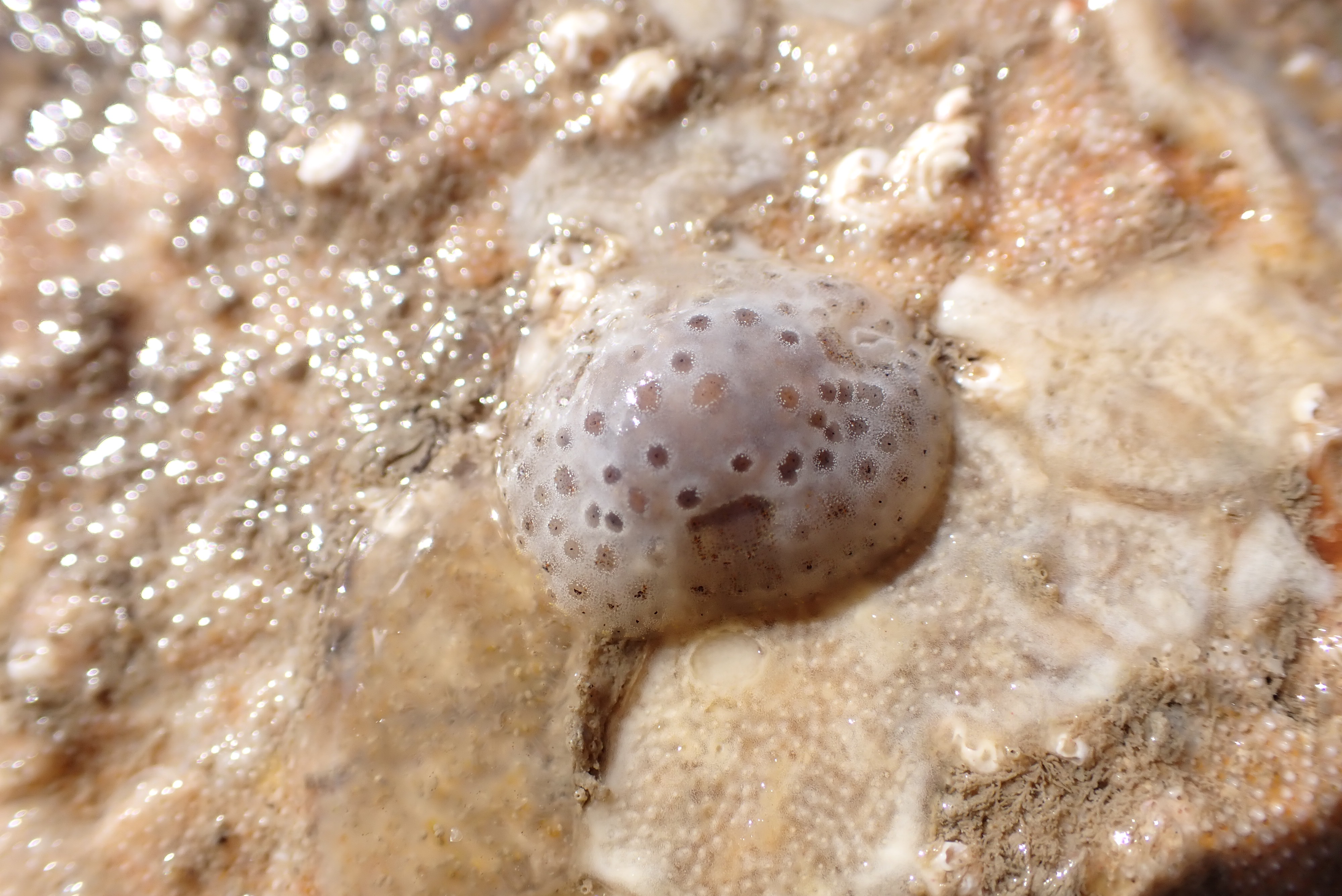
Another lovely little find: Lamellaria latens (gastropod mollusc) at Lizard PointDahlia anemone at Lizard Point, CornwallGem anemone. Lizard Point, Cornwall.
Whatever the weather, always stay safe in the rock pools. Follow my rockpooling tips to look after yourself and the wildlife on the shore.
This website is a labour of much love and the content is available for free to everyone. My wonderful readers often ask if there is a way to support my work. You can now ‘buy me a coffee’ through my Ko-fi.uk page. (Just click donate and you can set the amount to pay by PayPal). Thank you!
My son has had the same spade since he was three. When I first agreed to let him loose with something bigger than himself with sharp metal on the end it was something of a risk. Since then, it has been his favourite possession, enjoying frenzied use on beaches all around the Cornwall and in all weathers, creating dams, pits, castles and ‘sand volcanoes’. The blade has been wobbling for some time now, but today Junior has plans for a tide fort at Millendreath, so we hope for the best.
Blue spade going strong in 2019 (age 8).
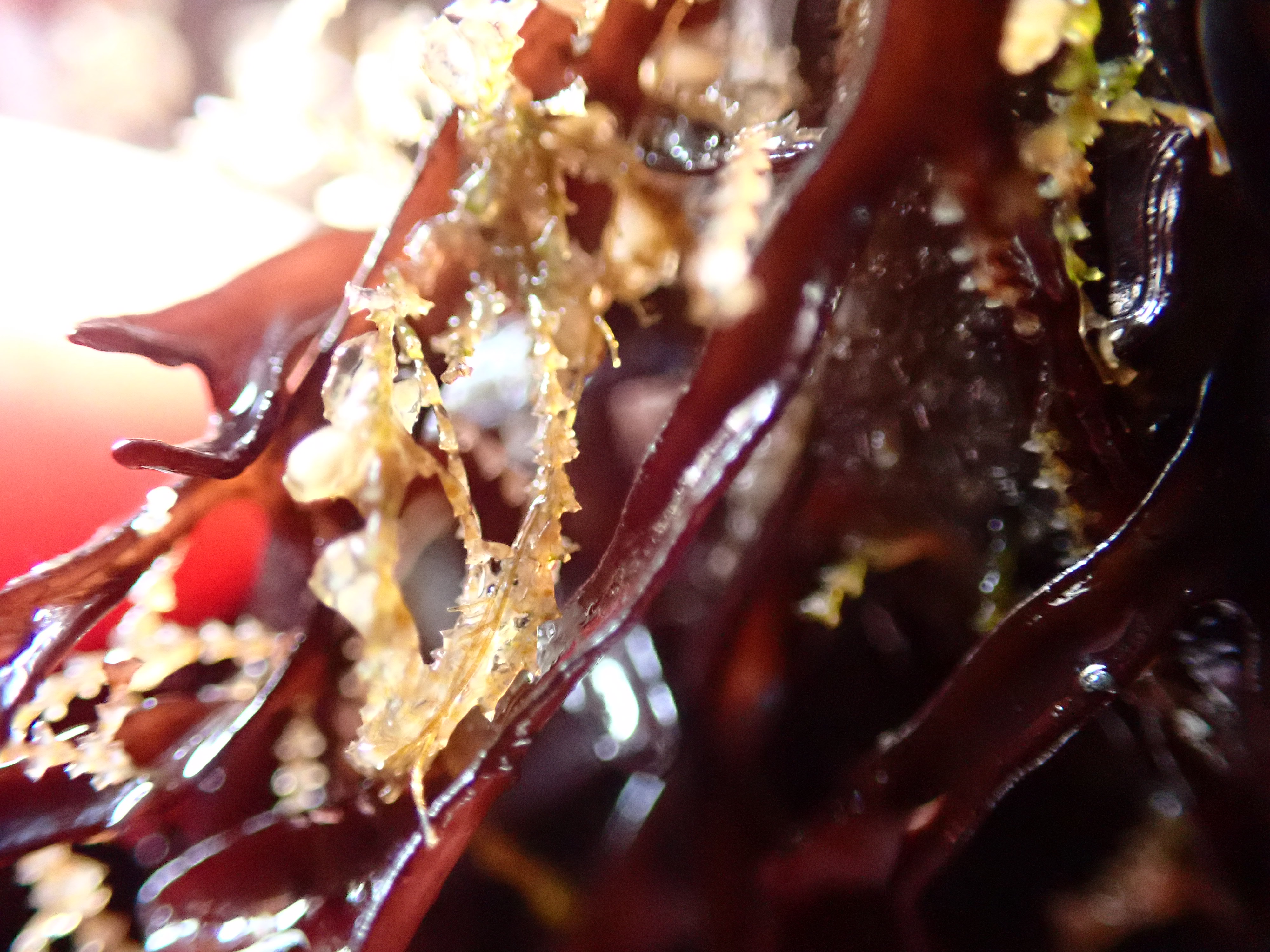
We cross the rocks towards the sandy beach, stopping on the way to explore the pools. Many of the seaweeds growing at the base of the rocks are covered in a dense thicket of Dynamena pumila hydroids.
Dynamena pumila hydroids (the yellow strands) on seaweed.
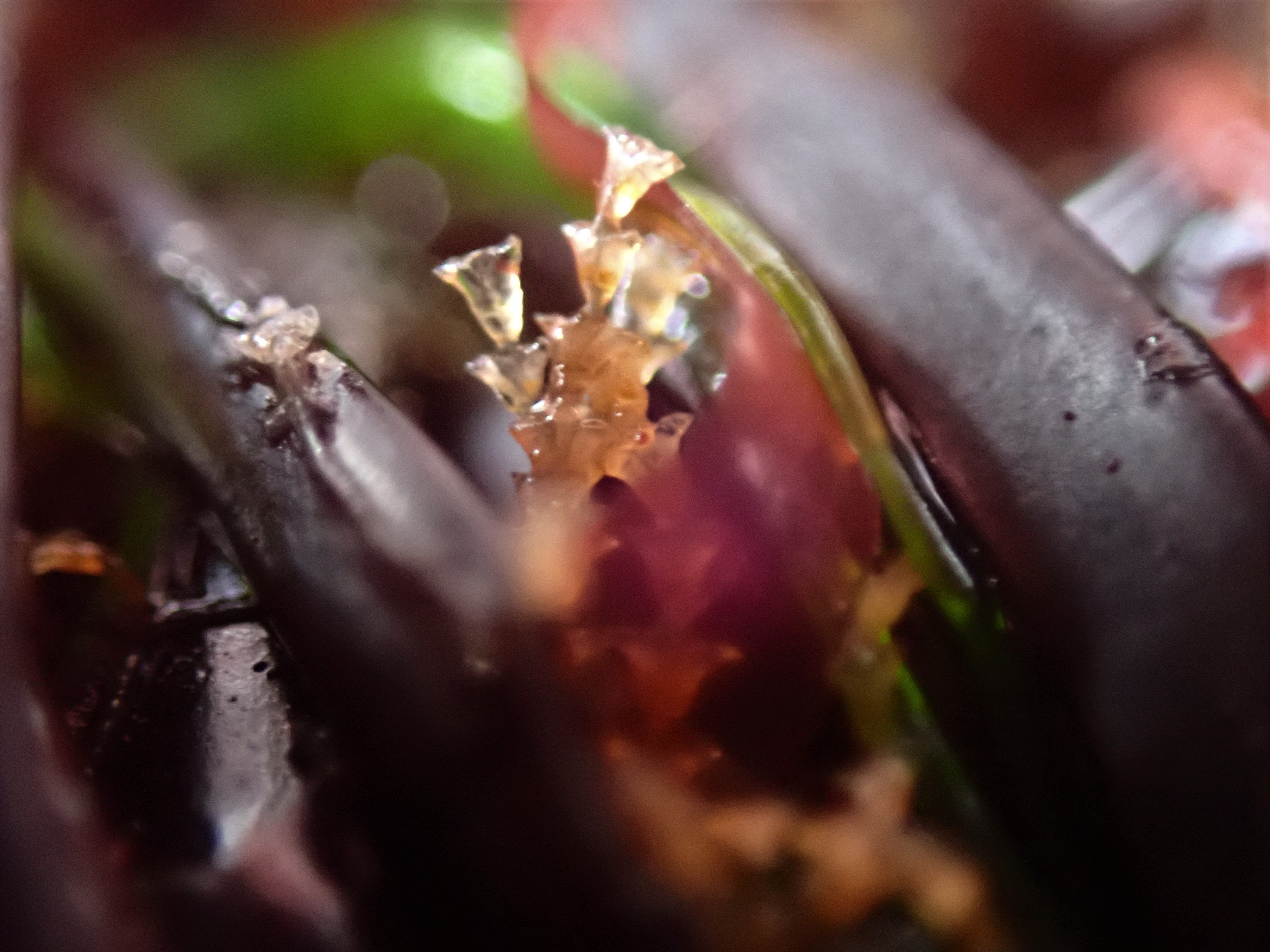
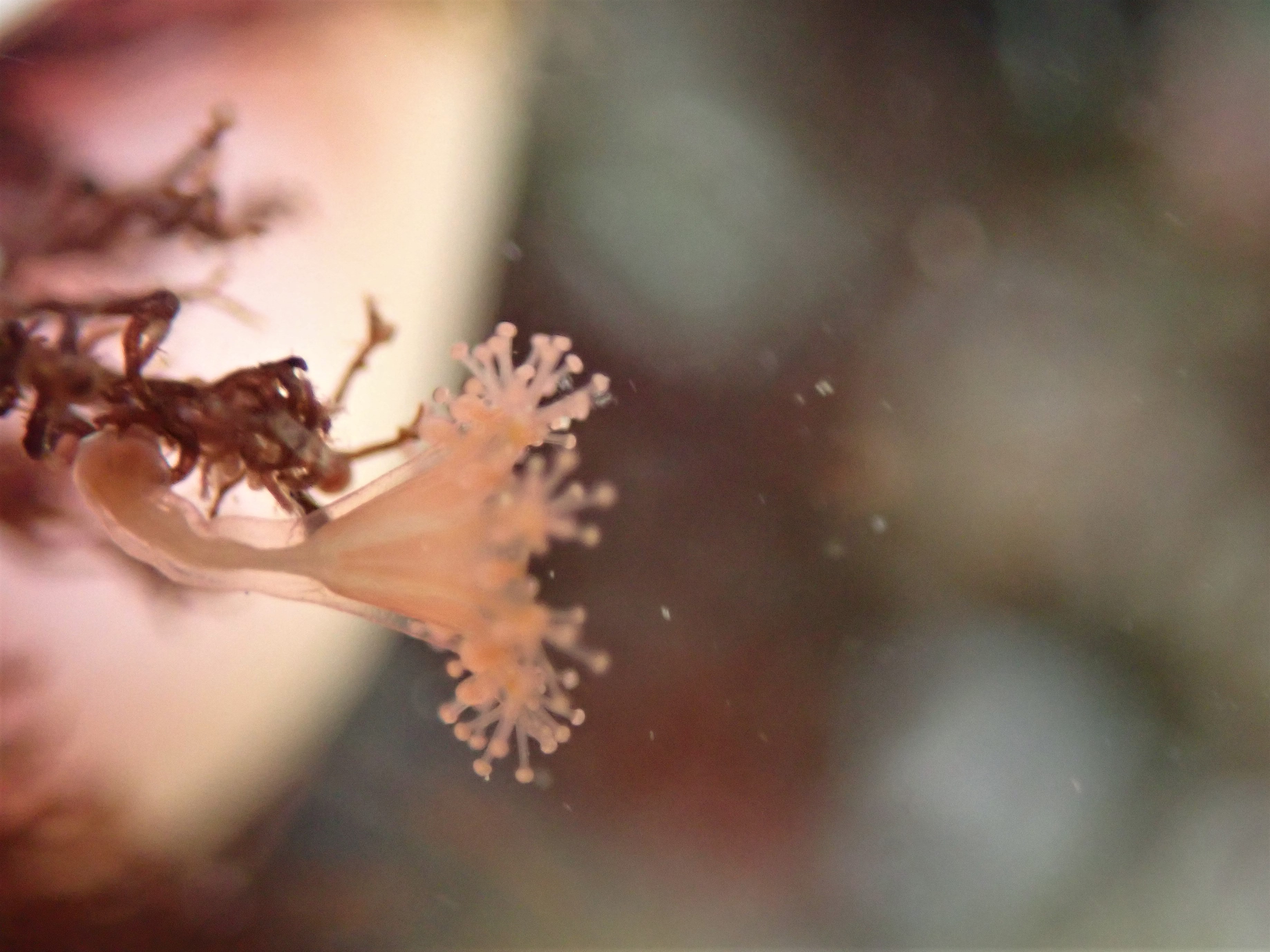
They look like pale plant stalks, each just a few centimetres long, but up close I can that each ‘stalk’ is made of a stack of downward-pointing triangle shapes.
Dynamena pumila up close – looking like a stack of tiny golden cups.
When they are submerged as the tide comes in, a circlet of delicate stinging tentacles will emerge from each side of every triangle to catch passing food. Hydroids are fascinating animals, and are also a favourite food of some other species, including sea slugs.
Among the hydroids are a few spots of jelly, just a few milimetres long. They are very hard to see, especially while the seaweed is stranded out of the water, but these are sea slugs. In places I find the hydroid stalks are entangled with a fine strand of white – the sea slug spawn.
A tiny Doto sea slug out of water – my fingertip is in the background for scale.
I try various ways to get the hydroids into water so that I can see the slugs better, but nothing works. I don’t want to harm any of the animals by removing them so I give up.
Trying and failing to take good photos of a Doto sea slug in situ.
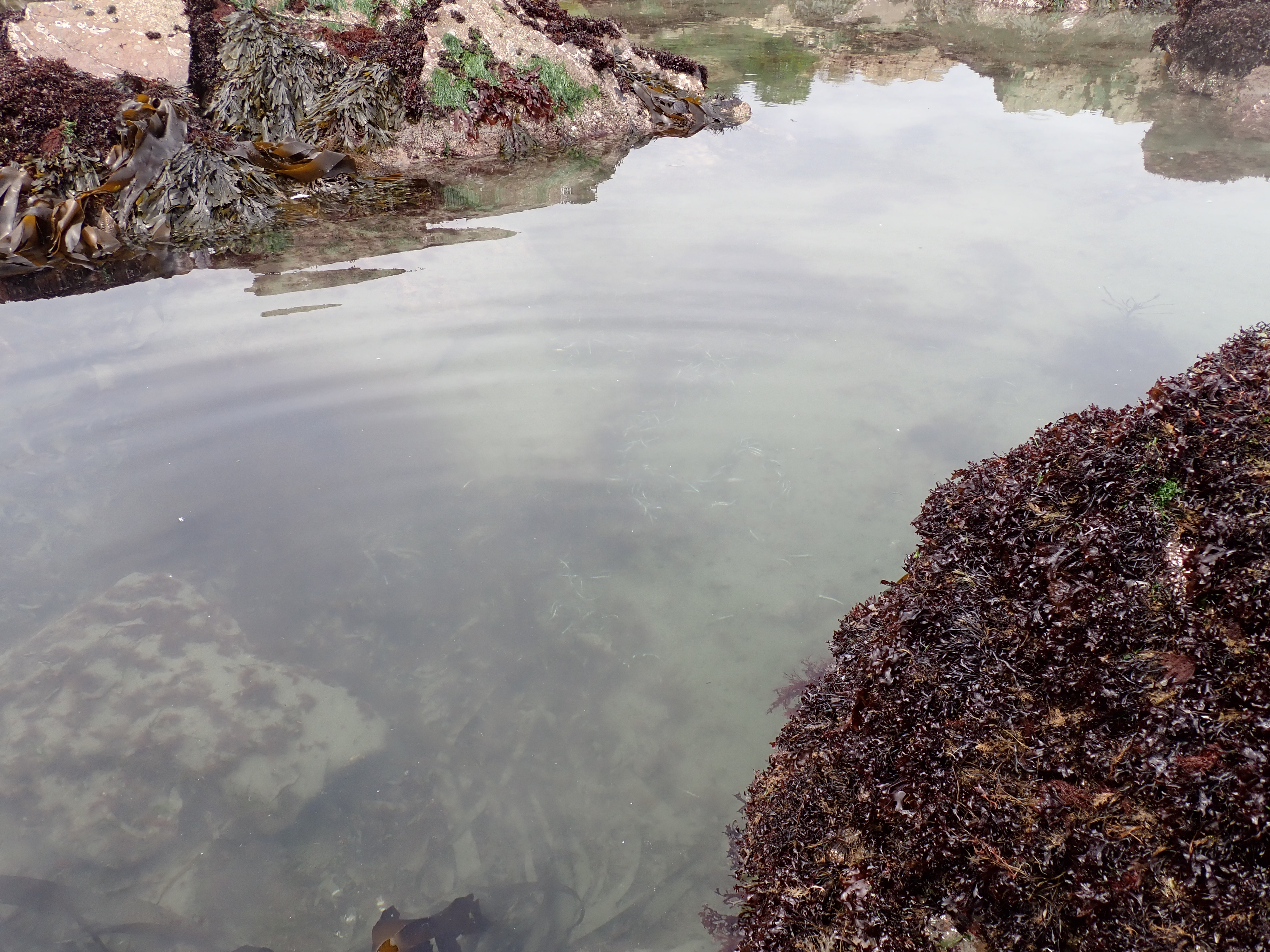
Further down the beach towards the sea, the gulls are making a huge racket, screaming and splashing. Where the rocky gully we are in opens into a wide sandy pool, we come upon a scene of complete chaos. Scores of herring gulls and some greater black-backed gulls are jostling for space: some swimming on the pool, others flying down and yet more perched on the rocks all around. Many are dunking their heads in the water, reaching for something. There must be food here.
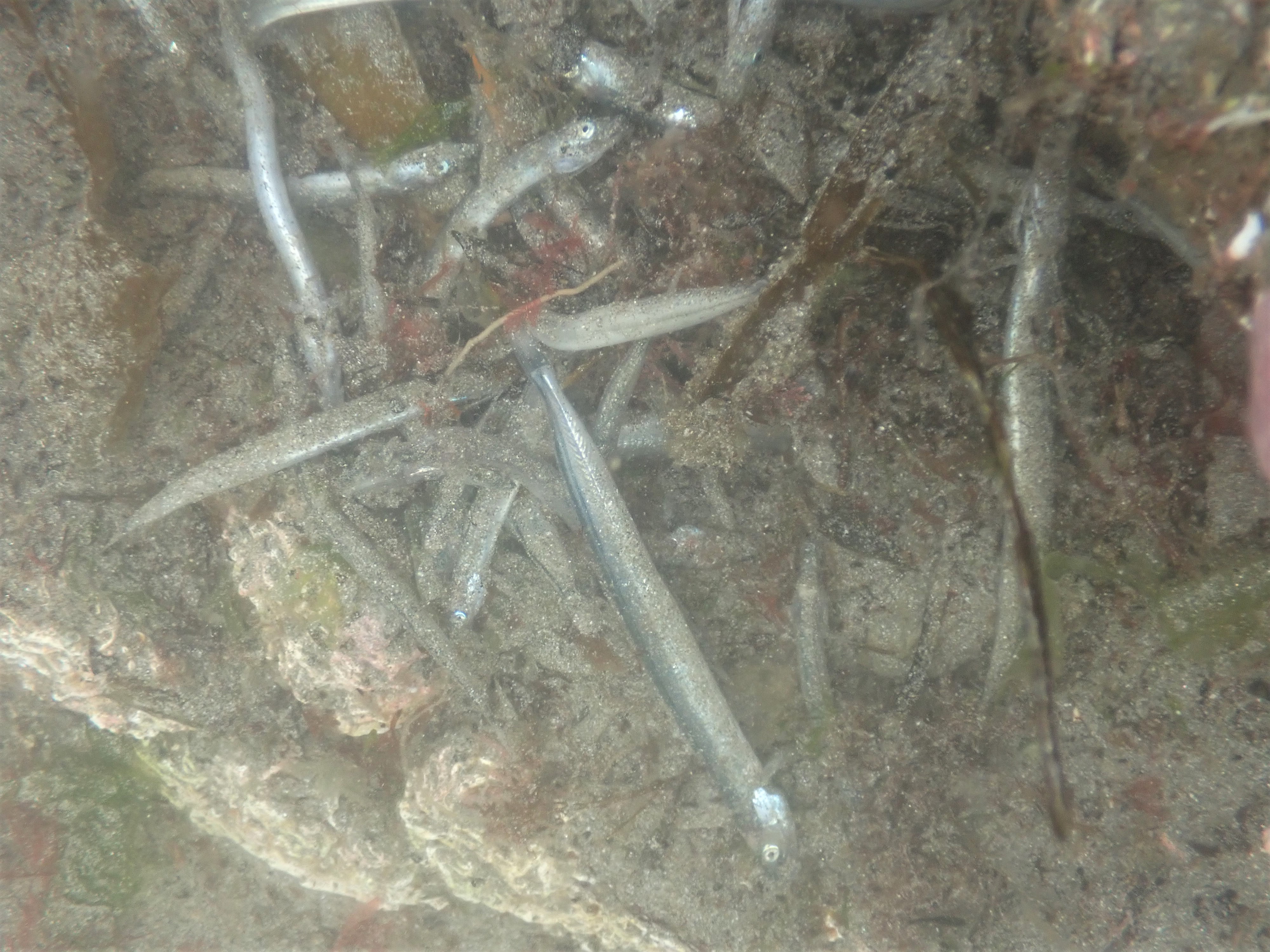
We try not to bother them but most of the birds fly up as we clamber over the last rocks to the beach. I take a quick look in the pool and find it is strewn with dead sand eels. There are so many that they have drifted into heaps against the rocks and some have tangled themselves into balls in their efforts to escape.
It’s sad to see so many dead sand eels but, for the gulls and other seabirds, it is a bonanza.
These mass strandings of sand eels happen sometimes. Perhaps it is the warm weather and low tide combining to starve them of oxygen as they hide in the sand, or perhaps a large shoal became trapped here and were an easy target for the seabirds. There is nothing to do but leave the gulls to their feasting.
There were hundreds of dead sand eels in this pool.
While Junior is shoveling sand with his dad, I return to the hydroids. After much searching, I find a slug that is only loosely attached to its prey and manage to wash it into a small tub. As soon as it is in the water, it transforms from a featureless blob into a magnificent structure of wobbling towers and waving rhinophores.
Doto sp. These slugs look magnificent in the water.
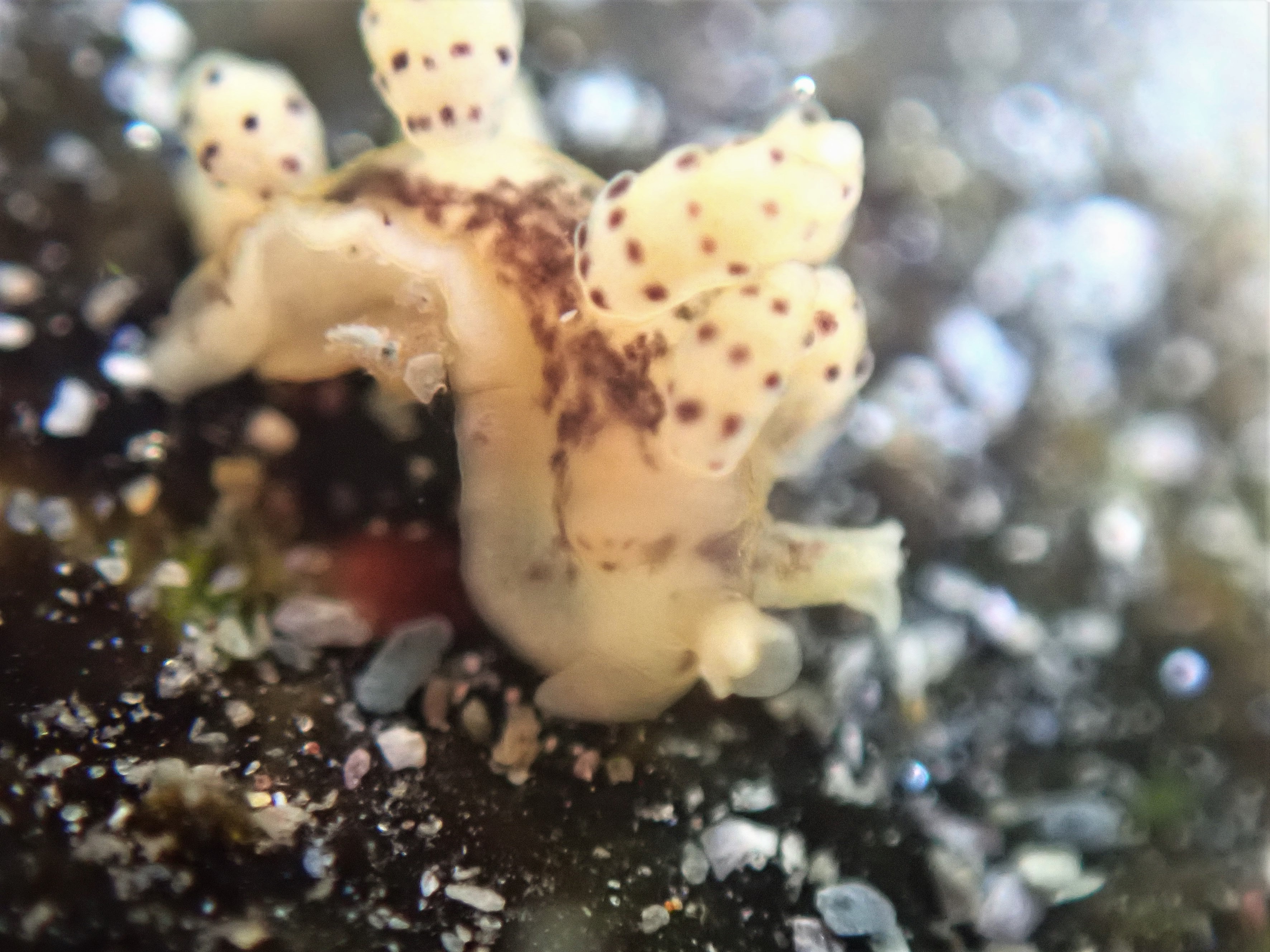
This is a Doto sea slug, but the species is not so clear. Most Doto slugs feed on very specific hydroids. My old books suggest Doto coronata can feed on Dynamena, but now it seems that they eat other things and that this is likely a different species, perhaps Doto onusta. Whatever it’s called, it is a true leader in the field of jelly architecture.
I have no idea what purpose the towering protrusions topped with dark spots fulfill – maybe camouflage, maybe just housing to its digestive organs, but they are incredible.
Doto sp. sea slug.
I find a sheltered pool where I can photograph and watch the little Doto for a while, before gently returning it to the exact same place I found it.
The dotty Doto slug exploring the pool.
Junior has just about finished his sand fort when his spade finally parts from the handle with a wet crunch. We lovingly assemble all the bits and make sure to pack them into our bags, hoping that we can somehow repair it later. We share stories of all the happy times Junior has enjoyed with his spade over the course of the last nine years. It feels like saying goodbye to a family member, but the tide is coming in and Junior perks up to defend his fort from the waves, standing atop the sand until the sea starts to flood his wellies.
Back at home, Other Half disappears into the garage and rummages for a while before emerging with the spade firmly fixed to a new shaft. Blue spade lives to build again!
Finding a sea slug is always a moment of joy. I can’t imagine ever losing the excitement of spotting a minuscule blob that might just be something and realising that it is moving, unfurling, becoming spectacular. There are so many species, that I have plenty yet to discover as well as many old acquaintances to renew.
Limacia clavigera – the orange-clubbed sea slug. Near Falmouth. Out of the water, these slugs are shapeless blobs.
The oystercatchers are unusually quiet, huddling between the rocks in the distance and I’m glad of my waders to keep the worst of the north wind off. Conditions could be better, but with two households of keen rock poolers on the beach today, all trussed up in enough layers for an Arctic expedition, we feel sure that good things will happen. Junior and his friends let us adults get a head start while they chat after a long time apart, but they’ll soon join us when we uncover something interesting. Sure enough, just minutes into our explorations, the shout of ‘slug’ goes up.
Other Half, who was just saying that he always looks for sea slugs but never finds them has found one. He beams and points it out; I have to follow his finger to see it among the pink coralline seaweed.
Not only has he found a slug, it is an absolute beauty.
Other Half’s wonderfully orange Aeolidiella alderi – the white-ruffed slug.
At first I think this is a species that I haven’t seen before. The slug’s body and the rhinophores protruding from its head are an intense orange. The dense hair-like cerata on its back are mostly patterned in speckled grey and orange, except for a bright white row of cerata immediately behind the slug’s head, forming a pretty white ruff around its ‘neck’.
Among the pink algae, the slug is surprisingly well camouflaged.
It is this white collar which makes me realise that the slug is likely to be a species which is usually far less colourful, Aeolidiella alderi. This slender slug feeds on anemones, and is particularly fond of daisy anemones. Like some other Aeolid slugs, A. alderi takes in the colour from its food, so it looks like this little slug has been feasting on something orange.
Aeolidiella alderi.
I have barely started to look at the A. alderi slug under my camera when our friends shout, ‘Slug!’ I hurry across the rocks as fast as my waders will take me, looking and feeling rather like a lumbering green Teletubby and not caring one bit. The day has started as we hope it will go on.
We position ourselves around the minute blob and angle the rock it is on so it is a little deeper in the pool. Like most slugs, it looks like a tiny streak of jelly when it is out of the water, but once submerged its back fluffs into long star-studded cerata and enormously long moustache-like tentacles curve out from its head.
The wide oral tentacles on this Facelina annulicornis remind me of a circus ringleader’s moustache.
The ringed rhinophores on this slug’s head look like a pair of mini helter-skelters, waving at my camera as the slug advances towards me. A pair of black eyes stares up into my lens.
Facelina annulicornis.
The slug is so small that I’m not entirely sure of the species until I see the photos on a bigger screen back at home. The little star-spots all over its body are a giveaway. This is Facelina annulicornis, which I call the ‘starry unicorn slug’ to help me remember the scientific name.
Facelina annulicornis – or the ‘starry unicorn slug’ as I call it.
Back on the beach, I take our friends to see Other Half’s little orange slug and we explore the pool further. To my amazement, the very next stone I check has an intense spot of purple on it, like a gleaming amethyst. This can only be another slug.
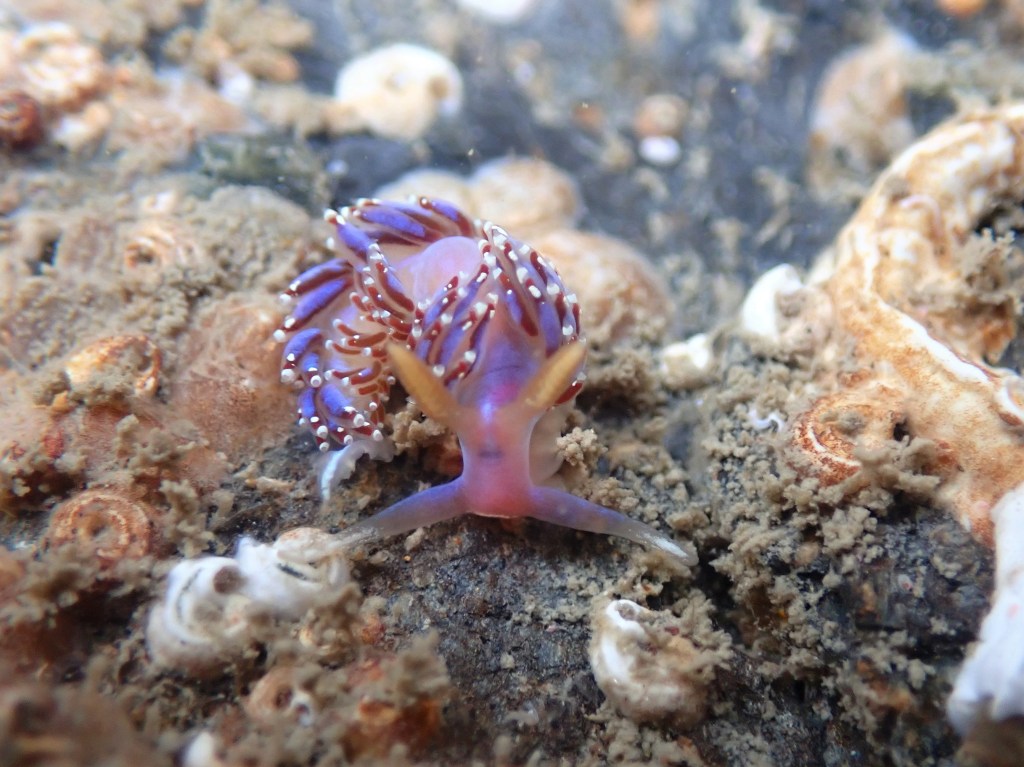
I place the rock gently under the water and the slug fluffs up in an instant, forming a ball of intensely coloured cerata. The colour is so bright that I expect it to be an Edmundsella pedata, but as it stretches out its body I can see that the cerata are vivid blue, red and white, a Facelina auriculata.
The exceptionally brightly coloured Facelina auriculata.
This is the most incredibly coloured one I have ever seen and my camera cannot fully capture how bright it is. The slug is so captivating that I only realise there is a second, less colourful, slug on the rock when it photobombs its companion. This is likely to be a mating pair, although there is no sign of spawn as yet.
The second slug is larger, but I almost miss it because the first Facelina auriculata is so strikingly coloured.
By now, the children have joined us, keen to see what all the excitement is about. Junior recognizes the ‘patriotic sea slug’, as we call the Facelina auriculata (in honour of the many countries that have red, white and blue flags), but the colours make him gasp with amazement. He sets to with his camera, trying to capture every angle.
One of Junior’s lovely photos of Facelina auriculata.
As the tide rolls further out, the pools seem to stretch forever in every direction and I’m torn as to where to go next. Every pool is full of possibility and I cannot visit them all before the sea returns.
I decide to make the most of my waders, slooshing out to the edge of the sea, through shallows packed with rainbow wrack adorned with the mermaid’s purse egg cases of greater spotted catsharks (Scyliorhinus stellaris).
A catshark eggcase (Scyliorhinus stellaris)
There are flatworms galore, their clusters of eyespots seeing the world in ways I struggle to imagine. A variegated scallop spots me through the many eyes dotted around its part-open shells and decides to move to safety, slamming its shell shut to propel itself.
Urchins extend their tube feet in their strange dance, curving and twisting between their purple-tipped spines.
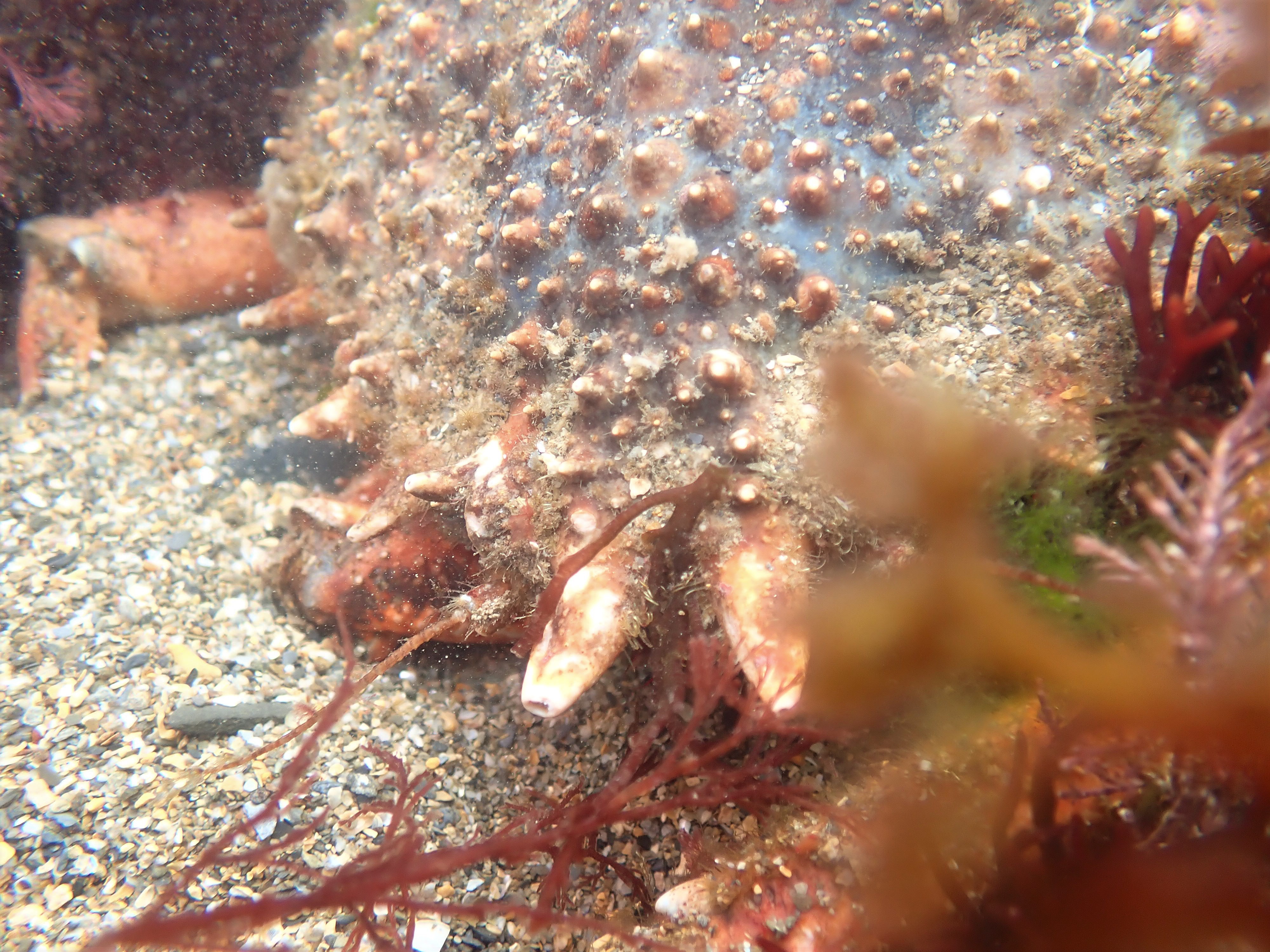
One of our friends finds a fully-grown spider crab, sheltering beside a rock, wonderfully camouflaged against the shell sand. We leave it undisturbed and well covered in seaweed to keep it safe from the marauding gulls.
The spider crab, hiding away.
Our other friend signals to me from beyond the rock line. She is performing our special arm-waving dance, as invented by Junior. She must have found a Discodoris slug (Geitodoris planata).
The pair of Geitodoris planata slugs. They can make their bodies almost flat on the rock, with only their rhinophores and their feathery gills standing up.
These unpretentious brown pancake-flat slugs don’t have any of the bling of the other nudibranch slugs we’ve seen today but looks aren’t everything. The Geitodoris planata’s secret weapon are acid glands, forming white stars on the slug’s sides. This is a formidable and fascinating slug.
Geitodoris planata. The white patches on its back are acid glands.
Incredibly, our slug finds keep on coming. Close by is a Berthella plumula, which we call the ‘feathered Bertha’. This striking yellow slug can also produce acid if it is disturbed and, weirdly for a slug, has an internal shell, visible as a dark patch in the middle of its back.
Berthella plumula with its tentacles extended, exploring the rock.
Another yellow spot on the rock turns into this fabulous Limacia clavigera slug as soon as I put it in water. I take a few photos before carefully returning it to its hideaway.
Limacia clavigera, the orange clubbed sea slug.
The tide is coming in and the raw wind has taken its toll on my hands. I stuff my frozen fingers down the neck of my jumper, but they are still painful and numb from plunging repeatedly into the water. A sensible person would give up before frostbite sets in, but I’m not that sort of person… there might still be slugs to find. The kids are not so daft: they have wandered back to the top of the beach to start on the picnic lunch.
The rocks are full of animal life and seaweed. A yellow-ringed sea squirt (Ciona intestinalis) on a rock encrusted with sponges.
As the tide moves up behind us we explore the mid shore, hoping to find goby eggs or clingfish eggs and the slugs that eat them. It’s still a bit early in the season, but we find a few patches of yellow clingfish eggs.
Clingfish eggs.
Eventually, hauling up a rock that feels as big as myself, I spot some capsule-shaped eggs on the underside. These are larger than the rock goby eggs I’ve seen this week, so they could belong to a giant goby. Some of the eggs are empty and others are well-developed, the baby fish looking out at us with silvery eyes. Taking great care not to disturb them, we scan the rock.
Goby eggs.
Seeing no sign of slugs, I use my camera to look more closely. At first I find nothing, but spotting something tiny and dark I zoom in. My hands are struggling to press buttons, but I convince myself this is something. It seems to move a little.
All of a sudden I have it in focus, although it is half-hidden between the eggs. This is a slug quite unlike the others we have seen today. Its body is compact, lumpy and camouflage green. On its head two wonderfully tall rhinophores stick up, poking above the eggs like periscopes. If the army designed slugs, they would probably look a bit like this.
Palio nothus – looking like a stylish armoured car.
I’m so thrilled I almost keel over backwards as I try to balance my camera and keep the stone steady. This is a Palio nothus; the very first slug of this species I’ve ever found. It is probably feeding on tiny animals called bryozoans on the rock rather than the eggs. It’s barely 5mm long, probably less, and almost impossible to photograph properly with my seized up fingers, but I couldn’t be happier.
Palio nothus among the goby eggs.
This beach is amazing and the slugs are just what I hoped to see, but the best thing of all is to finally share the experience again with amazing friends and my wonderful family. It will take me all day and night to thaw out but I couldn’t care less. This is my happy place.
Rock pooling is a wonderful way to see the wildlife if it is done carefully. If you are heading to the shore, remember to leave the stones, seaweed and animals exactly as you found them. Take nothing with you and leave nothing behind. There are lots of rockpooling tips on this site to help you rockpool safely and sustainably and identify your finds.
Privacy & Cookies: This site uses cookies. By continuing to use this website, you agree to their use. To find out more, including how to control cookies, see here: Privacy and Cookies Policy.































 Cornish Rock Pools