Tag: cornwall

  • We’re going to find… a rainbow sea slug!

    We’re going to find… a rainbow sea slug!

    Back in March, Junior and I had the opportunity, together with our fabulous home education group, to explore the shore in Looe on one of the lowest tides of the year. For these keen rock poolers, searching for rainbow slugs was the perfect challenge.
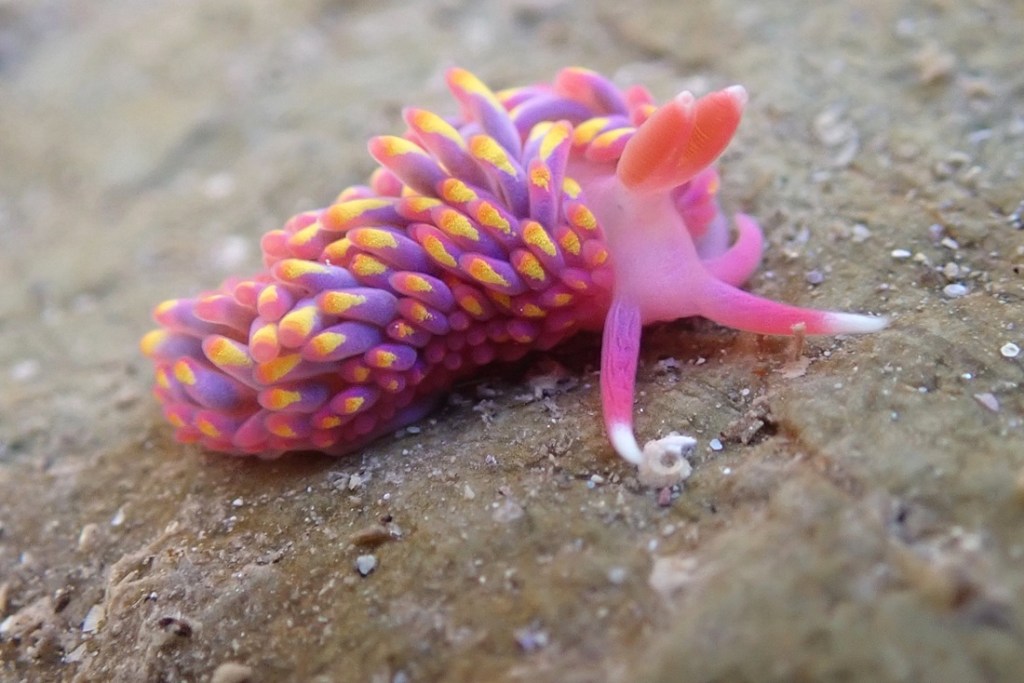
    Brightly coloured pink purple and yellow sea slug.
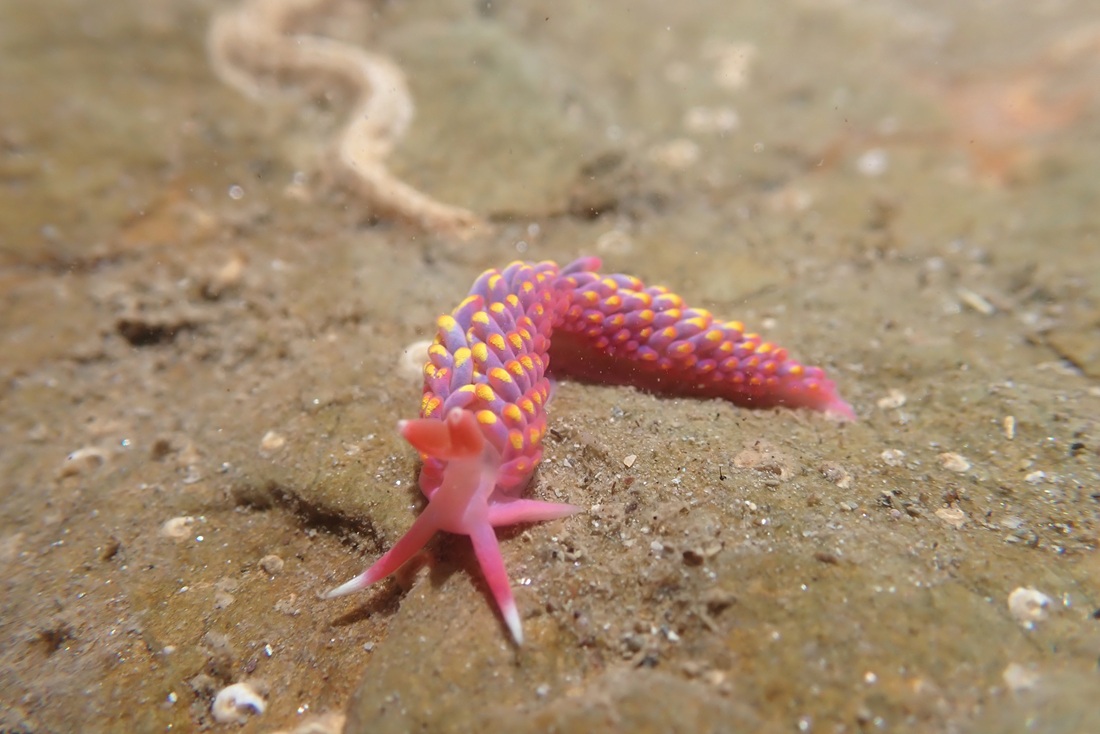
    Rainbow sea slug, Babakina anadoni

    “So, what does a rainbow sea slug look like?” asks one of the children. A good question.

    I admit I have never seen one in real life.

    “It’s tiny, so you’ll have to look closely,” I say. “Maybe the length of my little fingernail?”

     I hold my fingernail out for inspection and the group gathers round.

    “If you find this slug, you’ll know,” I assure them. “It might be tiny, but it’s a fluffy rainbow, with the brightest colours.”

    Since the first UK sighting off the Isles of Scilly in 2002, the rainbow sea slug, Babakina anadoni, has been found increasingly frequently, including in several locations around Cornwall. Needless to say, I have been looking for it. Everywhere. Endlessly.

    The general view is that this species feeds on hydroids, in particular the rather odd looking (and giggle-inducing) Candalabrum cocksii.

    Most hydroids live in delicate, feathery colonies. Described by the naturalist Cocks 1854 (and previously by Gosse in 1853), Candelabrum cocksii looks more like a blobby worm and, to complete the look, it can even wriggle vigorously.
    Candelabrum cocksii hydroid with red body sticking up and a mass of white balls and frilly tentacles at the base. On a rock in the sea.
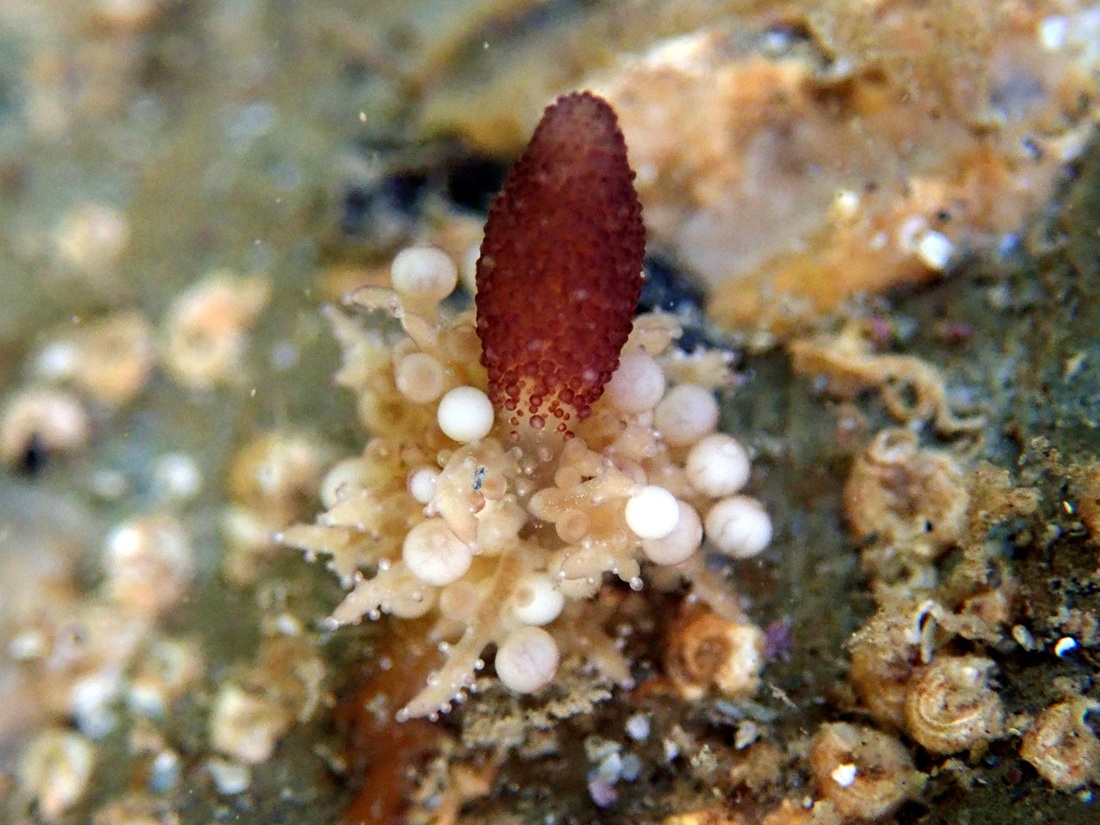
    Candelabrum cocksii hydroid: believed to be the favoured food of the rainbow sea slug.

    You can just about see why Cocks compared this little animal to a candle-holder. The main, burgundy-red body of the animal often sticks upright like a candle, with the animal’s mouth at the top, and seems to be propped in place by its rounded base, comprising many tiny white balls, and frilled tentacles. Hydroids use stinging cells in their tentacles to fire paralysing toxins into passing prey in the same way as other cnidarians like anemones and jellyfish.

    Underneath the base is a “foot”, which secures the animal to the rock, but can also extend when it wants to move. In fact, the whole animal is highly extendable and transforms in appearance when it puts out its short, round-ended tentacles.

    Candelabrum cocksii hydroid in horseshoe shape on rock, with mass of branched tentacles on right and short tentacles extended all over body.
    Candelabrum cocksii hydroid – showing how it can extend its body and tentacles.

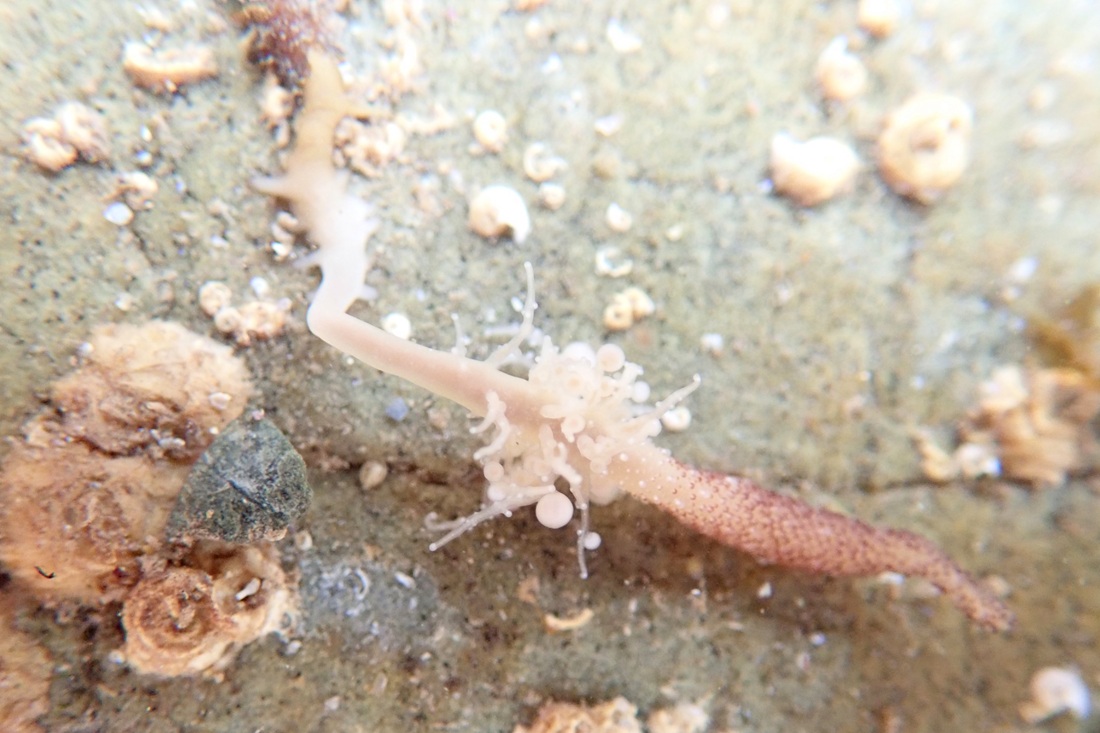
    To make itself seem even longer, it can also connect to other Candelabrum cocksii, forming a pseudo-colony.
    Extended worm-like Candelabrum cocksii hydroid(s) on grey rock.
    A very extended, worm-like Candelabrum cocksii, with another at the other end.

    To my mind, lots of Candalabrum cocksii hydroids should equal lots of well-fed rainbow sea slugs. Sadly, as so often happens, the slugs don’t seem to have read the same articles as me. After many months of looking, I still haven’t found one.

    Fortunately, Junior’s home education group have good form. We have set out several times with a particular mission, most recently to find baby sharks . Each time, they succeed. Therefore, today we are going to find a rainbow slug.

    Conditions on the shore are beautiful. For once, we have sunshine, very light winds and a calm sea. Not only that, but there is a perfect spring low tide forecast. We follow the retreating sea towards an emerging rocky reef, checking everywhere along the way.

    There are lots of fabulous crabs, fish, squat lobsters, anemones and more, but no rainbow slugs.

    Small headed clingfish over pebbles in rock pool
    Small headed clingfish

    As low tide approaches, I am delighted to bump into the legendary (and also very real) Dr Keith Hiscock of the Marine Biological Association in Plymouth, who is enjoying his own marine explorations. We catch up briefly before I am called away to see another exciting find by the children: a catshark egg case that appears to be on the brink of hatching.

    I keep up my increasingly frantic search for a rainbow sea slug without success. There’s a little Jorunna tomentosa slug and a beautiful red Rostanga rubra. I’m also happy to see a young snake pipefish, but there’s no sign of rainbow slugs.
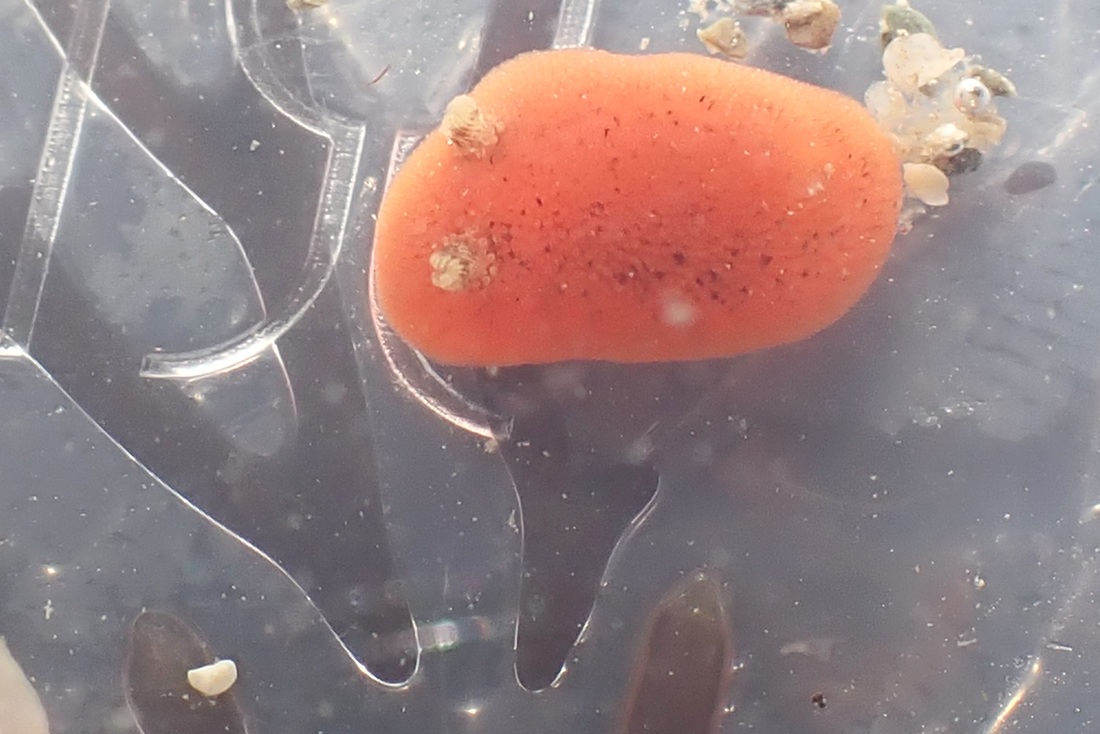
    Rostanga rubra - a bright orange sea slug with light-brown rhinophores
    Rostanga rubra – a slug that feeds on orange and red sponges
    Jorunna tomentosa. A cream coloured sea slug with small brown spots and a furry look. Slug is crossing a rock covered in short green seaweed.
    Jorunna tomentosa – I call these “Dalmatian” slugs as they always have little brown spots.
    Juvenile snake pipefish, showing the long snout and dark mask-like marking over the eye. Fish is in the sea over pebbles.
    Juvenile snake pipefish, showing the long snout and dark mask-like marking over the eye.

    I am taking some photos of a gorgeous little Anapagurus hyndmanni hermit crab, when Junior calls over to say that Keith found a rainbow slug. For a moment I think he’s pulling my leg, but Junior knows that slugs are a serious matter.
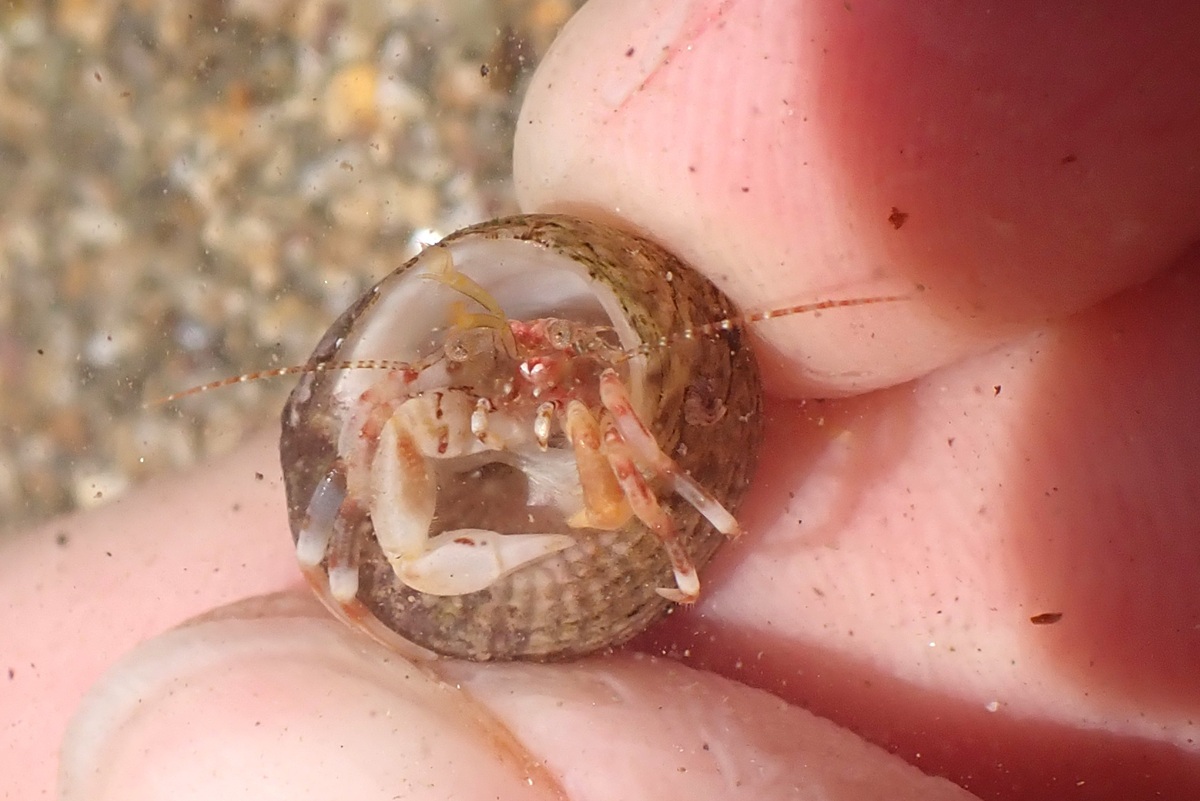
    Anapagurus hyndmanni small hermit crab with large white right claw in topshell.
    Anapagurus hyndmanni. These small hermit crabs have a larger right claw, which looks like a white boxing glove. They also have lovely striped antennae.

    “He found it earlier,” he says. “Over there somewhere.” He points to the opposite side of the lagoon.

    My heart leaps and sinks at the same time. There’s a rainbow slug! However, it’s unlikely to be more than 2cm long and is somewhere among many square metres of rocks and seaweed.

    I slosh through the water to where Keith is exploring and he tells me he has marked the place. Fantastic! I call the kids over and, together, we start hunting for a rock marked with a piece of kelp.

    Inevitably, the tide is already turning and time is against us. We find one rock with kelp on it and search all around to no avail. Then we try another place. Nothing.

    Keith to the rescue! With a little hunting around (rocks and kelp are incredibly plentiful on this part of the shore), he identifies the right area. The first rock we gently turn is slug free and we place it back, glancing nervously at the edge of the sea, which is visibly flowing in our direction.

    When we turn the second rock, the children gasp in excitement. Yes, it’s small, but there is nothing disappointing about this slug. The pinks, purples and yellows are virtually glowing.

    Brightly coloured pink purple and yellow sea slug.
    Rainbow sea slug, Babakina anadoni

    “It’s like a Pokémon!”

    The children have a point. With its bright pink headgear and multicoloured mane of cerata along its back, this creature would not look out of place on a trading card.

    Brightly coloured pink purple and yellow sea slug.
    Rainbow sea slug, Babakina anadoni

    Vivid colours like this often announce to any would-be predators that an animal is toxic. Many sea slugs retain toxins from their food, or even stinging cells, which they keep in their cerata (the sticky-up bits on their backs). My books neither confirm nor deny that Babakina anadoni does this, but I imagine that few creatures would be foolish enough to chance a bite.
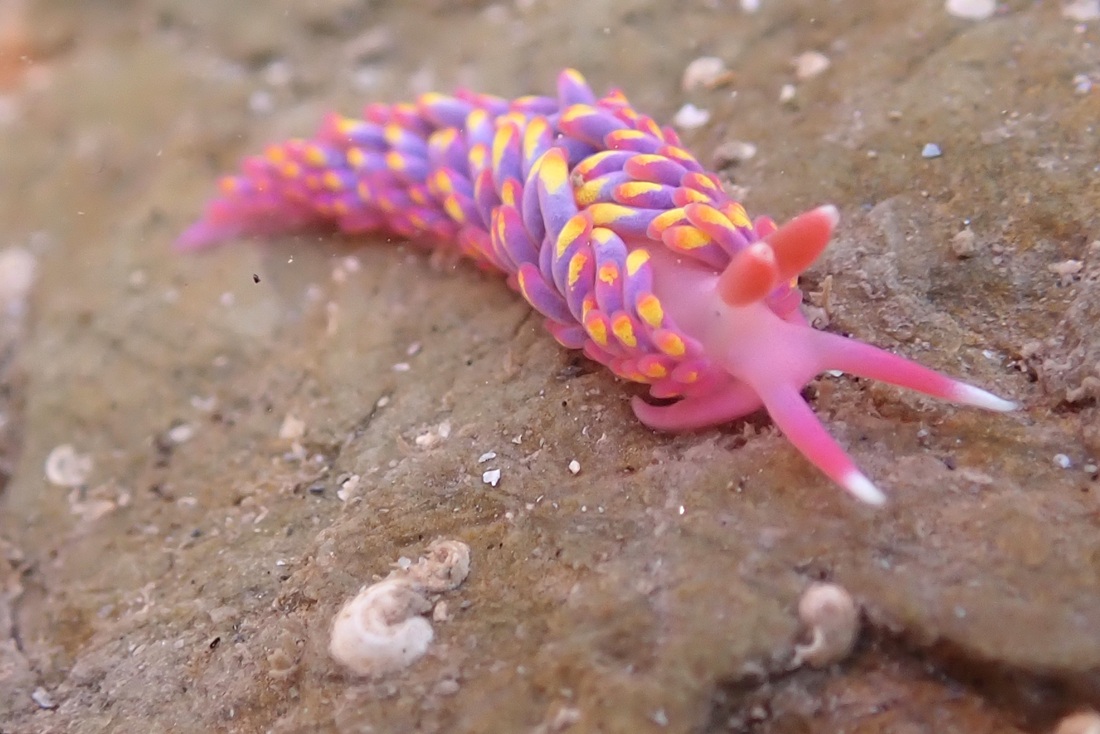
    Brightly coloured pink purple and yellow sea slug.
    Rainbow sea slug, Babakina anadoni

    Excitingly for me, the rainbow slug is not at all camera shy. It keeps changing its pose on the rock, allowing us to take some excellent shots from all of its best sides.

    Amid the appreciative chatter and my own delighted squeals, I do my best to do justice to this slug’s stunning appearance.
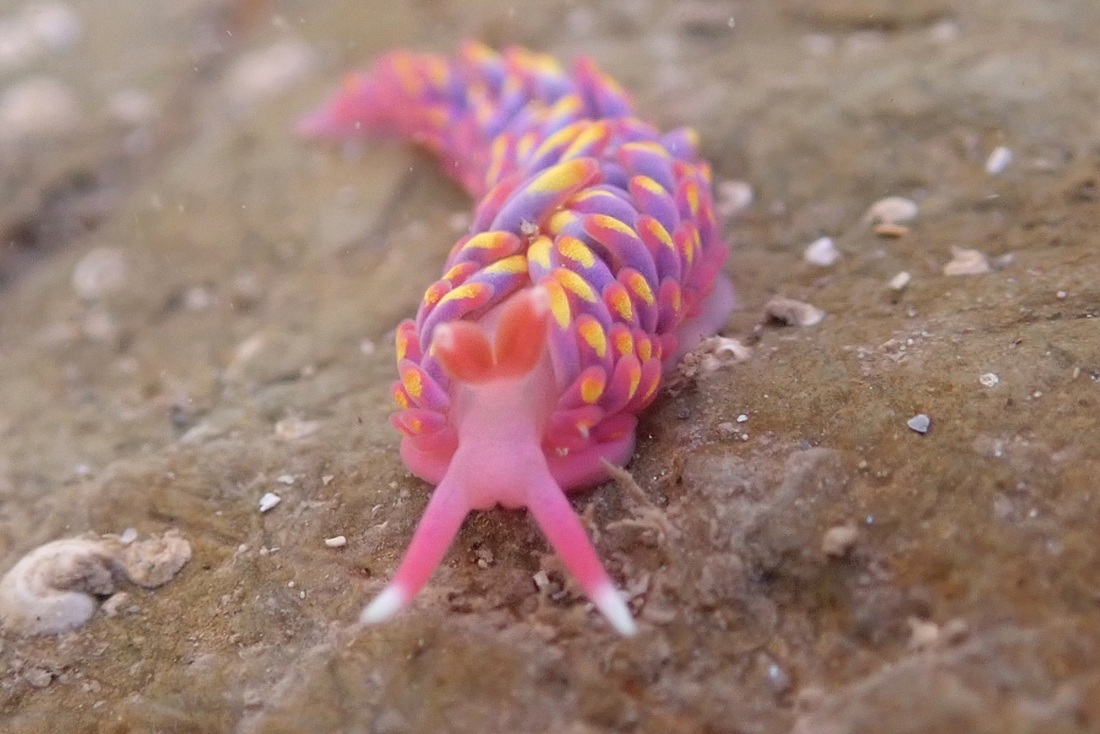
    Brightly coloured pink purple and yellow sea slug.
    Rainbow sea slug, Babakina anadoni

    Also on the rock is a Candelabrum cocksii hydroid – possibly slightly chewed by the slug.
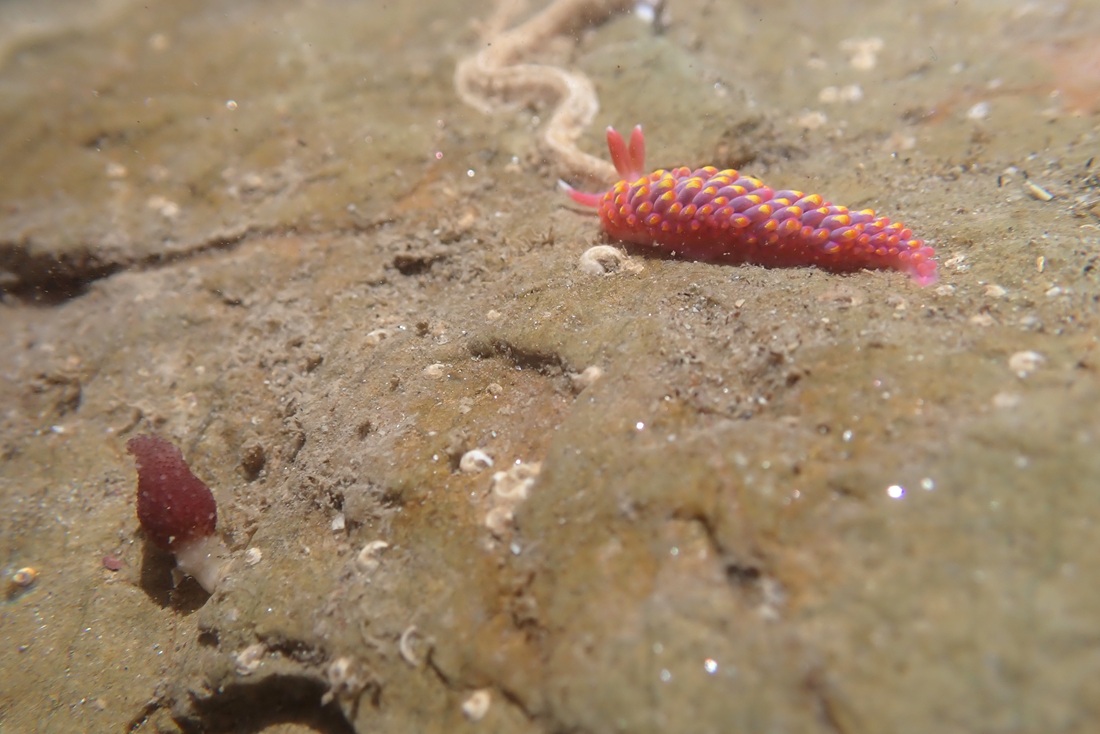
    Brightly coloured pink purple and yellow sea slug.
    Rainbow sea slug, Babakina anadoni with a Candelabrum cocksii hydroid (bottom left) – possibly nibbled!

    I cannot thank Keith enough for sharing his discovery with us all. What an incredible experience for all of us. There may well be some budding marine biologists among the group!

    Brightly coloured pink purple and yellow sea slug.
    Rainbow sea slug, Babakina anadoni

    With the tide pushing at our heels, we retreat to the top of the shore to relax and eat a celebratory ice cream, still buzzing about the beautiful slug and its amazing colours.
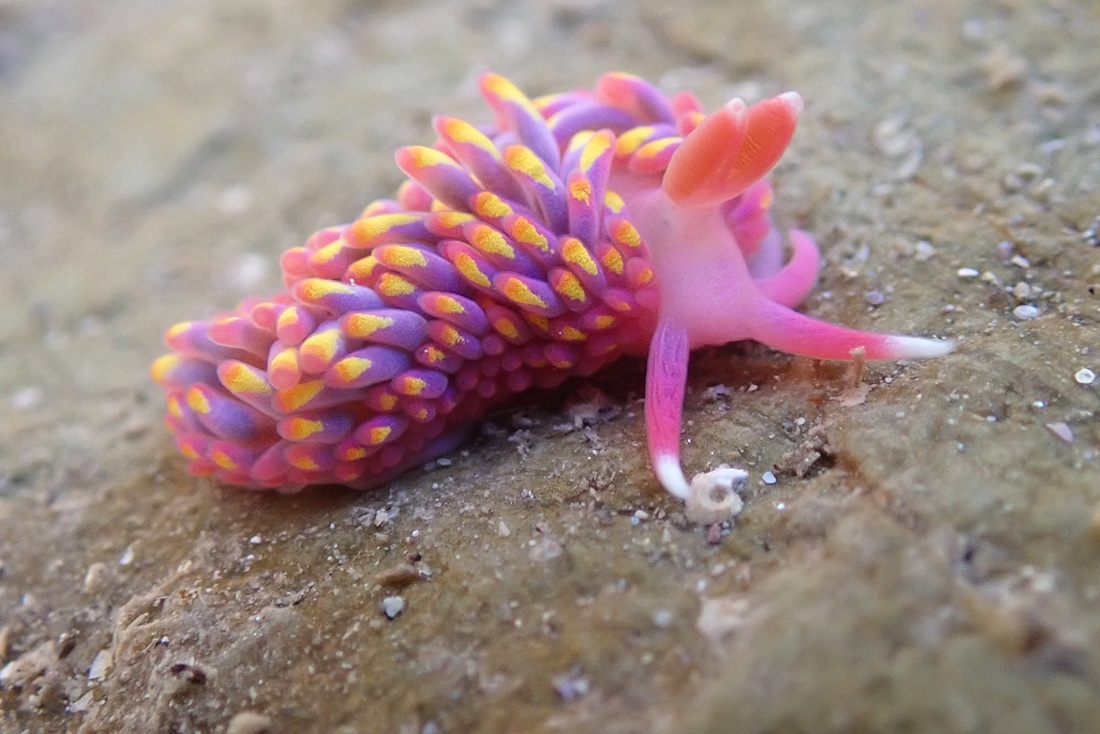
    Brightly coloured pink purple and yellow sea slug.
    Rainbow sea slug, Babakina anadoni… strutting its stuff!

    The intertidal rocky shore is a fragile environment that we can all help to protect. If you are heading out to look at the wildlife, join a local expert-led event if possible and be sure to follow my rock pooling tips to help you to look after the wildlife and stay safe.

    This website is a labour of much love and the content is available for free to everyone. My wonderful readers often ask if there is a way to support my work. You can now ‘buy me a coffee’ through my Ko-fi.uk page. (Just click donate and you can set the amount to pay by PayPal). Thank you!

    Buy Me a Coffee at ko-fi.com

  • Wishing on a Rosy Feather Star

    Wishing on a Rosy Feather Star

    It’s been a while since I posted – thank you for bearing with me. I have so many rock pool adventures to share. I hope you will love this rosy feather star as much as I did.

    “Do you see many feather stars?” Libbie asks. We’re on a favourite north coast beach, where we randomly first met a few months back. This time, she has brought her sister in law, Lynne, whose joyous rockpooling Twitter feed I highly recommend: lynne (@lynne08777205) / Twitter.

    Asterina phylactica cushion star among seaweed
    An Asterina phylactica dwarf cushion star among the seaweeds – one of our first finds of the day.

    I admit that I have never seen one. Neither have Libbie or Lynne. I am convinced feather stars are somewhere here on this very beach, but it feels as though I’m looking in the wrong way. Perhaps between us, we’ll spot one? We all agree that sometimes you find things just because you have decided to. This, we say, will be our lucky day.

    There is plenty to keep us occupied, including some new life. This is good to see after the heat-bleached seaweeds and poor water quality we have experienced around the coast over the summer. Young Montagu’s blennies flit between the rocks and turn their large eyes to watch us. Libbie discovers a juvenile white-ruffed sea slug (Aeolidiella alderi) under a small slate.

    Juvenile Aeolidiella alderi slug found by Libbie.
    The second slug of the day – another gorgeous white-ruffed sea slug, Aeolidiella alderi.

    Nearby, an even smaller solar powered sea slug, Elysia viridis is out in search of seaweeds to eat. Under my camera, we can see the green and turquoise colours, clues to the presence of chloroplasts from algae it has consumed, which are still photosynthesising – making glucose inside the slug’s body.

    A “solar powered” sea slug – Elysia viridis

    While the tide recedes, we take a leisurely look into pools packed with St Piran’s hermit crabs and discuss Lynne’s wishlist for the day (Celtic sea slugs, Scarlet and gold cup corals and blue-rayed limpets). They are all species that don’t move far or fast and conditions are ideal.

    Excitingly, there are some very small baby St Piran’s hermit crabs like this one in the pools. The next generation is doing well.

    Junior, who now knows these rocks as well as I do, sets a course across the slippery stream bed towards an area where we’re almost sure to find everything we’re looking for.

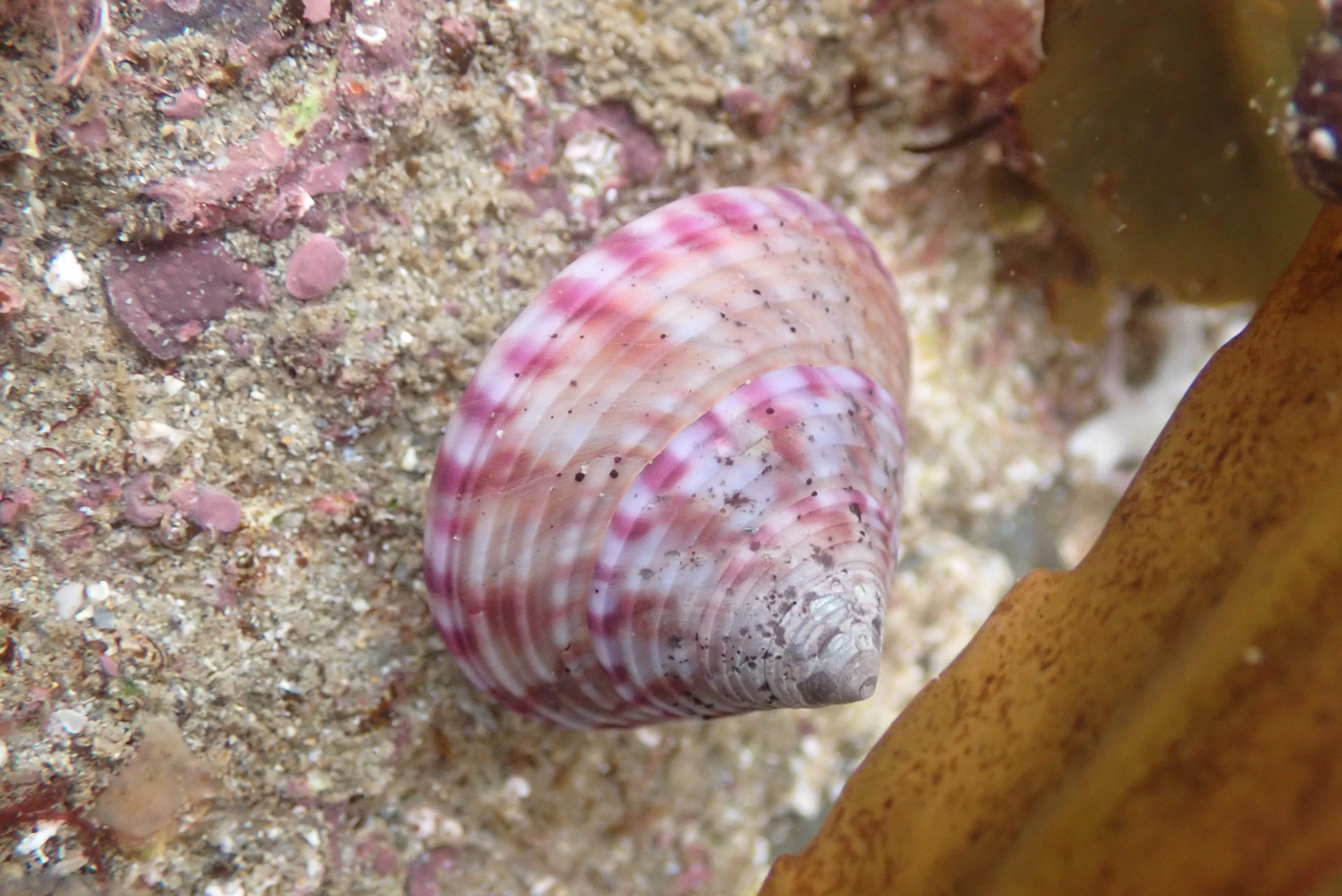
    The painted top shells come in especially striking colours on this beach.

    As always, progress is slow. There is so much to see and we can’t resist checking every pool. There are vivid pink painted top shells and all sorts of fish and crabs. To my excitement, we find a species I haven’t noticed before, Perophora listeri – a cluster of small bubble-like sea squirts on the red seaweed.

    Perophora listeri sea squirts
    Perophora listeri sea squirts

    In a wide pool near to where Junior is searching for Celtic sea slugs, we settle down to look closely at the rainbow wrack. Not only is this bushy seaweed a brilliant iridescent turquoise color and a favourite place for catsharks to lay their eggcases, it is also teeming with life, like a miniature forest.

    Pheasant shell
    A cowrie moving over an Asterina phylactica cushion star and a turf of other creatures.

    Pheasant shells roam the canopy, young anemones cling on like epiphytes and the dense animal crust of sponges, sea squirts, hydroids and bryozoans around lower ‘branches’ attracts cowries and other small predators. Pretty Asterina phylactica cushion stars are everywhere and as I look down into the base of the seaweed, something else grabs my attention.

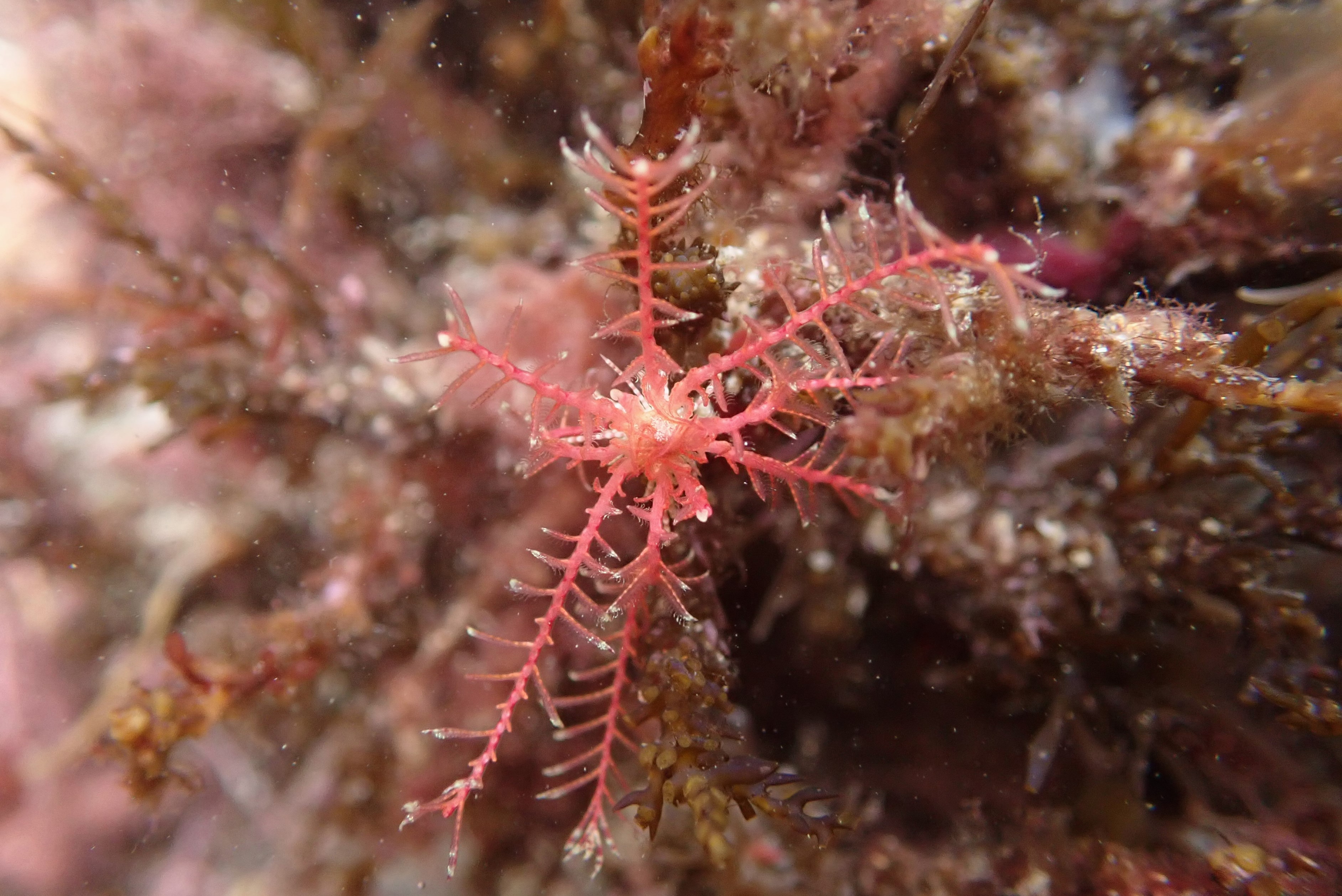
    There is a bright pink, branched shape that doesn’t look like seaweed. I crawl in close to get my camera in position, but I already know what it is. “A feather star!” I gasp. It seems ridiculous to find one just because I’m looking, but there it is.

    Our first rosy feather star!

    As we watch, the rosy feather star extends and retracts its arms, uncurling them to show the alternating twiggy branches along the sides. These are fringed with a little comb-like structure to catch passing food. The animal is clinging onto the seaweed with its hooked pink-striped “cirri”. It is such a shocking coral pink colour that it seems impossible I would overlook one, but it is well hidden under the seaweed and camouflaged against the crust of pink seaweed and the coral weed that lines the whole pool.

    Convinced there must be more feather stars here, I search for a while without success. In the meantime, Junior has found everything on today’s wish list and is keen to show Lynne and Libbie before the tide comes up. Sure enough, we are treated to scarlet and gold cup corals, blue rayed limpets and quite a battalion of Celtic sea slugs!

    Celtic sea slug
    Blue-rayed limpet on seaweed

    Soon the oystercatchers are moving up the shore with the tide and it is time to retreat. We sit at the top of the shore, watching kestrels hovering over the clifftop while we enjoy a much-needed picnic. Buoyed by our success with the feather star, we reckon we should carry on actively looking for unlikely things next time. Soon, we have a whole list. Cuttlefish, octopus and seahorses, here we come!

    A few more bonus creatures from our day’s rock pooling!

    Clingfish sp. – probably small-headed clingfish.
    Candelabrum cocksii hydroid
    Botryllus leachii colonial sea squirt
    A pretty chiton (a type of mollusc). Lepidochitona cinerea

    This website is a labour of much love and the content is available for free to everyone. My wonderful readers often ask if there is a way to support my work. You can now ‘buy me a coffee’ through my Ko-fi.uk page. (Just click donate and you can set the amount to pay by PayPal). Thank you!

  • Rock Pooling at Lizard Point: Cowries, Sea Slugs and a Saffron Bun

    Rock Pooling at Lizard Point: Cowries, Sea Slugs and a Saffron Bun

    It’s not exactly tropical, but we’re as far south as you can go on the UK mainland. The sun is shining and the clear water gives us a perfect view into the pools. After a morning of geological exploration at Kynance Cove, my family are treating me to some low tide rock pooling here at Lizard Point.

    Rock pools at Lizard Point

    Apart from the chatter of seabirds and a distant hum of voices from the cafés perched on the cliffs, the beach is still, expectantly waiting for the tide to turn. Out in the bay, a bull grey seal rests upright in the water. He is ‘bottling’, his broad snout raised to the sun, keeping half a sleepy eye on the female that is snoozing closer to the shore. There are no boats here to disturb the seals, so they nap peacefully on and on, barely moving with the gentle rise of the swell.

    The colours in the pools are as vivid as a royal procession. Neon green snakelocks anemones jostle for space with dusky pink coralline algae, yellow sea squirts and iridescent blue seaweed. Tiny rainbows play across the rocks.

    A colourful pool at Lizard Point – Snakelocks anemone

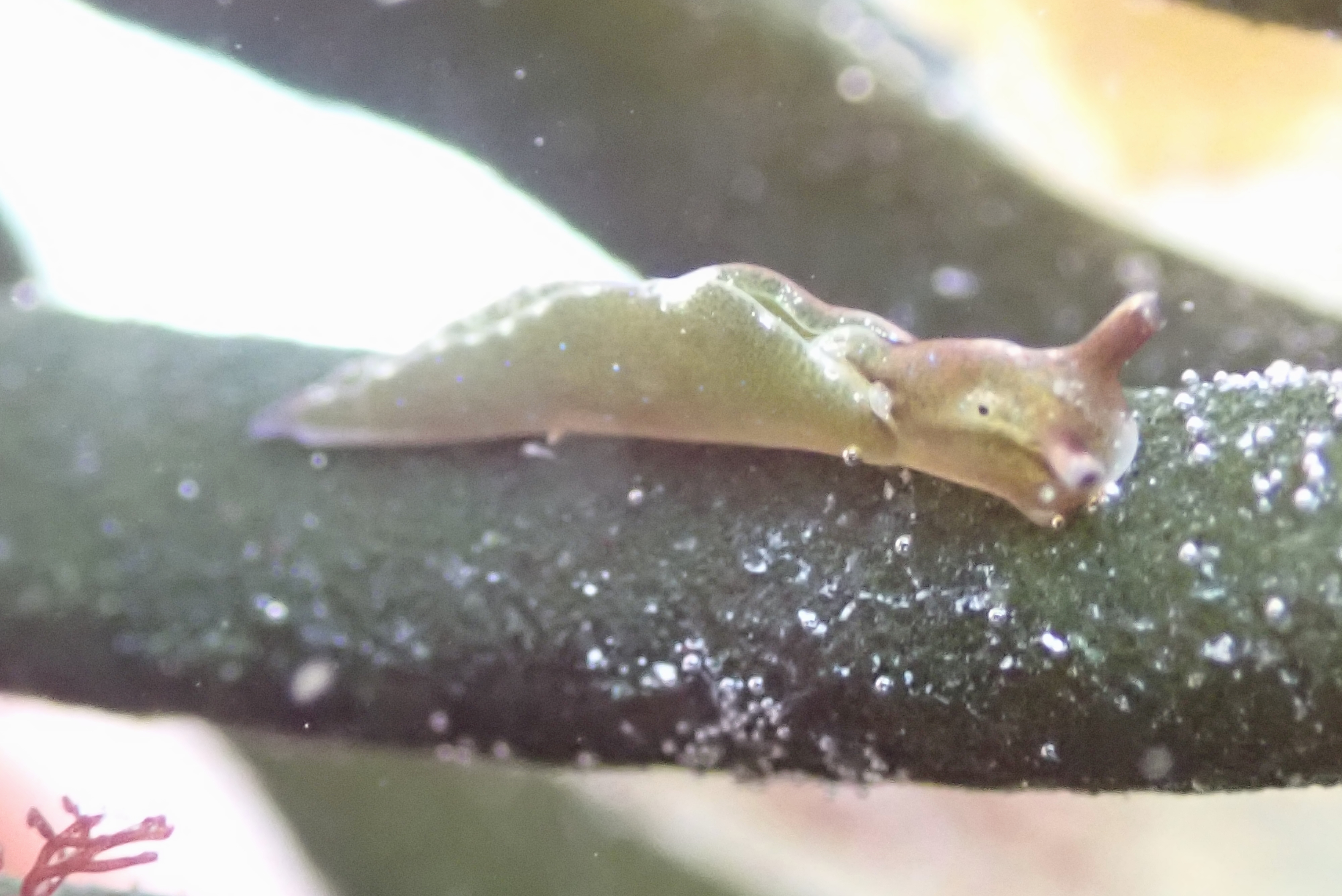
    Looking closer, we begin to notice other rock pool wildlife that is less keen to stand out, adopting the same bold colours as the seaweeds and encrusting animals to hide from predators. Tiny Elysia viridis sea slugs are everywhere, but they match the deep green of the codium seaweed perfectly.

    Elysia viridis on codium seaweed.

    These are the ‘solar powered’ sea slugs. They retain the seaweed’s chloroplasts, which carry on photosynthesizing in their bodies, making glucose to supplement the slugs’ diet.

    Elysia viridis sea slug stretching out to make the most of the sunlight. Spot the second slug!

    A variety of animals are resplendent in shocking pinks and oranges, which allow them to disappear among rocks adorned in pink paint seaweed and forests of other red seaweeds. A European 3-spot cowrie (Trivia monacha) is roaming the rocks looking for sea squirts to eat.

    Trivia monacha – the European 3-spot cowrie at Lizard Point. It feeds on sea squirts like the blue star ascidian to the left of the photo.

    With its sunset-orange proboscis fully extended and its spotty mantle draped over most of its shell like a (fake) fur cape, it has the air of a glamorous Dalek.

    European 3-spot cowrie (Trivia monacha) doing a Dalek impression

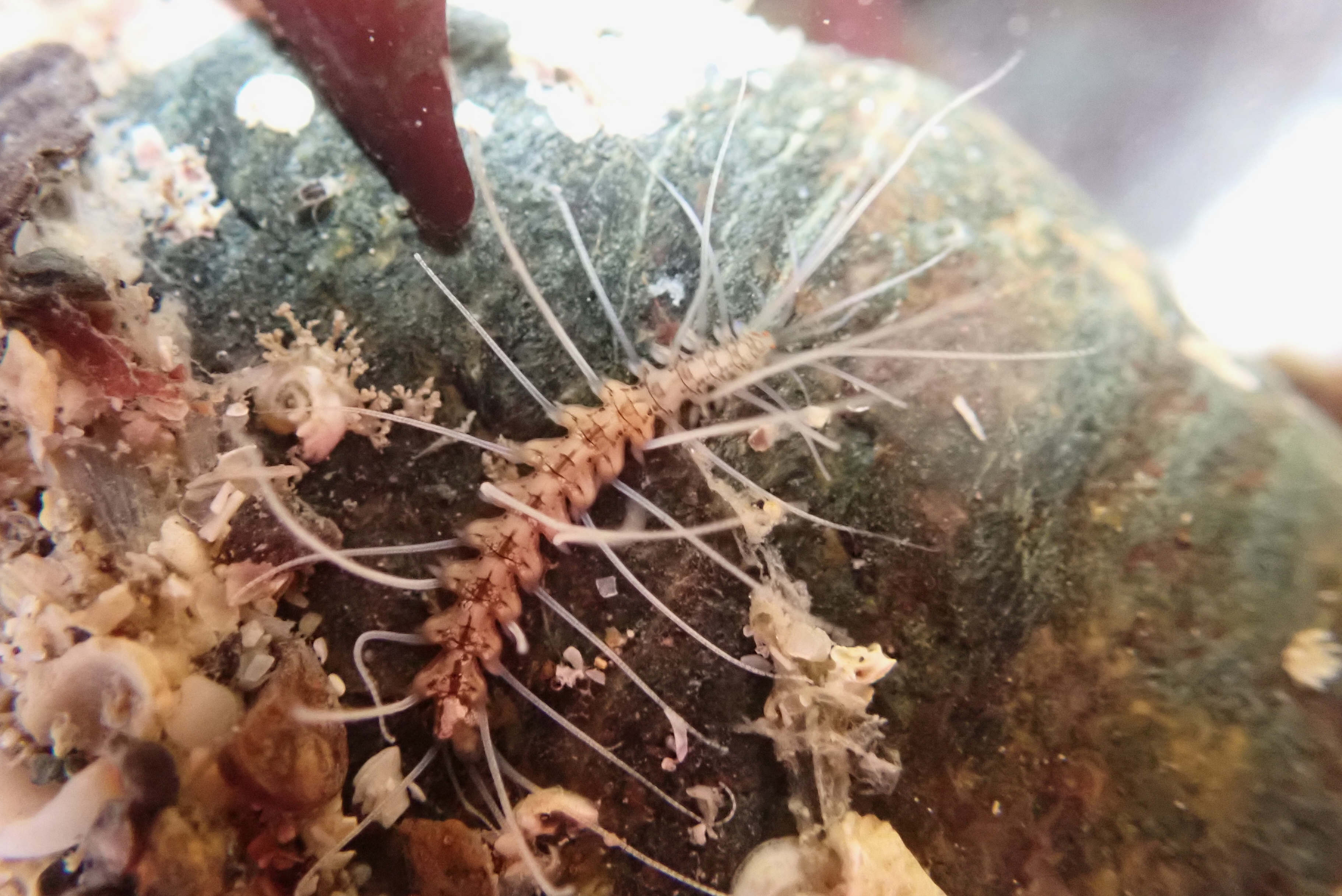
    Not to be outdone by the molluscs, there are some stunning worms in the pools. My favourite is this syllid worm, gliding across the rock with its enormously long, whisker-like appendages stretching and curling in all directions at once.

    Syllid worm. Amblyosyllis sp. looking spectacular. Lizard Point, Cornwall.

    This feels like a spot that sea slugs should like. There is a variety of food on offer and no shortage of hiding places among the pools and boulders. Sure enough, under one rock I find two species hanging out together. They look like friends, but they are on separate missions. The great grey sea slug (Aeolidia filomenae) feeds on anemones, while the Berthella plumula – or feathered Bertha as I like to call it – eats sea squirts or sponges.

    A quick hello in passing – Great grey sea slug (Aeolidia filomenae) and Berthella plumula sea slugs.

    Junior, who excels at gathering people to look at things, has collected up an excited young boy and his grandfather to show them the pools. We all find things to show them – solar powered sea slugs, hermit crabs and a stalked jellyfish. While Junior is explaining barnacles to his fascinated audience, I wander down the shore, thinking I might find a starfish for him to show his new friend.

    Stalked jellyfish (Haliclystus octoradiatus) on codium seaweed at Lizard, Cornwall. Photo by Cornish Rock Pools Junior

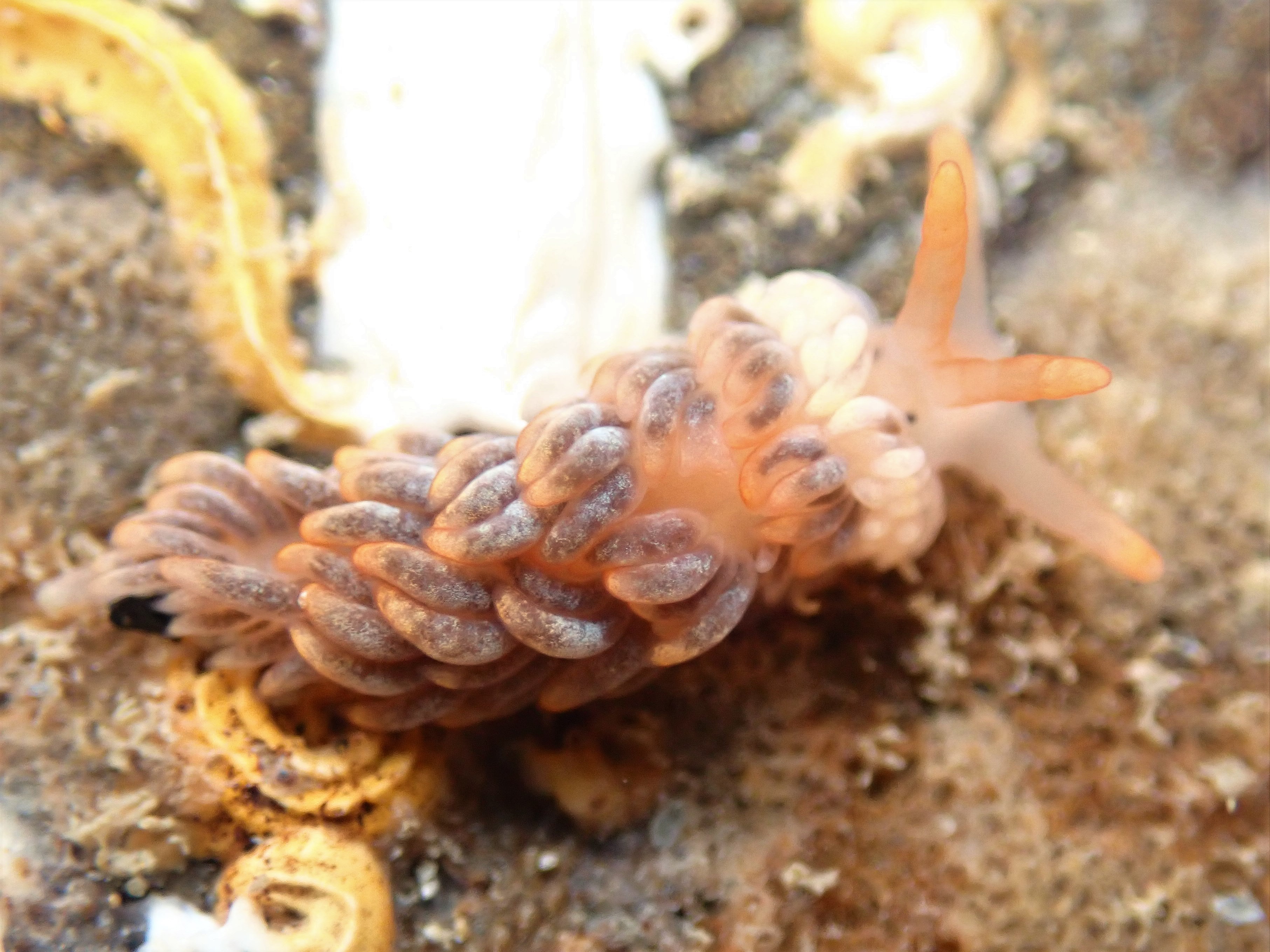
    Sheltering under a small stone is a neat five-armed cushion star, but close to it, even more excitingly, there is a slender little Aeolidiella sp. sea slug.

    This slug looked a little different: Aeolidiella glauca

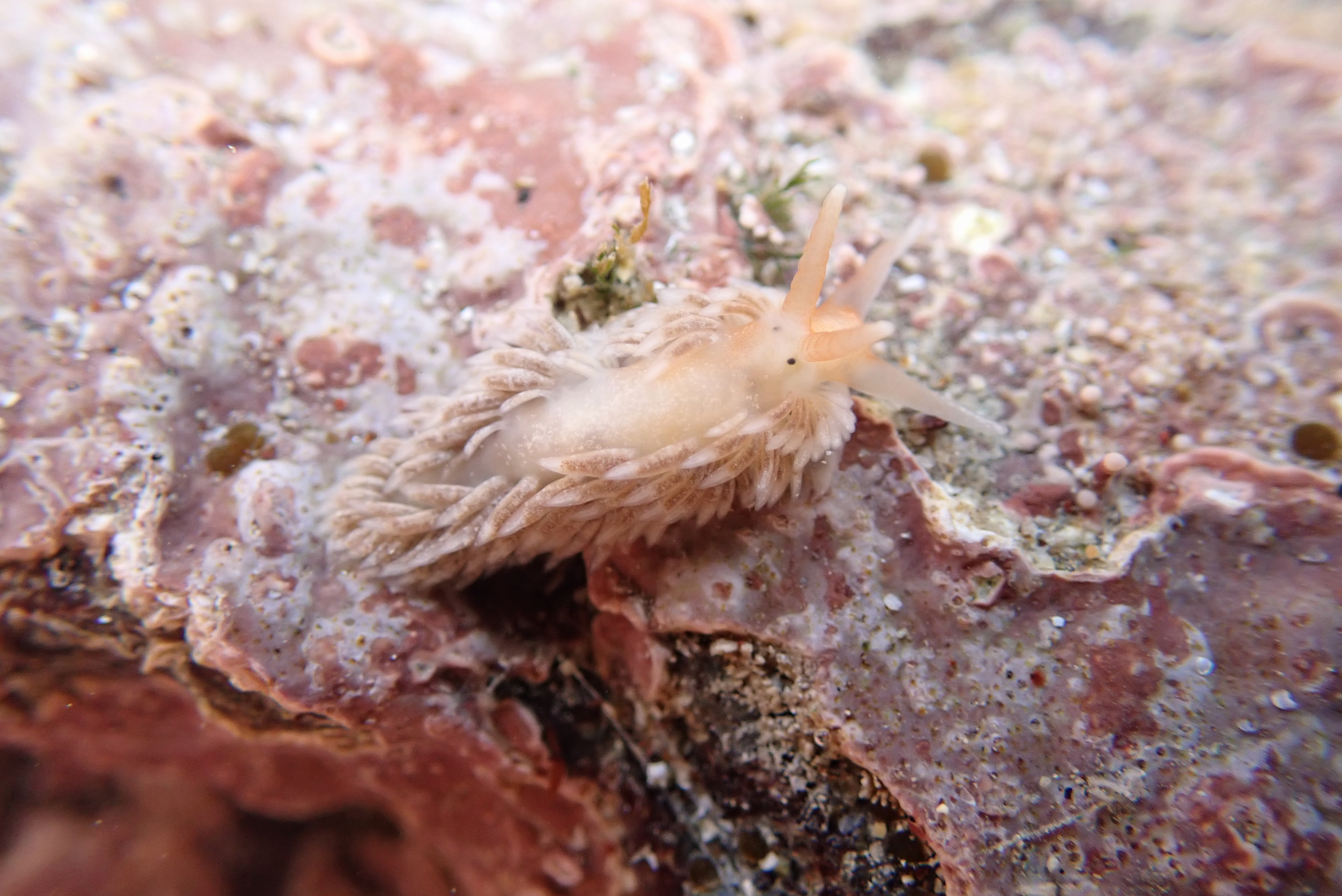
    Aeolid slugs vary in colour depending on what they have eaten, but there is something unusual about this one that I can’t place. It has a bit of a white ruff behind its head, but I’m not convinced it is the white-ruffed sea slug (Aeolidiella alderi) that I frequently see.

    Aelolidiella alderi (pictured near Falmouth) is the more common species locally. It is often white or grey, but can take on bright colours like this after eating anemones.

    I take some photos. Zooming in, I soon ‘spot’ the difference; the difference is the spots! There are tiny white flecks on the slug’s body. I take photos in the pool before ensuring it is returned safely back under its stone.

    Aeolidiella glauca sea slug, Lizard, Cornwall

    Despite my rush to identify the slug (which I suspect is an Aeolidiella glauca) there are even more important things to do on the way home: like stopping for a saffron bun and ice creams at Roskilly’s, and visiting friends in Gweek.

    Thanks to the wonders of expert Facebook groups and also the brilliantly helpful David Fenwick of Aphotomarine, I have confirmation the same day. Aeolidiella glauca has occasionally been recorded in this area before, but it’s a first for me. It may be more common in northern waters, but marine creatures rarely follow the rules.  There are surprises everywhere and that is exactly what makes rock pooling so fabulous.

    Another lovely little find: Lamellaria latens (gastropod mollusc) at Lizard Point
    Dahlia anemone at Lizard Point, Cornwall
    Gem anemone. Lizard Point, Cornwall.

    Whatever the weather, always stay safe in the rock pools. Follow my rockpooling tips to look after yourself and the wildlife on the shore.

    This website is a labour of much love and the content is available for free to everyone. My wonderful readers often ask if there is a way to support my work. You can now ‘buy me a coffee’ through my Ko-fi.uk page. (Just click donate and you can set the amount to pay by PayPal). Thank you!

  • Who Needs Mythical Beasts? Rocket Jellies, Snakelocks Anemones and a Dragonet

    Who Needs Mythical Beasts? Rocket Jellies, Snakelocks Anemones and a Dragonet

    When my son was younger he thought he saw a kraken. I returned from releasing a crab after an event for the local Cub pack to find him and a friend staring out over the sea, shading their eyes to better spot tentacle tips or unusual splashes among the waves. They were quite sure it was out there.

    I watched with them for a long time, until the tide was lapping at our boots, because you never know what might be in the sea. A giant squid would be unusual, but our oceans are full of things that are so weird we are only just beginning to understand them. We sometimes see seals, dolphins and fish feeding frenzies, so why not a kraken?

    Since then, my son has grown up a lot and is less sure that there are krakens in Looe. We no longer spend much time hiding in the woods looking for dragons or watching the waves for sea serpents. Junior still loves mythology, Cornish and otherwise, but knows that the real world has as much strangeness as fiction.

    We are two minutes into this week’s rock pool expedition when he calls to me urgently to look at a thing he’s found.

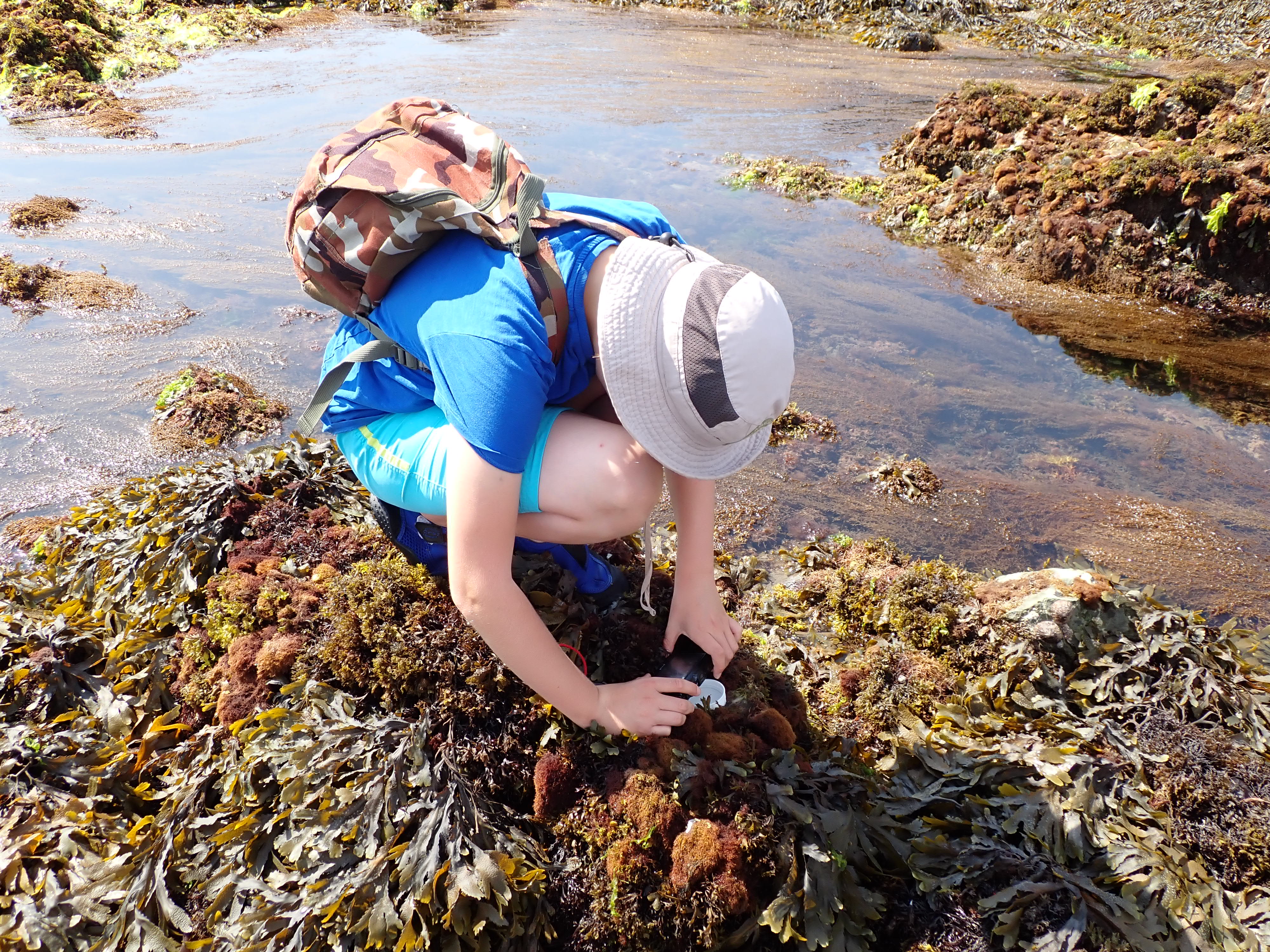
    Junior at work!

    “I think it’s a hydroid medusa,” he says, because there’s not much he doesn’t recognize these days. “Quick, it’s going to get away.”

    I grab a pot and wade over to where he is pointing. Staring into the tangle of colourful seaweeds, at first I see nothing.

    A flicker of movement has me scooping up the water and when I look in my pot there is a tiny creature zipping from side to side, throwing itself against the edges of the pot like a trapped Trogglehumper. Of course, this creature is not a Roald Dahl creation, but an actual, fabulous marine animal. My books call it a ‘root arm jelly’, although Junior and I know it by a different name.

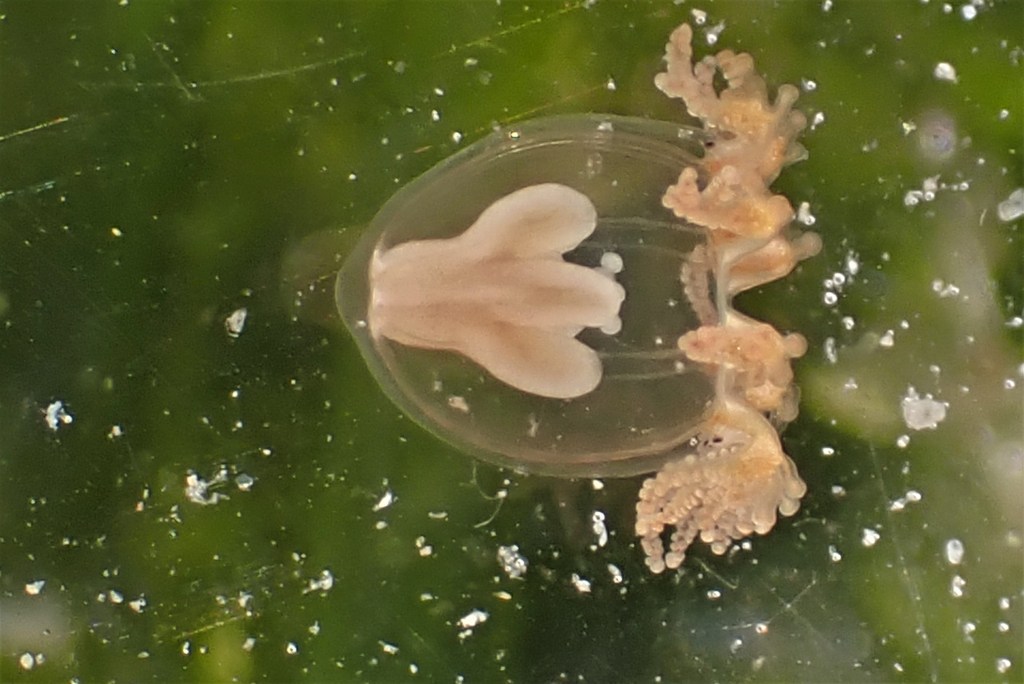
    Whoosh! A rocket jelly. (Cladonema radiatum – aka the root arm jelly).

    “Rocket jelly!” we shriek in delight.

    With great care, we transfer the jelly into the lid of the pot to see it better.

    The underside of the hydroid medusa (Cladonema radiatum – the root arm jelly)

    The main part of its body, measuring less than a centimetre, is a perfectly transparent dome, through which we can see its rocket shaped internal parts. Pointing downwards, a mouth fringed with ball-shaped structures is feeling about, moving left and right.

    The jelly’s transparent body with dark eyespots around the edge. Root arm jelly (Cladonema radiatum).

    At the base of the medusa’s dome there are several dark eyespots. Spreading out at around them, like the fire below a rocket, are the most incredible red tentacles. They are branched, curled and almost feathery. As we watch they expand and contract, feel and reach.

    Every time I focus on the medusa, it fires itself off in a new direction. Zooming from one side of the petri dish to another in an instant.

    I have never seen a medusa with such expanded tentacles before, but I am sure this is the same species of ‘rocket jelly’ we have seen before (Cladonema radiatum).

    Those little tentacles pack a strong sting for their size; it is an efficient little predator. I always find it hard to comprehend is that this free-swimming, speedy jelly is the reproductive stage of a colonial hydroid: an organism which lives attached to rocks or seaweed and doesn’t move from the spot.

    Obelia geniculata - a hydroid known as 'sea fir'.
    Hydroids like this sea fir, Obelia geniculata, live attached to seaweeds.

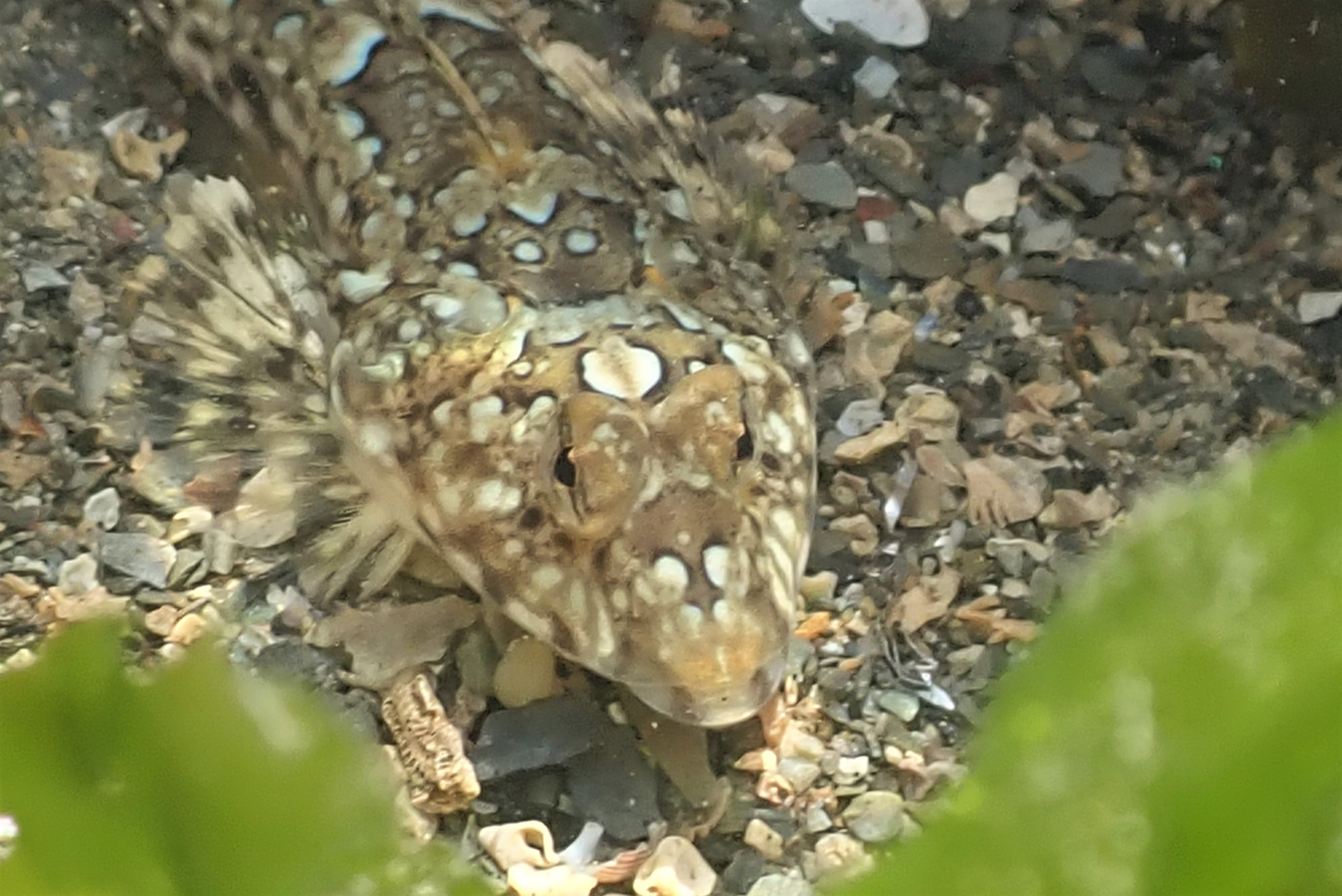
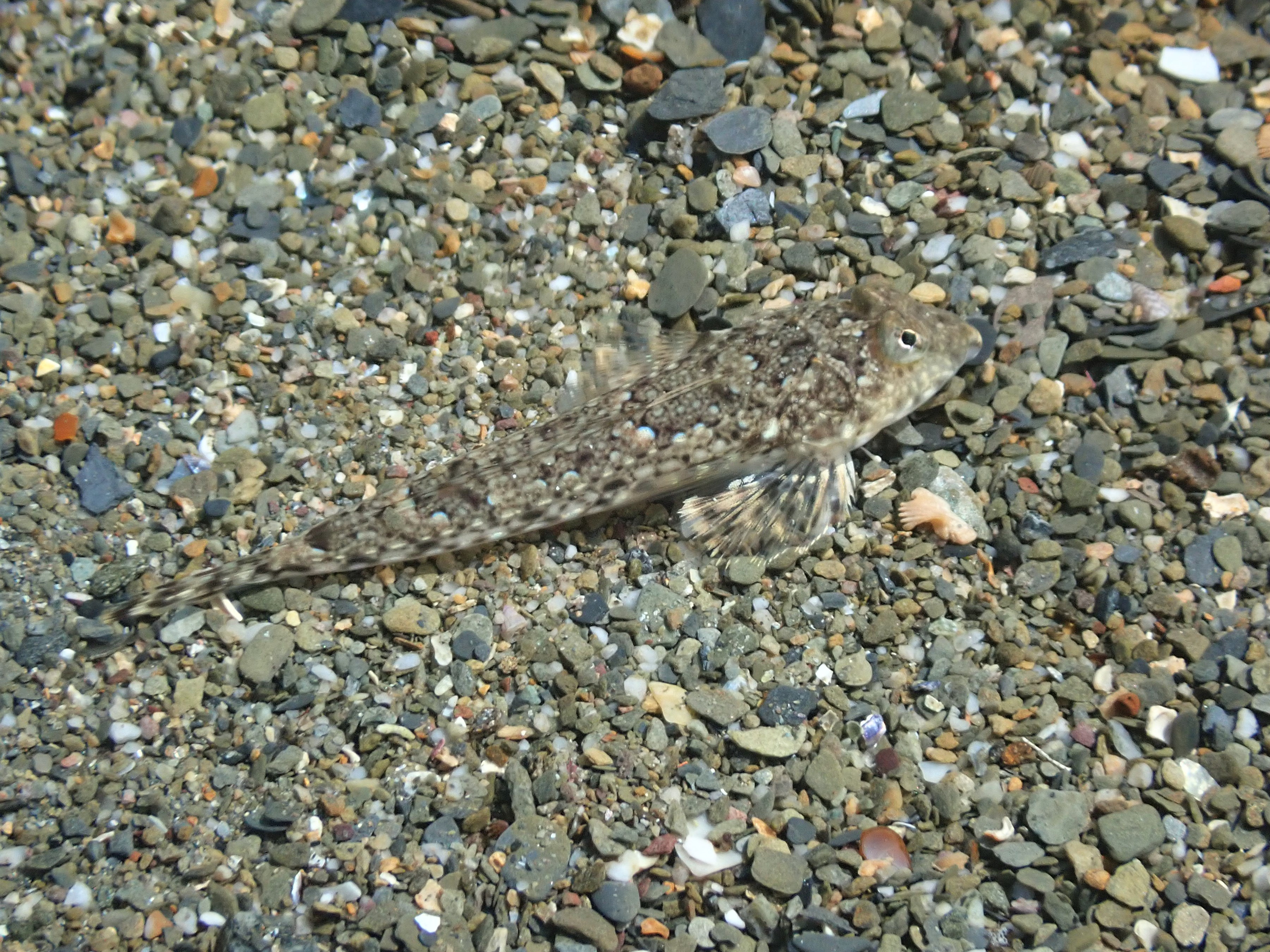
    While Junior takes photos of the rocket jelly, I notice a young fish glide over the sand, stopping near my feet. It has mottled markings in blue, orange and brown, which look colourful and yet provide the fish with an ideal camouflage among the sand, pebbles and shell fragments. Its eyes are mounted high on its head, giving it a wide field of vision. This is the wonderfully-named dragonet.

    Dragonet lying still on the sand. Despite the lovely colours, it is perfectly camouflaged.

    These captivating fish have a distinctive way of swimming in short bursts across the seafloor and they have an exceptionally long first dorsal fin. Male dragonets raise this sail-like fin as part of a mating dance, which I would love to see some day! It is perhaps this display, somehow reminiscent of a frill-neck lizard opening its collar, that gives these fish their fabulous name.

    Dragonet saying hello to my camera!

    The dragonet comes unusually close to my camera before scudding away over the sand, becoming invisible every time it stops.

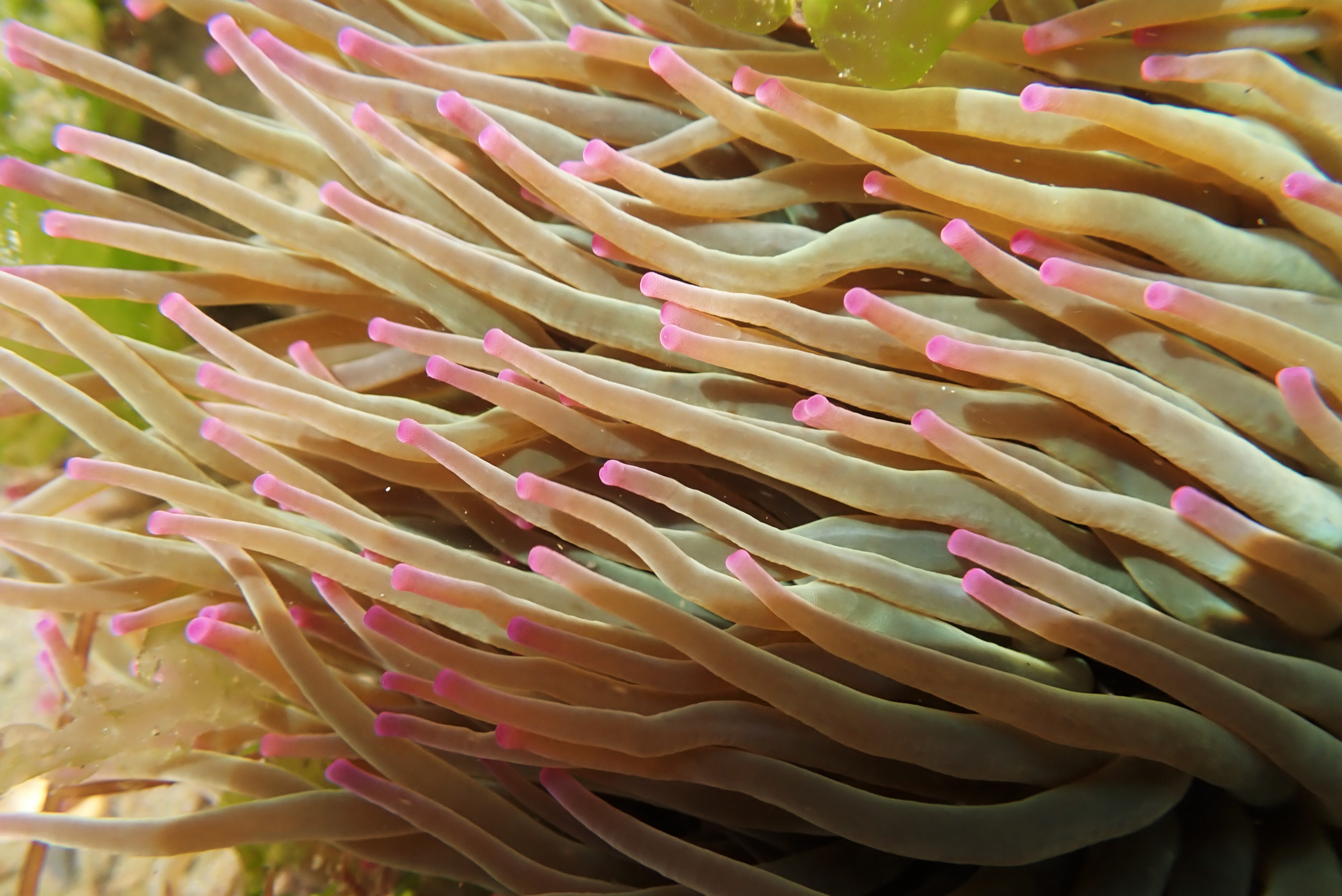
    I take some photos of another striking animal with a mythical name, which seems to abound in this pool: the snakelocks anemone. Just like the Medusa of Roman mythology, this anemone has long, green moving ‘hair’. Instead of being made of snakes, though, the anemone’s locks are its stinging tentacles. They are pretty but deadly, especially if you are a small animal, or even quite a big one. We’ve often seen crab legs hanging out the mouths of these large anemones.

    Snakelocks anemones in the rock pool.

    Some snakelocks anemones are neon green with purple tips, while others are a muted beige colour. Out of the water, they are a sorry squidgy mess of jelly but in the pools their tentacles move and flow, sometimes with the current, sometimes reaching and grabbing for prey they have sensed.

    Snakelocks anemone – some are green and some are beige.

    The chug of a boat makes us look up. Unusually for this area, there is a dive boat close to the rocks. Two-by-two, people in Scuba gear pop up on the surface and clamber aboard. I wonder what they have seen and whether they have noticed the tiny rocket jellies, lurking dragonets or even the medusa-haired snakelocks anemones.

    Dive boat close in to shore.

    Perhaps the divers have seen the kraken as they’ve explored the sea just beyond our reach. Even if they have, we don’t feel we have missed out by being confined to the land. The rock pools are full of truly magical beasts. You just have to look.

    Snakelocks tentacles waving in the current.
  • paddle–swimming And fish-whispering: Summer rock pooling in Cornwall

    paddle–swimming And fish-whispering: Summer rock pooling in Cornwall

    The sun is back and, for once, it has coincided with some big tides. Beach shoes at the ready, Junior and I scramble across the rocks, the clamour of the busy beaches far behind us, heading for our local pools. With Covid levels higher than ever in Cornwall at the moment, we’re hiding away from the crowds as much as we can.

    The view to Downderry from East Looe.

    We are so used to having to put on layers, waterproofs and wellies that it feels quite decadent to be able to wander about comfortably in shorts. The water is sparkling and the sun’s reflection on my camera screen is so strong that I can’t see the image properly, even when I adjust it to maximum brightness.

    I might not be able to see much at first, but the pools are full of life. We cross the rocks to a wide pool fringed with oarweed and sugar kelp. We slip and slide over thongweed and step carefully into the cool water to avoid disturbing the wildlife.

    Gorgeous blue-rayed limpets are everywhere on the kelp.

    A small movement reveals the presence of a well-camouflaged dragonet. Knowing how hard it is for anyone to detect it, the fish takes its time, gliding a short distance across the sand then taking a break, seeming to disappear each time it stops.

    The dragonet blends in perfectly with the sand, pebbles and shells.
    Dragonet

    Among the delicate red seaweeds, there are plenty of stalked jellyfish (Haliclystus octoradiatus). Their colour range is the same as that of the seaweeds, so although they are bright and attractive, they are not easy to spot.

    Stalked jellyfish: Haliclystus octoradiatus

    With every step I am getting deeper into the pool, but for once it doesn’t matter. Soon I am right in the middle, with water lapping up to my waist. A blue dragonfly zigzags past me, swooping low before turning back and disappearing towards the cliff.

    I wade over to a tall rocky overhang while Junior enjoys a swim across the pool. There are several large fish flitting in and out of the kelp so I lower my camera a little at a time to see how they react. When this is successful, I decide to make the very best of the summer conditions. I pull my swim goggles on and lower my head into the water.

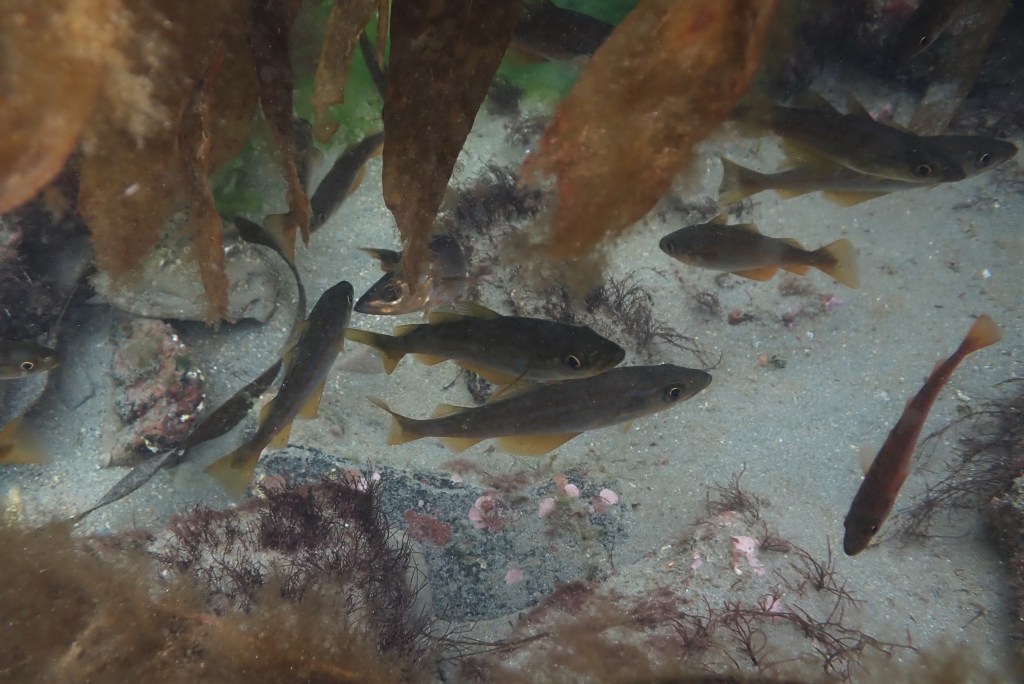
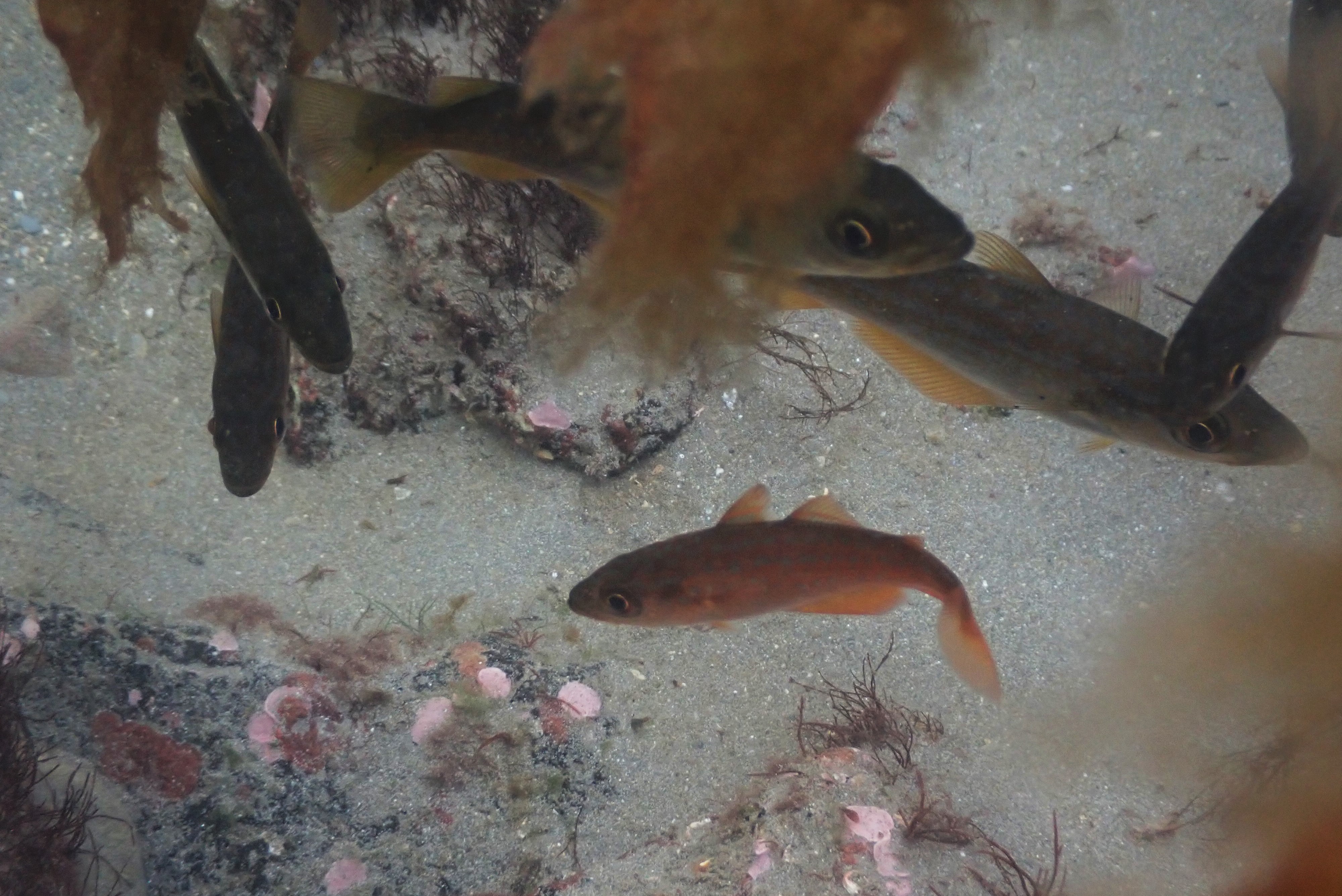
    The fish (juvenile pollock) are stand-offish at first

    There is a nursery shoal of juvenile pollock down here.  They hesitate at first. Winding their slender bodies through the kelp fronds, they watch me through wide yellow-rimmed eyes.

    The young pollock get ever closer to take a look at me.

    I’ve always thought of pollock as a silver coloured fish, but these youngsters are golden-green with shimmering blue stripes running from their head to their tail. Their jutting bottom lip makes them look open-mouthed, mid-conversation.

    Hello fish friends! The young pollock are keen to take a close look at my camera.

    They are certainly a friendly bunch, swimming ever closer to the camera until their tails are brushing the lens. I have to keep lifting my head to breathe, but they don’t seem to mind.

    Video: Hello fish!

    After a while, I leave the pollock to talk among themselves and move on to an adjoining pool. A shoal of sand eels is patrolling here. These fish are of a more nervous disposition, turning, balling and flashing with silver at the slightest disturbance. If they spotted a predator, they would flee head-downwards, burying themselves in the sand in an instant.

    Sand eel swim-past.

    I move slowly and give the sand eels space, turning my attention to the sea squirts and snails on the rocks.

    An especially pretty yellow star-ascidian surrounded by pink algae and red seaweeds.

    When the tide turns, Junior and I retreat to the first pool, swimming and bobbing in the water, watching butterflies tumble past and swallows circling high above. There are boats, people and a whole world out there, but, like the pollock, we are happy in our rock pool refuge.

    Even the seaweeds are shining in the sun. Forkweed, Looe, Cornwall.

    Whatever the weather, always stay safe in the rock pools. Follow my rockpooling tips to look after yourself and the wildlife on the shore.


    This website is a labour of much love and the content is available for free to everyone. My wonderful readers often ask if there is a way to support my work. You can now ‘buy me a coffee’ through my Ko-fi.uk page. (Just click donate and you can set the amount to pay by PayPal). Thank you!

  • Neap Tide Adventures

    Neap Tide Adventures

    Days like this don’t seem ideal for rock pooling; the tide is nowhere near low enough to expose my favourite pools and the weather is iffy. Despite this, I am convinced that there is plenty to see on the mid-shore. Cameras and rock pooling super-crew (Other Half and Junior) at the ready, we set out to uncover marine treasures.

    One advantage of neap tides, when the sea doesn’t go out very far, is that it won’t rush back in either. We can take our time. Junior soon locates lots of gem anemones with their tentacles wide open.

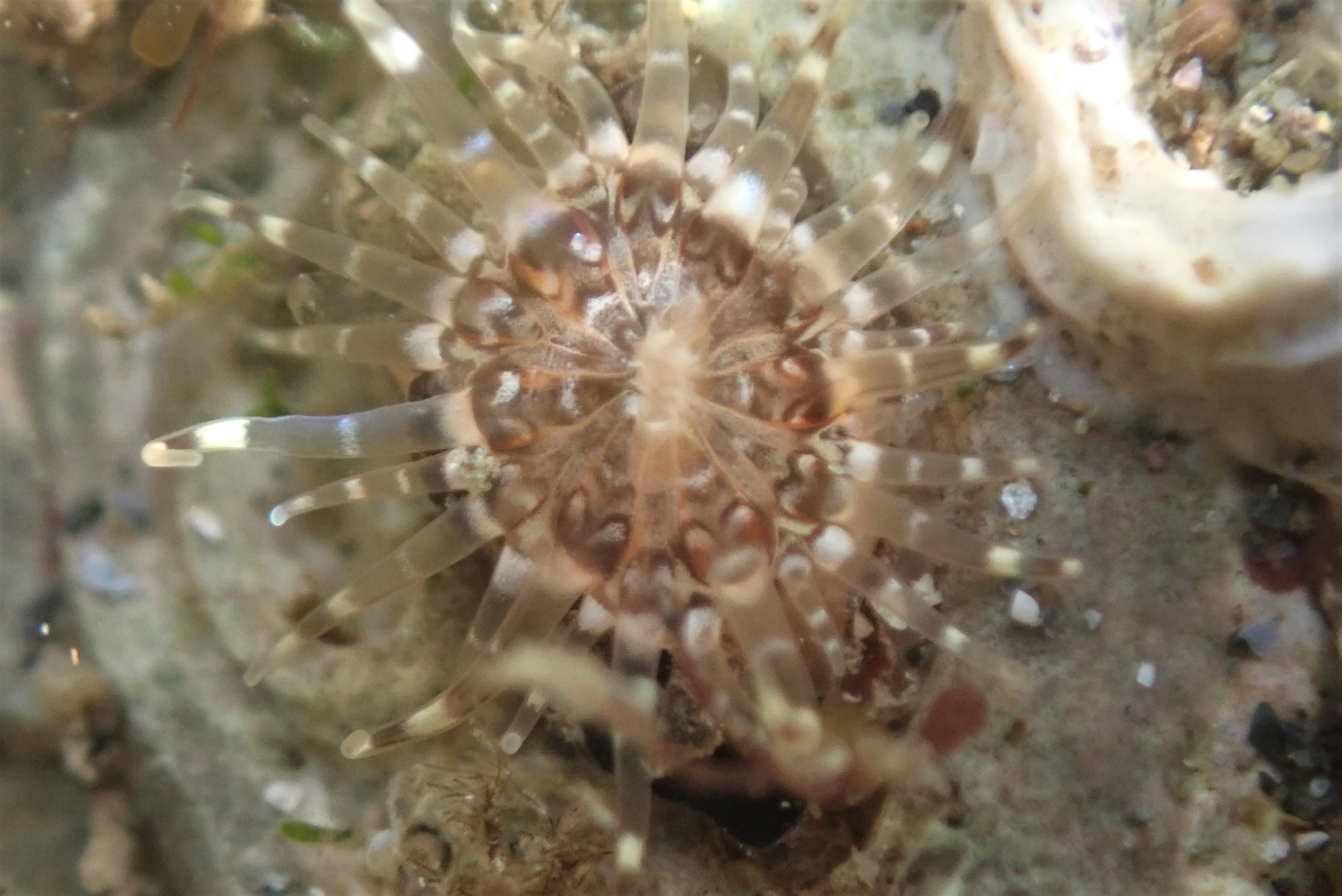
    Gem anemone

    Under a stone further down the shore, I spot a beautifully camouflaged anemone. It’s too small to see properly, so I have to wait until I get home to confirm that it’s a Sagartia troglodytes anemone.

    Sagartia trogladytes anemone

    The B shape at the base of the tentacles is a useful identifying feature, although I’ve always thought they look more like Scooby Doo ghost eyes than letters.

    Other Half calls me over to look at a blob. He’s becoming quite an expert blob finder.

    We look together at the tiny brown jelly-spot on the seaweed. At first, we think it is an anemone because it seems to have a circle of retracted tentacles. As soon as I dunk it in the water though, I can see the pale lumps of primary tentacles around the edge. It must be a stalked jellyfish.

    Is it just me or does this stalked jelly not look pleased to see me? Haliclystus octoradiatus.

    Gradually, the stalked jelly unfurls each arm until it looks much less blob-like.

    Haliclystus octoradiatus -starting to look more like a stalked jellyfish than a blob.

    The rain seems to be holding off now, and I make myself comfortable by a calm pool to watch the little world go by. My camera has barely entered the water before a bold prawn trots out of the seaweed, its legs working at top speed in its eagerness to check out what I’m up to.

    Common prawn coming to take a look at my camera.
    Common prawn

    A head pops up between the fronds of saw wrack at the back of the pool. The young Montagu’s blenny swivels an eye back and forth beneath its jaunty headgear. I feel a larger blenny move through the seaweed near my hand and lift my camera out of the water before I get a nip from the territorial shanny.

    Peek-a-boo! Montagu’s blenny taking a look above the serrated wrack.
    Montagu’s blenny.

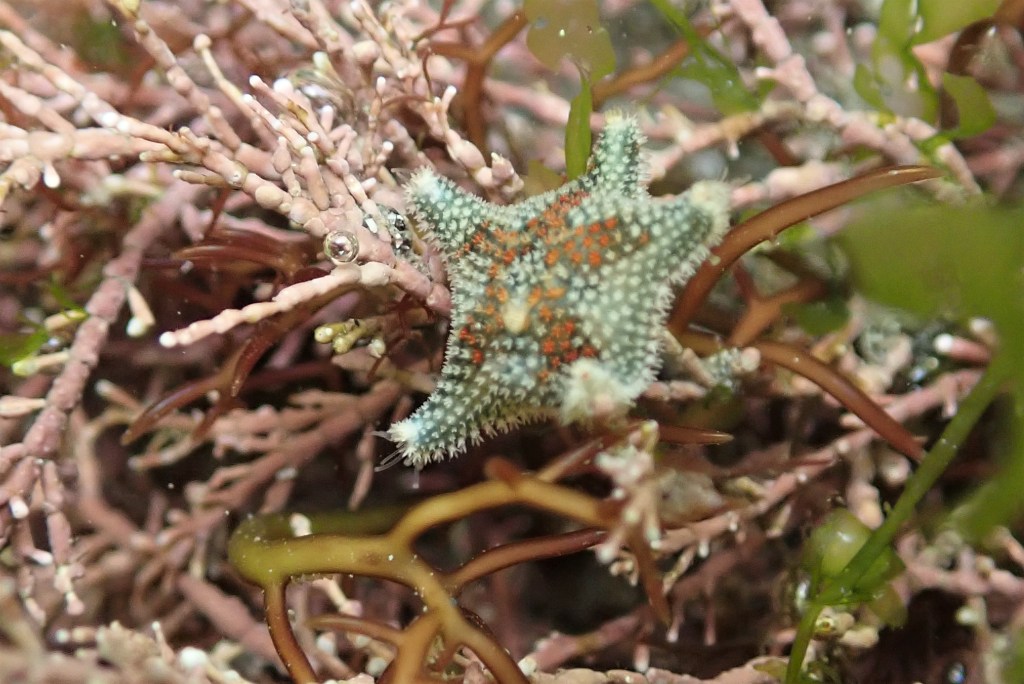
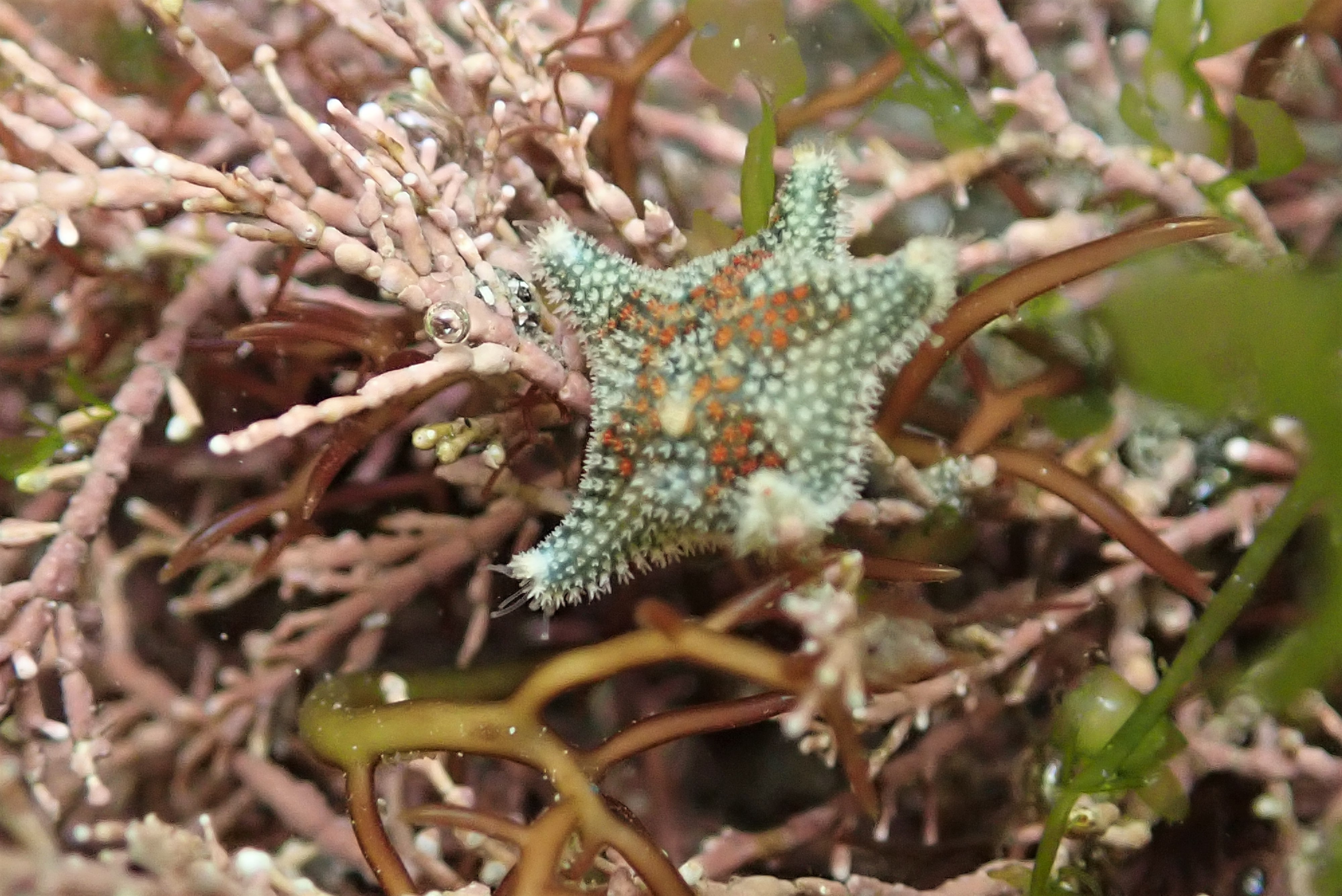
    A dinky starfish in the coral weed catches my eye. I see several species of starfish on this beach, but this is a mid-shore specialist: Asterina phylactica. The colours of the tiny pincers on its back (the pedicellariae) form an orange star shape. Under the camera, I can see its tube feet reaching out and exploring its surroundings as it glides along.

    Asterina phylactica – cushion starfish

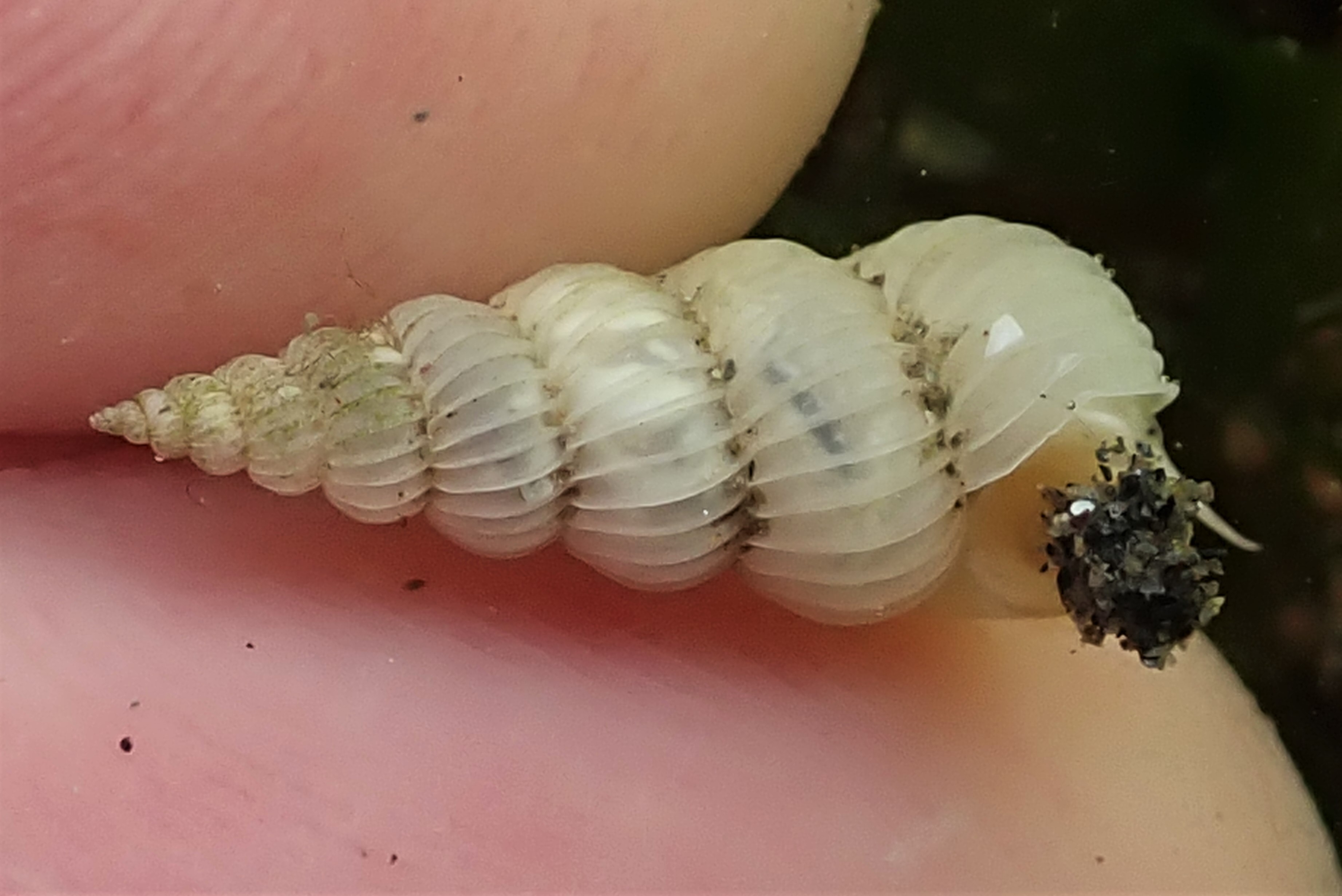
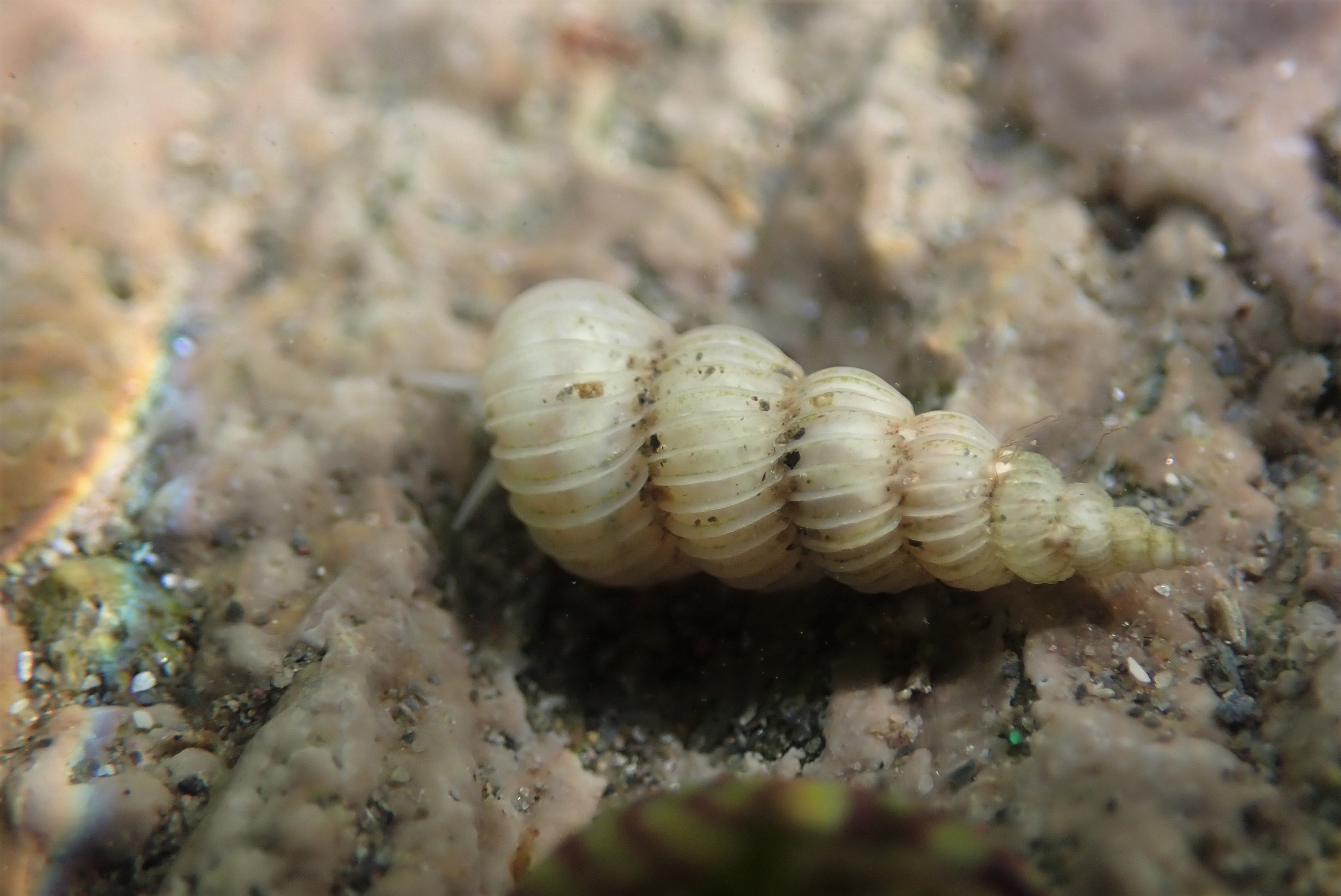
    Other Half brings passes me a tiny shell he has found. He thinks it might be a wentletrap, a shell we sometimes find. I have never seen one so small and assume it is probably a different species. I take a look with the camera and realise he was right. The bold sculpture of ribs over the rounded whorls of the long spire are striking, even in this tiny juvenile. Best of all, the shell is occupied.

    Juvenile wentletrap

    I watch the snail emerge and set off across the pool.

    This makes me think of a unicorn and a rainbow – juvenile wentletrap.

    Sea squirts are something of an enigma to me. They are hugely varied in their colours, shapes and sizes. Aplidium turbinatum, in particular, seems to me to look different every time I find it. When I first see this one, I am convinced that the white, spiky-looking set of openings under the coral weed is a bryozoan.

    I know this looks familiar, but takes me a long time to work out that it is Aplidium turbinatum, a sea squirt.

    Yet, after a while watching it, I realise it is opening and closing like a squirt, puffing water in and out. It bears little resemblance to the orange gelatinous Aplidium turbinatum I usually see further down this beach, but the jutting triangular crowns around the edge of each opening are the same.

    Aplidium turbinatum sea squirts

    Fortunately, I can turn to the incredible Aphotomarine website for confirmation and, sure enough, it has some photos of very similar specimens (thanks David!).

    While the tide seeps back into the pools, we chat with a fellow rock pooler whose photos I have often seen online, and who I eventually realise I have met before in real life through another conservation group.

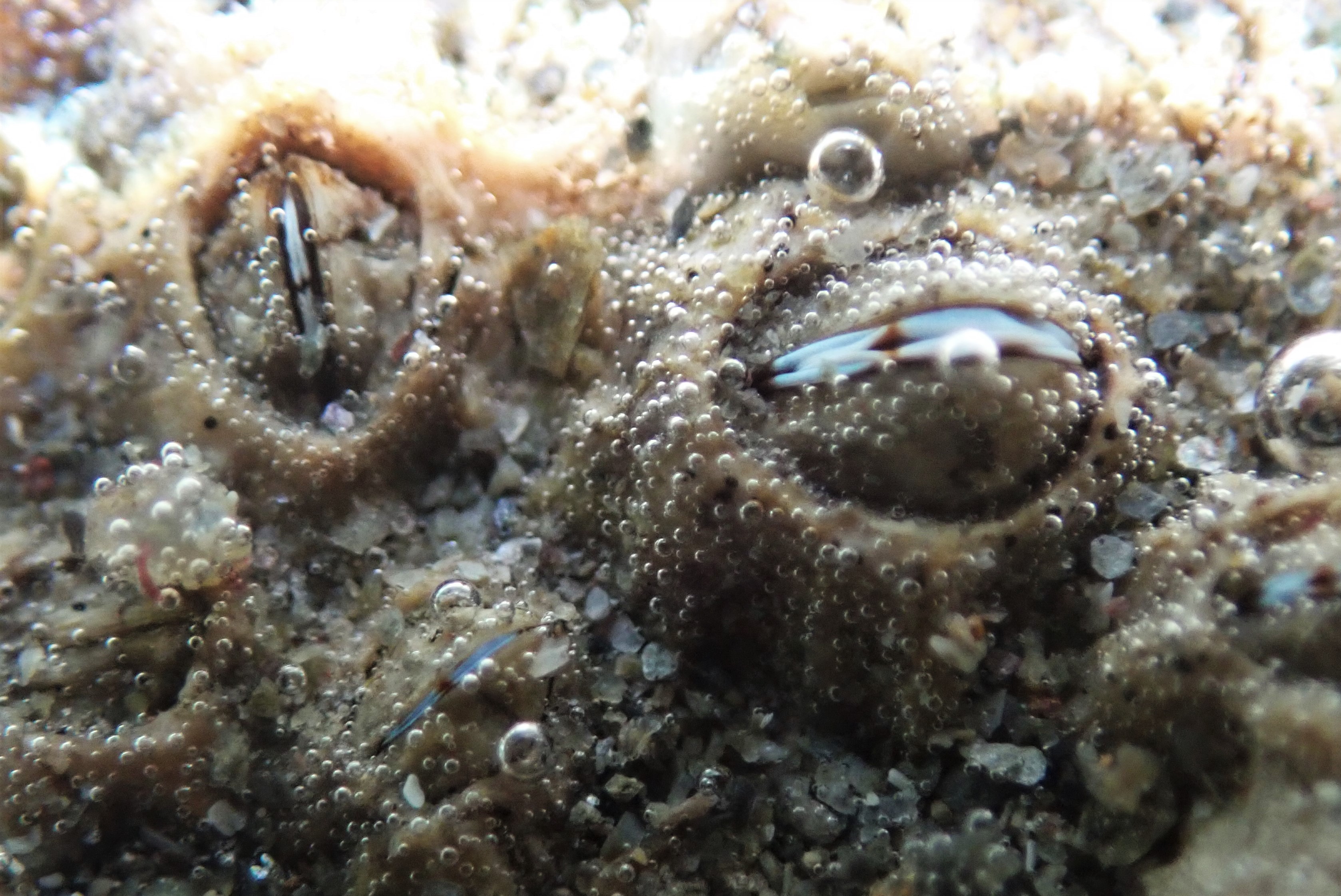
    Chthamalus sp barnacles starting to open as the tide comes in.

    By the time we leave, the sun is low in the sky. I am more than satisfied with all the wonderful creatures I have found on the neap tide, and it is high time I had some birthday cake.

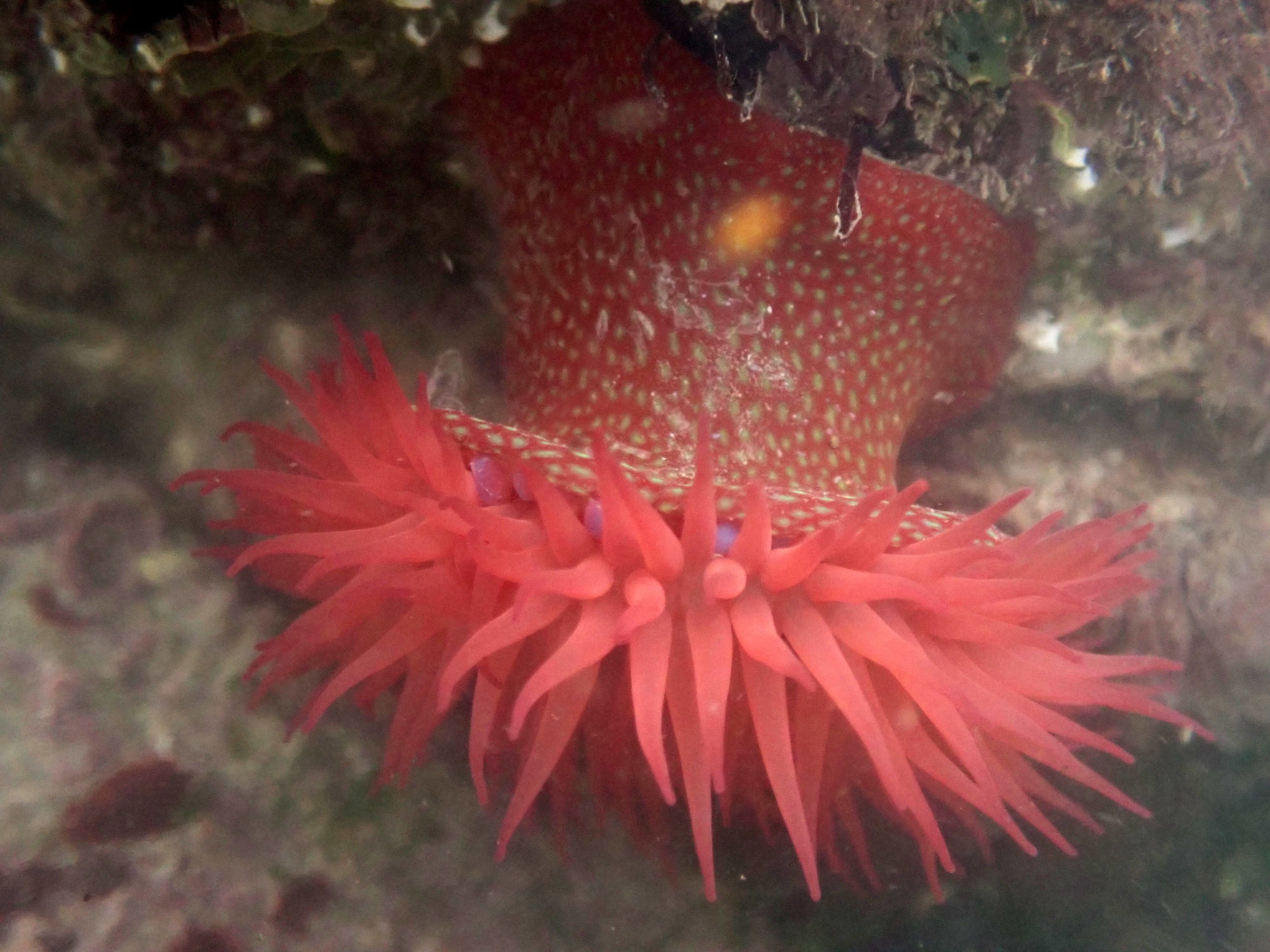
    Strawberry anemone

    Whatever the tide, always stay safe in the rock pools. Follow my rockpooling tips to look after yourself and the wildlife on the shore.

    This website is a labour of much love and the content is available for free to everyone. My wonderful readers often ask if there is a way to support my work. You can now ‘buy me a coffee’ through my Ko-fi.uk page. (Just click donate and you can set the amount to pay by PayPal). Thank you!

  • A Swim Over The Rock Pools

    A Swim Over The Rock Pools

    “Quick, I need the camera. There’s a jelly.”

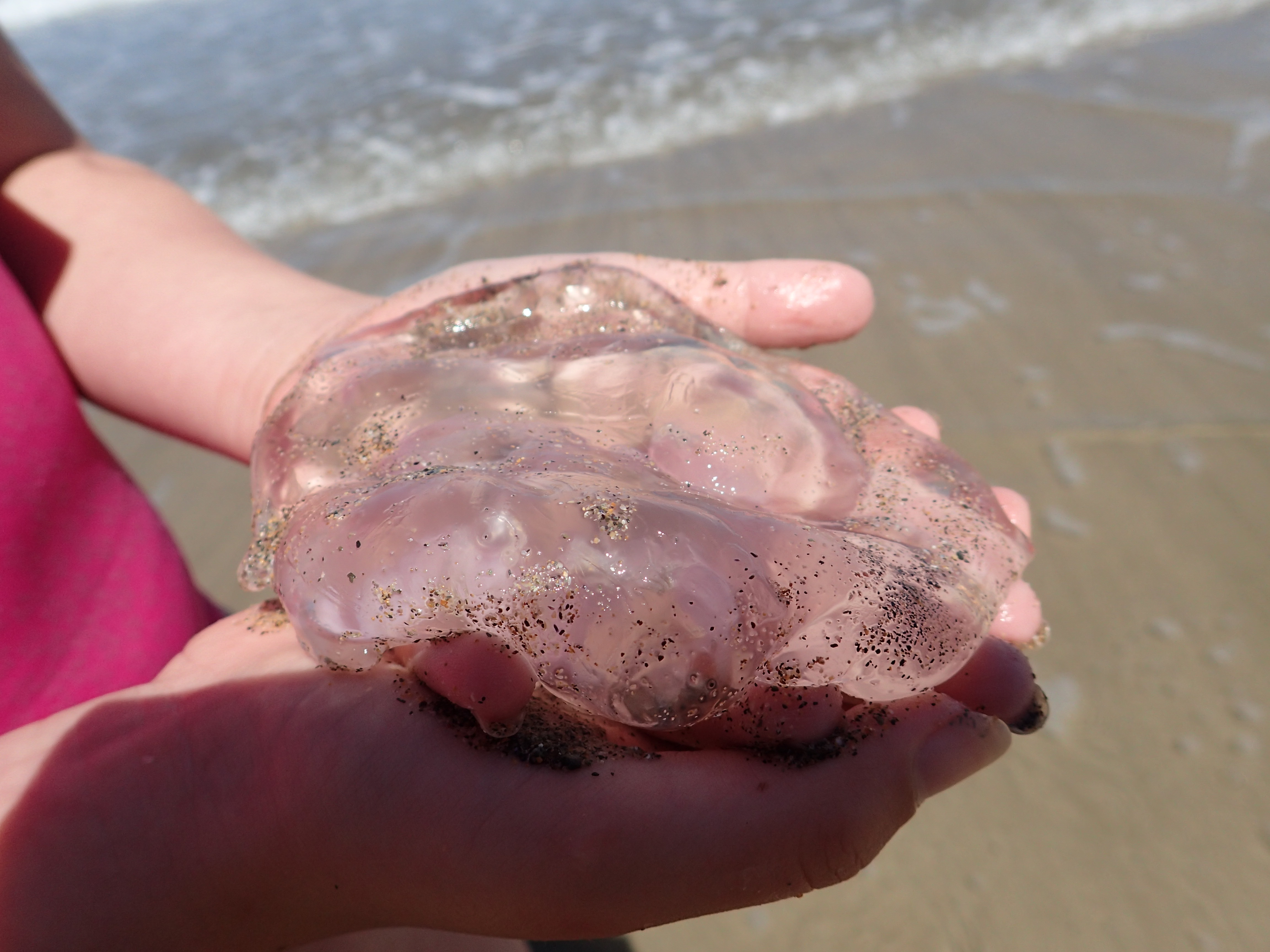
    Junior’s enthusiasm takes me aback. He has a healthy aversion to getting close to jellyfish. We have already changed course many times on today’s high tide swim to avoid the trailing tentacles of compass jellyfish.

    Compass jellyfish. Also known as sea nettles as they pack quite a little sting, these jellyfish have beautiful markings.
    The distinctive markings of the compass jellyfish.

    These common summer visitors have striking brown V-shaped markings around their edges, like the points of a compass. Although their sting is rarely serious, somewhere in the region of a stinging nettle in strength, it isn’t much fun if you swim face-first into one as I have done on a few occasions.

    Crystal jelly. This is a hydroid medusa rather than a ‘true’ jellyfish. It has short tentacles around the edges rather than long trailing tentacles.

    Some other species we have seen this week, like the moon jellyfish and crystal jellyfish, are harmless but today only the compass jellies are out.

    One of many moon jellyfish washed up by the strong swell. This species is harmless.
    Moon jellyfish only have a very weak sting so are usually harmless to people. Never touch a jelly if you’re not sure of the species and wash your hands well before touching your eyes.

    Incredible numbers of sand eels fill the water in every direction, flashing silver as they turn, before melding into the green sea. Junior notices a small spotted catshark (Scyliorhinus canicula) – also known as dogfish – swimming through a rocky gully beneath us. Alongside submerged rocks, several species of wrasse flit among the kelp.

    This sand eel is speeding along – photo by Junior

    I unclip the camera from the safety float and pass it to Junior who is pointing excitedly at something I can’t see.

    I dip under the water and look at where he’s pointing. Still nothing. I bob up for air and try again.

    This time I see something much smaller than I was expecting, or half see it – it’s mostly transparent with just the faintest pink hue.

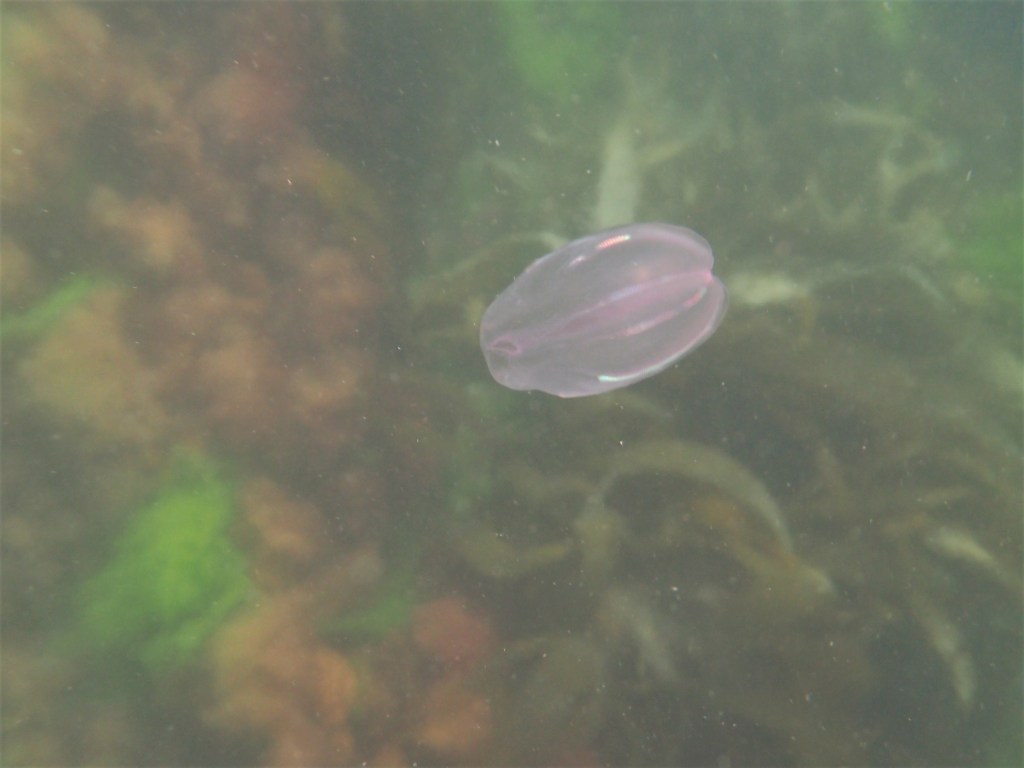
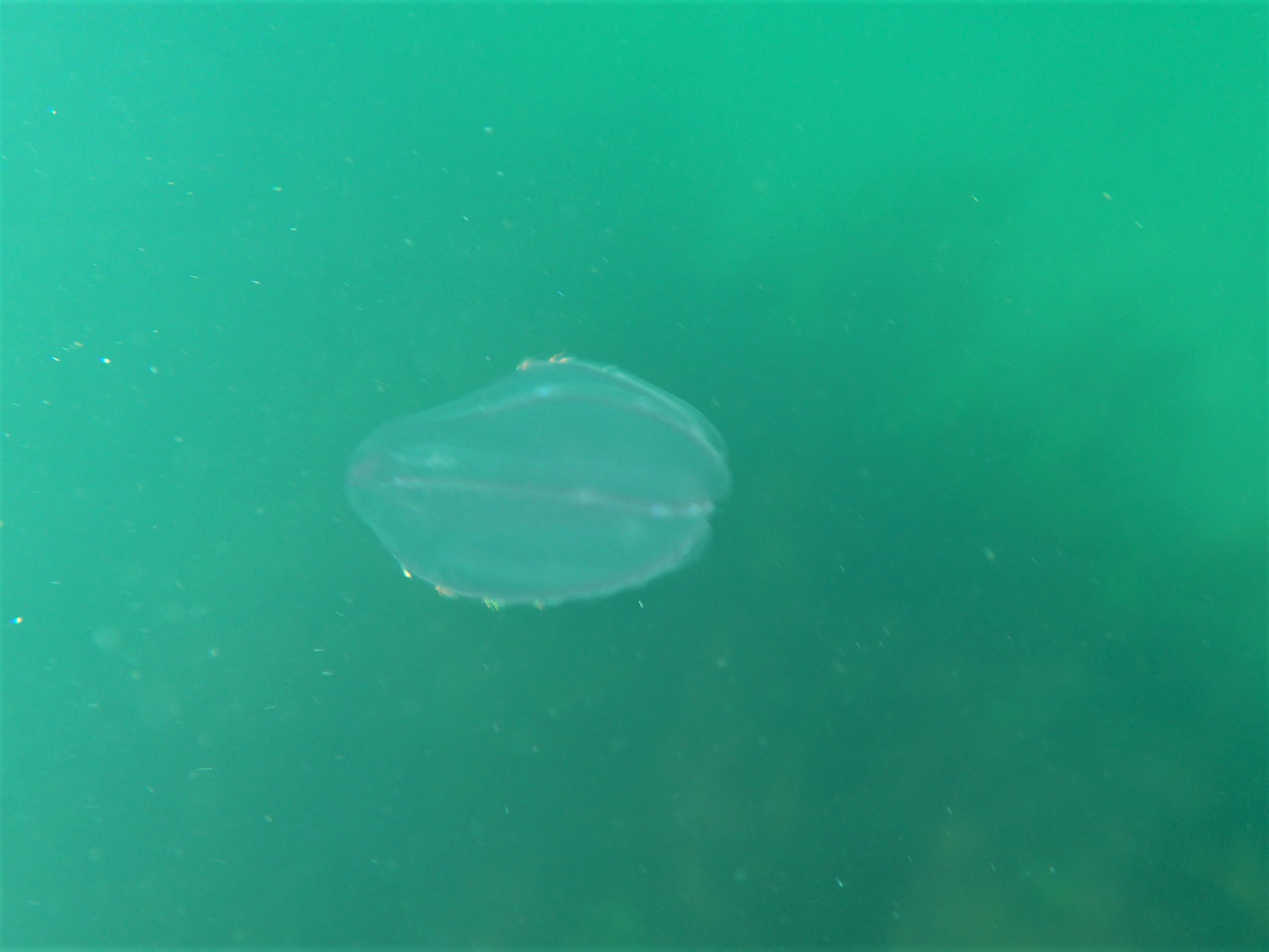
    Comb jelly – photo by Junior

    “Is it a comb jelly?” Junior asks. This is the first one he’s seen and much excitement ensues as he tries to photograph a barely visible tiny swimming thing while holding his breath and floating in water 5 metres deep.

    Comb jelly by Junior. The transparency of the animal and its movement in the water make it hard to focus, but you can see the shining light of the combs.

    Mostly we just enjoy the incredible coloured light show this Beroe cucumis comb jelly is putting on for us. The iridescent disco-light effect is created by lines of beating hair-like cilia (the combs) that run the length of the comb jelly’s body.

    This species looks like a simple hollow tube or sack, but it is an efficient predator, known to feed on other comb jellies.

    The different colours of the lights around the edges of the comb jelly are incredible to watch. Photo by Junior.

    How Junior spotted this little speck in the ocean, I have no idea. We look around for more but find none.

    Comb jelly by Junior.

    Eventually we have to head back to shore, drifting over all of our familiar rock pools on the way. Hermit crabs and netted dog whelks are out in force and as we near the beach, we see shannies basking on sunny rocks in the shallows.

    There are lots of these ‘south clawed’ hermit crabs (Diogenes pugilator) on the sand. Their left claw is much longer and larger than their right.

    This might not be rock pooling in the usual sense, swimming on a high tide gives us a whole new perspective on life here. You don’t need to be a billionaire to become weightless and take a soundless flight over the rock pools. There is no better way to see how this environment looks for most of each day, when the wider ocean and the shore cross over and become one.

    Swimming in the sea in Cornwall is a wonderful experience but is very different from swimming in a pool and can be dangerous. Always consider the conditions and stay well within your limits. Check the weather, tides and currents, enter the water slowly and adjust to the temperature. Choose a lifeguarded beach if possible and a place where you know how to safely enter and exit the water. Swim alongside the shore. A tow float makes you more visible and beach shoes can protect you from weever fish and sharp rocks. Don’t swim alone and let someone know where you are. In any emergency at sea or on the shore, call the Coastguard on 999.

    This website is a labour of much love and the content is available for free to everyone. My wonderful readers often ask if there is a way to support my work. You can now ‘buy me a coffee’ through my Ko-fi.uk page. (Just click donate and you can set the amount to pay by PayPal). Thank you!

  • May Half-Term Rock Pooling

    May Half-Term Rock Pooling

    Who doesn’t need a week off at the moment? Whether you’re visiting your local beach or holidaying in Cornwall, rock pooling is a free and fun experience for all the family.

    Read on for links to events, rock pooling tips and my guide to what you might find.

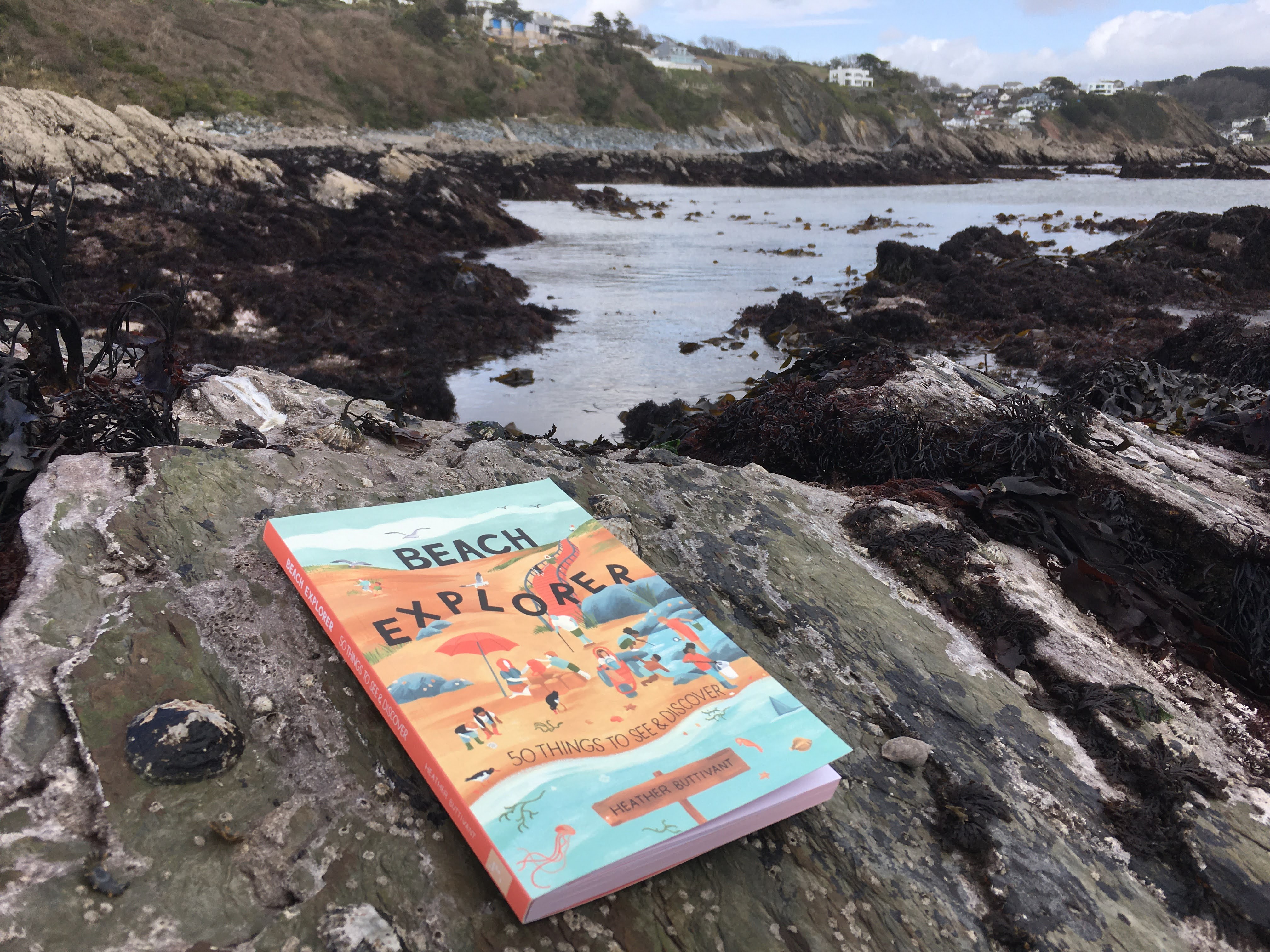
    Make every beach trip an adventure with my children’s book, Beach Explorer: 50 Things to See and Discover. It’s packed with hands-on activities, facts and quizzes.

    EVENTS

    Organised rock pooling events are perfect for learning about marine wildlife with the experts. Due to current restrictions, booking is essential for most activities and plans may change. At the time of writing, the following groups and organisations are planning events in the half term:

    If you’re not able to attend an event, don’t worry. It’s easy to rock pool safely and to look after the wildlife with a little preparation.

    ROCK POOLING TIPS

    All you need for successful rock pooling is a pair of wellies or sturdy shoes and a little patience. There are many fascinating species to see, so go slowly, look carefully, leave everything as you found it and have fun!

    • The European 3-spot cowrie (Trivia monacha)
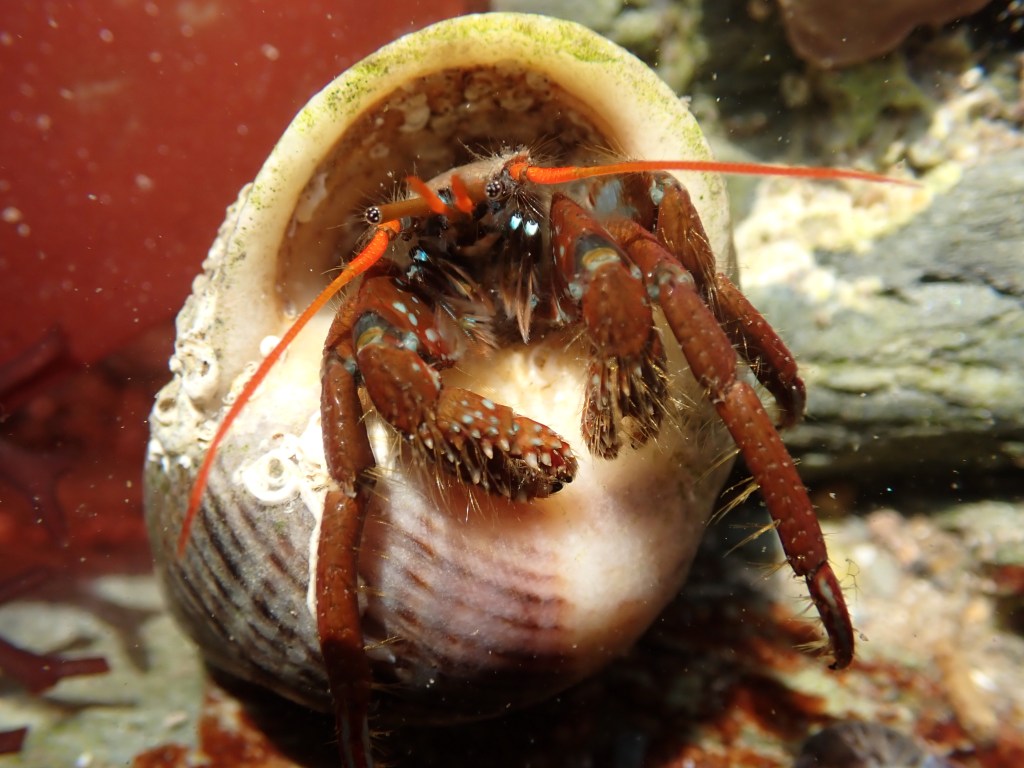
    • St Piran's Hermit Crab at Hannafore, Looe
    • A colourful Xantho pilipes crab.
    • A dahlia anemone.
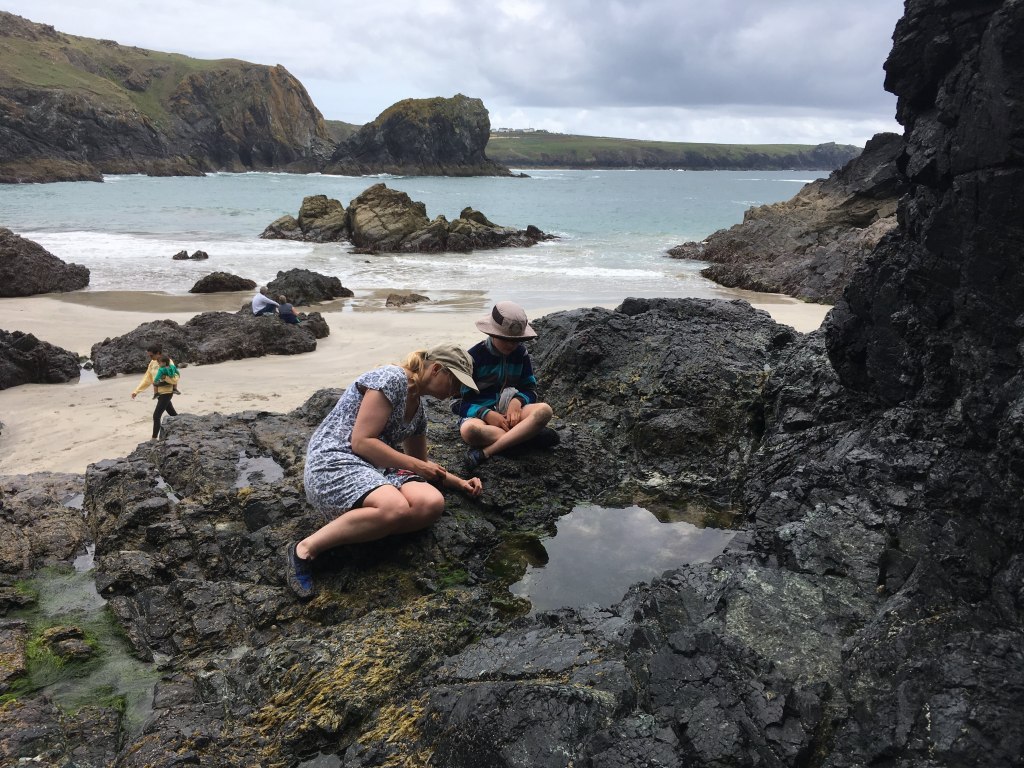
    • Watching fish at Kynance Cove with Junior (photo by Other Half)
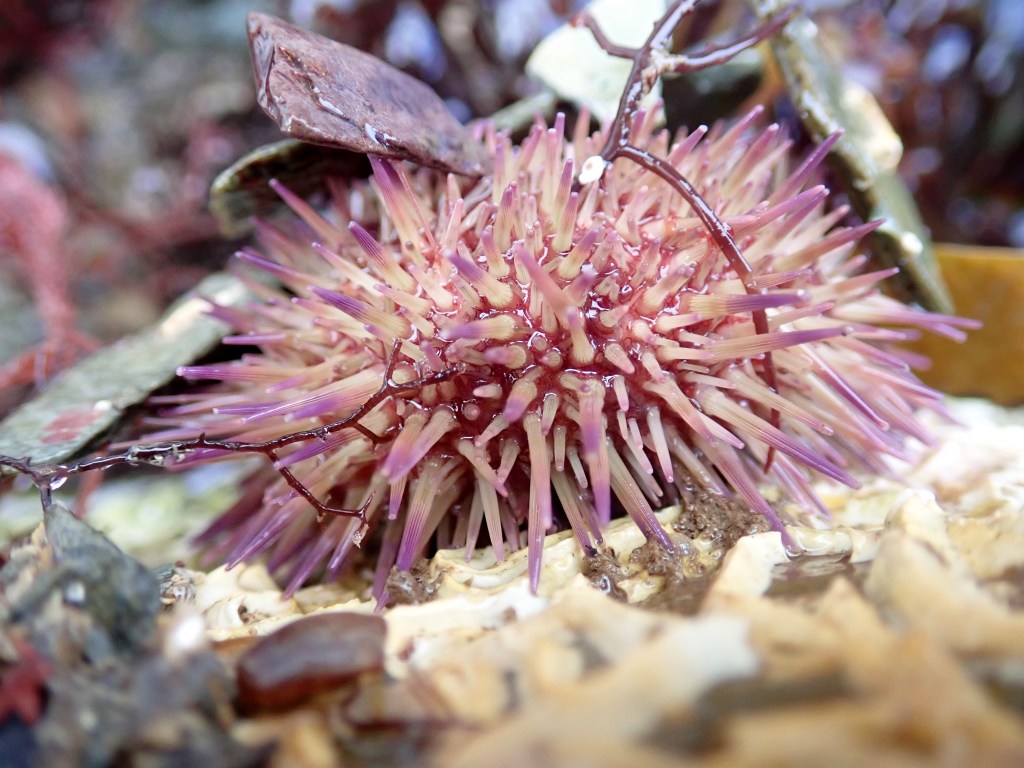
    • Green shore urchin, Hannafore, Looe
    • Passing round a spiny starfish
    • Junior getting to know our wrasse-friend
    • A juvenile turbot at Lundy Bay
    • Cornish Rock Pools junior drying off in the sunshine at Port Nadler, near Looe.
    • Plaidy near Looe
    • Just one more rock... exploring the Cornish rock pools
    • Flat periwinkles and other shells washed up on Looe Beach
    • Montagu's blenny with its distinctive head crest
    • Although painted topshells are a common sight on my local shores, I never tire of photographing them.
    • Always check the tide times, stay clear of cliffs and waves and dress for the weather.
    • Nets can harm delicate sea creatures so are best left at home. A bucket or tub is ideal if you want to scoop up an animal to look at, but be sure to put it back.
    • Why not finish up with a beach clean to help look after the wildlife?

    Find out more about rock pooling with my top tips and guides.

    BEACHES

    The choice is endless! Cornwall has over 300 beaches and they are all fantastic. Any beach with rock pools will have crabs, snails, anemones, fish and more.

    Find out about some of my favourite rock pooling beaches here.

    WHAT TO SEE

    May and June are fabulous rock pooling months. The pools are bursting with new life from baby fish to brightly coloured seaweeds and stunning starfish.

    Sit quietly and look closely at the pools to watch prawns, crabs and sea snails going about their business. Gently lift seaweed and look under stones to reveal the secret hiding places underneath (be sure to put them back as you found them).

    Here are some of my favourite treasures to find in the pools …

    Cushion Stars

    These puffy little starfish are common in the pools. Did you know that they can re-grow their arms?

    Shannies

    The common blenny (or shanny) is perfectly adapted to shore life and can even breathe through its skin when out of the water. It also has a great smile.
    The common blenny (or shanny) is perfectly adapted to shore life and can even breathe through its skin when out of the water. It also has a goofy smile.

    Sea lemons

    In the water the sea lemon's rhinophores and frilly gills emerge and we can see its wonderful colours
    Sea lemons a type of sea slug. They eat sponges and breathe through the frilly gills on their backs.

    Green Shore Crabs

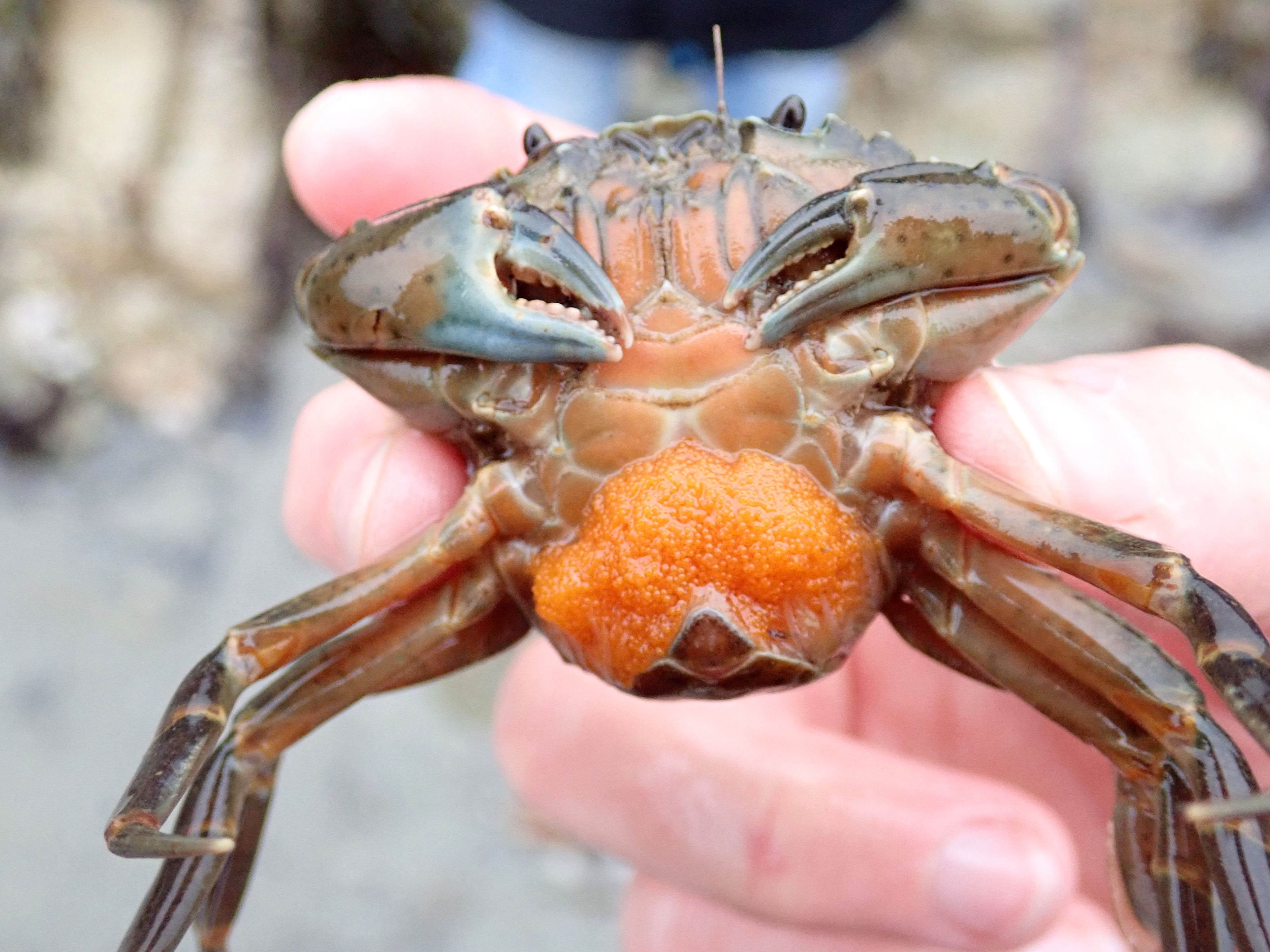
    Green shore crab with eggs - Christmas eve 2018 in Looe
    Green shore crabs can survive in lots of different conditions and can eat almost anything – even each other. This female has eggs under her tail.

    Common Prawns

    Prawns are curious and will often swim over to investigate anything new in their pool. You can see right through their bodies!

    Strawberry anemones

    Strawberry anemones are red with yellow flecks, just like a strawberry. Their tentacles are packed with stinging cells to catch their prey.

    Star Ascidians

    Star ascidians might look like flowers but they are simple animals called sea squirts. They form colonies – each ‘petal’ of the flower shapes is an individual animal. They can be yellow, blue, purple, red or white.

    Flat Periwinkles

    Flat periwinkle in the Cornish rock pools
    Flat periwinkles feed on seaweed and come in lots of colours. Look out for their eggs on the seaweed – they look like little circles of jelly.

    These are just a few of the creatures you might find. Discover more with my guides to the wildlife in the rock pools and my blog.

    Happy rock pooling! Be sure to get in touch to let me know what you find this half-term.

  • A Year of Cornish Marine Life

    A Year of Cornish Marine Life

    Like everything else about 2020, this is a strange New Year’s Eve. Many have lost loved ones this year, and most of us have spent the festive season apart from friends and family. Whatever the year ahead brings, it will be made better by connecting with the natural world and doing the small (or large) things that we can to build a better society and environment.

    On the eve of 2021, I am struggling personally to come to terms with losing EU citizenship and all of the opportunity, discovery and connections it has brought me. International cooperation is essential to tackling the global issues that face our wildlife and we will have to work harder than ever to build understanding and find solutions to problems that cannot wait.

    Life will go on and I am super-excited about my new children’s book, Beach Explorer, due to be published in the spring. As ever, I will continue to bring you the very best of the Cornish rock pools straight to your computer through my blog.

    To bring a little cheer to myself and to you, here are a few of my favourite rock pool wildlife photos from my encounters this year. I hope you will be inspired to get outside and meet your own local wildlife, and to join all of us who are working to protect and restore nature.

    A Happy and Healthy New Year to All! Bonne Année 2021!

    A painted top shell – January 2020

    Xantho pilipes crab – February 2020.
    Pagurus cuanensis, the hairy hermit crab. March 2020
    Bright coloured sponge (Prob Oscarella sp.) April 2020.
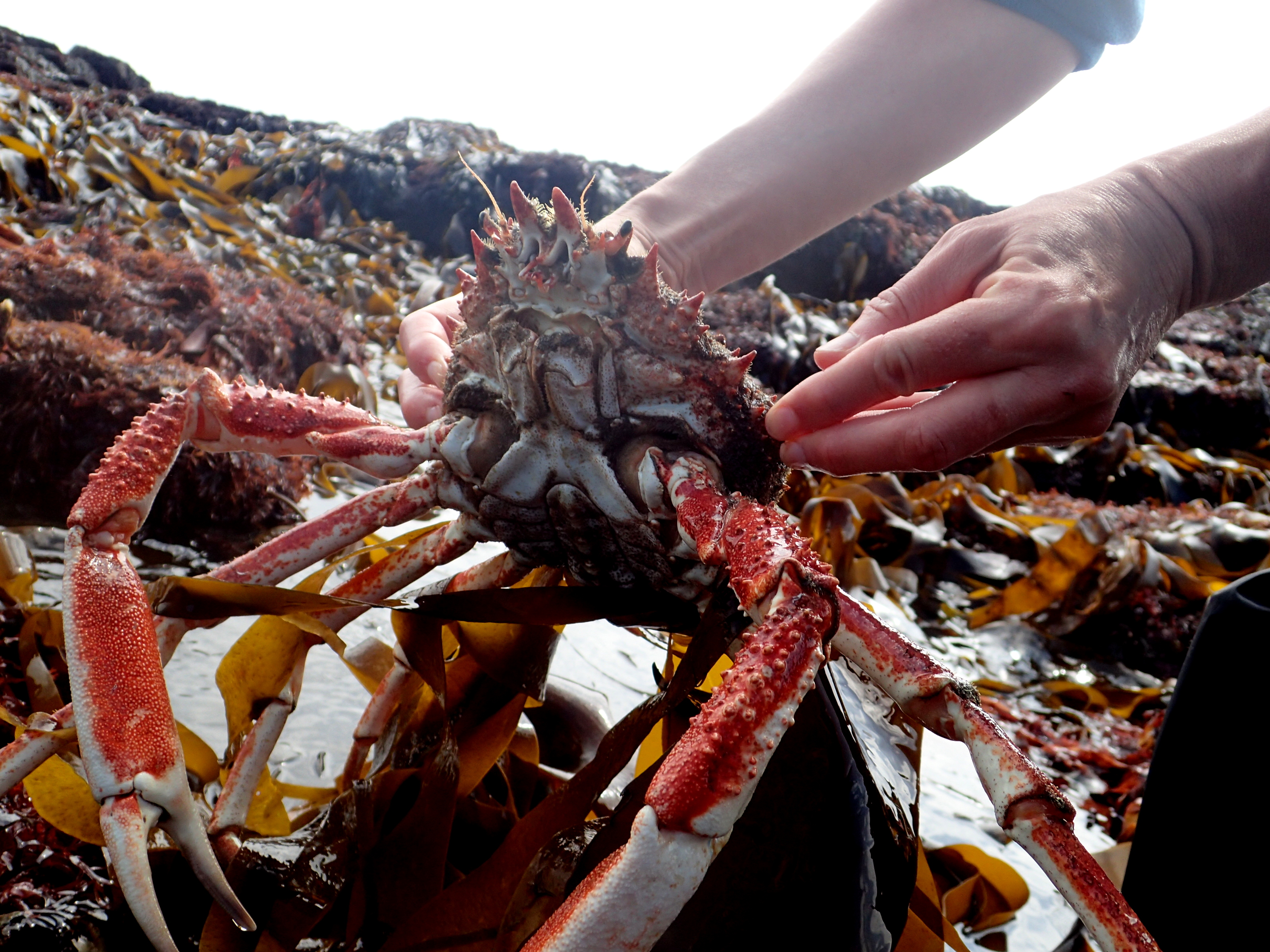
    “Cedric the spider crab”. Photo by Cornish Rock Pools Junior. May 2020.
    Juvenile masked crab moult. June 2020.
    Cladonema radiatum – an athecate hydroid medusa. July 2020.
    Calma glaucoides sea slug with its spawn. August 2020.
    Star ascidian growing on seaweed. September 2020.
    Dahlia anemone. October 2020.
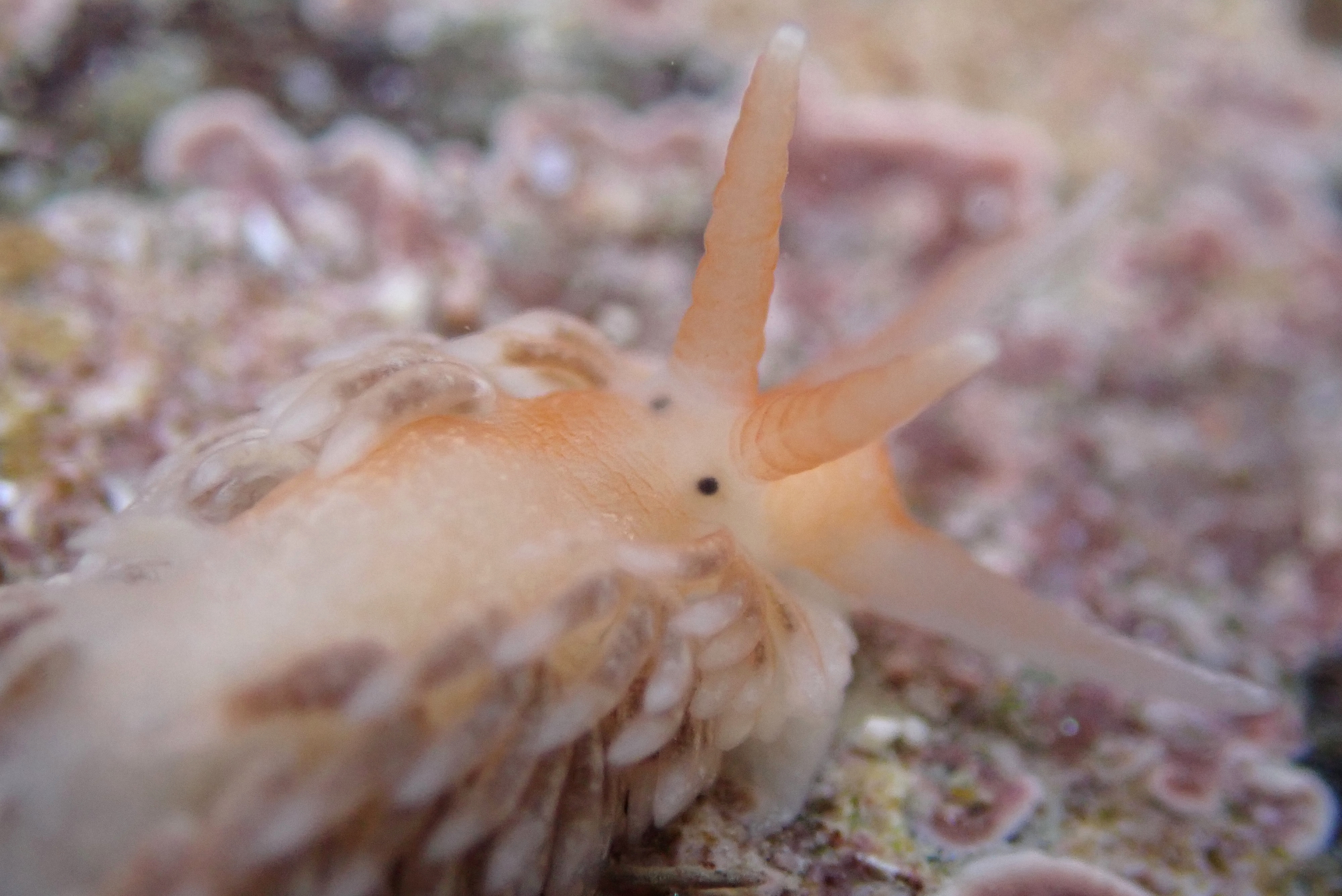
    Facelina auriculata – October 2020.
    My first ever Xaiva biguttata crab! October 2020.
  • Migrating Prawns and Blue-Rayed Limpets

    Migrating Prawns and Blue-Rayed Limpets

    Junior normally keeps a low profile on this blog, but for several years now, he has been taking his own photos and videos of marine life. He recently put together this lovely video for Cornwall Wildlife Trust’s Your Shore Beach Rangers project. It showcased alongside other amazing videos by local young people last weekend at the virtual See You at the Sea Festival and he would love to share it with all our Cornish Rock Pools friends.

    My favourite part of the video shows something Junior discovered in Looe a couple of months ago: a prawn migration. I was crawling around in waders with my head under a rocky overhang at the time, so I only saw the tail end of the procession as it advanced with the incoming tide. Fortunately, Junior managed to capture some fantastic footage of hundreds of prawns galloping along the seabed, all heading in the same direction in their hunt for food.

    Junior’s photo of a common prawn (not migrating!).

    Also featured in the video are Junior’s top photographic subjects – the blue-rayed limpet and sea slugs. He’s even coded an animation showing a day in the life of a corkwing wrasse family. We hope you enjoy his work.

    Blue-rayed limpets by Cornish Rock Pools Junior

    Junior’s friend, Rowen, has also created a video for the festival showing her beautiful marine artwork and how she creates it, all accompanied by incredible facts about the animals she draws and paints. She would love you to take a look.

    All of the videos are available to view on the Cornwall Wildlife Trust Marine channel on YouTube. The three with the most likes and views and that catch the judges eye will win prizes this weekend!

    I have been writing my new children’s book this year (due to publish spring 2021), but with that nearly ready, I’m looking forward to sharing lots of the fabulous creatures I’ve been seeing in the rock pools over the last few months. Watch this space!