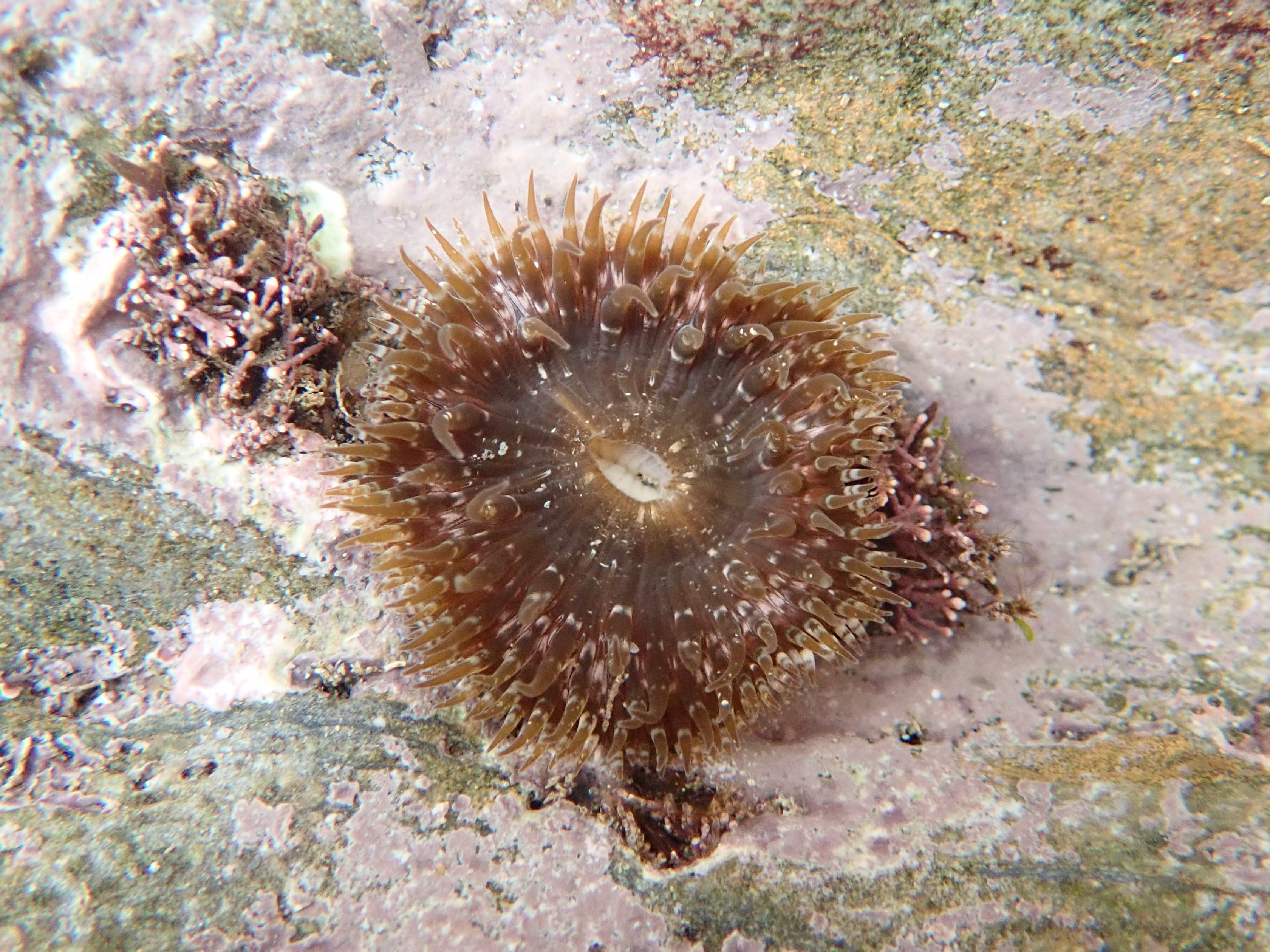
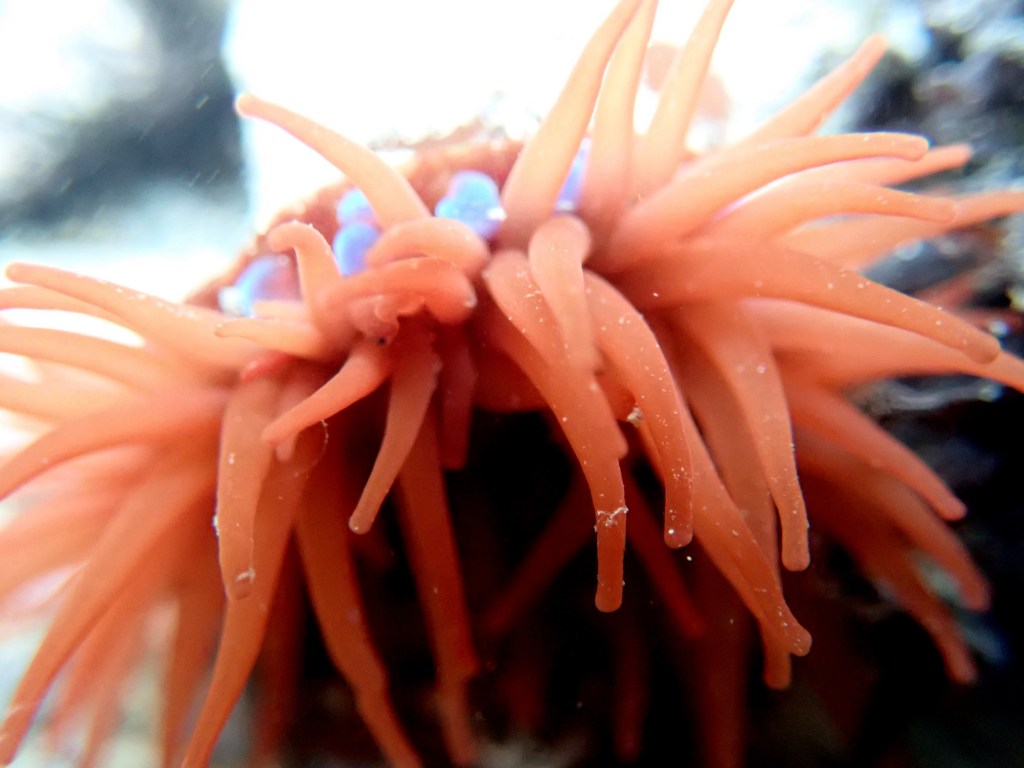
You’re never far from a beach in Cornwall, but the distances from one end of the county to the other mean I visit some beaches more often than others. I made the most of a recent trip ‘out west’ visiting friends to explore the Penzance area.
Although Mount’s Bay itself is a protected area and is best left undisturbed, there are plenty of fabulous rock pools to discover near the town and at nearby Mousehole.
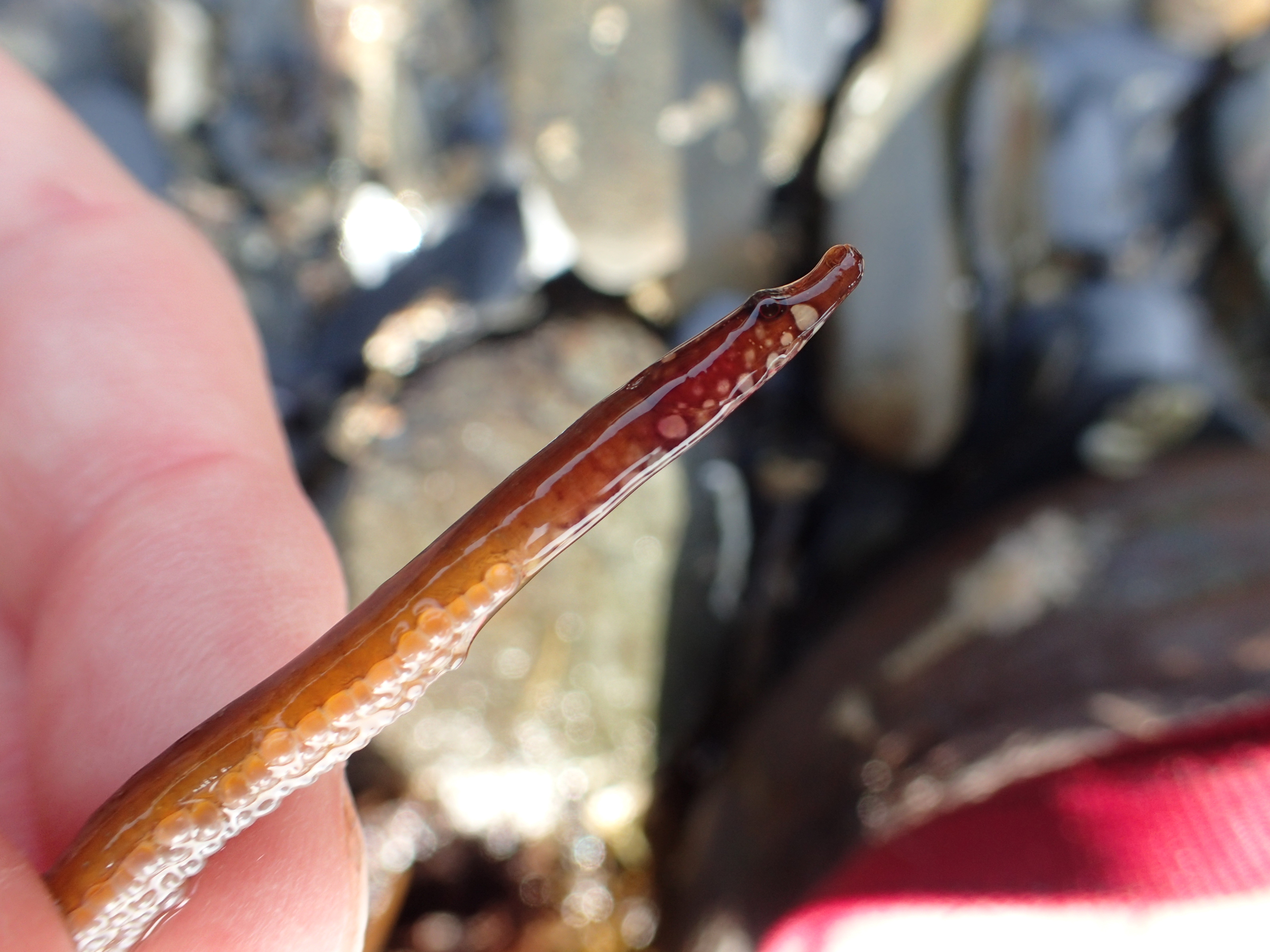
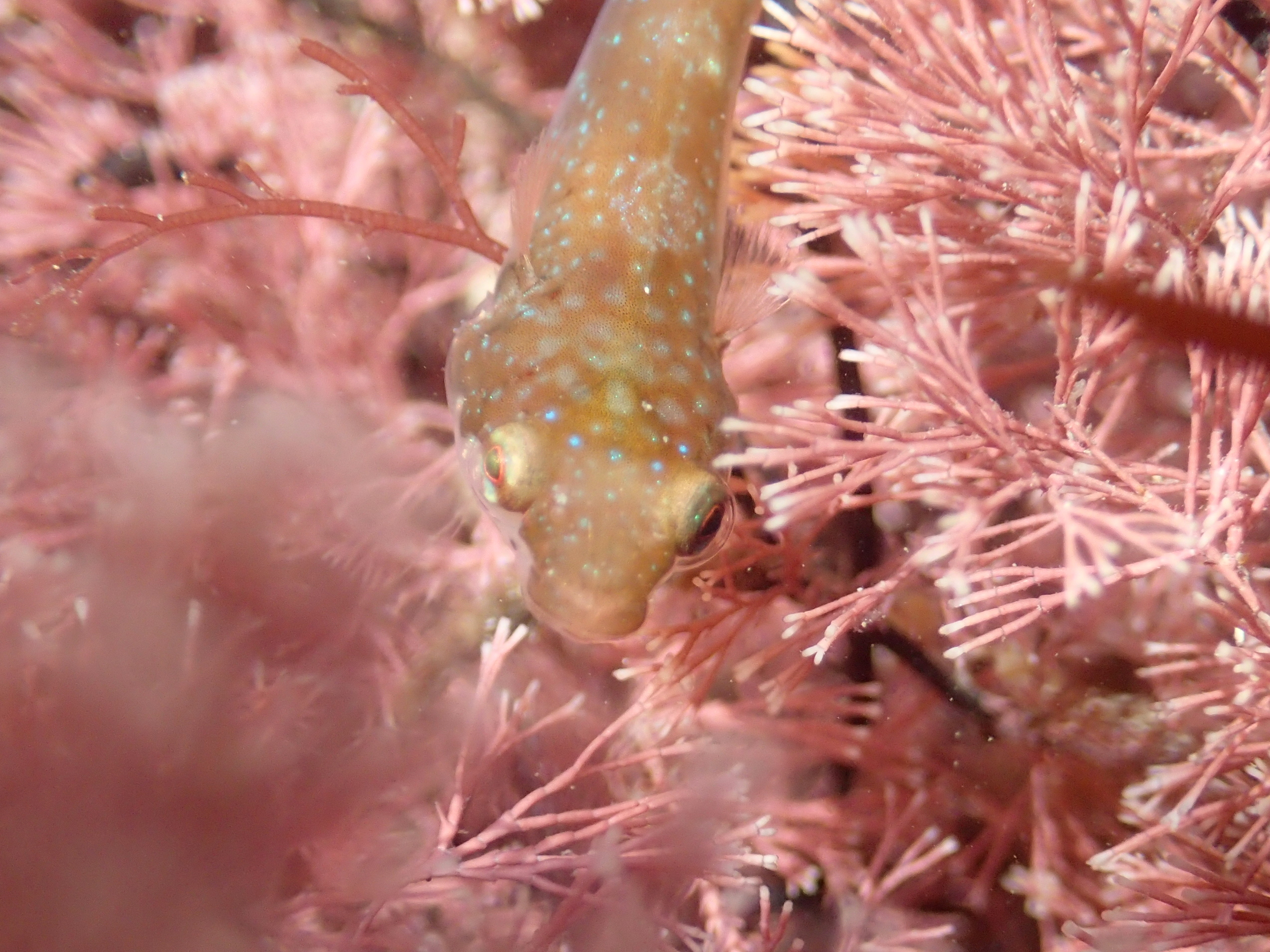
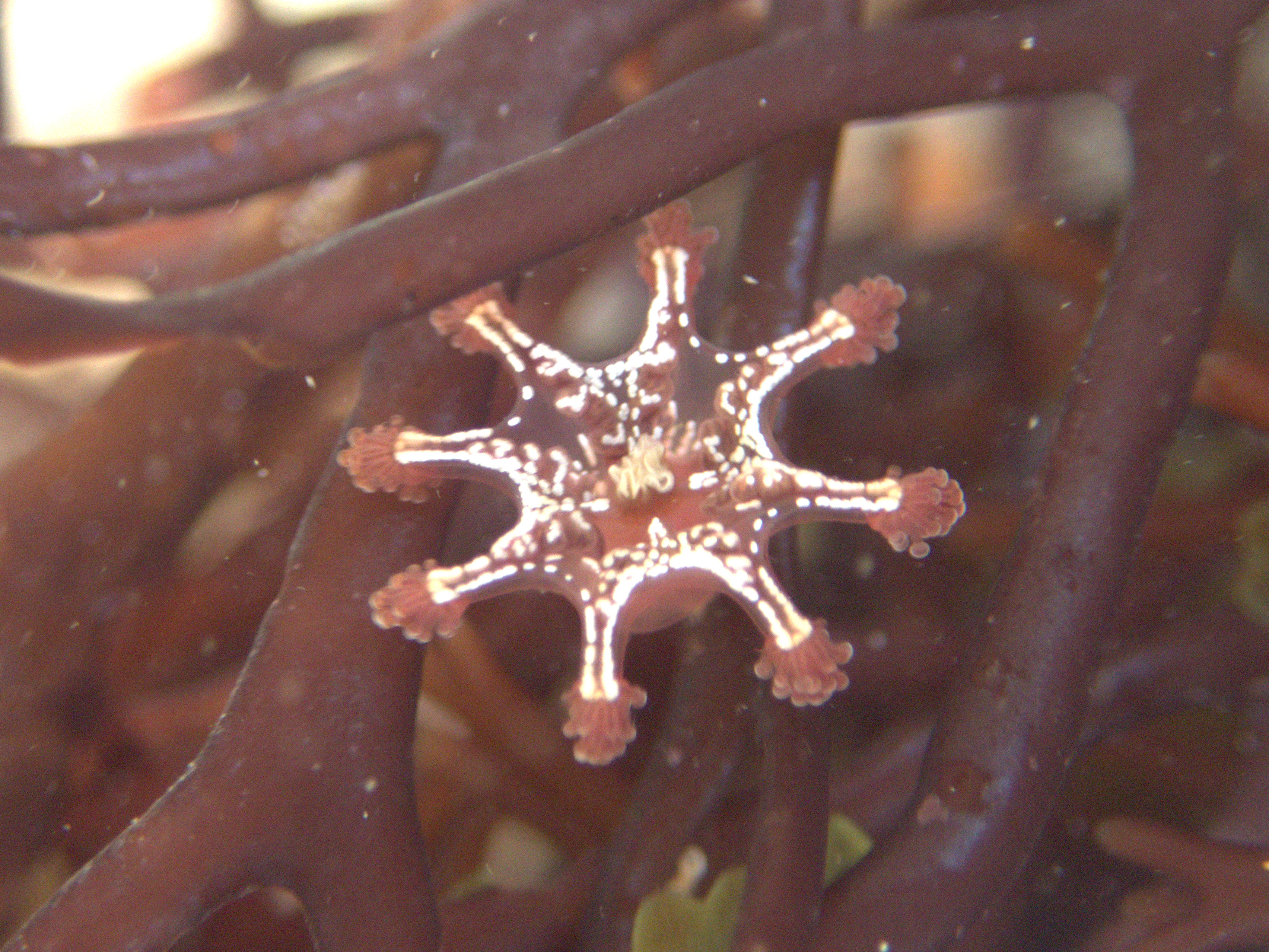
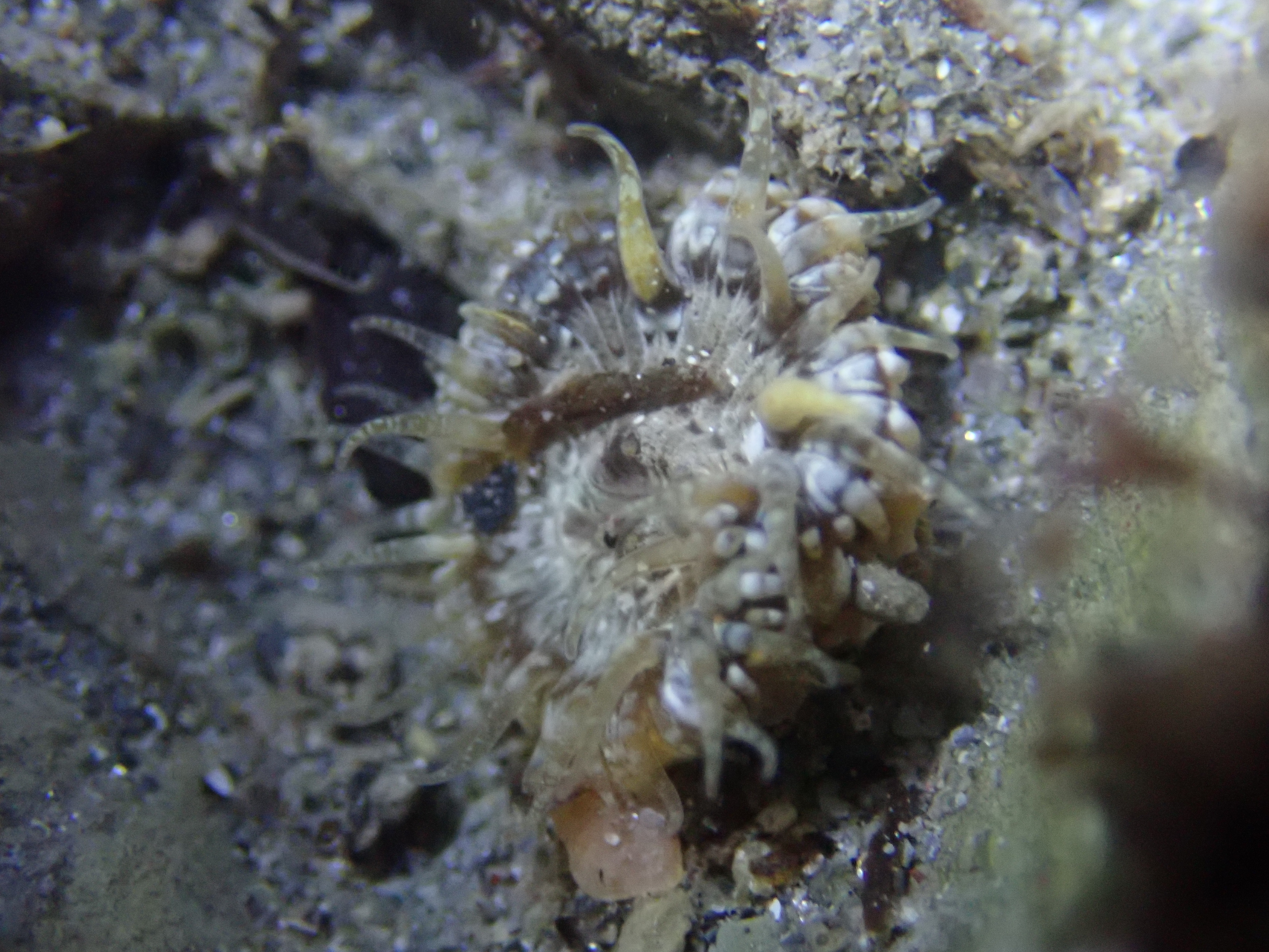
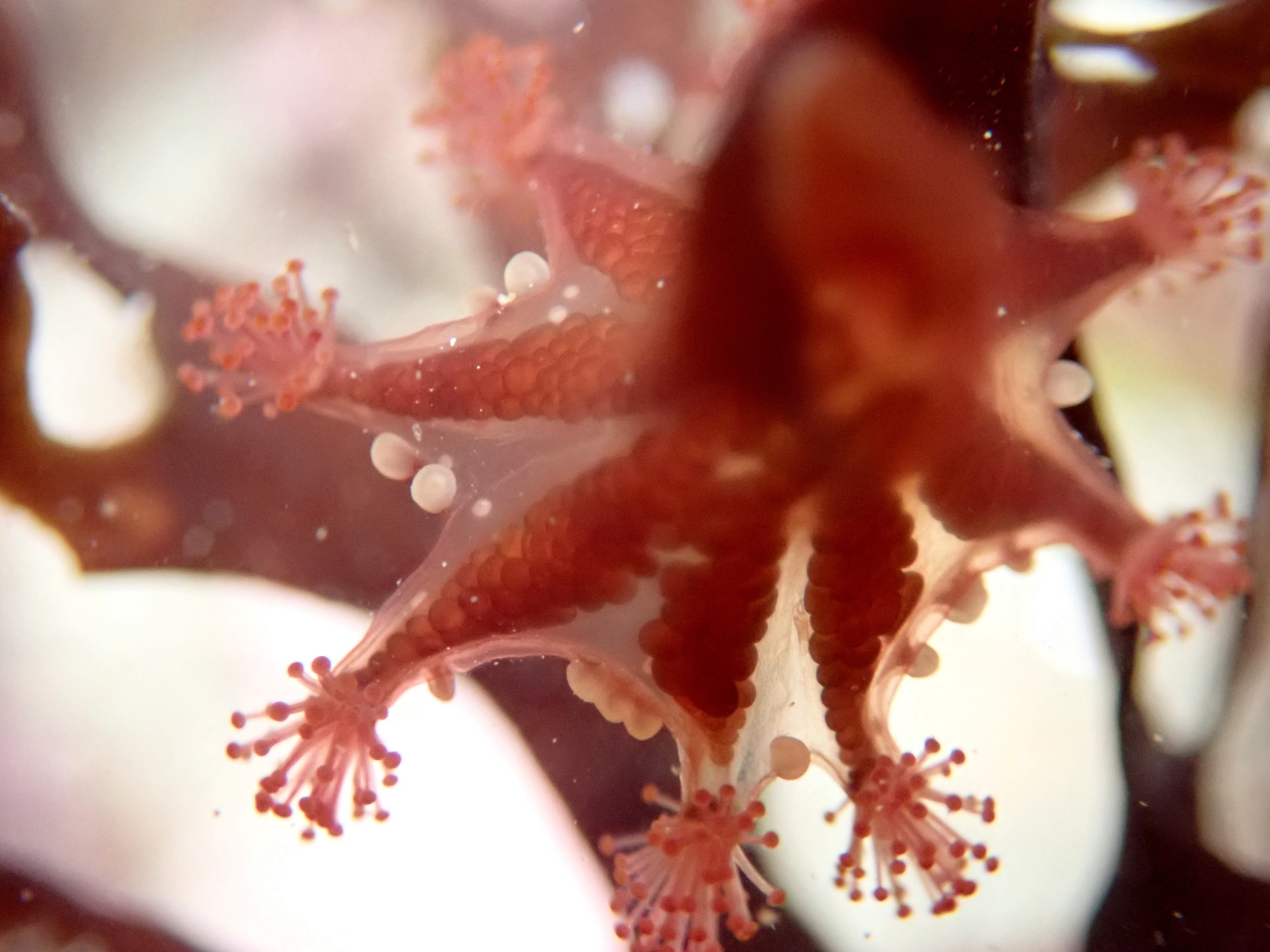
The wealth of colourful seaweeds here makes the clear waters especially enticing. Stepping carefully among them, I found clingfish, shark egg cases and an abundance of stalked jellyfish.
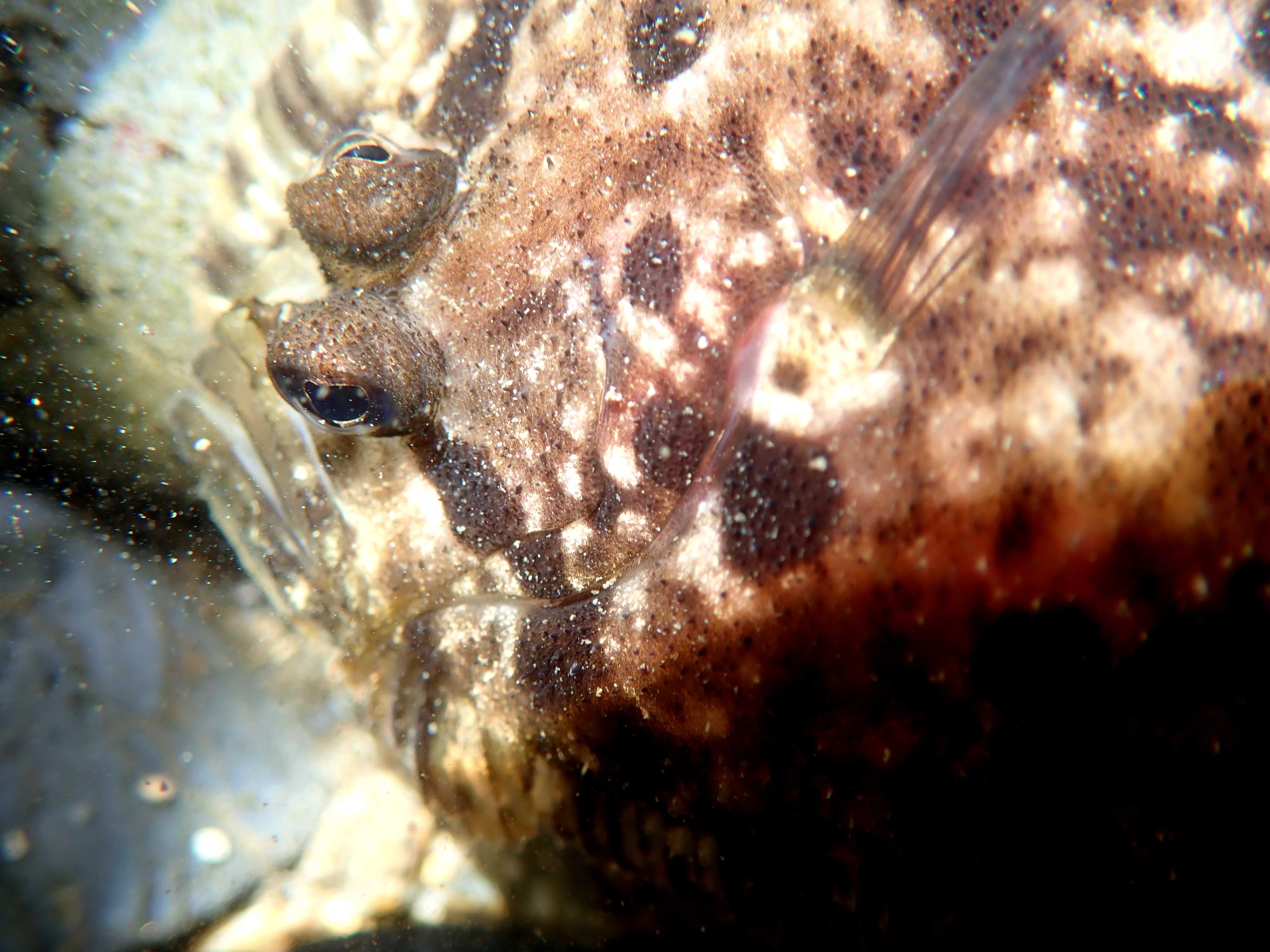
A small species of clingfish hides among the coral weed near Penzance.A Calvadosia cruxmelitensis stalked jellyfish near Penzance. The diverse seaweeds of the Mounts Bay area provide a perfect habitat for a variety of stalked jellyfish species.
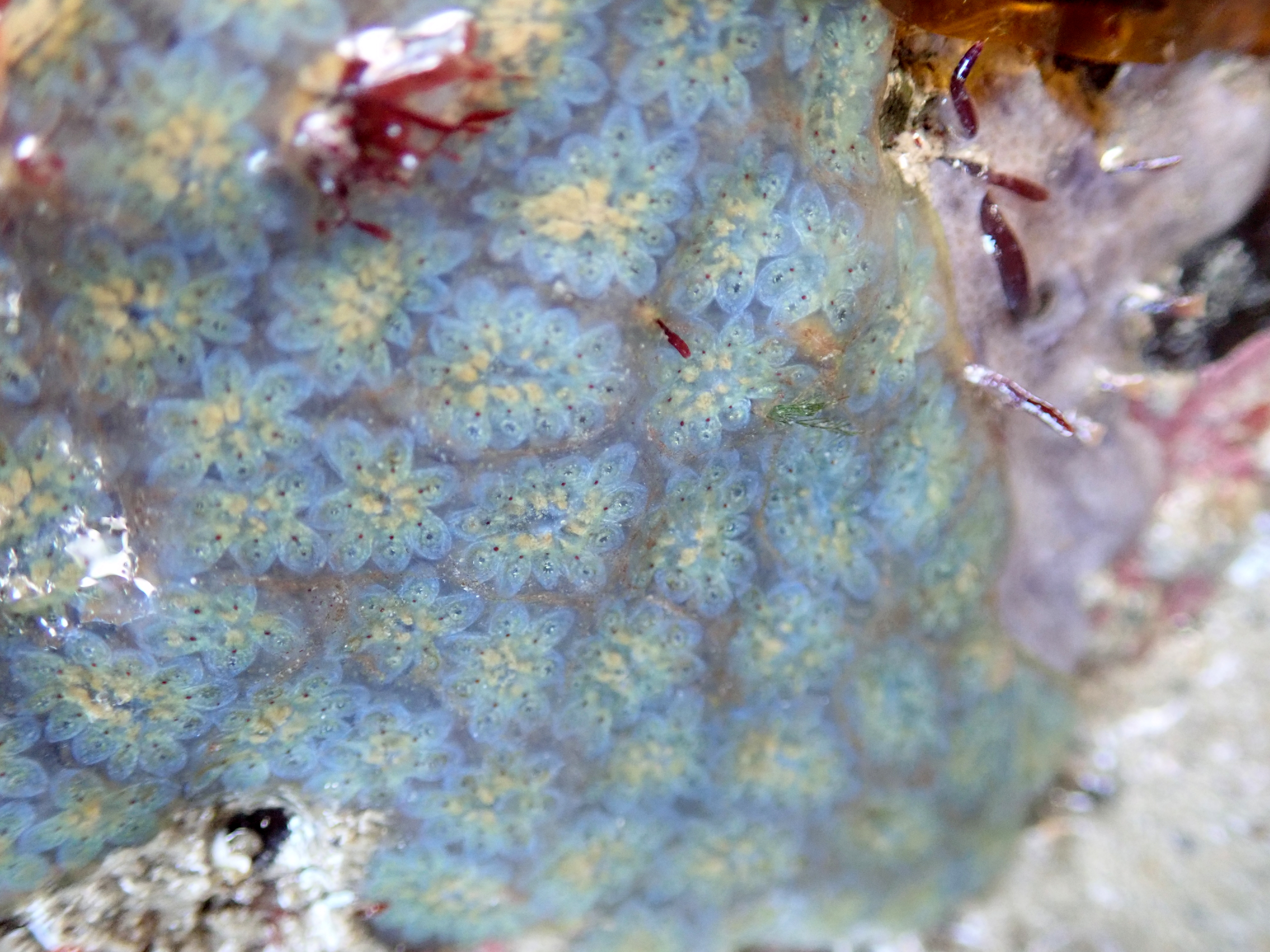
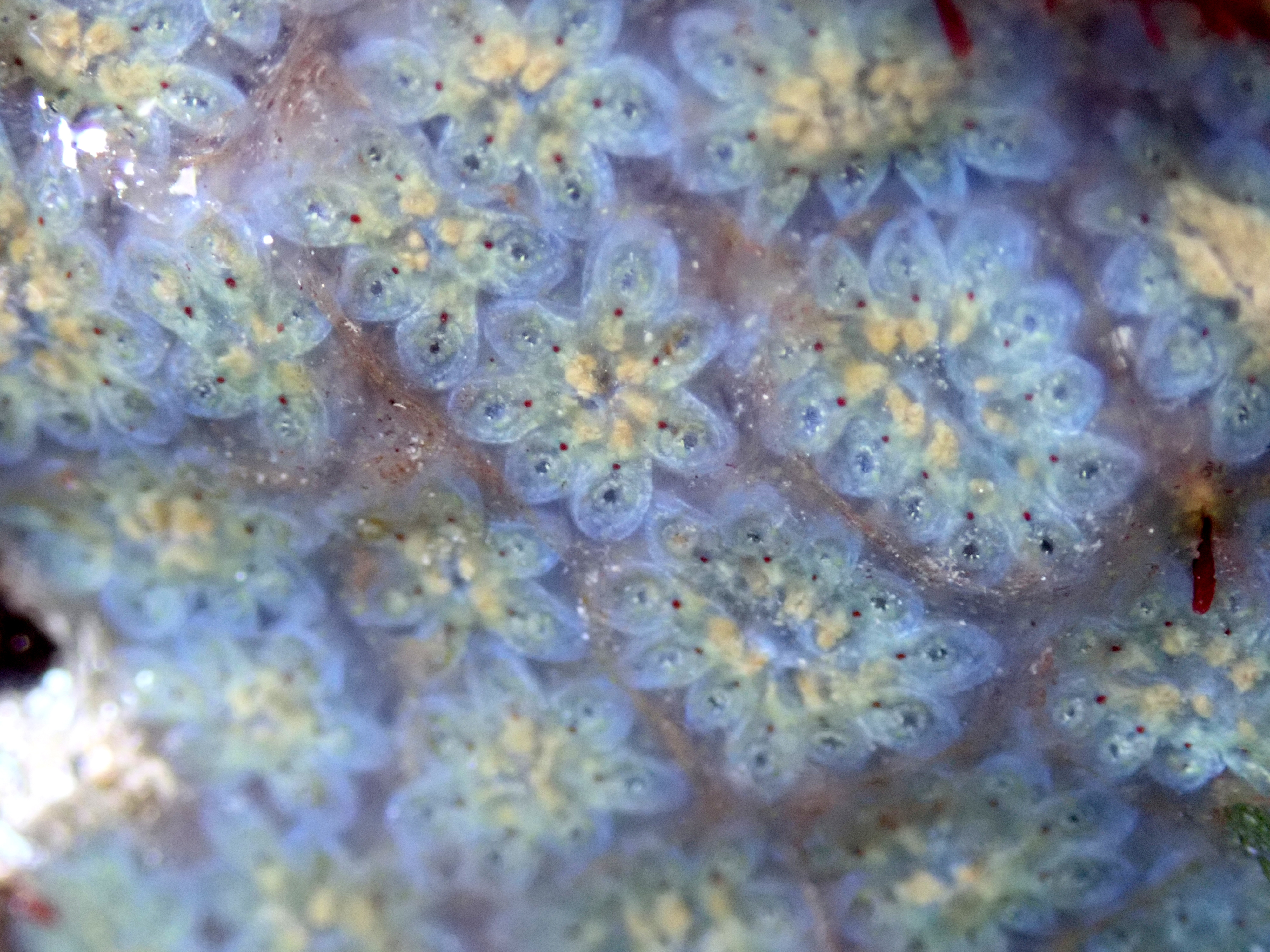
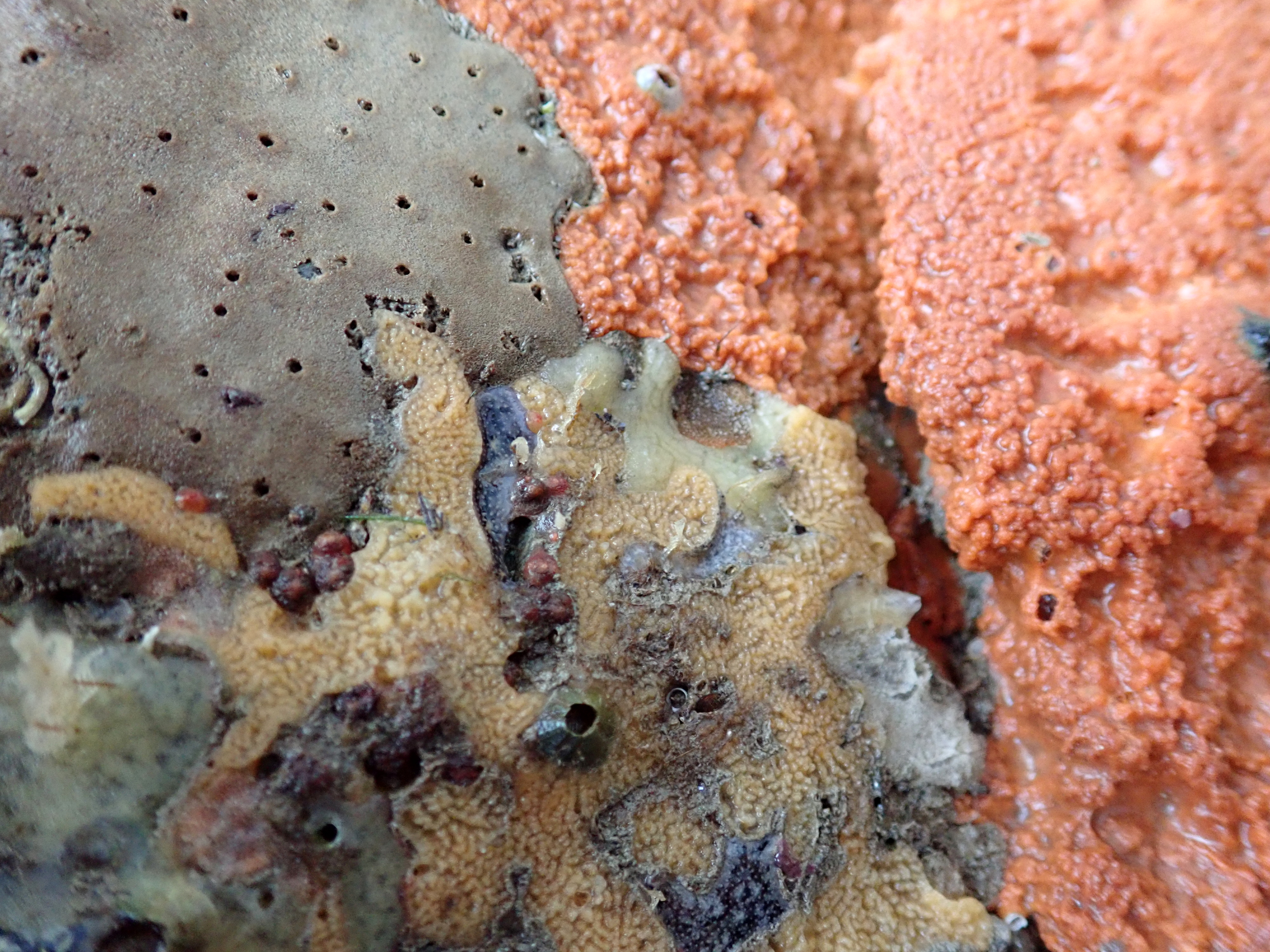
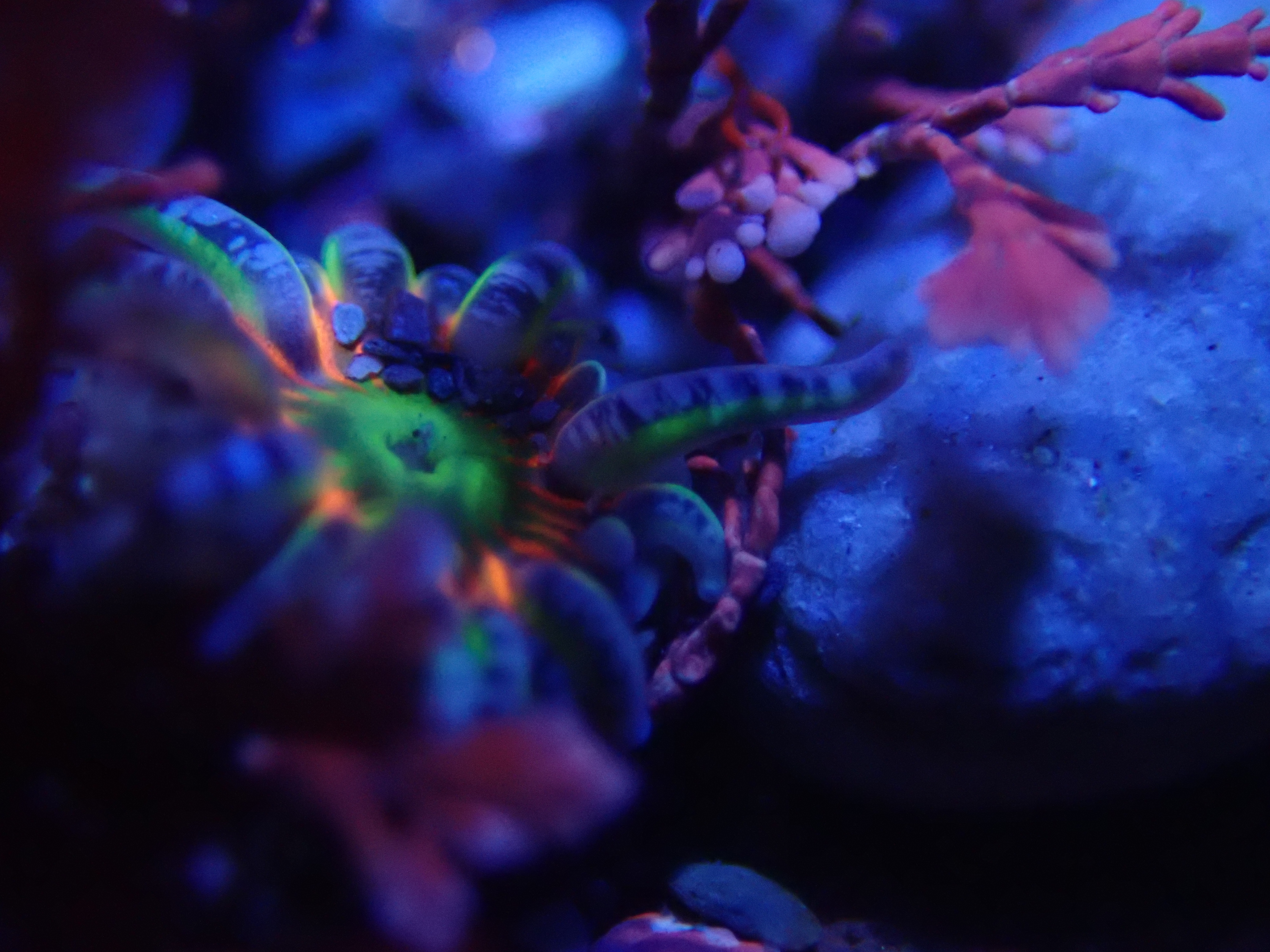
Star ascidians formed a psychedelic wallpaper of turquoise and pastel blue petal patterns along some deep overhangs. Close by, another star ascidian colony painted the rocks in saffron yellow.
The delicate colours of this star ascidian blew me away. It comes in so many colour morphs, but this one was new to me.
More of the wonderful pastel-blue star ascidian, looking like an impressionist flower painting.
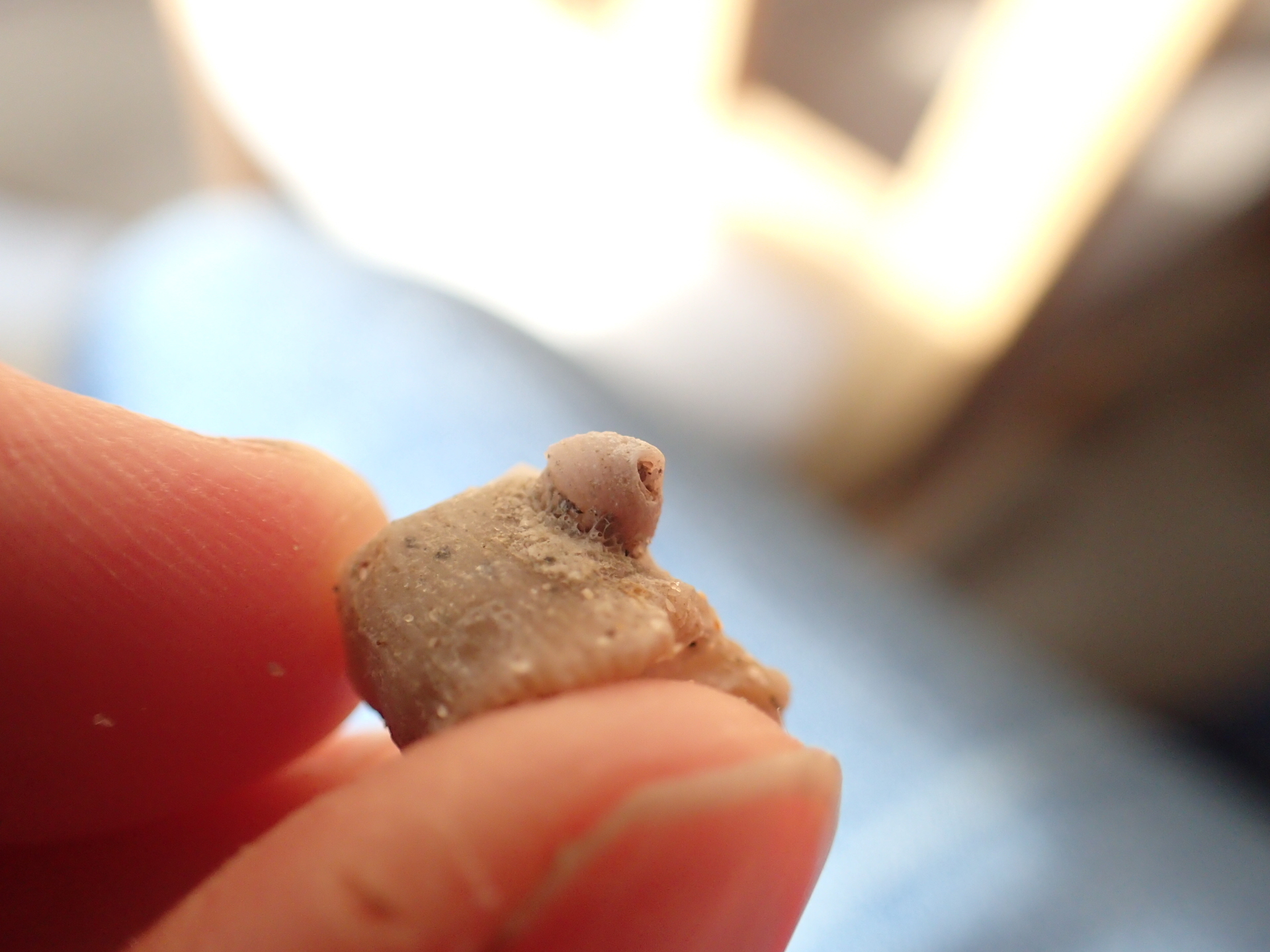
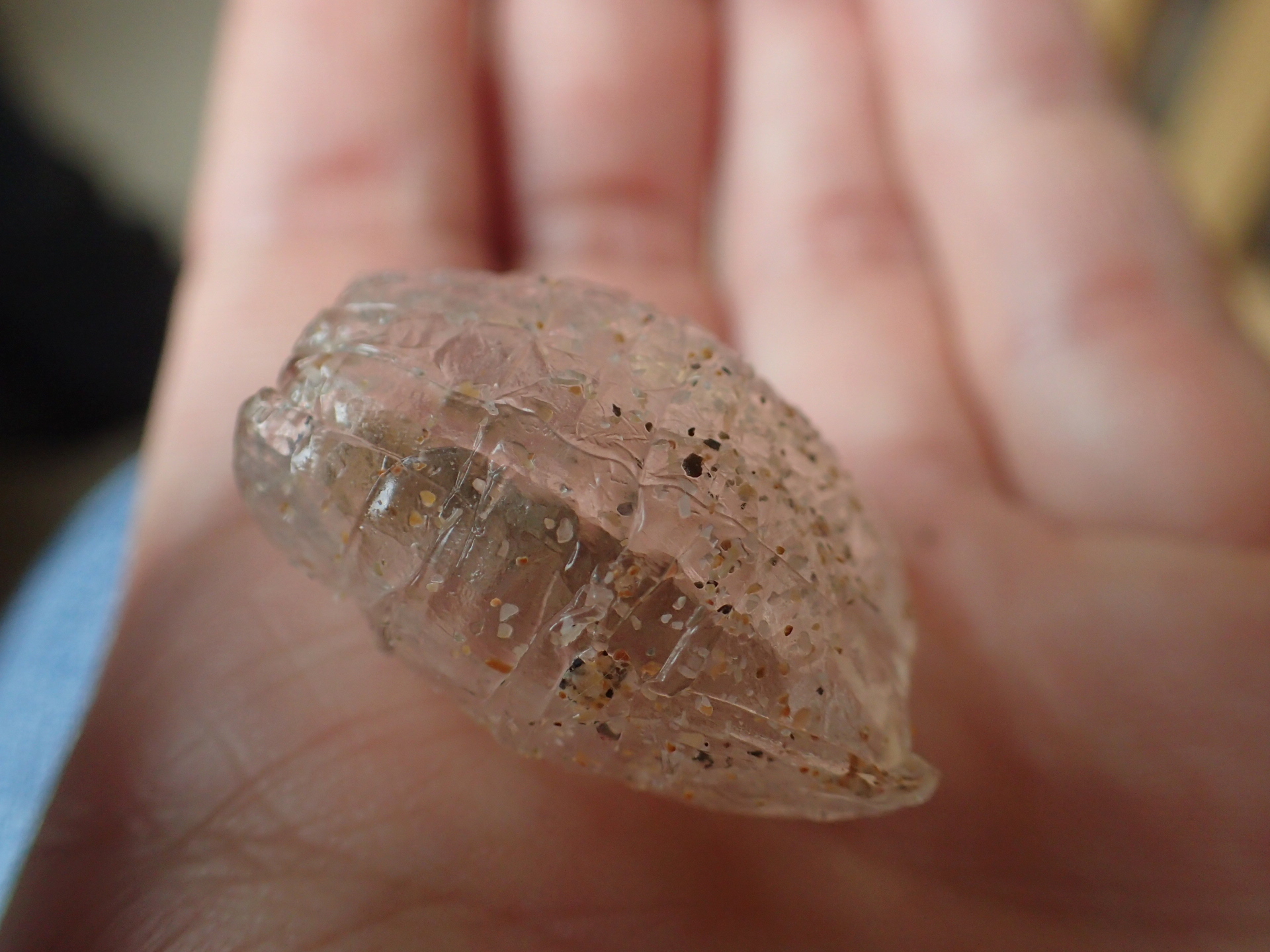
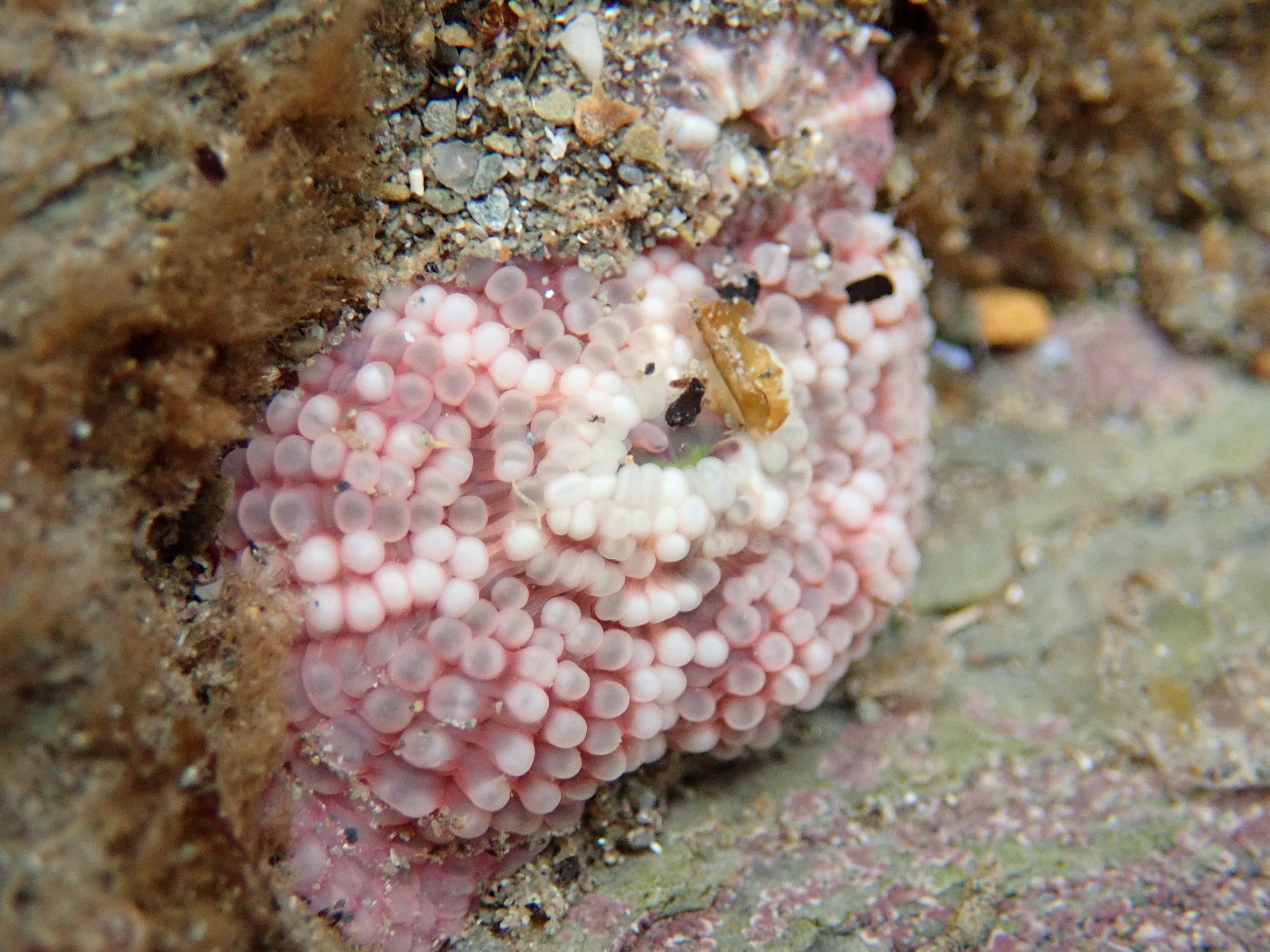
Shouts carried across the shallow waters. My friends had found something exciting: a newly-hatched baby catshark. This young greater-spotted catshark, also known as a bull huss or nursehound, had spent many months incubating in an egg case before emerging. When fully grown it could be over one-and-a-half metres, but for now it lay quietly in the tub, taking in the world through half-closed eyes. We returned it quickly to the shelter of the dense seaweed where it would soon be covered by the rising tide.
Egg case with a young greater-spotted catshark developing insideHatchling greater-spotted catshark, which we kept for a minute before returning it safely exactly where it was found.
As the days begin to lenthen noticeably I hope this is the first of many forays to new and more distant beaches over the course of the summer. No matter how many times I visit the rock pools, there is always something new.
If you’re looking for some summer reading, my book Rock Pool: Extraordinary Adventures Between the Tides is out on 2nd May with September Publishing and is available at local book shops, Waterstones and through NHBS as well as through online retailers.
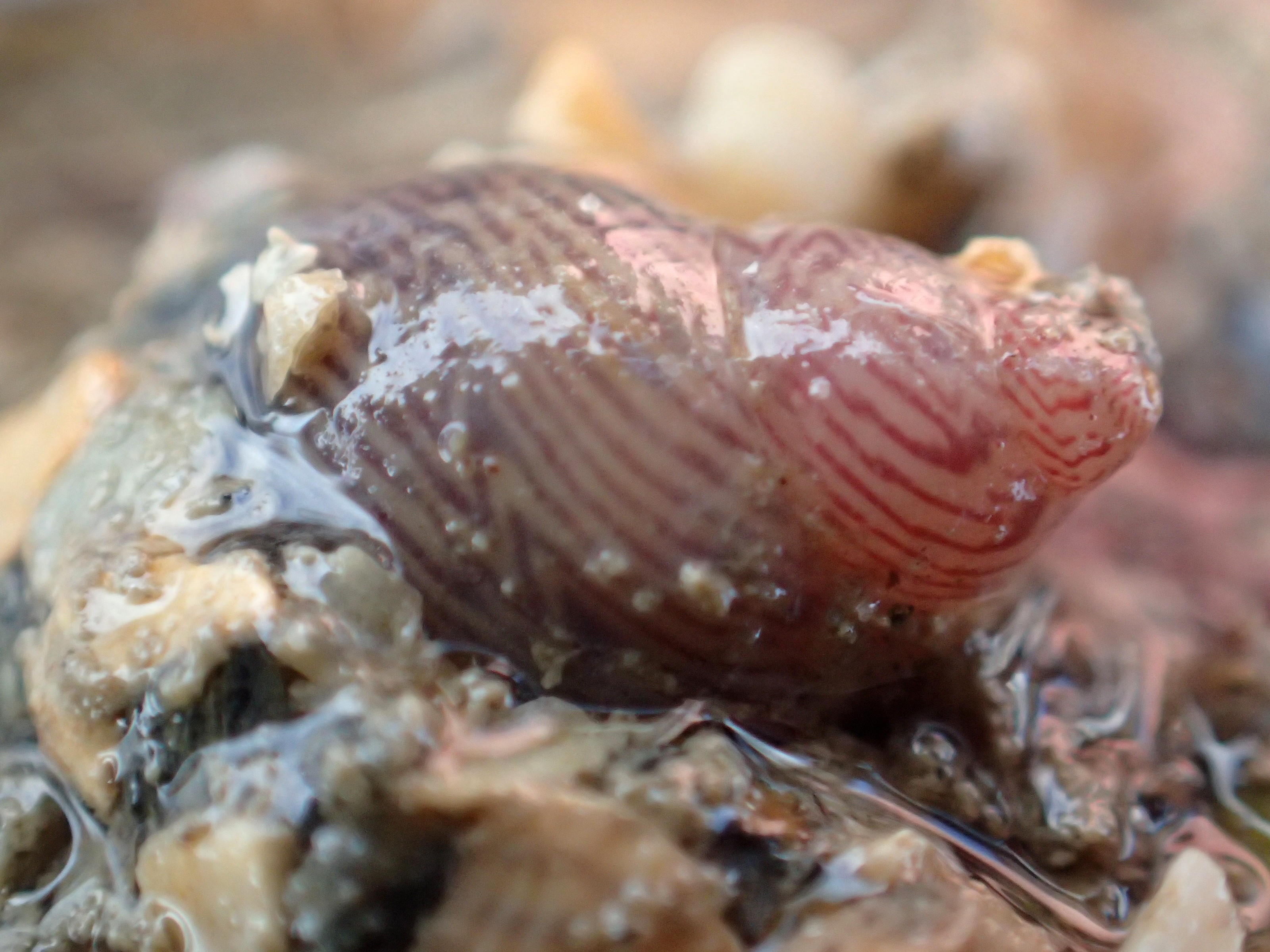
Another species of stalked jellyfish – Haliclystus octoradiatus – near PenzanceA beautifully marked pheasant shell near Penzance, Cornwall
It’s that time of year again. Amazing spring tides, ideal conditions and, of course, it coincides with Other Half’s birthday. Lucky him! What else could he possibly want to do but come rock pooling? To be fair, he needs no persuading that it beats a day in the office and, as a birthday treat, I offer him an evening out afterwards – watching me give a talk at the Cornwall Marine Recorders’ event in Gwithian (with a bar and nibbles).
We pile into the car ridiculously early in the morning to make sure we make it to Prisk Cove in time to meet our lovely friends and their twins to explore as the tide rolls out.
This beach is a little off the beaten track, but worth the walk. We find it empty of people and the tide so far out that the kelp hangs limply in shallow pockets of water in the bay.
The beach’s sheltered position between the Helford and Falmouth Bay, combined with the huge numbers of loose boulders, makes this habitat perfect for many marine species. Despite his initial certainty that he won’t find anything, Junior’s friend is first to find a spiny starfish. Its long tapering arms set with thick spines have an attractive purple hue.
Spiny starfish at Prisk Cove near Falmouth
We watch its many tentacle feet reaching out to explore the rocks.
Spiny starfish arm in action
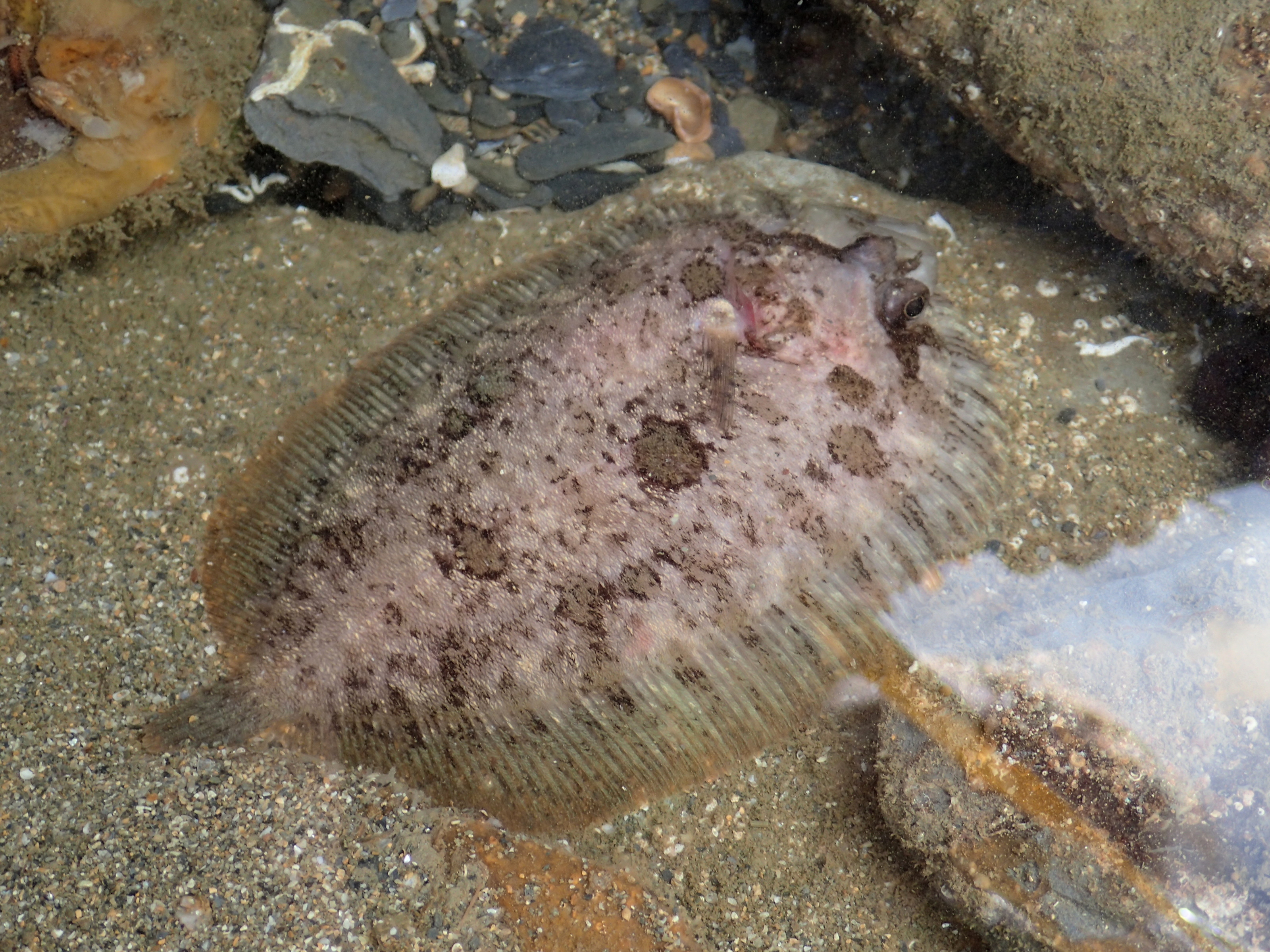
The asymmetric heads of flat fish always intrigue me, so I am delighted when we find the first little topknot, then more and more of them. Some are sticking to the rocks, even clinging on when completely upside down, using their fringing fins to mould themselves to bumps and imperfections in the surface. Their mottled patterns can make them hard to spot and they stay completely still to avoid detection.
Topknot flatfish resting on a rockFlatfish like this topknot have their mouth set on one side of their head.
Under a large rock we find a large edible crab that makes the other twin shriek. She soon overcomes her nerves when I move it out of the way so that we can look at the fish, which are also sheltering here.
Everyone crowds round to see the stunning colours and impressive headgear of the tompot blenny, and the kids are amazed by the smoothness of the rockling’s eel-like skin.
Tompot blenny
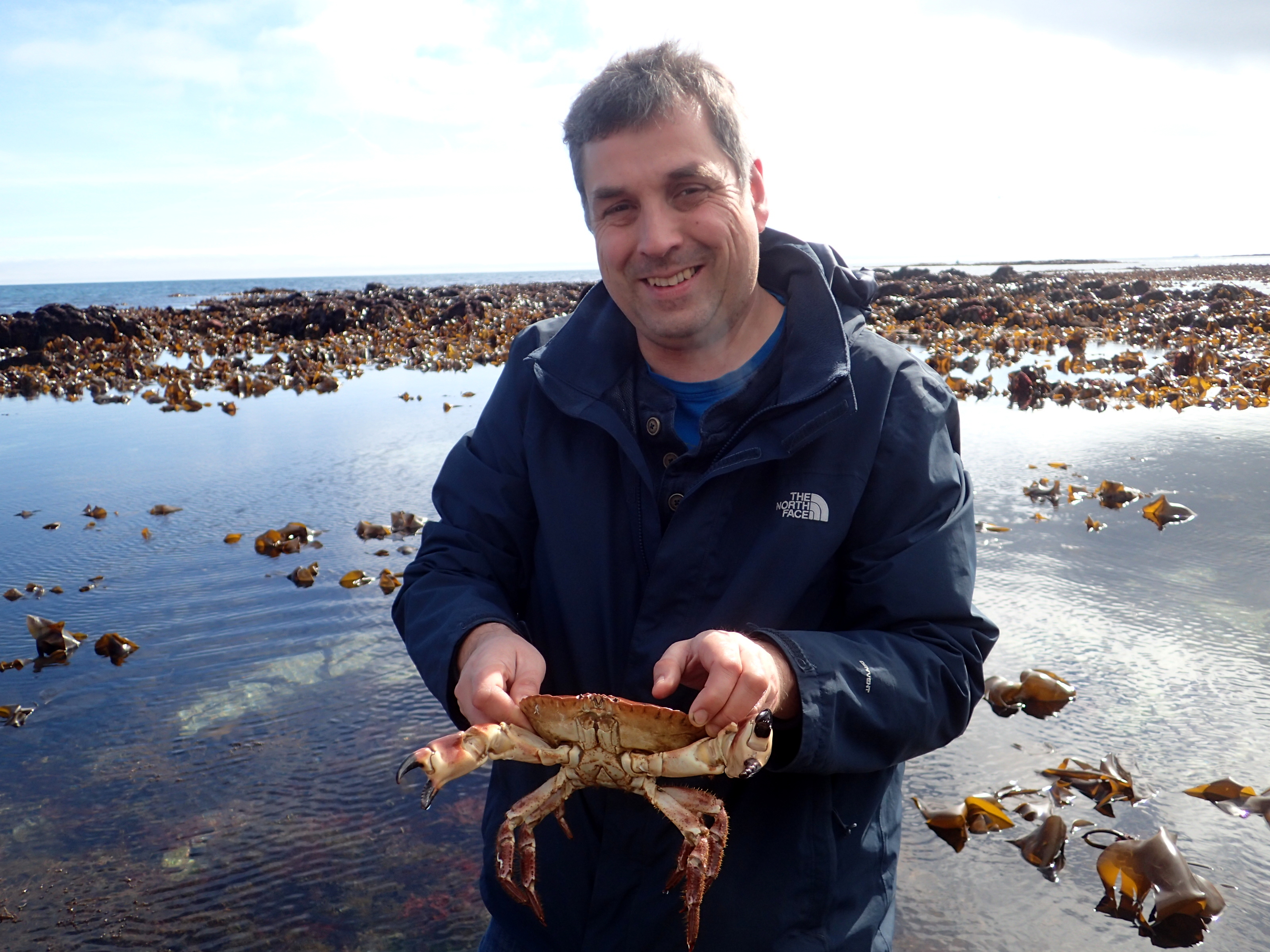
Other Half holds the edible crab for a quick birthday photo before we pop everything back where we found it.
Edible crab at Prisk Cove
Out among the furthest accessible rocks, the twins’ mum is not being outdone. She brings some fish over to show me, among them a beautiful goldsinny wrasse. It’s not a fish I often see on the shore, but it is easily identified by its two dark spots, one at the front of its dorsal fin and the other at the top of its tail.
Goldsinny wrasse at Prisk Cove
It has wide orange eyes with a flash of blue and the wonderful pouting lips of the wrasse family.
Goldsinny wrasse – a beautifully coloured fish
The finds flood in and I struggle to keep up with taking photos of everything to ensure that I can submit records afterwards. On one area of the shore I find a large patch of Wakame.
Wakame stipes
OLYMPUS DIGITAL CAMERA
This invasive non-native seaweed is easily identified by its corrugated-looking stipe and thin, floppy fronds. Originating from China, Japan and Korea, it has spread widely in Europe and can out-compete native seaweeds.
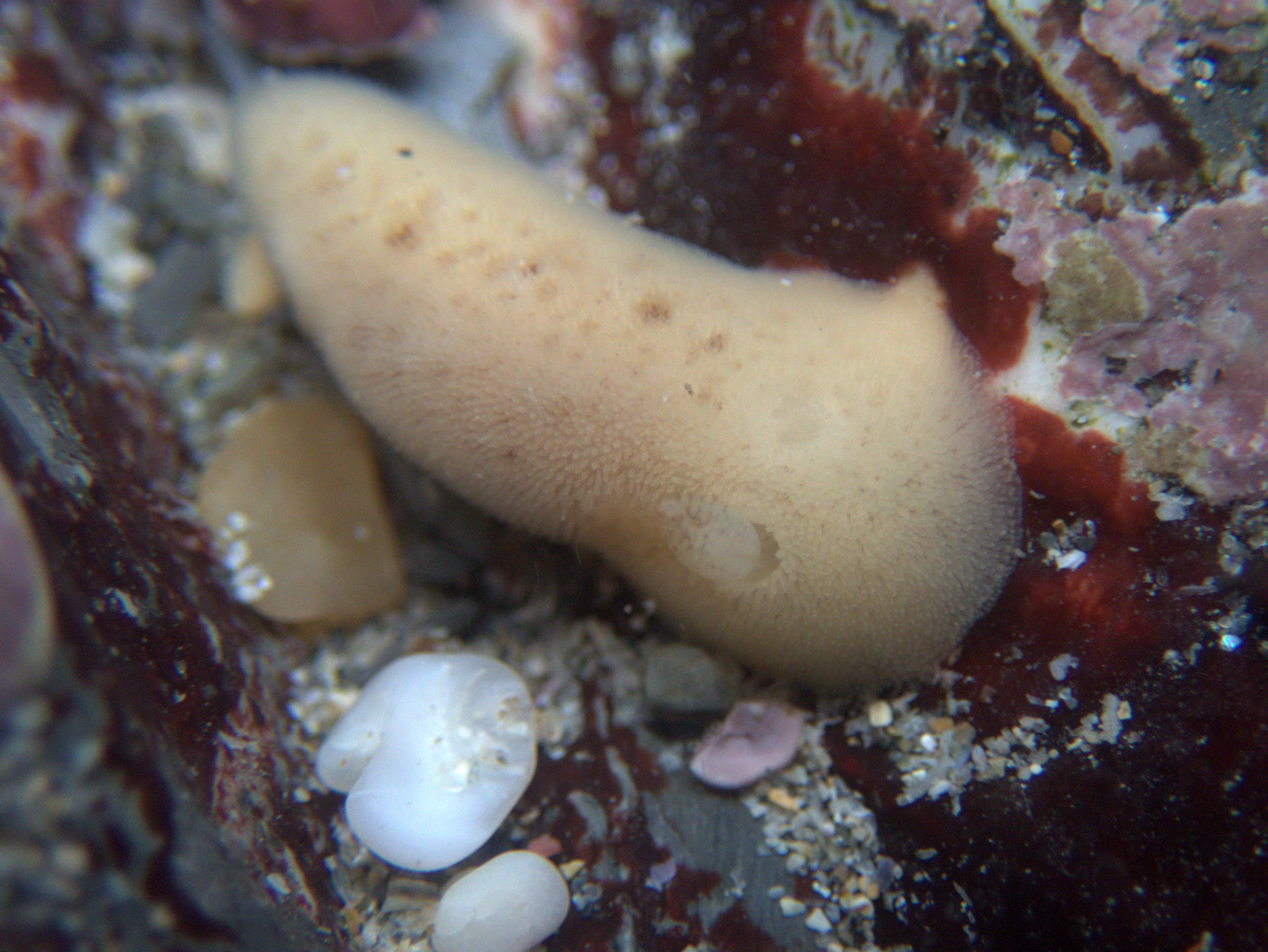
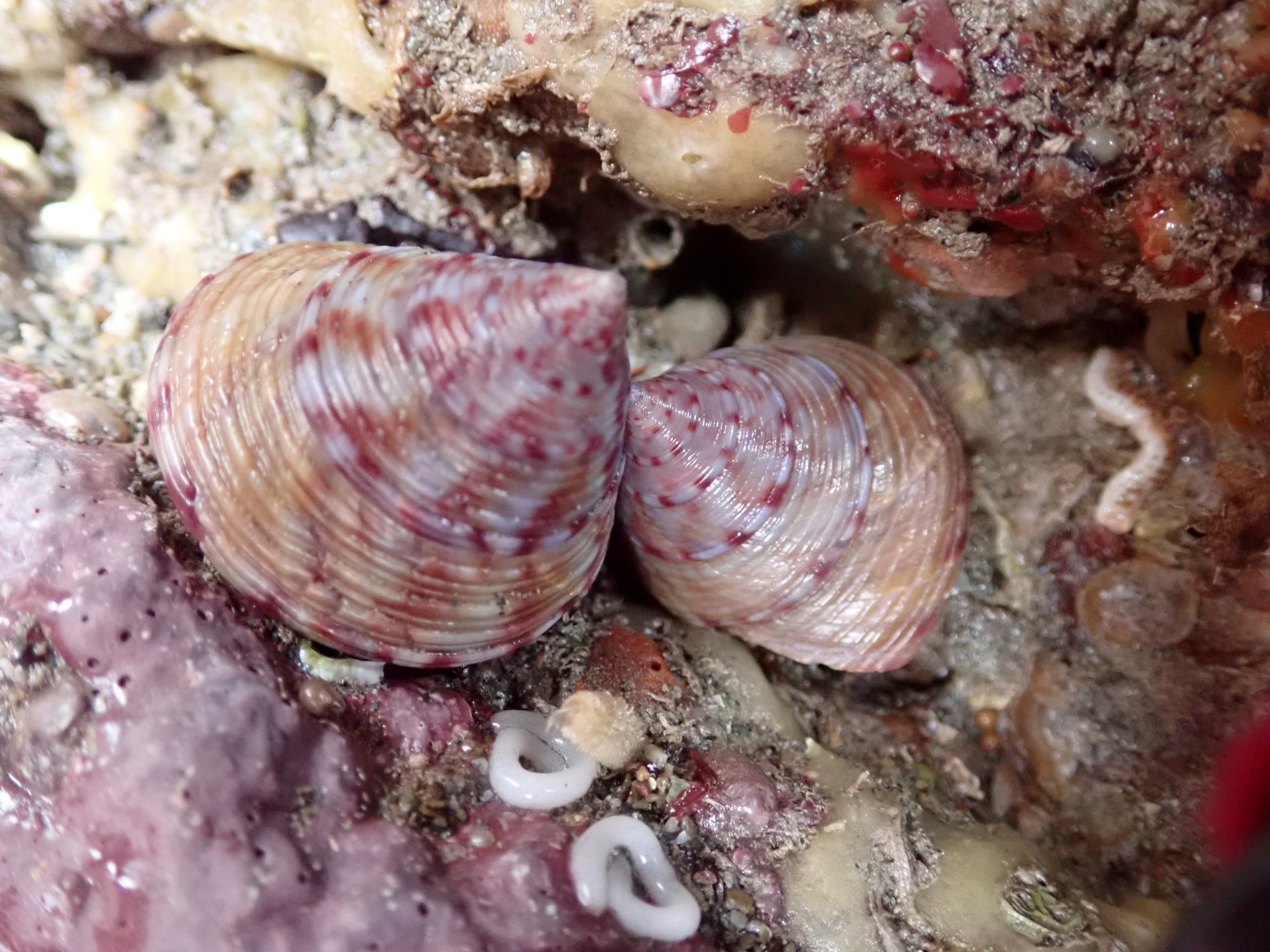
White painted top shells, an improbably hairy purse sponge and an interesting anemone all catch my eye before the tide turns.
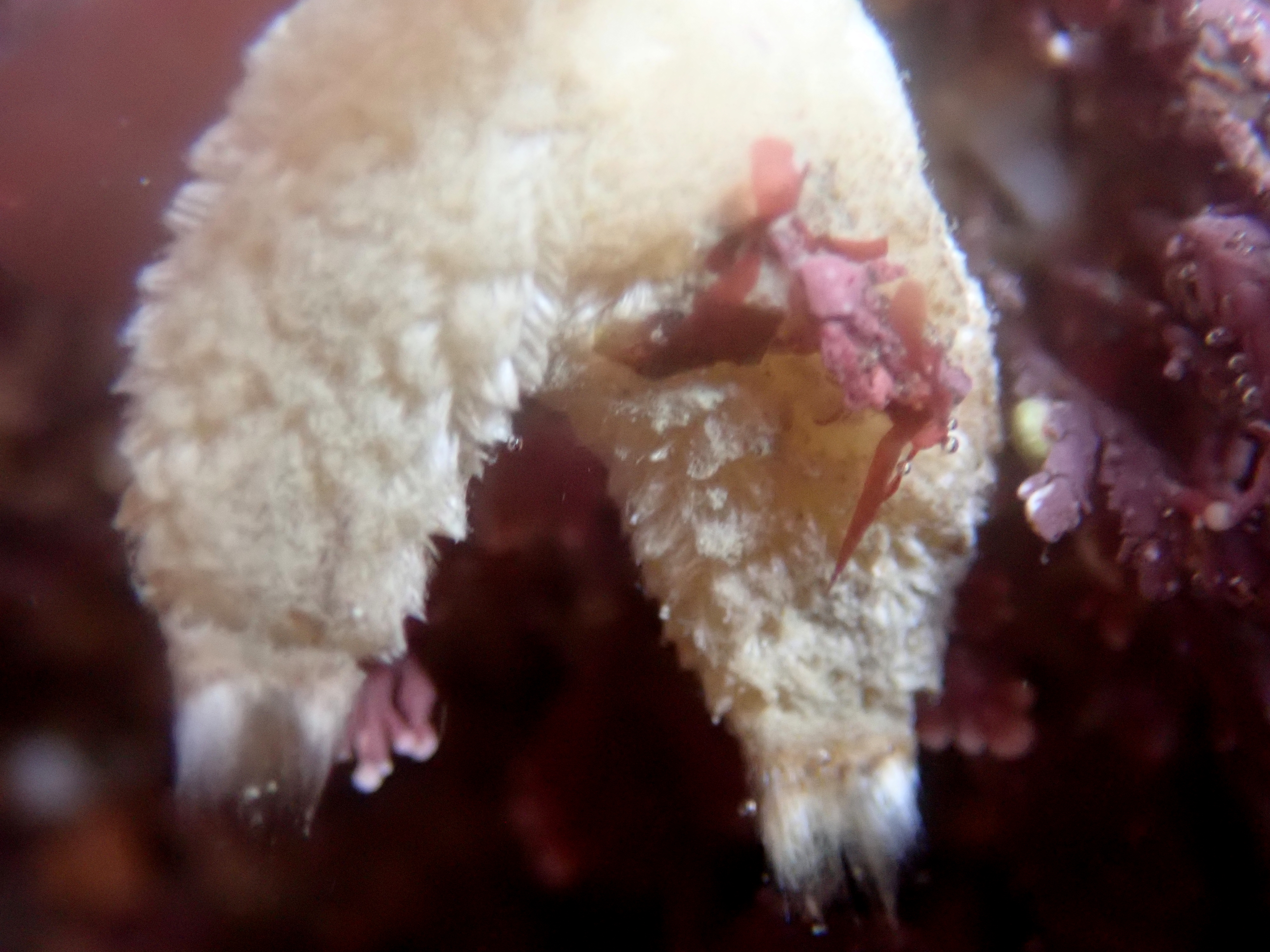
An especialy hairy purse sponge – presumably just a variant of Sycon ciliatumPainted top shells are usually pink, but this beach had many of the white variety
I also discover half a dozen shark eggcases of the Greater spotted catshark (Scyliorhinus stellaris) attached to the rainbow wrack of the lower shore pools.
Catshark egg case among the seaweedWhen it is in the water, Rainbow wrack is wonderfully iridescent
All too soon it seems, the tide is flowing in. At first it is a faint current, but it turns quickly into a churning river through the tight gullies and we retreat to enjoy a birthday picnic.
A lovely little Lamellaria snail, likely Lamellaria latensLimacia clavigera sea slug at Prisk CoveAn especially small anemone growing on rainbow wrack.
When the tides are perfect, I always hope that the weather will be perfect too, but this is Cornwall in late winter and strong southerlies are whipping up the waves. I plan my rock pooling accordingly, choosing Porth Mear, a north-facing beach between Newquay and Padstow to avoid the worst of the storms, accompanied by Junior and a new friend and fellow rock pool enthusiast.
Whatever the conditions may be, it’s a welcome chance to grab some fresh air after months of writing my new book Rock Pool: Extraordinary Encounters Between the Tides, which is out on 2nd May with September Publishing.
Junior hones his photography skills
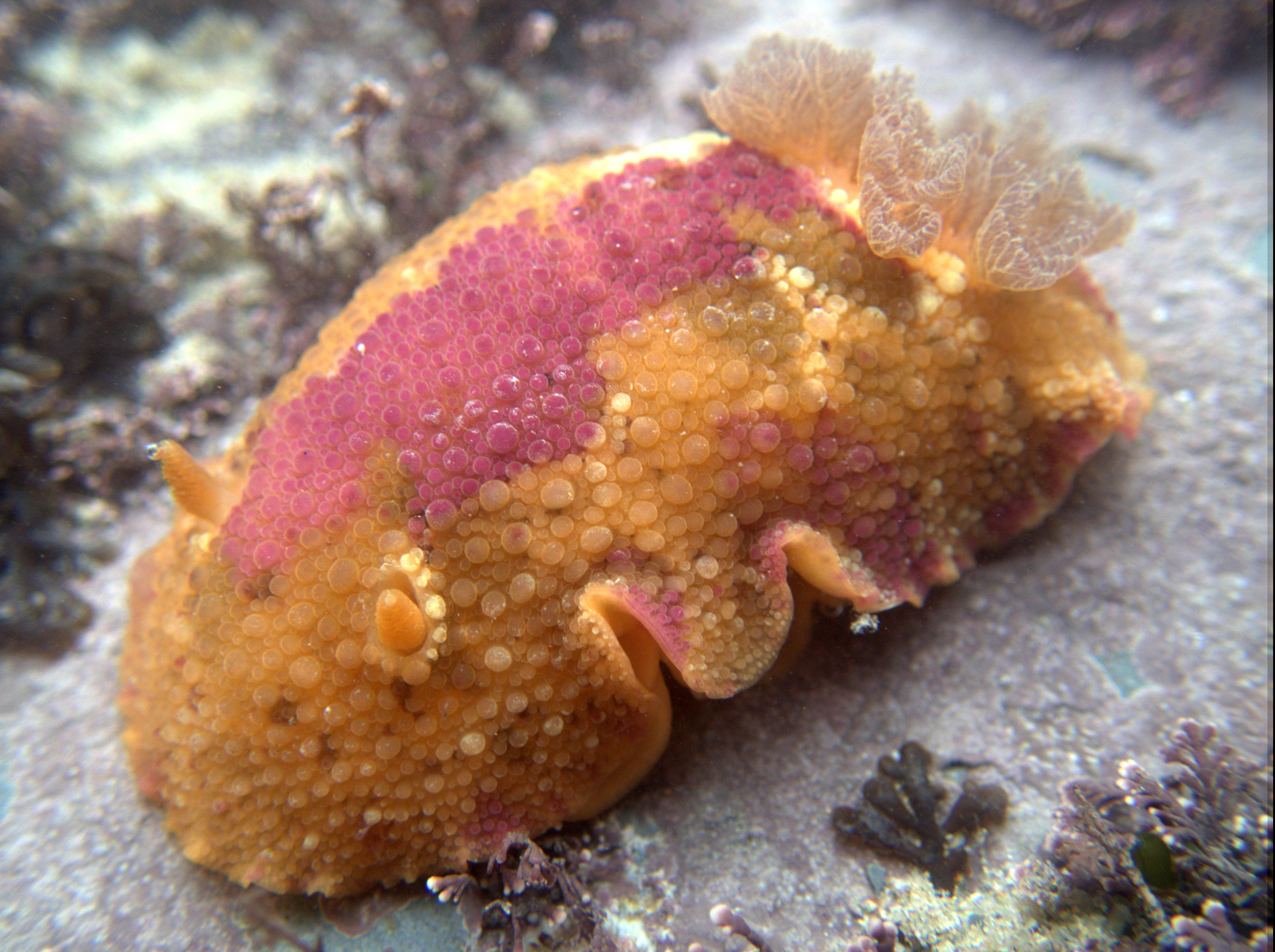
I give Junior a camera to use and he’s straight on the case, trying out the settings and attempting to capture a blenny at the back of a hole in the rock. He spots some jelly nearby; the eggs of a sea lemon slug and we soon find the animal itself. We place it in water to watch its gills and ringed rhinophores (head tentacles) emerge.
In the water the sea lemon’s rhinophores and frilly gills emerge and we can see its wonderful colours
We edge further down the beach, keeping a nervous watch on the swell that is breaking over the rocks and exploding through the gullies. Junior takes photos of everything and is entranced by the blue-rayed limpets, manoeuvring himself through every possible angle as he tries to capture the iridescent turquoise lines on their tiny shells.
Blue-rayed limpet. Photo by Cornish Rock Pools Junior
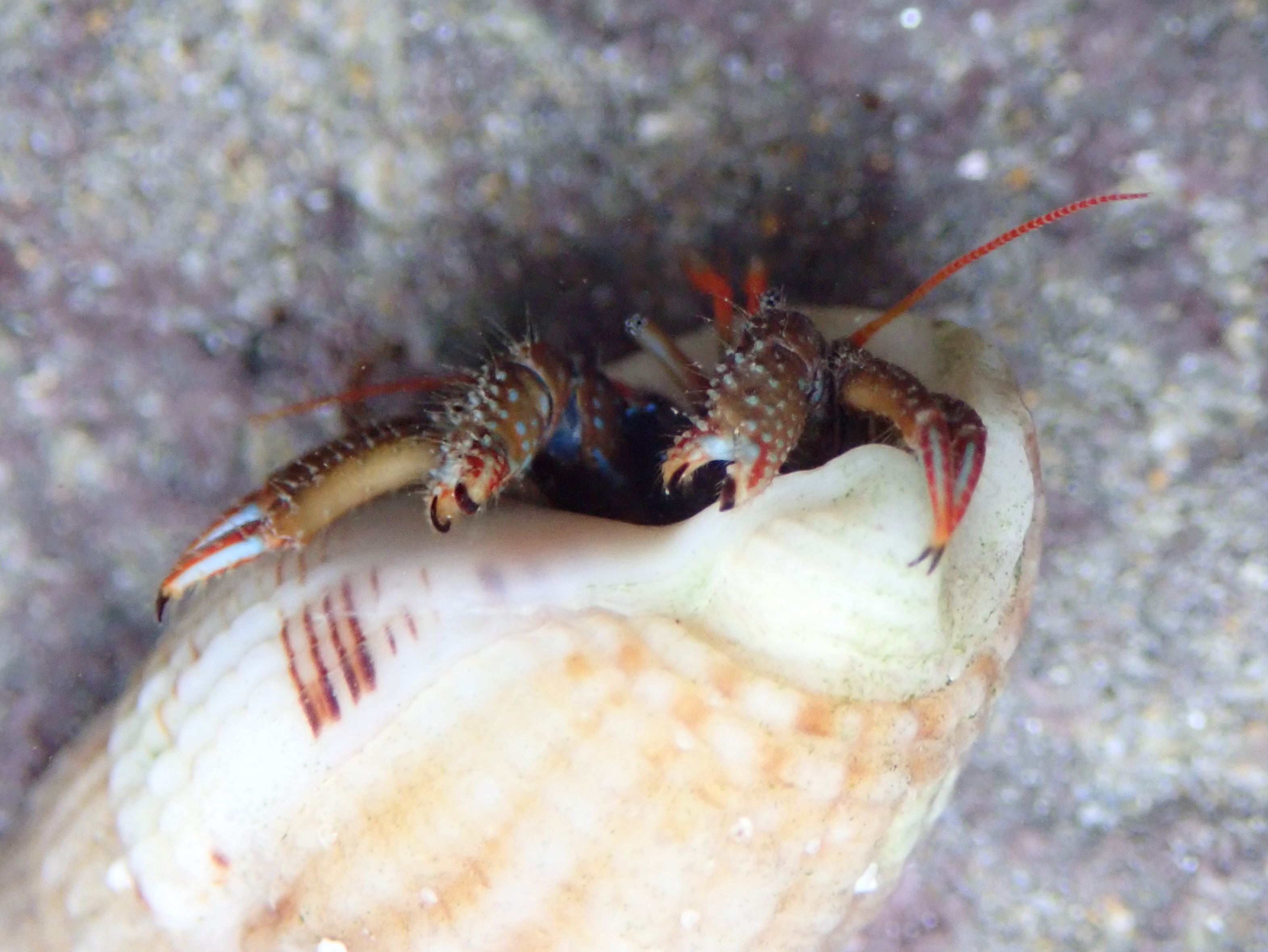
We find two thriving colonies of St Piran’s hermit crabs, with dozens of shells of all sizes in and around one pool, all occupied by these hermits. They are immediately recognisable by their red antennae and blue-tinged claws, but they stay firmly tucked away in the recesses of their borrowed shells.
A brief glimpse of a St Piran’s hermit crab.
Junior is keen to show our new friend a gully where we often make interesting finds, but even as the tide dips to its lowest point, we are unsure whether it will be accessible. We climb to a high vantage point to look down at our favourite spot, but with foaming waves crashing over the rock face on one side, we admit defeat.
I lead the way over the rocks to another sheltered inlet and we clamber down into a deep cleft in the blue slates. The wet rocks are so steep and slippery that after sliding to the bottom I briefly wonder if I will be able to haul myself out again, but I am soon distracted by the richness of the rocks here. Three-spot cowries abound and a large edible crab is resting under an overhang.
The European 3-spot cowrie (Trivia monacha)
Our friend carries on over a huge boulder to look at the pool on the other side. We discover cup corals at the same time; there is just a scattering of them on our side, but many dozens in the pool out friend has found.
Junior and I cross to take a look and balance precariously on the edge of a deep pool, leaning under a steep shelf of rock to try to take photos of the corals that are tucked away there. Most of the scarlet and gold cup corals are a deep, warm orange, but some are bright yellow like tiny suns.
Scarlet and gold cup corals at Porth Mear – showing both the yellow and the orange varieties.
Within a couple of minutes, we can feel a shift in the sea and the waves are breaking harder and closer to us, so we abandon our efforts to take photos and slip and scramble our way out of the gully.
Back on the beach, all seems calm and fish huddle under many of the rocks, waiting for the tide’s return. As always, this shore abounds with Cornish clingfish and worm pipefish.
A Cornish clingfish. There was also a Rock goby and a pair of worm pipefish under the same rock.
Under the rocks we find a host of crabs and a few Candelabrum cocksii hydroids, which are fascinatingly variable in colour and shape, extending and contracting their bodies and proboscises.
Candelabrum cocksii hydroids are limited to the far south west of the UK.
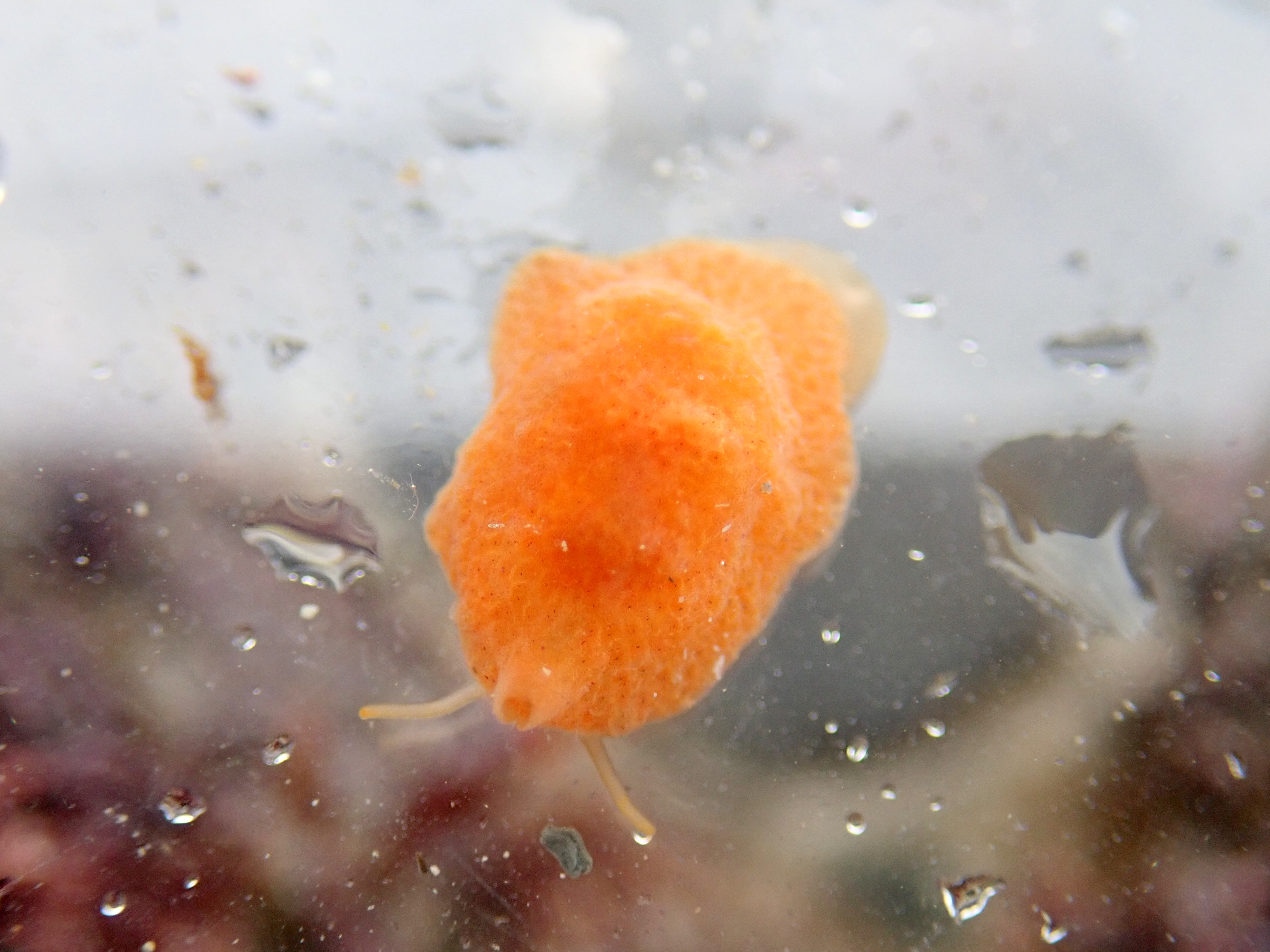
Junior is especially pleased to find a bright orange Lamellaria perspicua (Dalek snail, as he calls it). It looks like a slug, but keeps its shell hidden under its soft body, exploring the rocks with two small antennae and a tubular appendage like a Dalek’s gun held out in front of it.
Strange and colourful – the Lamellaria perspicua is one of our favourite finds of the day.
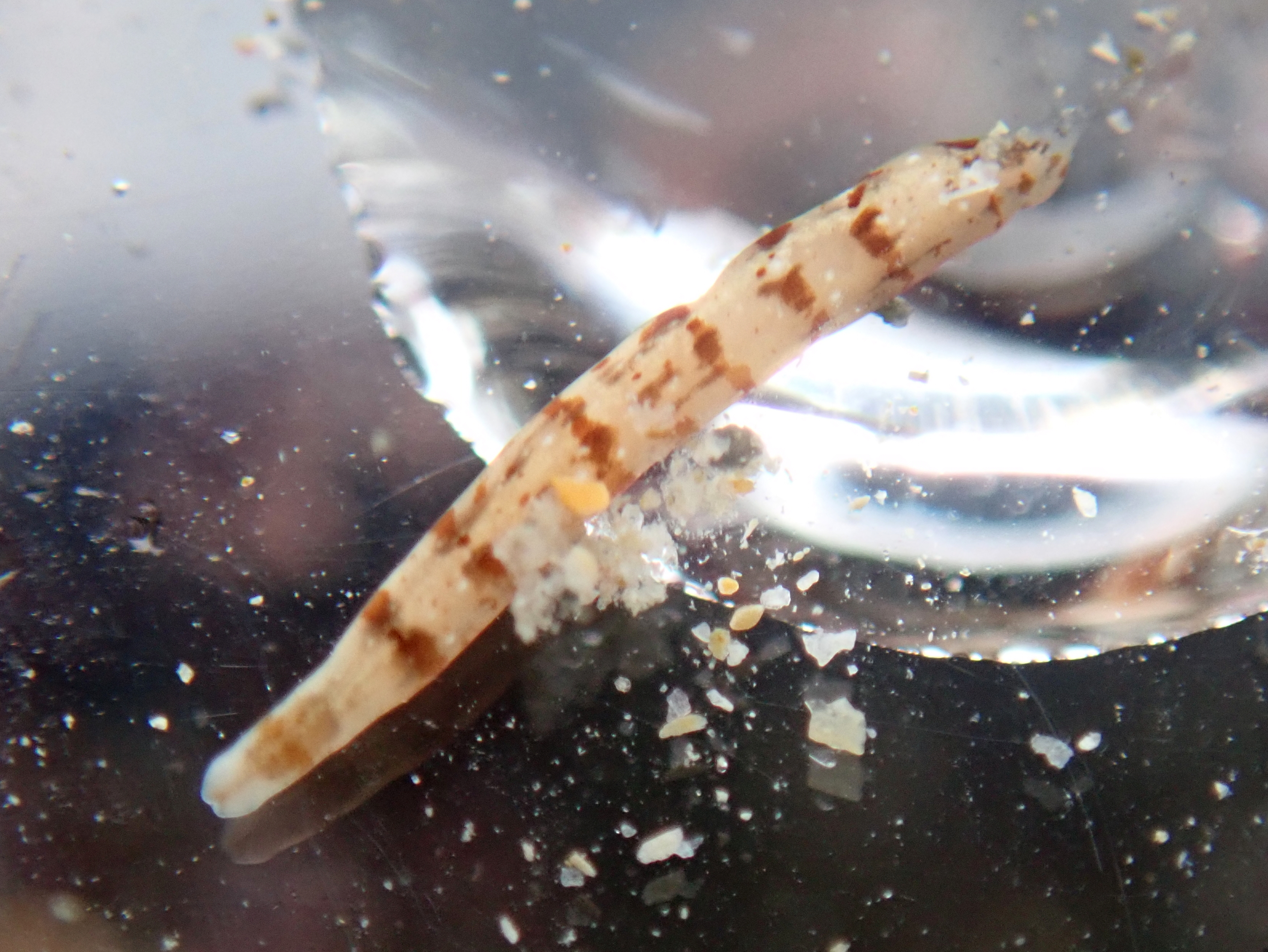
A short, prettily marked white worm with chestnut banding catches my eye, but I have little time to take photos as the waves are roaring in.
This colourful worm, which I think is Oerstedia dorsalis, was only around 1cm long
We watch the sea reclaim the shore from the safety of the tideline while we munch our sandwiches and check through our photos. Beaches can be challenging this time of year, especially when it’s stormy, but the vivid colours and strange lives of the creatures we have seen today, together with the chilly temperatures, send us home with colour in our cheeks.
Spiny starfish at Porth Mear near PorthcothanA fuzzy-looking Jorunna tomentosa sea slugFish eggs by Cornish Rock Pool Junior – these were floating in a pool, unattached to anything.
There are many advantages to home educating Junior, but one of our favourite things is being free to go outside whenever we like. During the winter months, good weather and daylight coincide so infrequently that we nearly always drop everything to make the most of it. Today, Junior wants to explore our local beach and dig in the sand, so we grab our wellies, spade and camera and set out with the low morning sun glimmering from behind the clouds.
Spring comes earlier in Cornwall than it does further north, and the signs are there even though the days are still cold. The herring gulls have already moved back onto the roof-tops in our neighbourhood, and some are sitting on empty nests to deter others from moving into their territories. Buds are tightly wrapped on the hedgerow plants, waiting to open and a few hardy wildflowers are already blooming.
We hear the fulmars honking to each other on the cliffside above Plaidy before we see them. When we stop at a viewspot to look across to the Eddystone lighthouse, a male fulmar glides towards us on stiff wings before circling back to land on a ledge and touch beaks with the female that is resting there.
In the rock pools, spring is even further ahead and I have been finding sea slug spawn for a few weeks already. ‘Sea mushrooms’, the holdfasts of seaweed are appearing on the rocks and beginning to sprout from their centres. Colourful colonies of star ascidian are budding and spreading across the rocks. On one a flatworm is grazing, while another young colony is being visited by a hungry 3-spot cowrie.
Star ascidian at Plaidy beachA 3-spot cowrie closes in on a small star ascidian colony.
The tide is wonderfully low so we scramble out to the furthest rocks we can safely reach. Junior discovers anemones and sponges. A tall rocky gully is coated in every colour of sponge, sea squirt and bryozoan, and we peer closely at their strange forms.
The overhang is coated in animal life including sponges, sea squirts and barnacles.
I spot an overhang that plunges into a pool. Even though I can see it’s too deep for my wellies, I wade in, balancing from one submerged rock to another, feeling a cold trickle down my shin as the water overtops my boots. At the edge of the rock the water is still precariously high, but I have noticed some dark, frilly tentacles in the water. Several sea cucumbers are lodged in cracks in the rock here and are busy feeding with their extended fronds. Junior crawls over the rock to get a better view of this unusual sight.
Brown sea cucumbers (Aslia lefevrei) feeding in the pool.Brown sea cucumber feeding tentacles
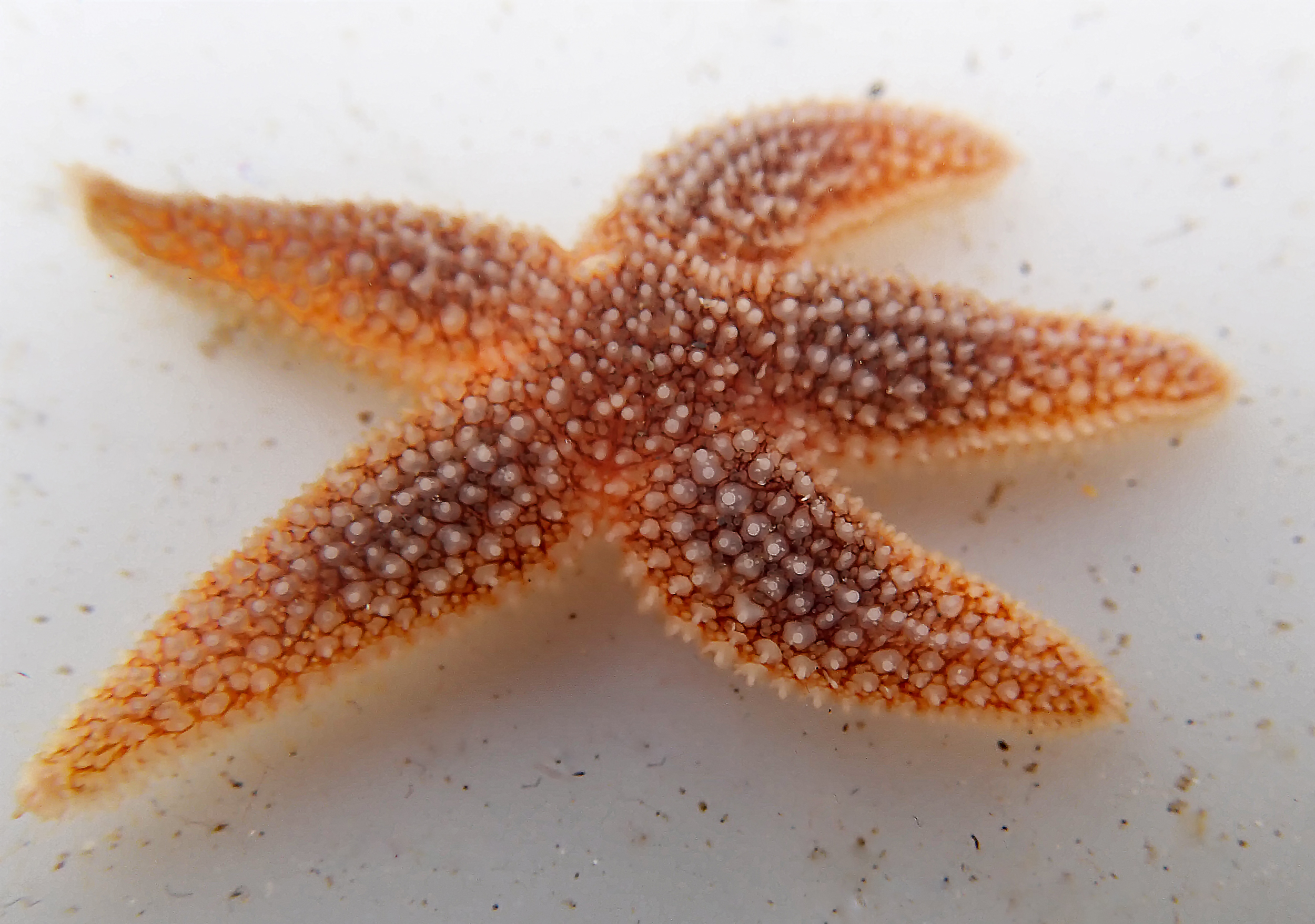
Edging our way through the narrow rocks, we reach the very edge of the sea. We are sheltered a little from the waves by a rocky reef further out, but the waves are still surging back and forth. In a hollow I can see a young common starfish. I tease it out of its hiding place and Junior holds it on his hand while I take photos.
One of several young common starfish we find on Plaidy beach.
Despite its name, this starfish is nothing like as common on our beaches as the other species we see here, preferring the deeper offshore waters. Junior takes a good look at its colours and its tube feet before placing it back where we found it.
We cross the rocks to the next beach, where Junior begins his sand-mining excavations while I take a walk along an old sea wall in the hope of taking a photo of shanny. These fish hide in holes out of the water while the tide is out and there are usually plenty in this wall. Of course, there are none in accessible places now that I have come to look for them, so I carry on across the beach to take photos of the lugworm casts that litter the muddy sand here.
The cast and depression in the sand mark the two ends of the lugworm’s burrow.
I am about to go back to see Junior’s work, when I see movement in a shallow pool. It looks as though there’s a tiny geyser beneath the surface throwing the sand up in a constant jet. There are several animals that like to bury themselves here, including some quirky species of prawn, but this sandy pool near the low tide mark makes me think of something else. I crouch by the pool for a few minutes without moving, scanning the sand before I see what I’m looking for. A small, sand-coloured fish is sitting unmoving in the shelter of a rock. I know it will be a weever fish.
A weever fish lying in the sand at Millendreath.
Trying not to scare the fish away, I cross to the other end of the pool. It sticks its ground, watching me through shining eyes set towards the top of its head. Even as I lower my camera into the pool, it stays perfectly still, so that I can see its gaping mouth and moving gills. The mouth is unlike that of most other fish: the opening is nearly as high as the fish’s eyes and is hinged at the bottom like a tall flap. Inside it, I can see some spindly, crooked teeth.
The weever fish lies still as I approach, watching me with shining green eyes.
I have no bucket and this fish will bury itself in the sand in an instant if I disturb it, so I just watch, putting my camera as close as I dare to frame the fish’s remarkable metallic-green eyes. Although the dark fin on the fish’s back is folded down now, it is made of venomous spines that cause painful stings to bathers in the summer.
Weever fish with its spiny fin folded down.
Junior emerges from the hole he’s dug to look at the photos and do a beach clean before we head for home in the last of the day’s pale sunshine.
Painted topshells and a sea slug laying eggs – spring arrives early in the Cornish rock pools.Junior’s top find of the day. The yellow circles on the rock are boring sponge. This sponge drills into the calcareous rocks and mollusc shells making round holes.
Ever since we discovered gem anemones in the pools at Plaidy last week, Junior has been planning a night-time trip to see them fluorescing under ultraviolet light. Lots of anemones glow in UV due to special proteins they contain that absorb the ultraviolet light before re-transmitting it at a longer, visible wavelength.
Snakelocks anemones are well-known in rockpooling circles for glowing a vivid, eerie green in UV and we have seen those many times, but we’re intrigued to see if gem anemones are as spectacular by night as they are by day.
Gem anemone by day
Other-Half joins our after-dark ramble. We wrap up and walk through the deserted lanes. In the light of the rising full moon, there’s no need for torches. The stars have been out for a while already and the Eddystone lighthouse is flashing away at the horizon.
It took us quite a while to spot the gem anemones by daylight. Despite their pretty colours, they are tiny and well camouflaged among the pink encrusting seaweed that lines the pools.
We cross the sand and the heap of seaweed that the tide has brought in to the far rocks and take our UV torch out. Junior scans it over the pool and within seconds we’ve found them. They seem to light up in patterns of green and orange.
Under UV the gem anemones are easy to spot
We kneel down and look closely at the starburst of orange that radiates out from the turquoise and pink mouth at the anemone’s centre. The green fringes to the tentacles that are sometimes visible by day are unmissable now.
Gem anemone under UV light
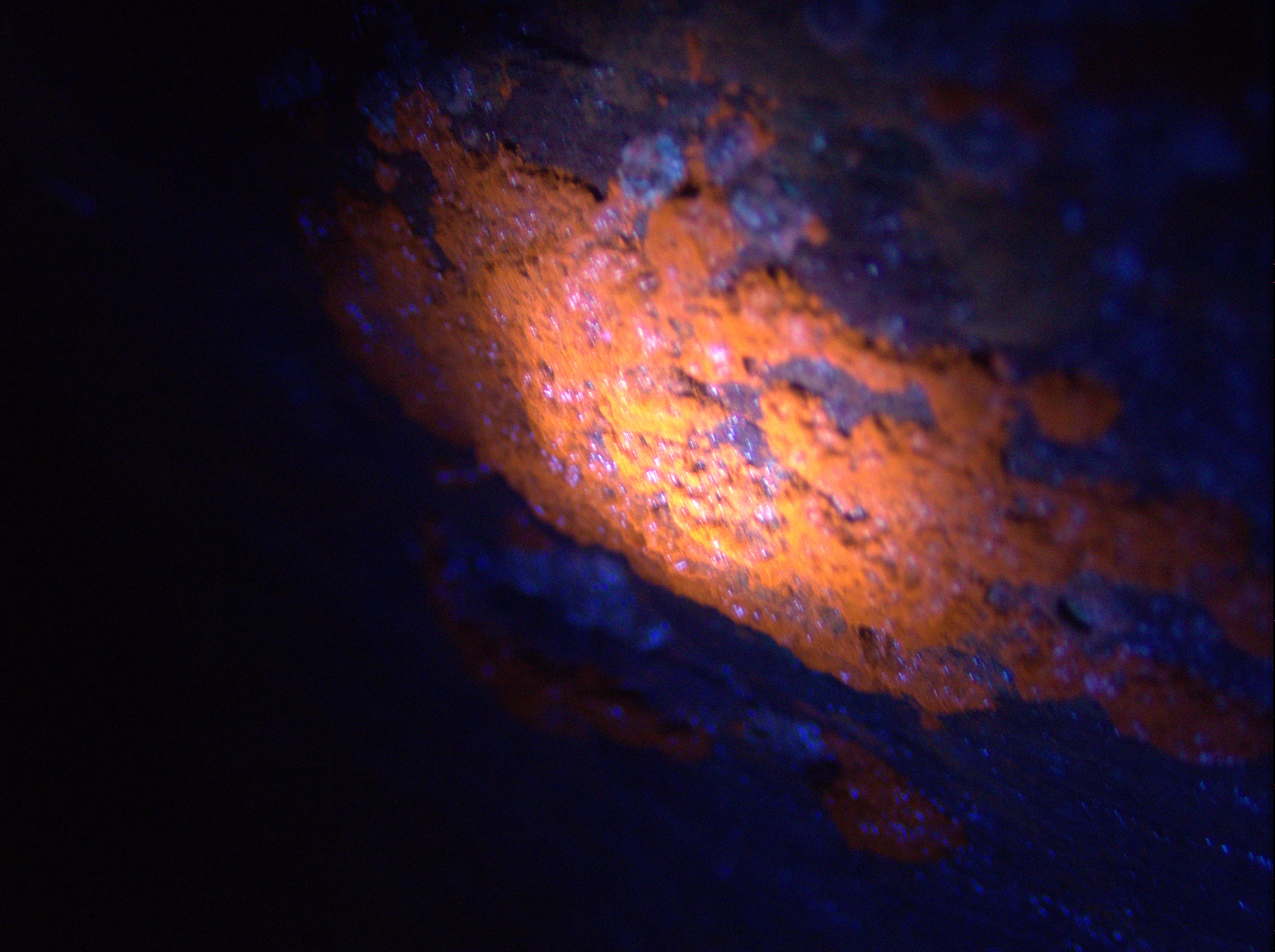
Junior is keen to look at the sponges and seaweeds to see what they do under UV and leads me on a precarious climb towards an overhang he knows. The rocks here glow insanely orange and though it’s hard to tell what is causing this effect in the dark, it feels like either a dense red seaweed or a sponge.
Junior’s orange-glowing sponge or seaweed
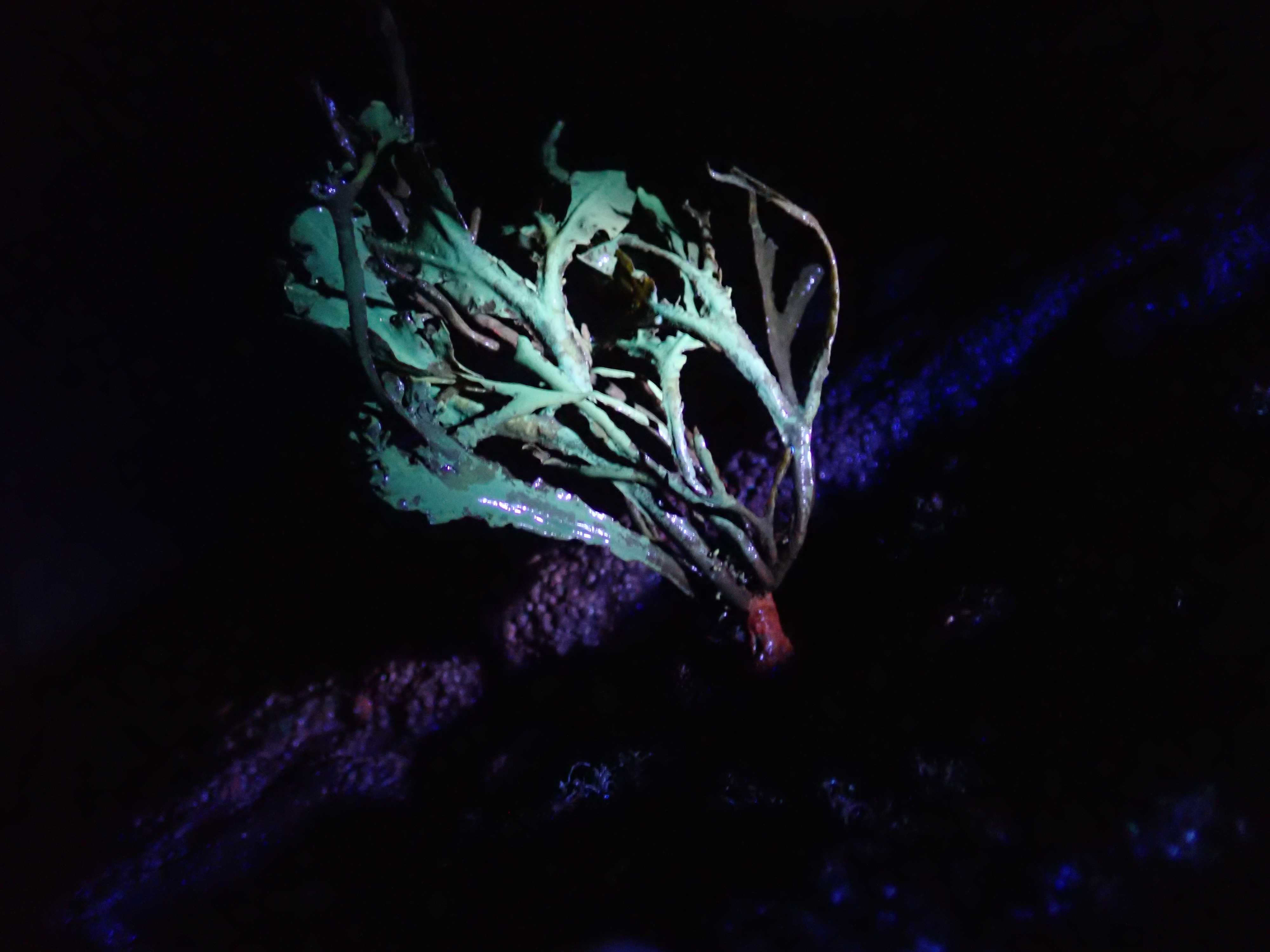
As we scramble over the rocks, we find more fluorescing plants and animals. A brown seaweed glows green, possibly due to micro-algae that is growing on its fronds.
Brown seaweed glowing green in places – presumably coated in a microalgae
Grey topshells are easy to spot because the tip of their shell glows pink.
Grey topshell in UV light
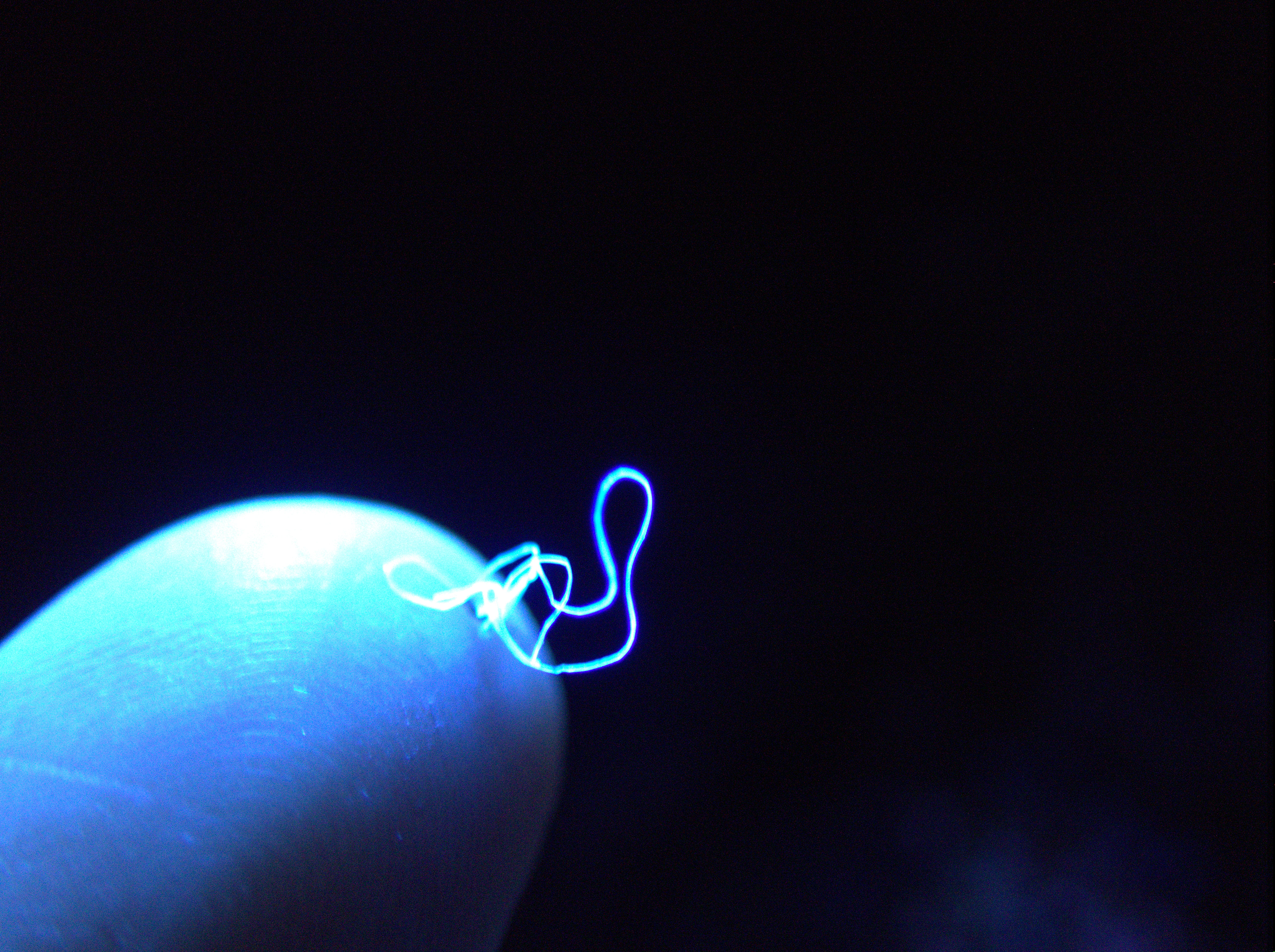
We are intrigued by thin bright-blue streaks among the seaweed. It takes a while for us to realise that these are man-made threads. They feel coarse and may well be fibres from a fishing net. Many seaweeds on the shore are so tangled in them that it is almost impossible to clear the plastic fibres without damaging the seaweed.
One of many plastic fibres we find tangled in the seaweed
In a shallow, rocky pool lined with sediment more anemones are glowing. These look nothing like the gem, snakelocks or daisy anemones I’ve seen so far.
Another anemone species that fluoresces – Sagartia troglodytes.
I turn my normal torch on them to see what species they are and I can’t see them at all. By switching back between UV and normal light I manage to pinpoint them. They are at least as small as the gem anemone, but are flecked with a marble of brown, white and orange that blends perfectly into the sand and rock around them.
Under the camera I can make out dark ‘B’ shaped markings at the base of the tentacles and realise this is Sagartia troglodytes. I don’t remember seeing this anemone before, probably because it would be almost impossible to spot in daylight.
The same Sagartia troglodytes anemone under normal torchlight is much harder to see among the sediment.
I touch one of the anemones gently with a finger and it retracts in a puff of sediment, disappearing without trace.
I take photos while Junior and Other Half climb onto a high rock to watch the stars. On nights like this it is hard to tell whether the sea or the sky is shining more brightly. With a last sweep of the torch over the glowing anemones we turn away and head home for hot drinks.
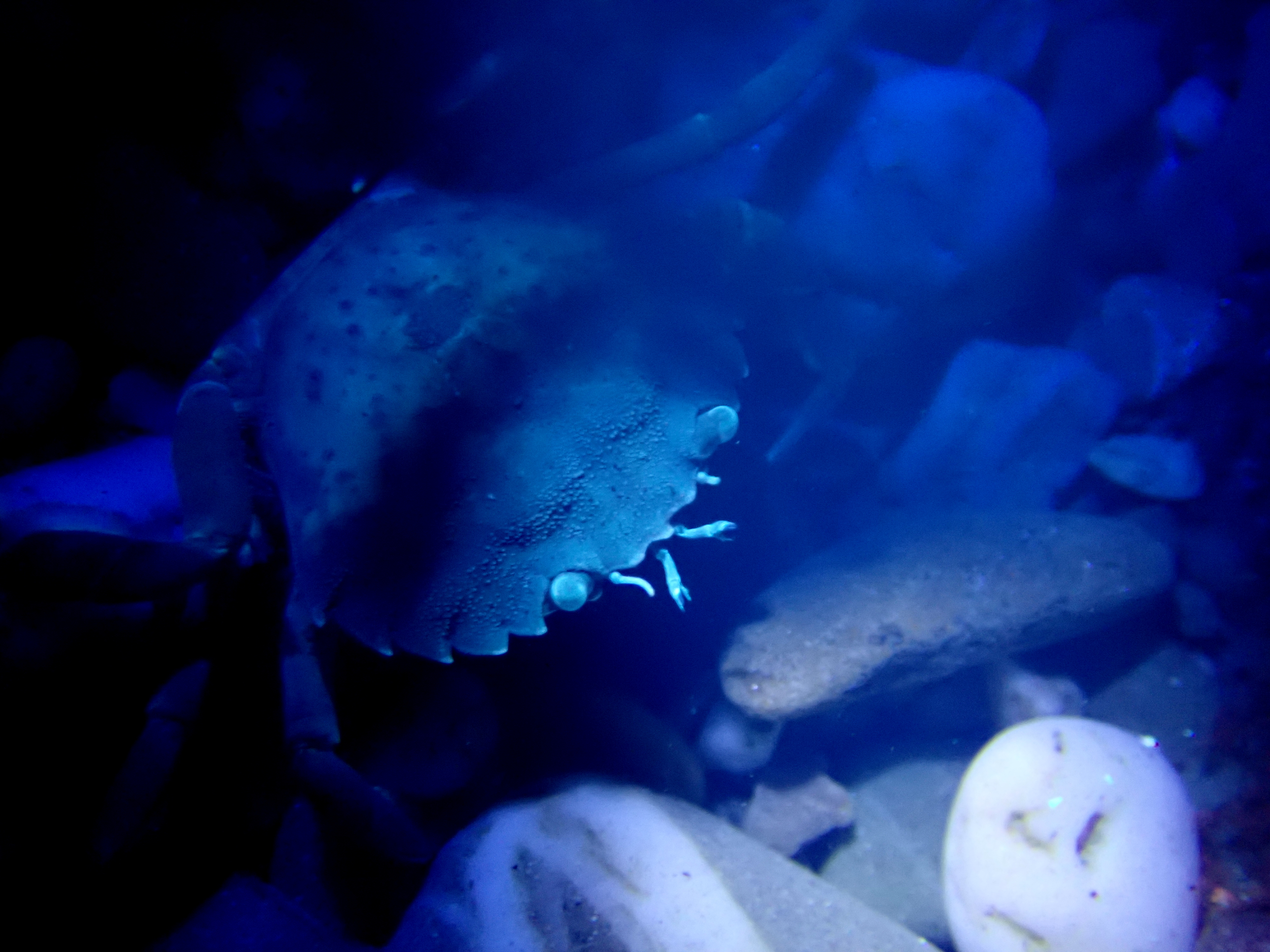
Gem anemone under UVThis daisy anemone glows red under UV but is a dull brown under normal light.Anemones aren’t the only animals out in the moonlight – this green shore crab glows blue under the UV torch.
The tide isn’t always out far enough to go rock pooling, but on a windswept north coast beach like Mawgan Porth there’s always something interesting washed up on the tideline. Junior and I wander through the dunes to the soft sand of the upper shore just after the tide has turned with a plan to look for shark and ray egg cases (mermaid’s purses). We often take them home to soak so that we can check the species and record our finds on the Shark Trust’s Great Eggcase Hunt website.
We found lots of egg cases on our last hunt – mostly from spotted rays
We both see it at the same time. A greenish lump is shifting at the edge of the retreating sea, being nudged in and out by surging waves. From a distance it could be a stranded animal, but we quickly decide it’s a net and run towards it for a better look.
Currents run fast across the bay and can easily catch you unaware, so I leave Junior behind while I attempt to drag the net clear of the waves. It’s several metres wide and is weighed down with water and sand. With an eye on the sea, I stagger backwards a few centimetres with each heave until the net is clear of the waves.
While I catch my breath, we examine the net close-up. Much of it is encrusted with seaweeds and hydroids. It looks as though it has been in the sea for some while. Attached to one of the intersections is a stony lump like a tooth. This is the ‘skeleton’ of a Devonshire cup coral.
Devonshire cup coral ‘skeleton’
I’m thinking about how to detach the coral without breaking it when I spot a couple walking across the beach towards us. They look like able recruits, so I ask if they might be able to help. The four of us grab the net between us and tug it behind us, army fitness-test style. We take a few breaks along the way, take a small detour to avoid a stranded barrel jellyfish because it doesn’t feel right to run it over. We’re all getting unseasonably warm, but we don’t give up. As we near the top of the beach another woman joins us for the last push to the rubbish collection point.
I take a few minutes to look over the net and find several more cup coral ‘skeletons’. Without a knife it’s not easy to remove them but I manage to prise a few off to show my net-hauling team. To my delight one cup coral has a bump on the side of it. This is an Adna anglica barnacle which only grows on cup corals.
Adna anglica barnacle on the side of the cup coral ‘skeleton’
We walk back along the strandline, picking up lots of stray pieces of netting. The plastic fibres are everywhere, breaking into smaller pieces that will stay in the sea for an incredibly long time if they aren’t removed.
There are a couple of lesser spotted catshark eggcases among the seaweed and a ‘by the wind sailor’ hydroid. Then I give such a squeal of excitement that an old couple walking near us turn to stare. When I pick up a transparent piece of jelly that looks like plastic, they turn away again.
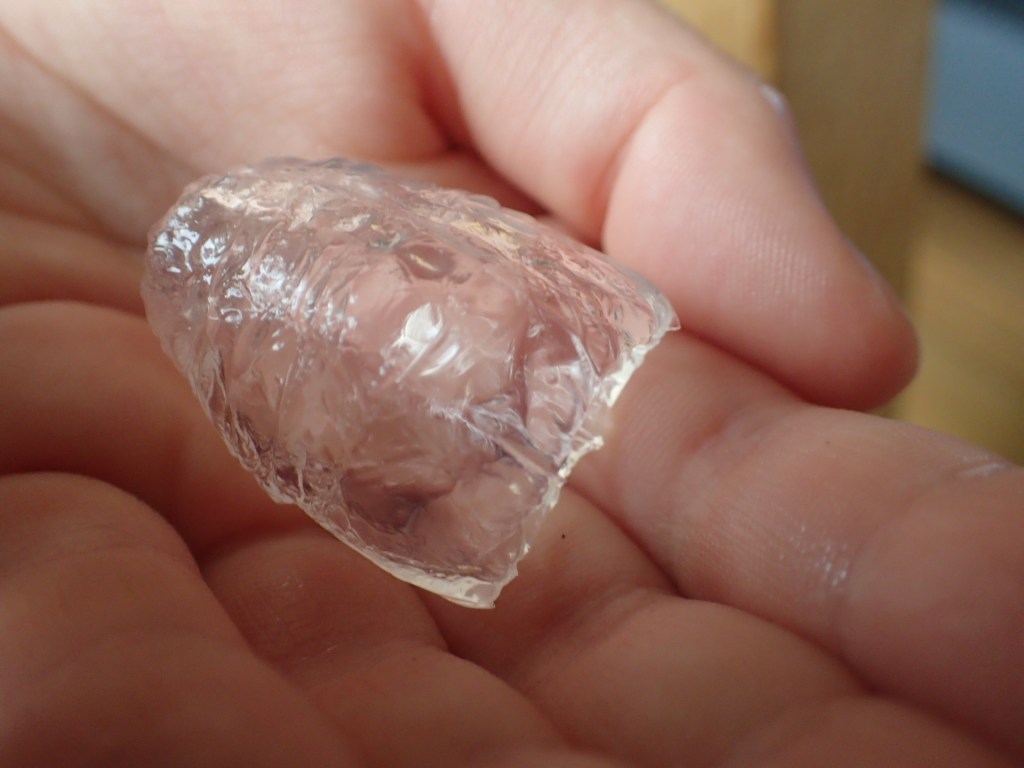
The creature fits neatly in the palm of my hand and glistens in the light and feels solid, even though it is entirely transparent. We turn it back and forth, looking through both ends of its tubular, barrel-shaped body. It’s no longer alive, but this is definitely my first salp.
Salp – still covered in sand from the tideline
Salps are tunicates, relatives of the sea squirts we find attached to rocks on the shore. They swim actively by contracting their bodies and some salps join together to form long chains. There is a species of amphipod (an animal like a sand-hopper) that is often found sheltering inside them, but this one is empty.
Junior names the salp Cecil. At home he rinses it in water before we take photographs of it. He then prepares a jar of salt water to place it in.
The salp is hollow through its middle
As soon as Cecil is in the water ‘he’ becomes near-invisible. This salp would be perfectly camouflaged in the sea, hiding in plain sight from predators.
At the end of our morning’s endeavours we have a remarkable collection of curiosities set out on the dining table. We have also left the beach cleaner than we found it. A perfect day’s beachcombing.
Huge thanks go to our team of net pullers from St Austell and Milton Keynes!
Some of our morning’s beachcombing collection from Mawgan Porth: cup coral ‘skeletons’, a dried out ‘by the wind sailor’ and a branching hydoid.
We weren’t really rock pooling, just going for a walk to the beach, or so we said. Junior packed his hammer and chisel in case there were fossils and I packed my camera, because you never know.
On my last wander at our local beach I had hoped to find some gem anemones to photograph, but didn’t succeed. It was worth another look for these tiny creatures, which have stripy tentacles and bright colours around their mouths when they are open, but at low tide most of them are retracted into white-striped blobs.
When retracted ,gem anemones look rather like an urchin test with a warty surface and white stripes down their sides.
I left the sounds of hammering and splitting rocks behind me at the edge of the shore, where Junior was happily amusing himself on a fossil hunt, and headed towards an unseasonably glassy sea, pausing to look for anemones in the small pools on the way.
At the water’s edge, I reached a large pool too deep for gem anemones, but in the middle of the pool a submerged boulder was covered in Irish moss seaweed, providing the perfect habitat for stalked jellyfish. I looked so closely among the tangles of weed, hunting for tiny jellies, that I almost missed the huge stalked jellyfish right under my nose.
Haliclystus octoradiatus stalked jelly near Looe, Cornwall
This was an unusually large Haliclystus octoradiatus stalked jellyfish, easily distinguished from the other species we see in Cornwall by the presence of blob-shaped primary tentacles in between its arms.
Most stalked jellyfish of this species have just one primary tentacle blob between each pair of arms, but this one had far more blobs than usual. The jelly can use these primary tentacles as anchors to grip onto the seaweed if it chooses to move, using a looping, cartwheeling motion.
I’ve sometimes seen a stalked jelly with one extra primary tentacle blob between its arms, but this one had lots of extras.
In another nearby pool I spotted this colourful Calvadosia cruxmelitensis stalked jellyfish, well decorated with white nematocysts, which are its stinging cells.
Calvadosia cruxmelitensis stalked jellyfish
Junior joined me at this point, wanting to show me a blenny he’d found. We scrambled nearly to the top of a high rocky outcrop in which some small pools had formed. There was no sign of his little fish, and there were no gem anemones, but there was this daisy anemone.
Daisy anemones have many layered tentacles, like daisy petals and come in all sorts of colours.
We carried on our expedition through a gap in the rocks to the adjoining beach where clear, shallow pools lined with pink encrusting seaweed nestled under a towering overhang carved out by the sea into the shape of a breaking wave.
Strawberry anemone
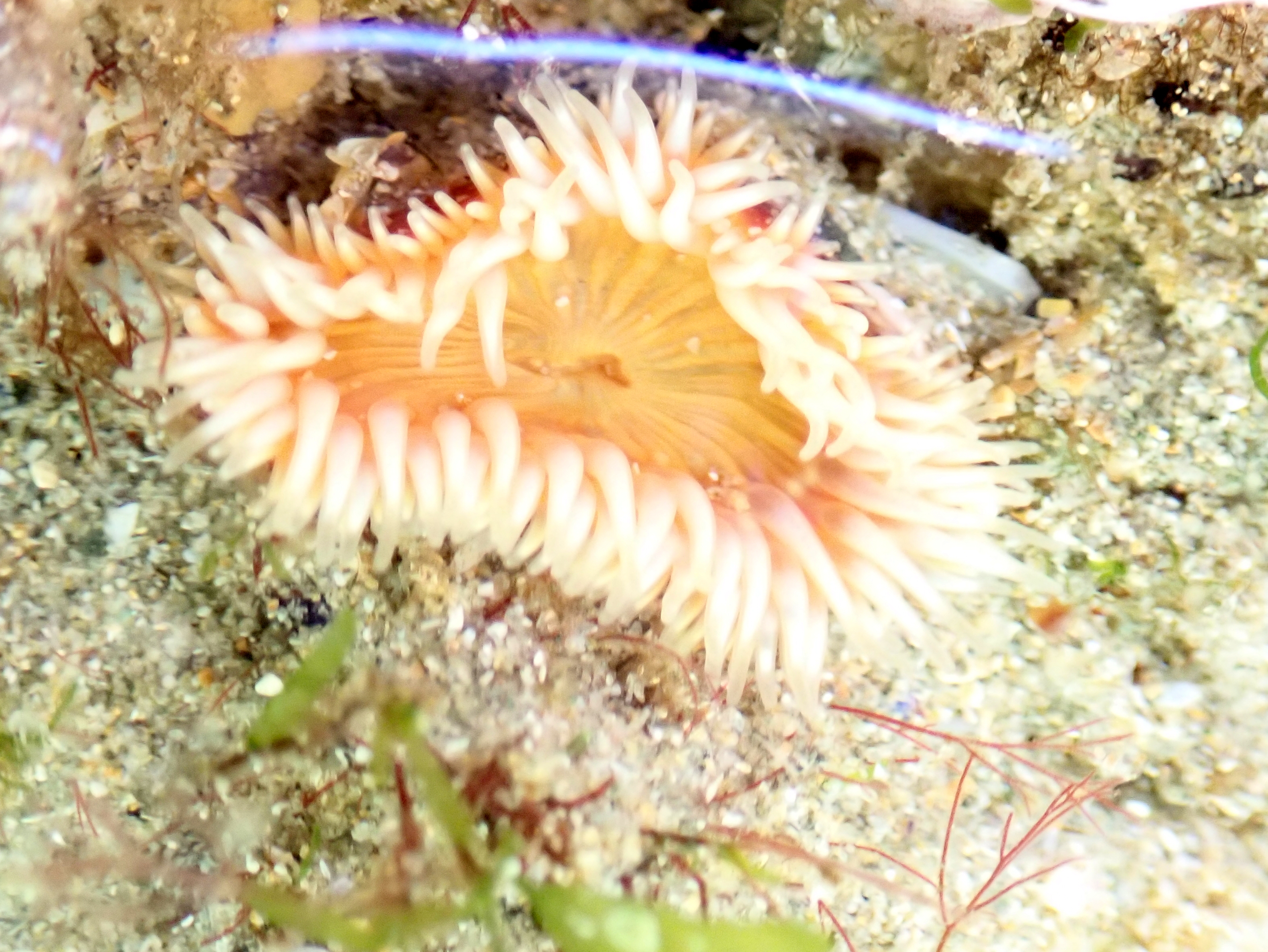
These pools were full of anemones too and we stopped to take photos of clusters of snakelocks anemones and a rather flattened-looking strawberry anemone before I noticed the first gem anemone. It was closed up, forming a diminutive pink blob that blended perfectly into the colours of the pool. Close to it was another.
As we moved among the chain of pools we found dozens, but not a single one was open. Junior stared determinedly into every cranny, excited that the pools he had found were proving so interesting.
“There are some open anemones here,” he called out, “maybe Dahlia anemones? What do gem anemones look like when they’re open?”
I knelt on the rock beside him. At the far edge of the pool, tucked under a small ledge, I could see the white stripes of the gem anemone tentacles. Much cheering and hugging ensued.
The open gem anemones Junior found near Looe
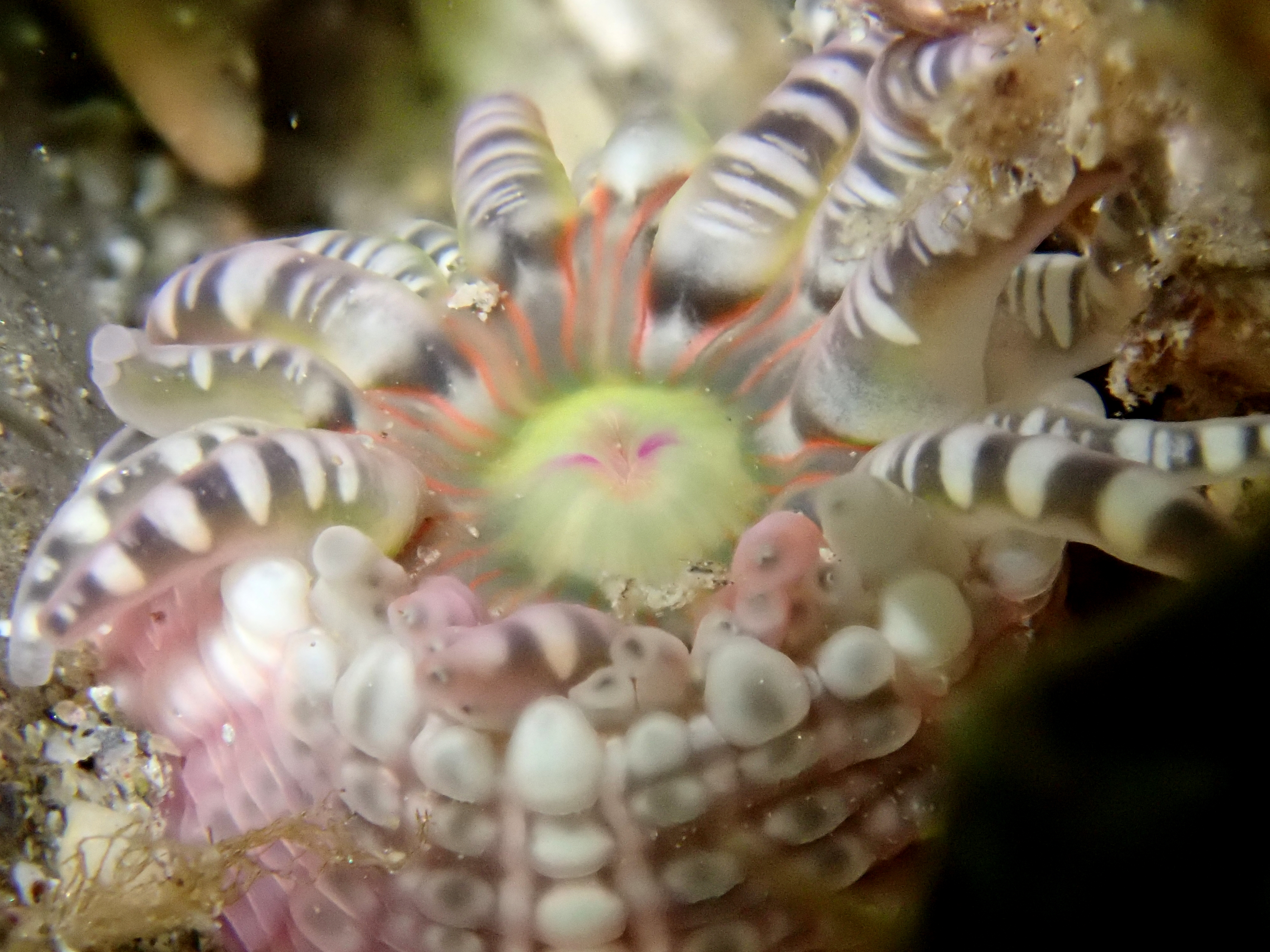
Soon I was able to show Junior my up-close photos of the anemones so he could see why I was so obsessed with finding them. Each one had a vivid, almost fluorescent green mouth tinged with bright pink spots at its corners. The anemone’s mouths were framed in deep red and grey rays that stretched to the base of the zebra striped tentacles, some of which had flashes of green at their bases.
The mouth of the gem anemone
Truly one of our most spectacular anemones, people rarely notice the gem anemone because it is only a few centimetres across even when fully grown.
Gem anemone near Looe, Cornwall
Junior is already planning a night time return to these pools to investigate whether these anemones will glow under the light of our ultra-violet torch. Watch this space!
Gem anemone -winter colour in the Cornish rock pools
Tis the season for overspending, overindulgence and over-exhaustion, so what better way to recharge the batteries than some fresh air and rock pool exploration? It’s a family tradition for us this time of year to head in the opposite direction from the shops and to take a breather on the beach.
Christmas cards don’t often depict the traditional Cornish winter weather for good reason. Between the fog and the persistent mizzle, we have to imagine the view through the valley to the beach. Even when we arrive on the shore, we can barely make out the sea, although we can hear it crashing over the rocks and surging up the gullies.
Waves breaking out of the mist at Porth Mear
The lower shore might be unsafe, but there’s no shortage of colour and variety in the sheltered pools. The rain kindly stops for long enough to let us enjoy our potter through the pools and we have the beach to ourselves.
Other Half finds a large common hermit crab, Pagurus bernhardus, tapping at a shell and we wonder if the crab’s about to move house. Looking closely, the shell it’s interested in is smaller than its own shell and when I look inside there are legs in there. Most likely our hermit is carrying a female around with her until she moults, hoping to mate with her when she does.
Hermit crab holding on to his mate at Porth Mear
The rock pool wildlife couldn’t care less that it’s Christmas, but the bright anemones can’t help but look festive and are all the easier to see now that the seaweeds have died back for the winter.
Snakelocks anemoneBeadlet anemones at Porth Mear
Stalked jellyfish are also easier to see on the remaining short crops of Irish moss and red seaweeds in the pools. In a short stretch I find Haliclystus octoradiatus and a beautiful red Calvadosia campanulata stalked jelly.
Haliclystus octoradiatus stalked jellyfish at Porth MearCalvadosia campanulata stalked jelly
Another jelly blob catches my eye, just a minute red speck among the seaweed. It seems to be moving, so I focus in with my camera to reveal a baby sea hare grazing its way across a tuft of seaweed. Its red sides seem to be snow-speckled with white and its black-fringed parapodia look like a tiny chimney pot.
Baby sea hare, Aplysia punctata.
In a few months’ time, if it survives the winter, this slug will swell and grow into a fat brown lump many times this size, feeding on the spring growth of seaweed.
Zipping across a shallow pool, a fish smaller than my little finger heads for the shelter of a low rocky ridge where it lies still, relying on its camouflage. The young shanny obligingly sits still for a couple of photos.
A young shanny (Common blenny)
Soft rain begins to blow into my face as I work my way back over the slippery rocks to rejoin Other Half and Junior, who are entertaining themselves with the noble sport of throwing stones at other stones.
No Christmas stress for us… with the beach to ourselves and an endless supply of stones to throw.
With our wallets intact and our appetites renewed, we’re ready for the feasting to begin.
Wishing you all a very Merry Christmas. Here’s to more rock pooling adventures in 2019!
Once the busy summer season of rock pooling events is over, we like to jump on the ferry and get away for a few weeks. We have friends to visit and lots to do, but somehow we always end up on the beach. It’s fascinating to discover the difference it makes to be a few hundred kilometres further south.
Although there are plenty of familiar species here, there are some that are around their northern limit here in Brittany, but might put in appearance in Cornwall one day, especially as the seas warm up.
On a sheltered shore in the lee of the Quiberon peninsula, the beach where our friend Mylene spent her childhood holidays, I find a Pachygrapsus marmoratus crab, a species I saw nearby last year when I didn’t have my camera.
Pachygrapsus marmoratus crab
The rippled pattern on its carapace and the wide flat edge between its eyes make it unlike any of our native crabs. Originally found further south on the Atlantic coast, it has been working its way northwards in recent years and seems to be firmly established in Brittany now.
The three teeth along each side of the carapace distinguish this species from other rock crabs
Something I didn’t notice last year is how fabulously green its knee joints are, matching its emerald eyes. It’s not afraid to use those leg-joints, scuttling away at high speed at every opportunity to hide among the dense aggregations of the invasive Pacific oyster. I nearly lose it several times before it decides to settle in the corner of a pool, allowing me photograph those hairy legs and green knees.
The wonderful green knees of Pachygrapsus marmoratus!
Junior calls out that he’s found a slug. He thinks. He’s not sure. There are so many living blobs on the shore that it can be hard to tell.
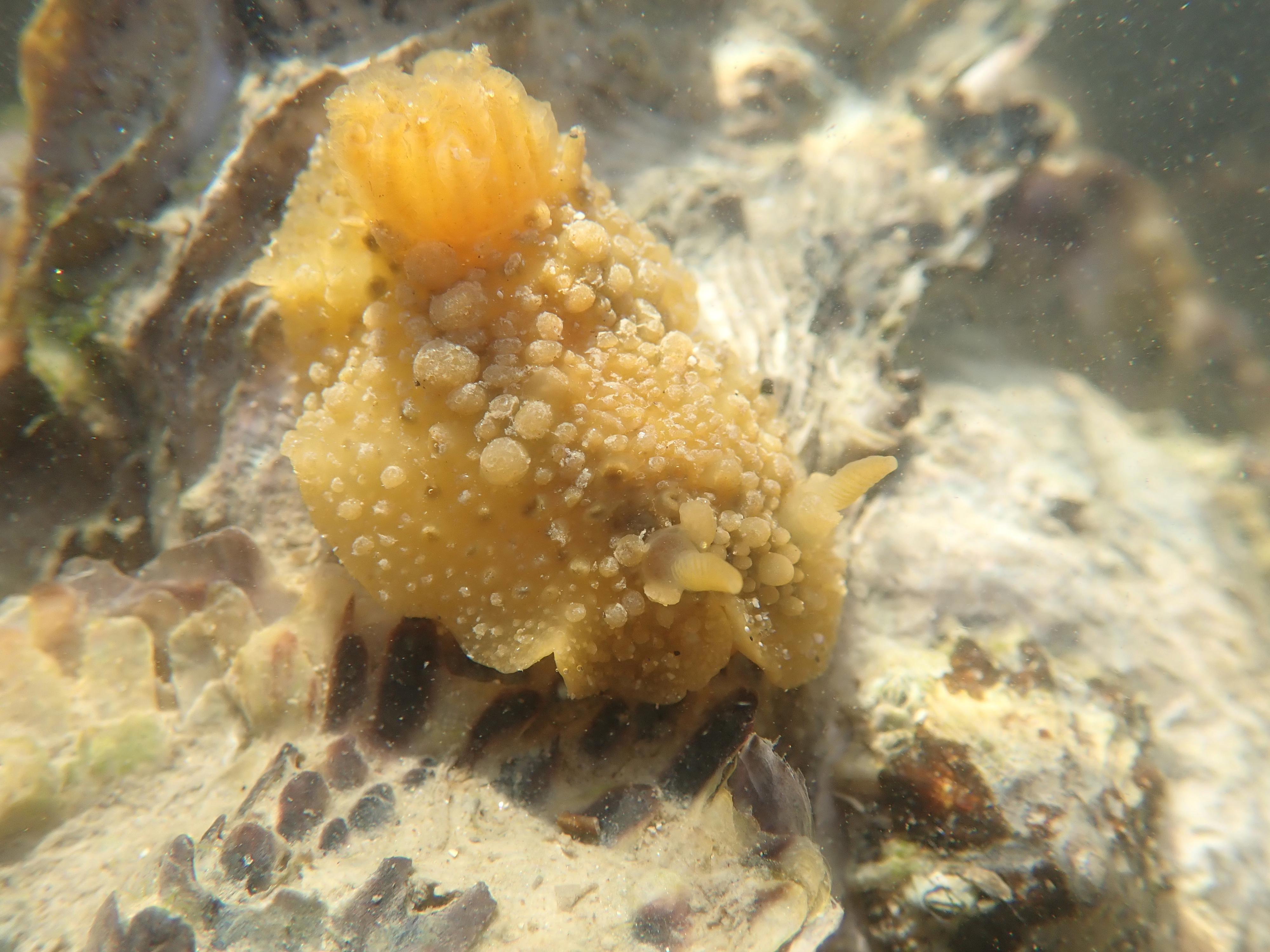
The blob is a plump yellow thing, perhaps four or five centimetres long and from the speed it’s crawling across the rock, it is most definitely a slug. Initially, I assume it’s a sea lemon, but it doesn’t quite look right. It has a more squidgy, unicoloured look and instead of the citrussy bumps of the sea lemon’s skin, this slug has rounded protrusions of varying sizes all over its back. I can’t place it so we call it a ‘Doris might be a sea lemon, species’ and I take plenty of photos to help identify it for sure later.
Doris verrucosa – the ‘warty Doris’ – exploring a bed of Pacific oysters
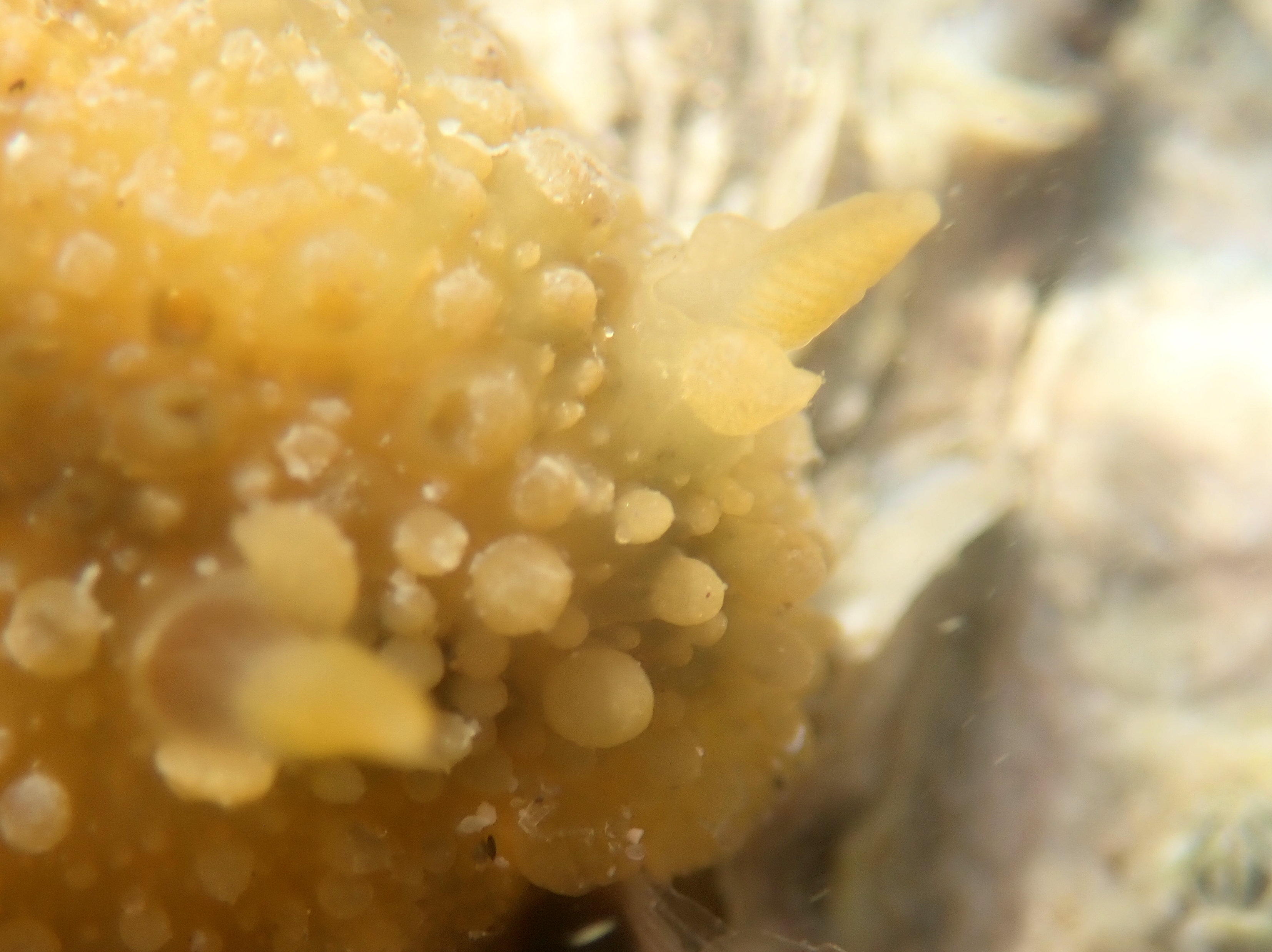
It’s over a month after we return from holiday that I remember the photos and transfer them to my computer. On screen it’s obvious that this Doris slug looks nothing like any sea lemon I’ve ever seen. With the help of some extremely geeky books, websites and a forum of fellow nudibranch aficionados, I manage to confirm that it is a Doris verrucosa. The “warty Doris”… not the most charming name, but Junior is rightly thrilled that he found it. This isn’t a species we’ve ever seen in the UK.
Each rhinophore on the slug’s head is framed by two pairs of prominent protrusions and the gills are framed by a crown of tall protrusions.
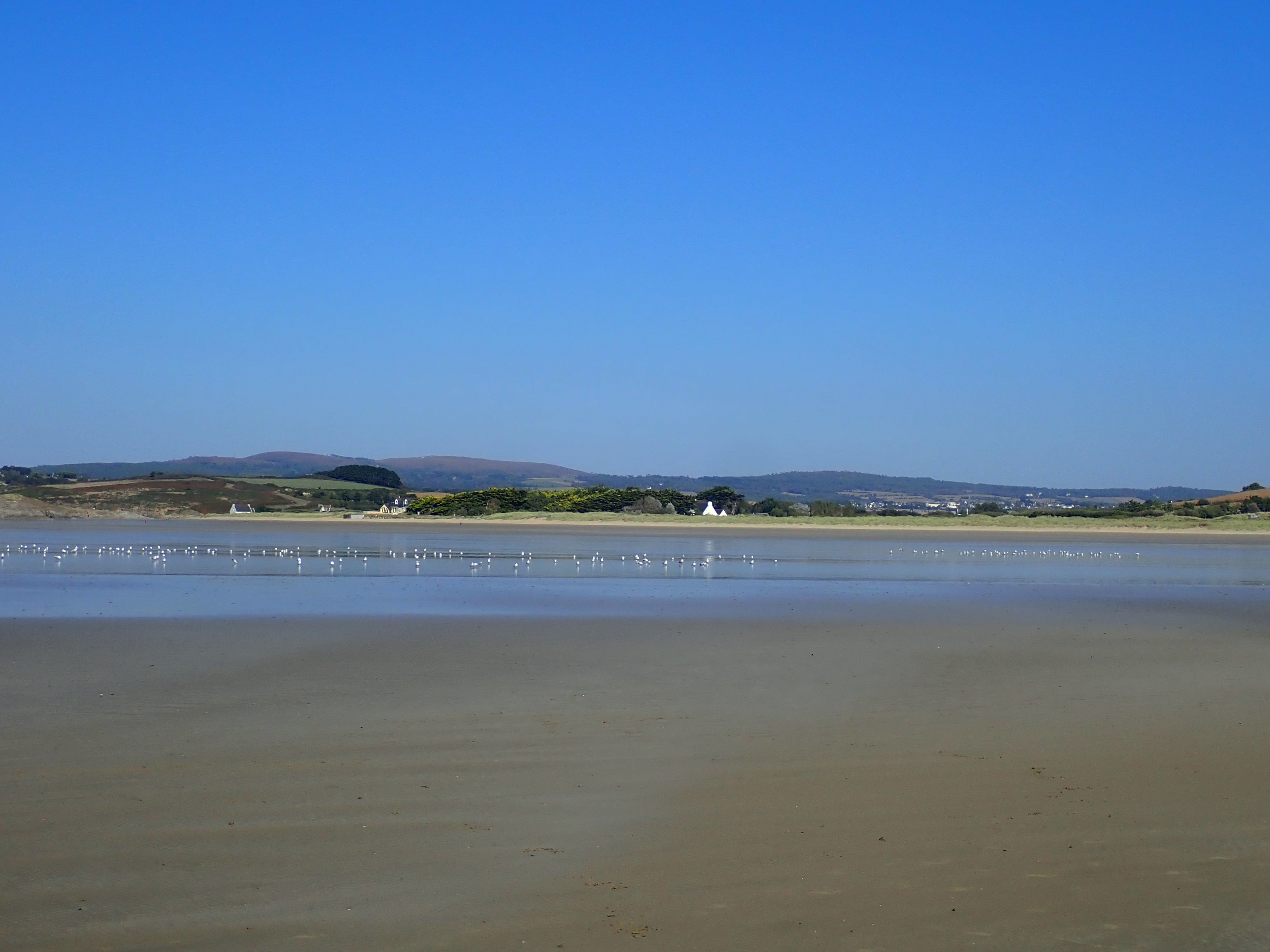
We revisit a beach that is the polar opposite of the sheltered shore of Quiberon. Ste Anne de Palud is a west-facing windswept expanse of muddy sand framed by a north-facing rocky headland and pools, which provide an incredible habitat for all sorts of clam shells and colourful anemones as well as a perfect set of conditions for the honeycomb reef worm, which builds its huge beehive-like structures all around the rocks.
A honeycomb worm reef overhanging a pool at Ste Anne la Palud, Brittany
The anemones are fabulous, but so well tucked under steep overhangs of rock or so well buried in sediment that they are tricky to see, let alone identify.
Sagartia elegans anemone, Ste Anne la PaludStrawberry amemone showing its blue beadlet fighting tentaclesAnother colour variation of Sagartia elegans
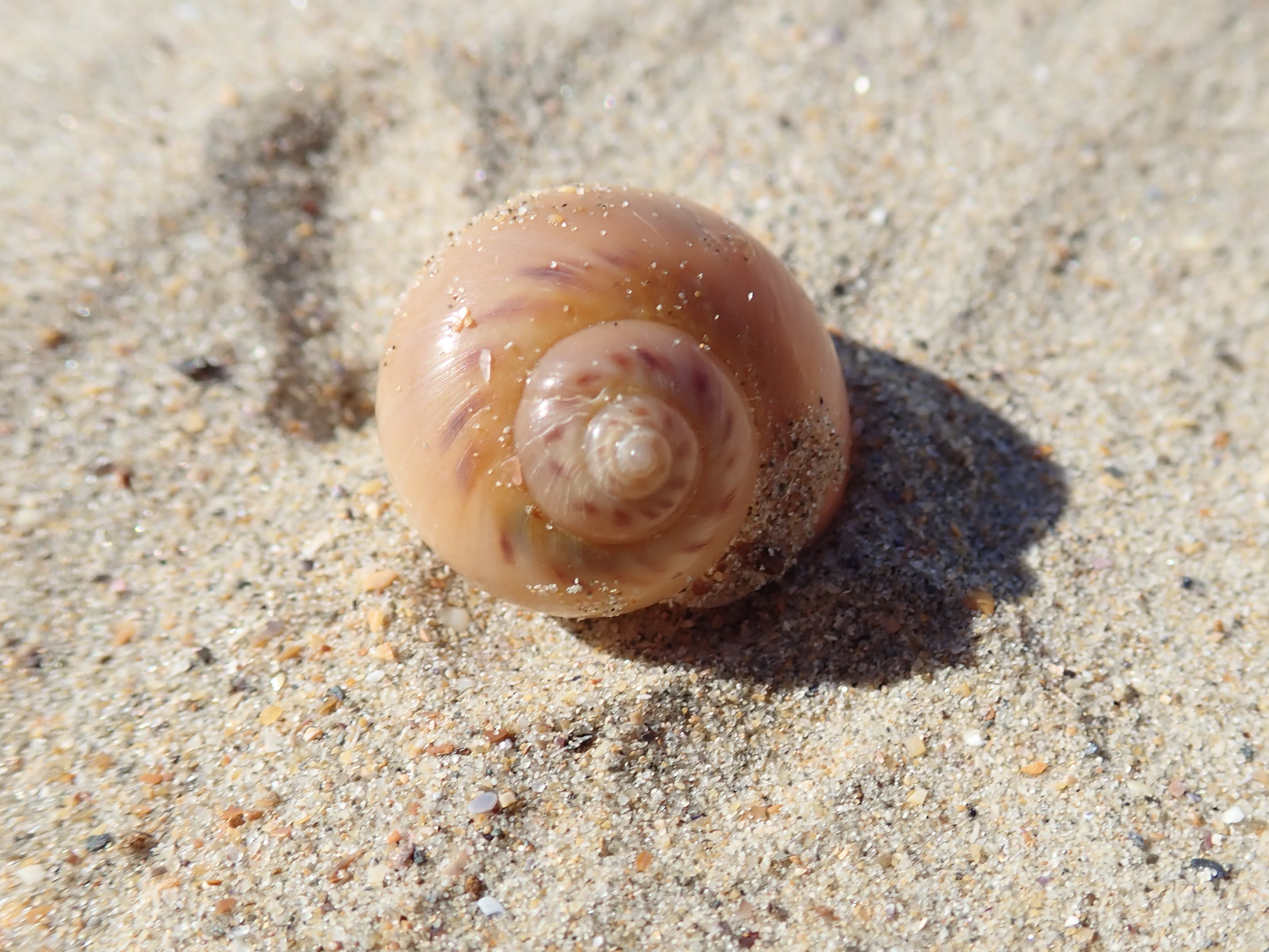
Junior is digging holes in the sand and discovers just how packed with life the sand is as he uncovers dozens of thin tellin shells, which burrow their way back down as he watches. The tideline is strewn with evidence of the diversity of life beneath our feet, with spiny cockles, sea potato urchins, the delicate tubes of the worm Pectinaria belgica and necklace shells.
Spiny cockles and their relatives are common herePectinaria belgica worm tubeNecklace shell. Euspina catena
There’s a good chance that some of the less familiar animals we’ve seen will show up on the Cornish coast at some point. The St Piran’s hermit crab has already successfully made the crossing and I saw them first here.
A trip to Brittany feels like the perfect way to familiarise myself with creatures that I might need to identify in future. It’s also a good excuse to eat lots of pancakes and put my feet up. Both make me happy!
The vast, rich sands of Ste Anne la PaludA juvenile sea hare
There’s no more auspicious start to an afternoon’s rock pooling than a dolphin display while you’re munching your pasty.
Jan from Coastwise North Devon, Junior and I were treated to an incredible leaping, spinning pod of dolphins at the start of our last Looe rockpooling foray, which could only be a good sign.
I was too busy watching the dolphins to take any good photos, but here are some distant fins.
Following a busy summer season, it was magical to have the beach to ourselves. Despite a keen wind that made it difficult to see into the more exposed pools, the sheltered gullies were full of colour.
Every colour variant of the beadlet anemone was on display in one short stretch of pools. These common anemones are often red, but here they showed off their full traffic-light range of shades. Some splayed open a shower of bright tentacles, while others were retracted, showing nothing but the distinctive blue circle at the base of their columns.
A rather green beadlet anemone with blue markings around its base and on its mouth.A closed-up orange beadlet anemone
Junior’s sharp young eyes were focused on the task and he brought us several isopods to identify. These minute woodlouse-type creatures swam around our pot-lids at high speed while we tried to photograph their tails. All of them had two prongs on their backs, so were male Dynamene bidentata.
One of Junior’s isopods – a Dynamene bidentata
We used our cameras to focus in on the blob-like bodies of the Ascidia mentula sea squirts, which we found attached to several rocks. From a distance, they have a pink tinge. Close-up, they seem to be gearing up for fireworks night, with bursting patterns of red sparks along their sides.
Pink fireworks – patterning on an Ascidia mentula sea squirt.
Lurking inside the sediment-filled layers of a fractured rock, was a colony of Thalassema thalassema spoon worms. These wonderfully alien creatures have plump pink bodies like an overfed grubs, with an extendible, frilled proboscis.
One of many contenders for the ‘strangest animal in the rock pools’ award – the echiuran worm Thalassema thalassema
Unlike many other marine worms that speed around on bristly legs or swim with paddles, Thalassema thalassema seems to have no efficient means of locomotion. Instead, it rolls contentedly in the muddy sand, feeding on detritus.
These worms alarm me with their indolence. I always suspect that, like most vulnerable-seeming marine animals, they must have some secret defence. Many worms have a impressive set of biting jaws, but despite my wariness this species is safe to handle. I think.
Among the dense carpet of animal colonies, among them sponges, sea squirts, bryozoans and hydroids, we found a smart small species of spider crab, probably Macropodia sp. It was perfectly camouflaged to hide among the seaweeds.
A perfectly decorated small spider crab (Macropodia sp.) at Hannafore
Further out in the lagoon, near a seagrass bed, we found several egg cases of the greater spotted catshark, Scyliorhinus stellaris. In some we could see the fresh yolk, in others the baby was forming while some were already hatched and thickly encrusted with life.
A fresh Greater spotted catshark (Scyliorhinus stellaris) egg case showing the yolk.
By the time we reached the rocky outcrop at the far side of the lagoon, the tide was at its lowest and we could only stay a few minutes.
Inevitably, the finds rolled in just as the tide was turning. Junior was delighted with the yellow colour of this common brittle star, Ophiothrix fragilis, which is more usually pink in colour when we see it further up the shore.
Junior’s yellow brittle star
Under one stone was a faint lattice pattern marking the spot where, earlier in the season, a clutch of clingfish eggs had been attached. Although they seemed to be long-since hatched, the site was still being watched by what was probably an anxious parent.
Cornish clingfish – Lepadogaster purpurea, Looe.
A speck of blue on the rock concealed a good cause for any clingfish parent to be concerned: a Calma glaucoides sea slug. Despite the elegance of its long blue cerrata, flashing their golden tips as they waved in the water, this slug could well have destroyed the entire brood of eggs, which are its food.
Calma glaucoides – a sea slug (nudibranch) that feeds on clingfish eggs.
We could easily have knelt around the pool for longer, wondering at this tiny creature, but a change in the wind and a stirring of the kelp out towards the island meant that the race was on.
We sploshed and slid our way back over hidden rocks and through tangled weed that grabbed at our ankles, watching the flow of water growing by the second as the powerful tide raced in. Behind us, the water was working fast to submerge the slugs, shark eggs, anemones and brittle stars, closing the door on the watery world.
We made it back without over-topping our wellies; wishing, as always, that there was a little more time between the tides.
On the way off the beachwe found this vivid green prawn with a huge left claw – an unusual colour variant of the more familiar hooded shrimp.
Privacy & Cookies: This site uses cookies. By continuing to use this website, you agree to their use. To find out more, including how to control cookies, see here: Privacy and Cookies Policy.