Category: Beaches

  • At Home in the Rock Pools

    At Home in the Rock Pools

    Our home educating days are coming to an end as Junior prepares to try out life at college. With this momentous change approaching, this year has been all about cramming in local, national and international adventures and travels to make the most of this precious time. Our visits to the rock pools – and my posts about them – may have been less frequent than usual in recent months, but it will not surprise you that we have still packed beach trips in between our travels and I have amassed lots of fabulous finds to share with you.
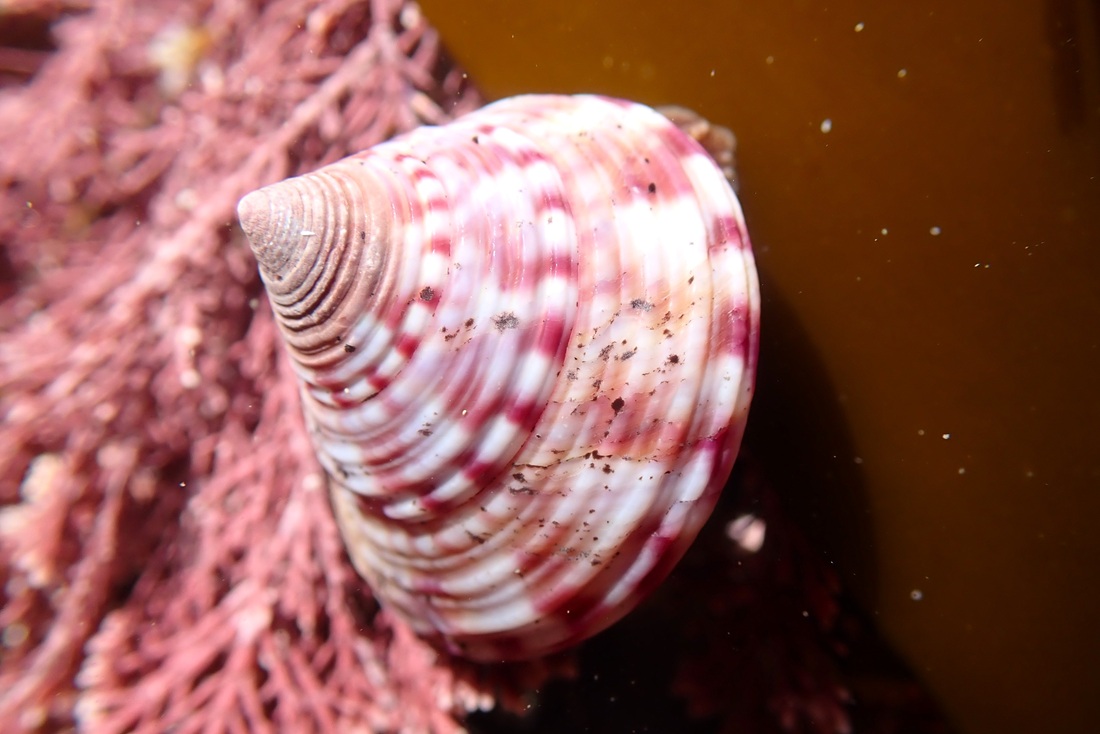
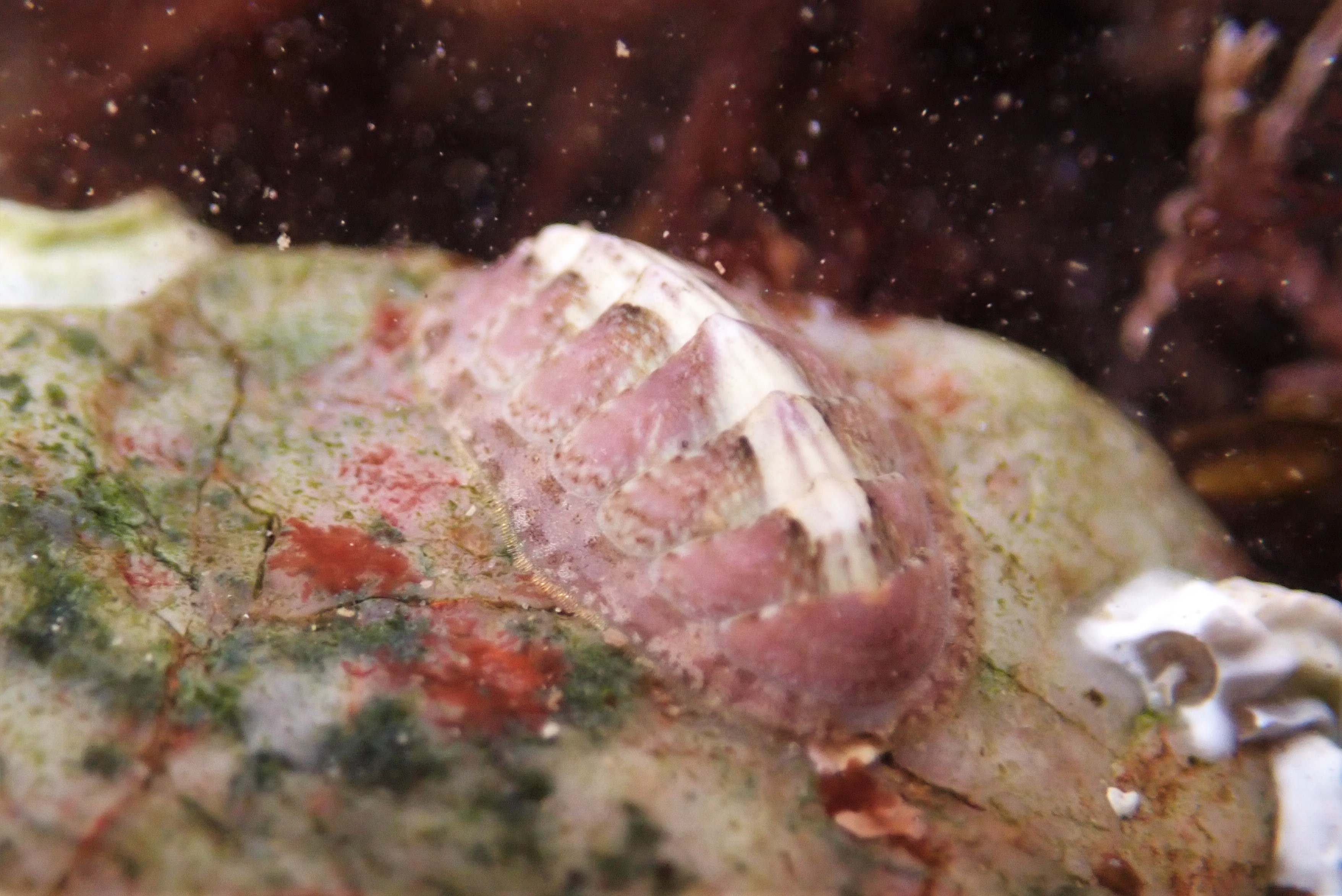
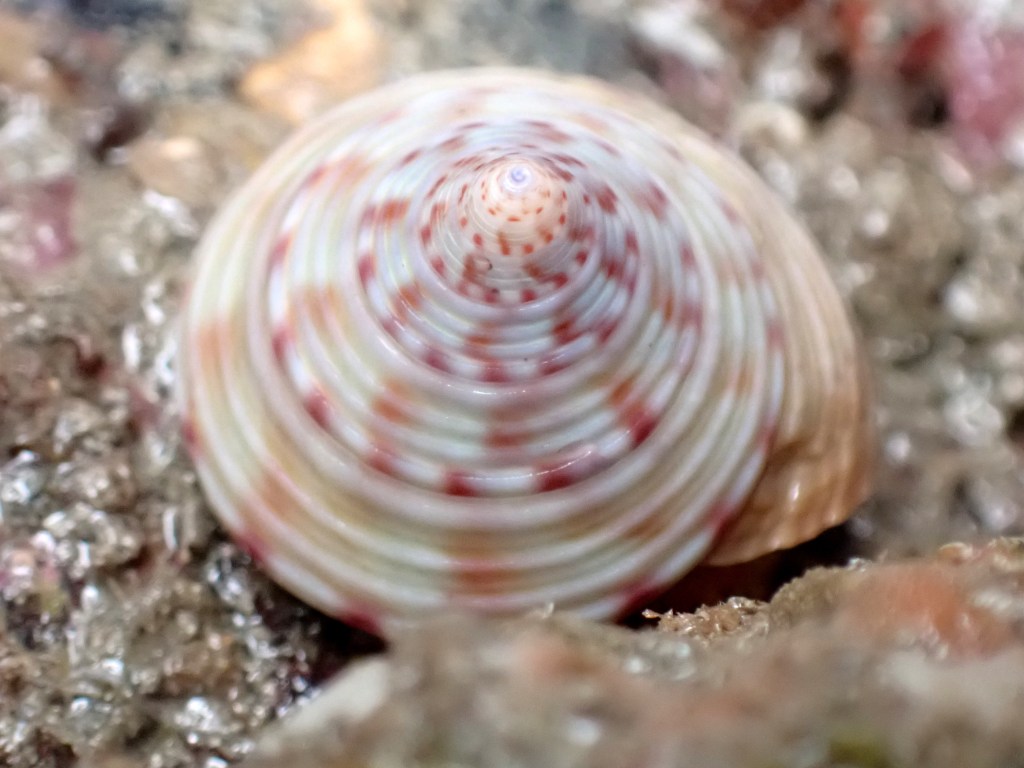
    Painted top shell - conical pink shell with pink coral weed in the background.
    Painted topshell at Porth Mear – the colours at this beach are always especially vivid.

    This trip back to my favourite childhood rock pooling beach at Porth Mear with Junior and Other Half was a reminder of what makes this place so special.

    There’s a hint of blue sky and the waves are only breaking around the edges of the rocky islands offshore, rather than bursting over the top as they so often do. With the tide set to fall to a low of less than 0.1m, this is set to be a perfect day.

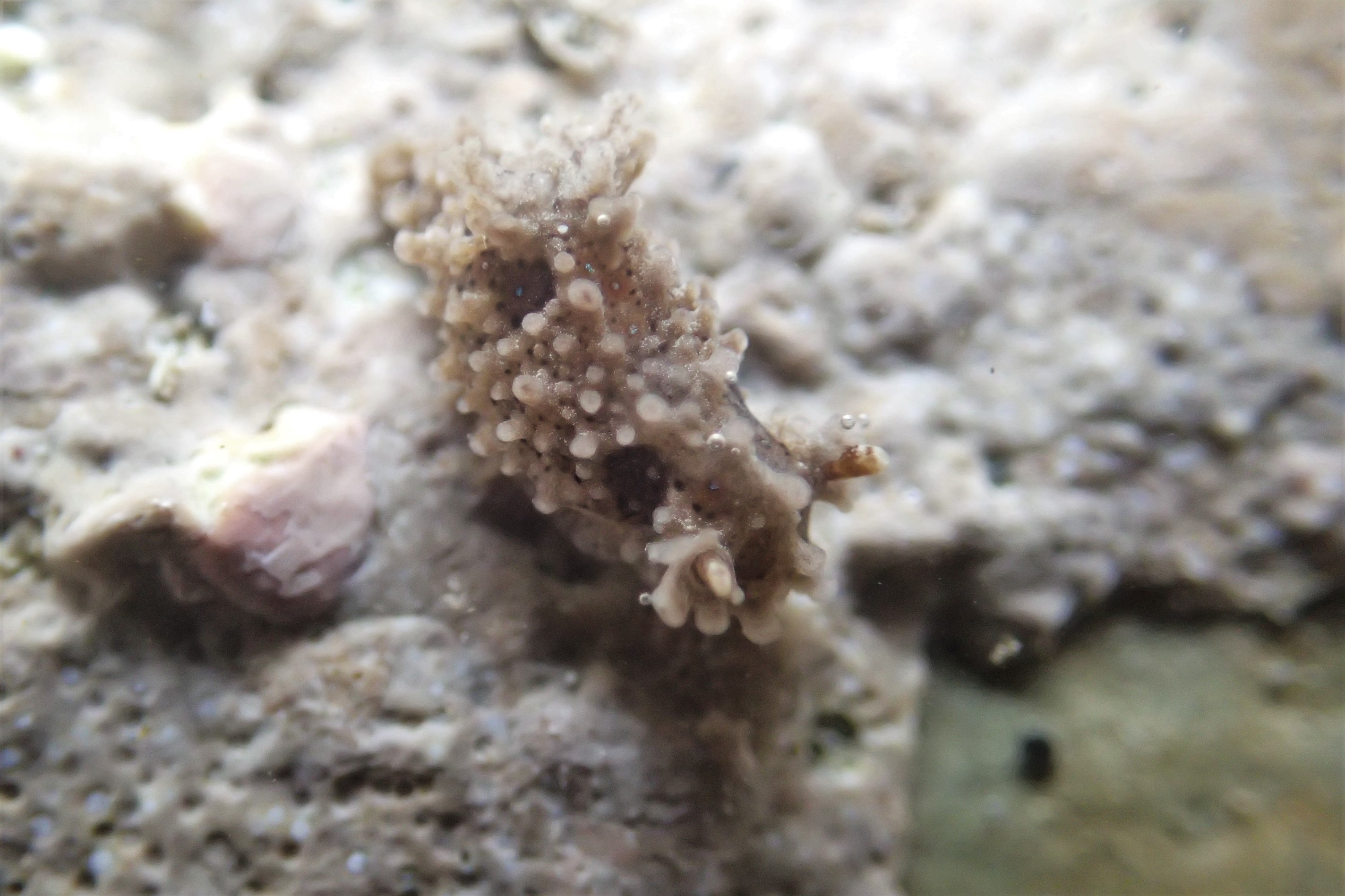
    In my happy rock pooling world, there is nothing more auspicious than finding a nudibranch sea slug in the very first place I look. Admittedly, I know this pool well and have good reason to hope, but this very tiny, citrus-yellow Doris ocelligera is the happiest omen. With its rhinophores held tall and proud, it is such a lemon-burst of joy that I spend many minutes crouched by the water watching it through my camera.

    Doris c.f. ocelligera – a small sea slug, which feeds on sponges. On its favourite sponges, it is perfectly camouflaged, but against the rock it it strikingly bright yellow.

    Since I have lived on the south coast of Cornwall, I have come to appreciate how wonderfully clear and un-silty the water is here on the north coast. Whether it is down to this transparency that allows more light through or something else about the conditions, the colours of the shells and anemones often appear more vivid here.

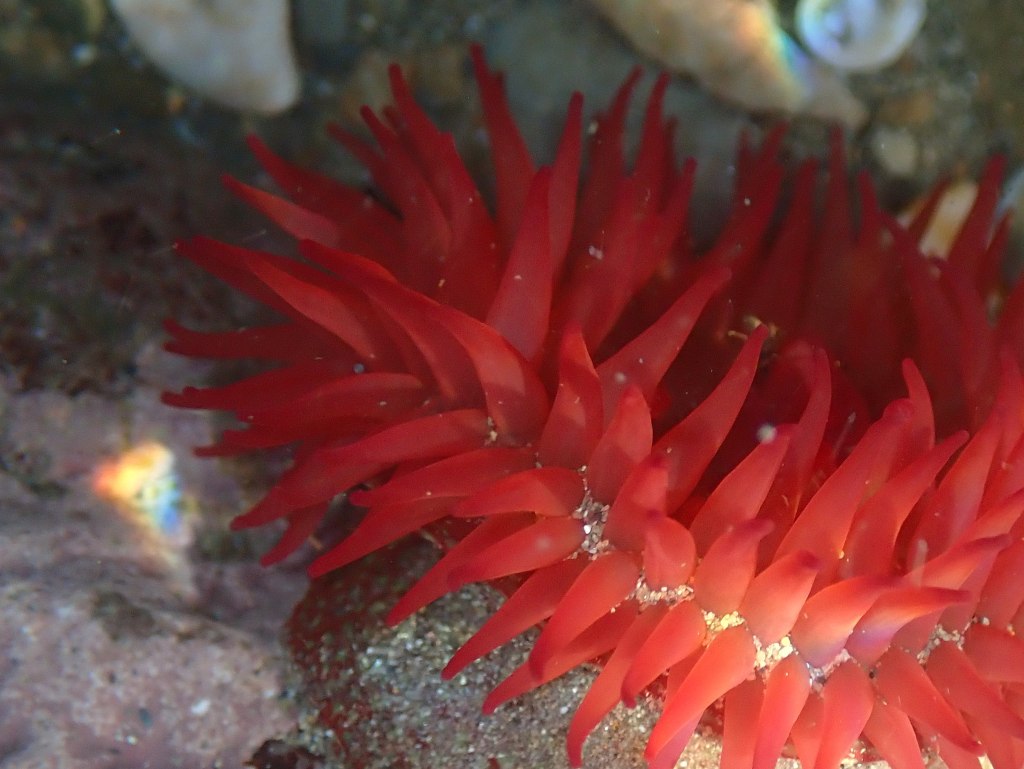
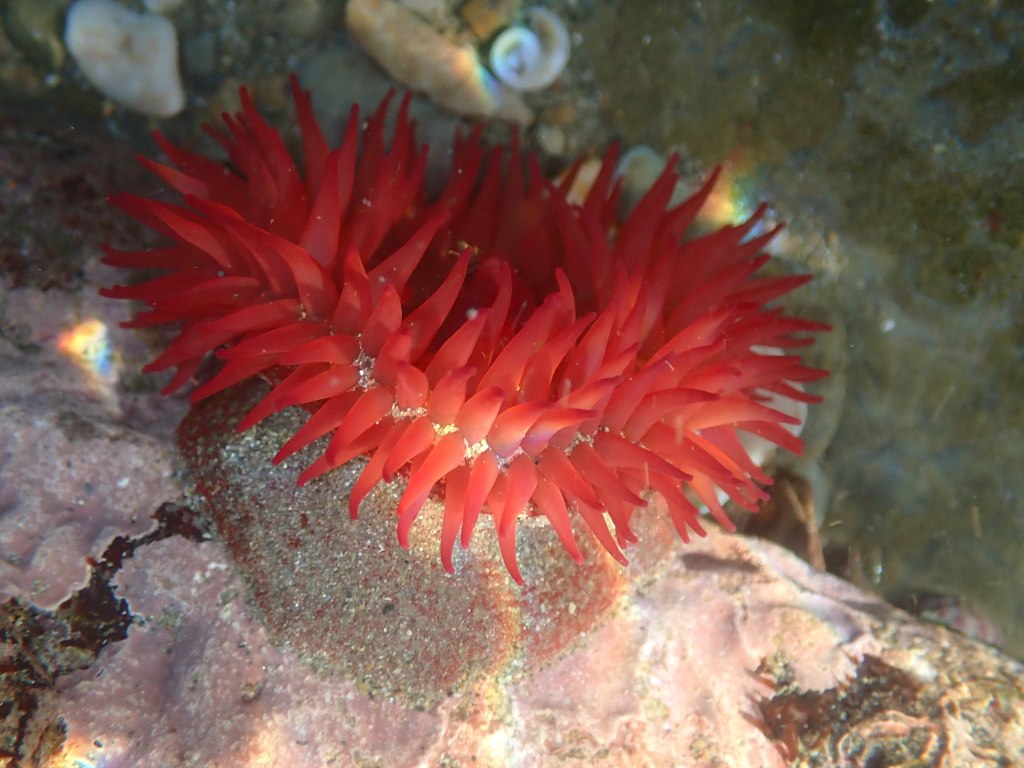
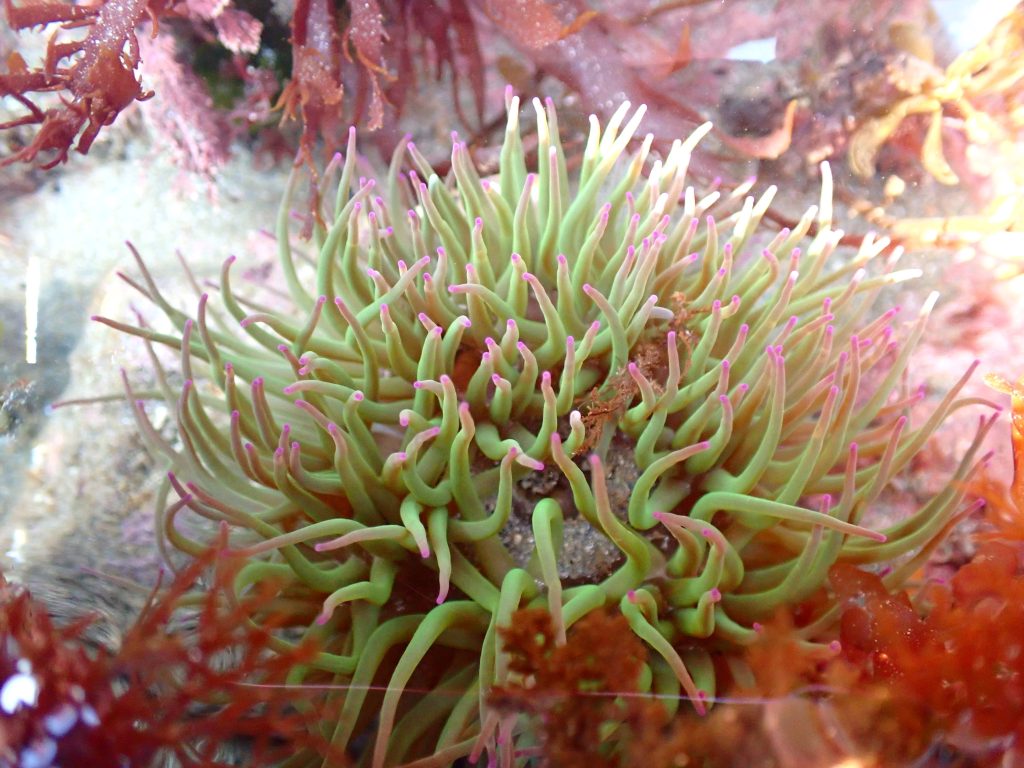
    An open strawberry anemone at Porth Mear.

    Strawberry anemones, which are bigger than beadlets, are especially photogenic whether they are open or closed. The pale red tentacles catch the sun beautifully, but the yellow flecks on the shiny red columns are also stunning.

    As I move down the shore, I come across some less commonly seen species, including some that are harder to idenitfy.

    This anemone is well hidden under an overhang and completely closed up, showing just the tips of white tentacles. The translucent column with pale stripes, but no suckers, suggests that it could be a sandaled anemone (Actinothoe sphydodeta). In my photos, you can see that the column is packed with curly white threads. These are the acontia and are packed with stinging cells. If something attacks the anemone, it can eject large numbers of these in defence.

    This anemone was less than 2cm across and well hidden in a dark gulley. I think it is a sandaled anemone.

    Nearby, the population of scarlet and gold cup corals is looking radiant. They live on the lower shore in areas of very high current and wave action, so most days they are completely inaccessible. Even on a relatively calm day like today, I keep nervously glancing up at the rocks behind me, expecting the waves to break over the top.
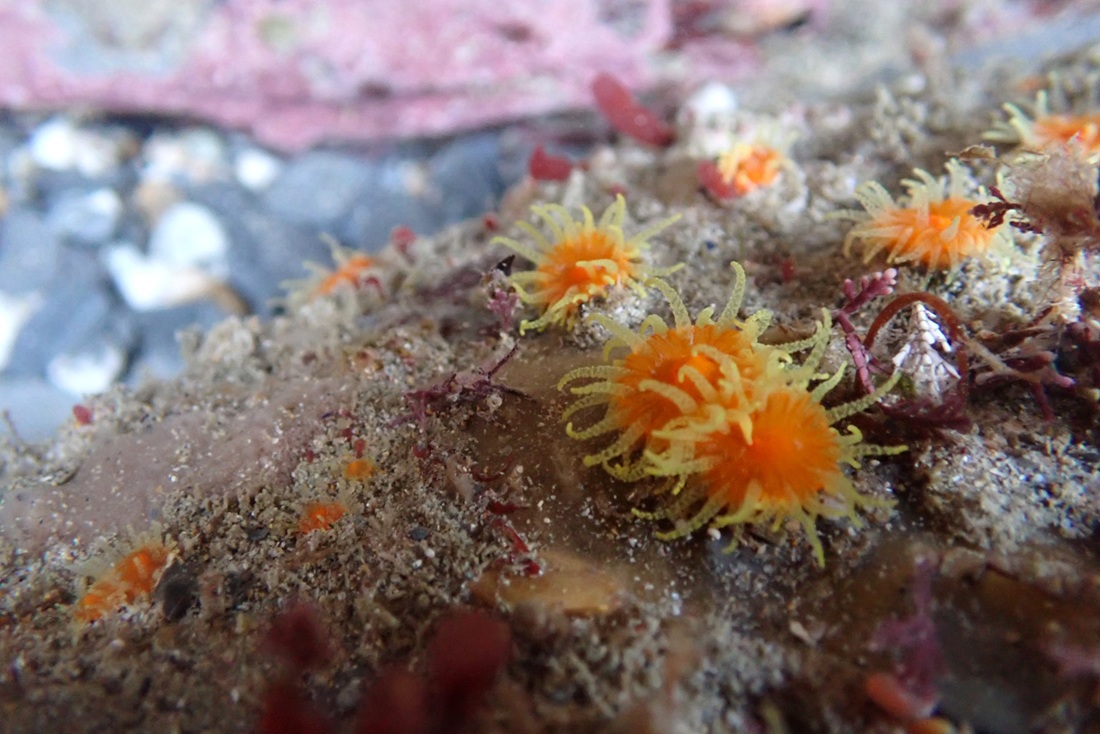
    Scarlet and gold cup corals.

    In another pool, I come across an even more mysterious anemone. It is hugely extended, like a long worm, when I first see it. I am amazed at how transparent it is, its organs clearly visible inside. It quickly retracts into a squat blob, with a few pale yellow striped tentacles. It has nothing stuck to the column and no obvious coloured spots, but there are some brown markings around the base of the tentacles in the disc. There are a few possibilities, but I will need to consult experts to see if anyone can narrow this one down.

    An anemone yet to be identified (centre).
    The same anemone as above – with the column retracted, showing its stripy tentacles.

    Another pool, another mystery creature. This time, a minute crustacean is making its way across a stone at the base of the pool. It is almost impossible to make out anything except the bright pink colour and the long antennae with the naked eye, but under my camera, I can see it has fabulously hairy legs.
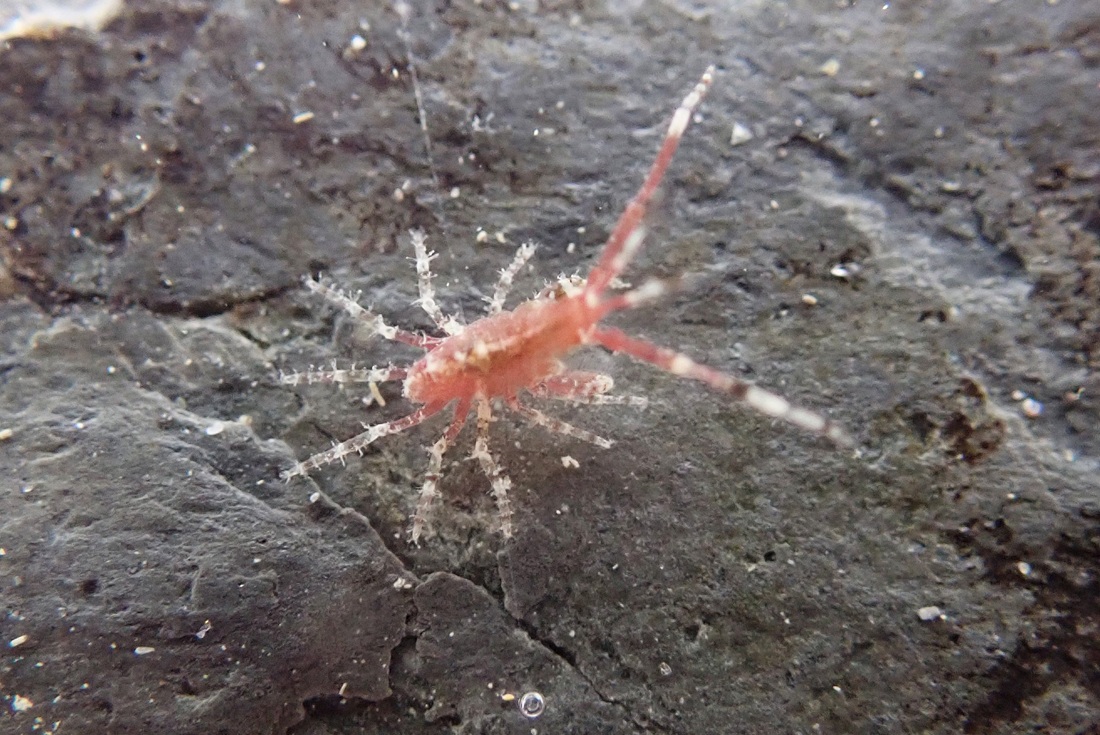
    A new (to me) amphipod sp. … possibly Podocerus variegatus. Another one to check!

    These animals are often only identifiable under a microscope and are tricky even then… so I take a few photos and carry on enjoying the shore, sharing finds with Junior.

    I am nearly fainting with hunger before I realise I haven’t had lunch yet. Other Half and Junior have long since had their picnic, but I keep going with the tide stalking me as I move up the shore. After all, there are more sea slugs to be found, along with hairy crabs, St Piran’s hermit crabs and plenty of colourful variants of other common rockpool creatures.

    Take a look at all the slugs we see!

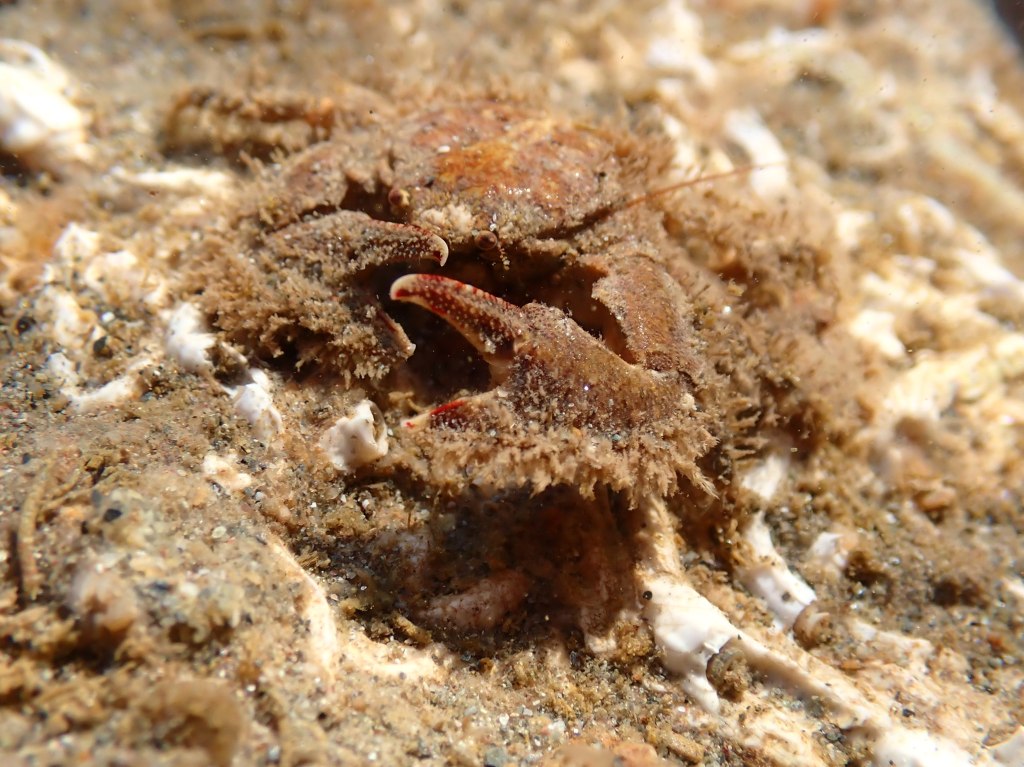
    A hairy crab showing off some smart hair tufts on its shell and legs.

    As a family, we have always spent time together on this beach, yet there are still new things to discover. Junior may be growing up, but I hope that we will often return here, to these familiar pools and to the springy-turfed paths of the wild cliffs that always feel like home.
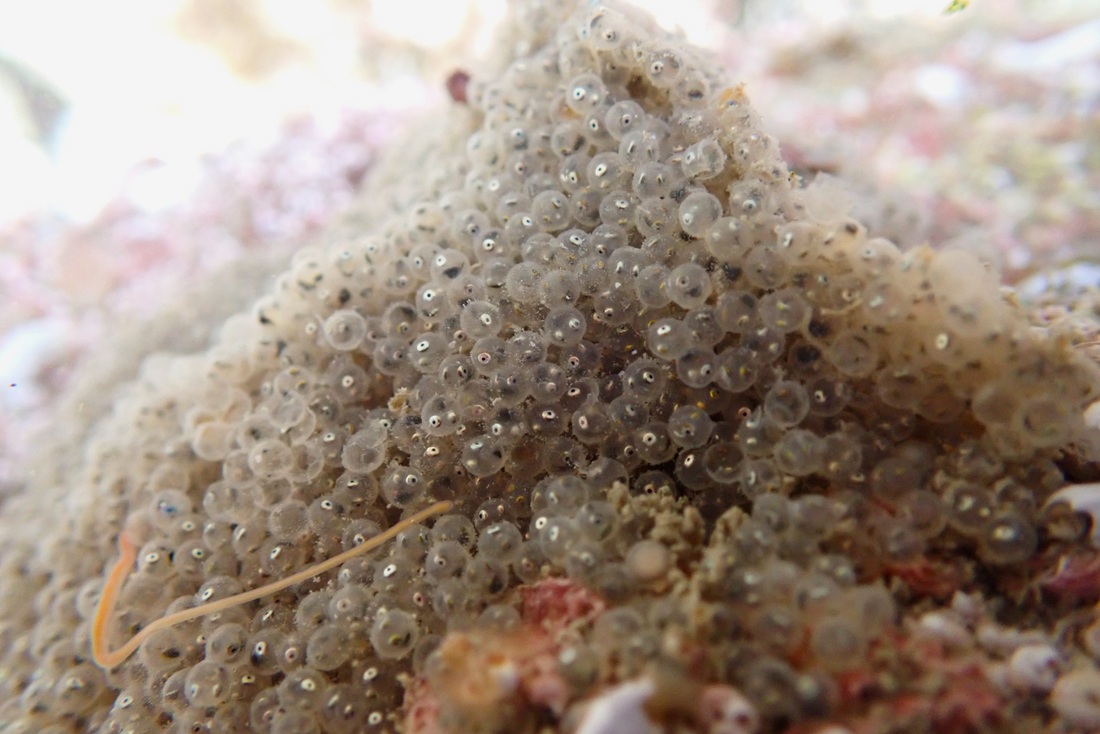
    An impressive pyramid of long-spined sea scorpion fish eggs that are close to hatching (these fish lay their eggs early in the year).
    A very white colony of star ascidian sea squirts – with an invasive non-native red-ripple bryozoan colony on the left.
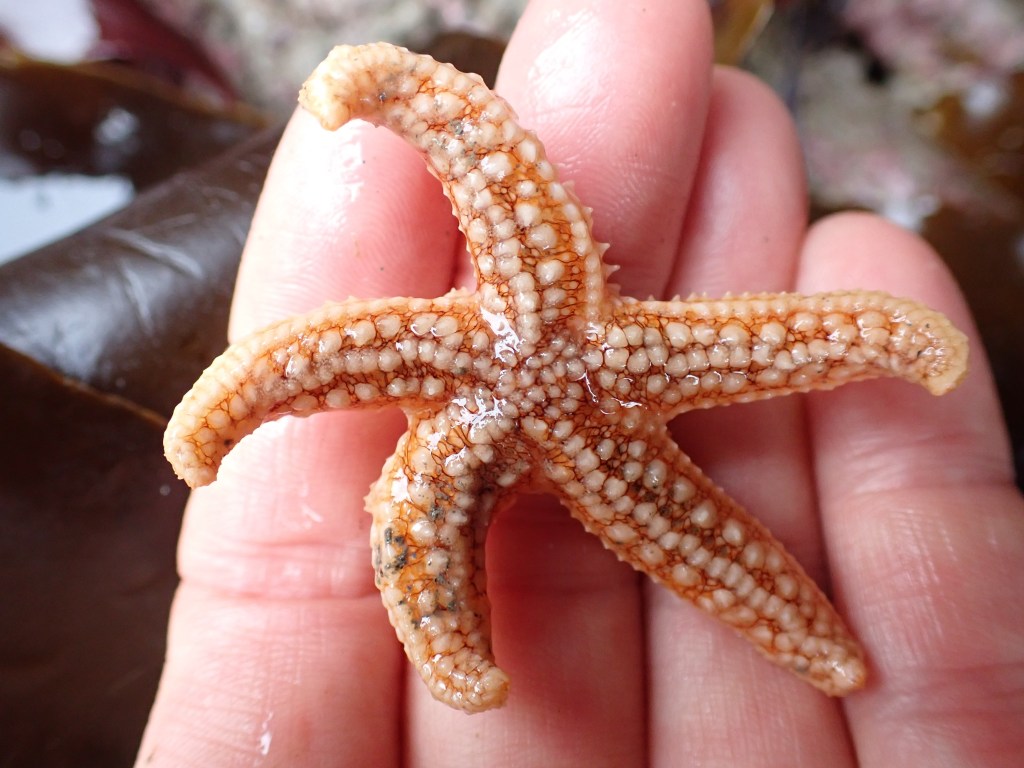
    Asterina phylactica cushion starfish.

  • Rock Pool Highlights in Looe

    Rock Pool Highlights in Looe

    As anyone who takes notice of the natural world knows, nothing stays the same. I visit my local beaches around East Looe so frequently that I know every rock and every pool. Yet, the more time I spend here, the more I notice.

    Sitting by a pool for a long time, I notice more and more detail, like this tiny needle whelk.

    Sometimes I learn something new about a familiar animal, sometimes I am treated to fascinating displays of natural behaviour, and sometimes I find species I never seen before. Here are five recent highlights from my local beach.

    There’s always something new to see… in this case it’s Other Half in his new waders.

    Cushion Star Hatchlings

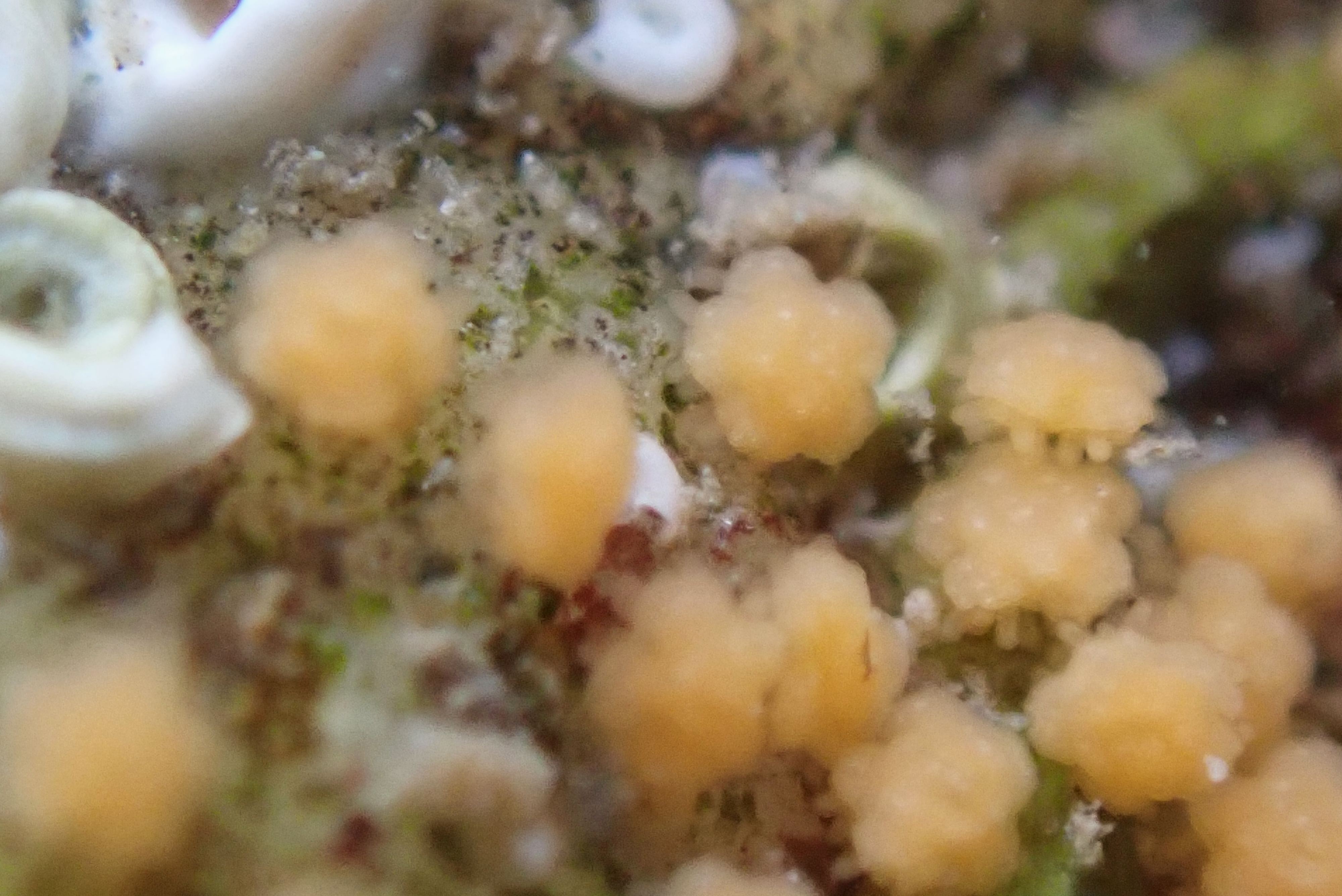
    It took me many years to realise that cushion stars lay eggs and to finally see my first just-hatched babies. Now I know what to look for, I see their eggs everywhere in the summer rock pools.

    So many baby cushion starfish (Asterina gibbosa), fresh out of their eggs.

    I find a cluster of new, tiny cushion stars and fall in love with their bright orange perfection and impossibly small tube feet.

    Cushion stars – these baby starfish have just hatched and are setting out across the pool on their little tube feet.

    A Hermit Crab Without a Shell

    The thing that everyone knows about hermit crabs is that they live in the empty shell of a sea snail. It’s not entirely true to say that they have no shell of their own though. Hermit crabs have tough claws and shell covering the front part of their body. Just like other crustaceans, they moult their shell each time they grow.

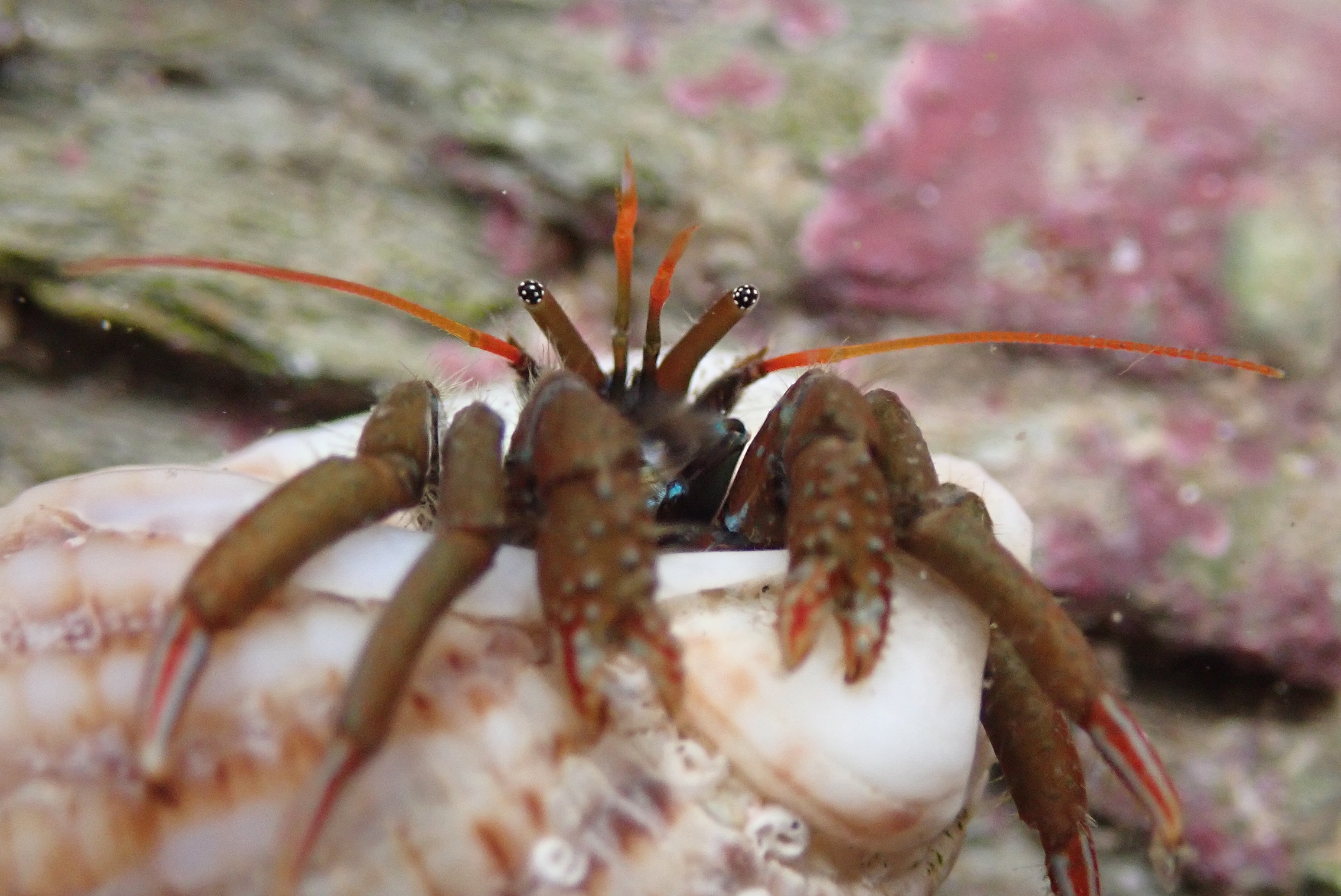
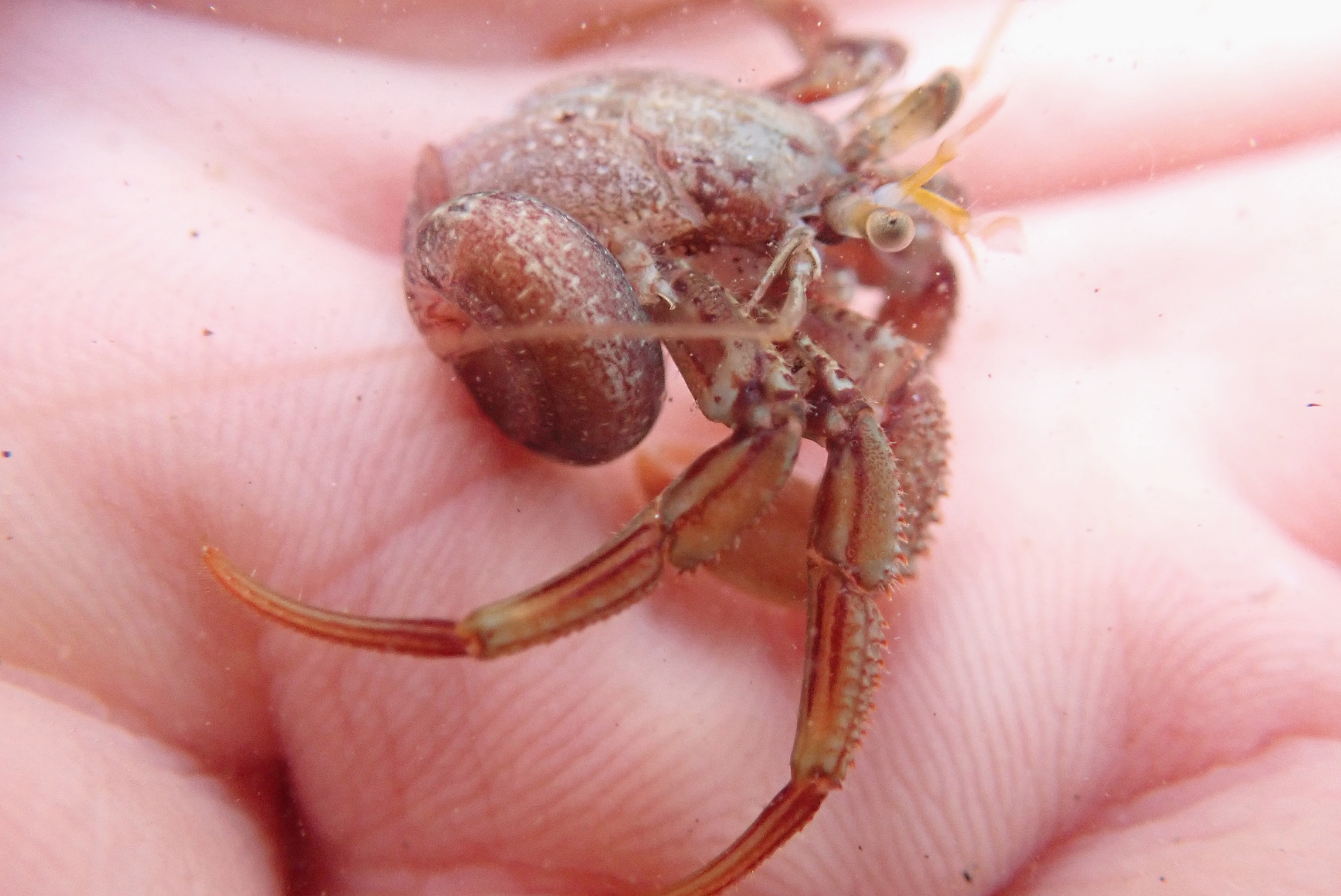
    A St Piran’s hermit crab, East Looe. This hermit crab’s rear end is comfortably housed in a shell.
    Moulted shell of a St Piran’s hermit crab. Hermit crabs have shell covering the front part of their bodies. When they grow, they moult their old shell, leaving it behind.

    Hermit crabs don’t, however, have a shell on their rear end. Instead, they have a long, spiral tail, which is soft and bendy. When the hermit crab finds a suitable shell to live in, it winds its tail up through the internal structure of the shell, clamping its home in place.

    If a hermit crab loses its shell to another crab or a predator, it finds itself in a real predicament. That soft tail is vulnerable to attack.

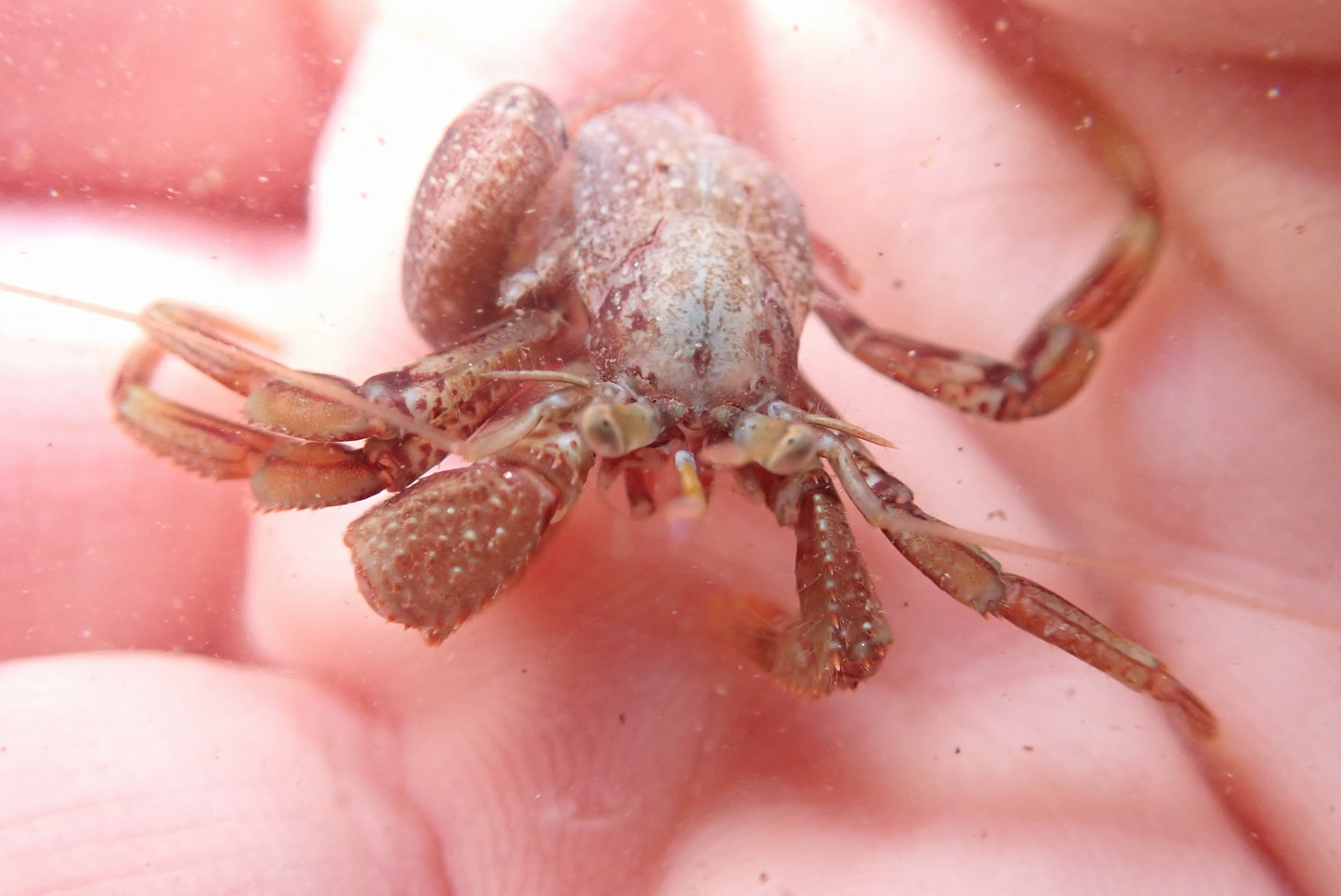
    Hermit crab out of its shell
    Hermit crab out of its shell, showing its curly tail.

    When Junior and I come across a homeless hermit, we locate a suitable empty shell and watch what the crab does.

    The whole process is astonishingly quick.

    Nudibranch Sea Slug – Eubranchus exiguus

    Regular readers will be well aware of my (entirely justified) obsession with sea slugs. If you aren’t already aware of how exquisite these little animals are, you might like my introductory talk for The Shores of South Devon.

    Most UK sea slugs are small and some are so tiny that you can barely see them with the naked eye. I spot a speck of jelly on some seaweed and spend the next twenty minutes crouching in the water to try to focus my camera on it.

    Eubranchus exiguus – a nudibranch sea slug, Looe, Cornwall.

    The slug is moving, the seaweed is moving and my hands are far from steady, but the photos are good enough. Meet a species of nudibranch sea slug that is new to me: Eubranchus exiguus.

    Eubranchus exiguus sea slug, showing the distinctive shape of the cerata on the slug’s back.

    The long, inflated cerata on the back of this sea slug look like they have been pinched in near the top, giving them a vase-like shape. Scattered white flecks adorn its body. When I can get it in focus, it is a fabulous-looking creature.

    The Eubranchus exiguus slug on seaweed with my finger in the background to give an idea of scale. It was around 2mm long.

    Rock Goby Eggs

    There are few things more mesmerising than fish eggs. They are generally transparent, meaning that you can see the babies’ eyes looking out at you. As the fish grow, they become fidgety, twisting and turning inside the egg. Rock gobies are a very common rock pool fish and their distinctive capsule-shaped eggs are usually well-guarded by the father, who stays close until they hatch.

    Rock goby eggs. Looe, Cornwall.
    Rock goby eggs

    Doto slugs (and a bonus slug)

    Finding sea creatures in the pools is a haphazard business; you can rarely be sure of finding even common species. However, if I want to find a Doto sp. slug, I know just where to look.

    In places around my local rocks, the brown seaweeds (wracks) are so completely covered in hydroids that they look like they have grown beards. Very close-up, these hydroids (Dynamena pumila) look like stacks of pale triangles. Among them, feeding on the hydroids, are the tiniest splodges of jelly – the Doto slugs.

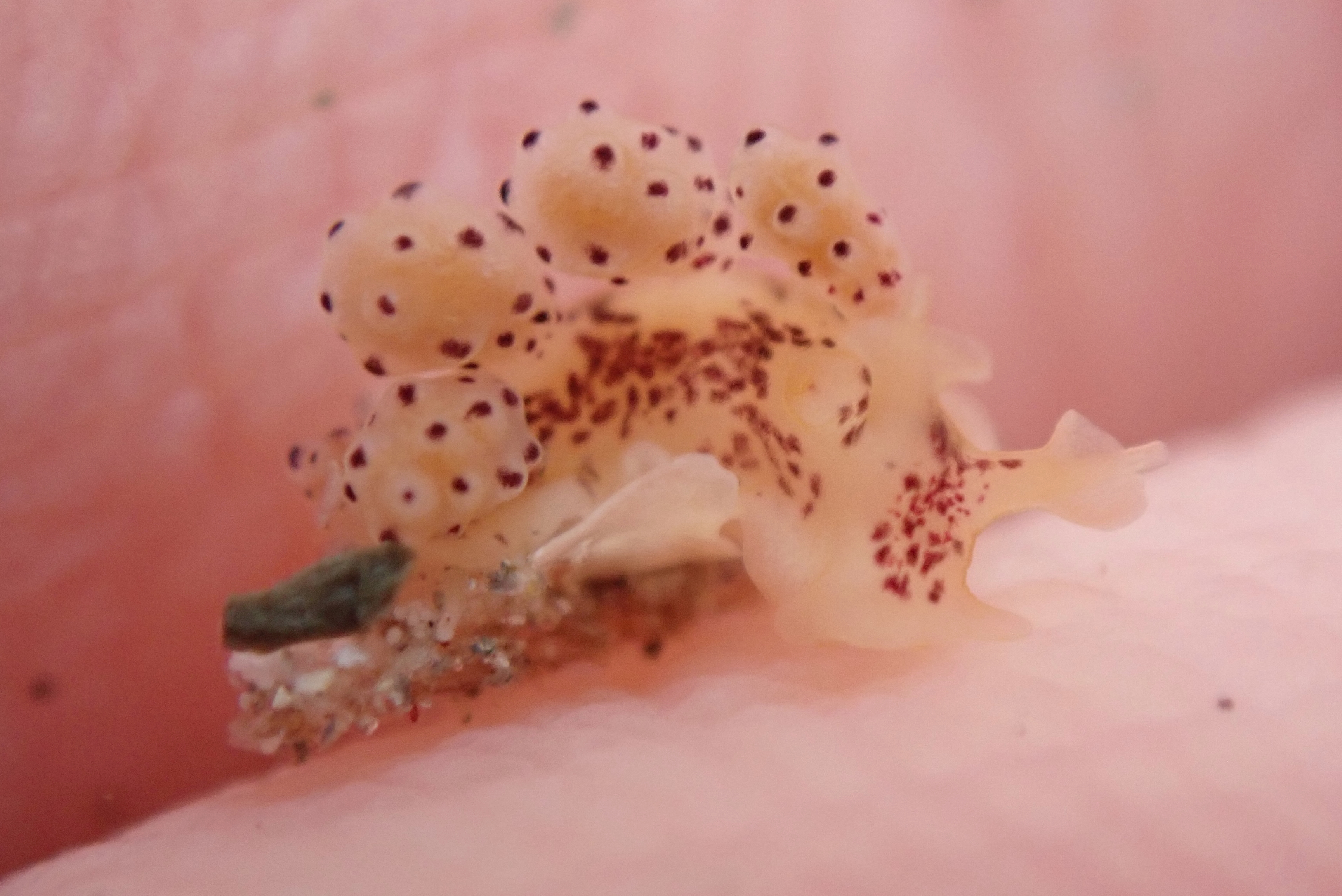
    Doto sp. slug – possibly Doto onusta. Looe.

    Out of the water, they are a sorry, squidgy mess. If, however, I can persuade one off the hydroid, I can put it in the water to reveal its towering jelly-mould structure decorated with charming crimson or black dots. The satellite dish rhinophores (antennae) on the slug’s head are an impressive accessory too.

    Doto sp. slug – possibly Doto onusta. Looe, Cornwall.

    Whether they remind you of cakes or jellies, there’s something gloriously edible-looking about the Doto slugs.

    Warning: Slugs are not dessert. Don’t eat rock pool wildlife.

    The little spots on the slug’s cerata look so much like cherries on a cake. Doto sp. slug, Looe.

    It isn’t clear what species these slugs are; Doto slugs are notoriously difficult to identify. They were initially thought to be Doto coronata. That species isn’t now believed to feed on Dynamena pumila, so they may be a species known as Doto onusta – or something else. Whatever they are, I absolutely love to see them.

    And now for a bonus slug… The orange-clubbed slug, Limacia clavigera, is a frequent find, but is too fabulous to be left out. Enjoy!

    The orange-clubbed sea slug, Limacia clavigera. Looe, Cornwall.

    Have you found anything new on your local beaches? I love to hear what other people have seen and can often help to identify unusual finds if you’d like to get in touch.

    You can also find identification guides to some common rock pool creatures such as crabs, starfish and fish on my Wildlife page.

    Whatever the weather, always stay safe in the rock pools. Follow my rockpooling tips to look after yourself and the wildlife on the shore.

    This website is a labour of much love and the content is available for free to everyone. My wonderful readers often ask if there is a way to support my work. You can now ‘buy me a coffee’ through my Ko-fi.uk page. (Just click donate and you can set the amount to pay by PayPal). Thank you!

  • Rock Pooling at Lizard Point: Cowries, Sea Slugs and a Saffron Bun

    Rock Pooling at Lizard Point: Cowries, Sea Slugs and a Saffron Bun

    It’s not exactly tropical, but we’re as far south as you can go on the UK mainland. The sun is shining and the clear water gives us a perfect view into the pools. After a morning of geological exploration at Kynance Cove, my family are treating me to some low tide rock pooling here at Lizard Point.

    Rock pools at Lizard Point

    Apart from the chatter of seabirds and a distant hum of voices from the cafés perched on the cliffs, the beach is still, expectantly waiting for the tide to turn. Out in the bay, a bull grey seal rests upright in the water. He is ‘bottling’, his broad snout raised to the sun, keeping half a sleepy eye on the female that is snoozing closer to the shore. There are no boats here to disturb the seals, so they nap peacefully on and on, barely moving with the gentle rise of the swell.

    The colours in the pools are as vivid as a royal procession. Neon green snakelocks anemones jostle for space with dusky pink coralline algae, yellow sea squirts and iridescent blue seaweed. Tiny rainbows play across the rocks.

    A colourful pool at Lizard Point – Snakelocks anemone

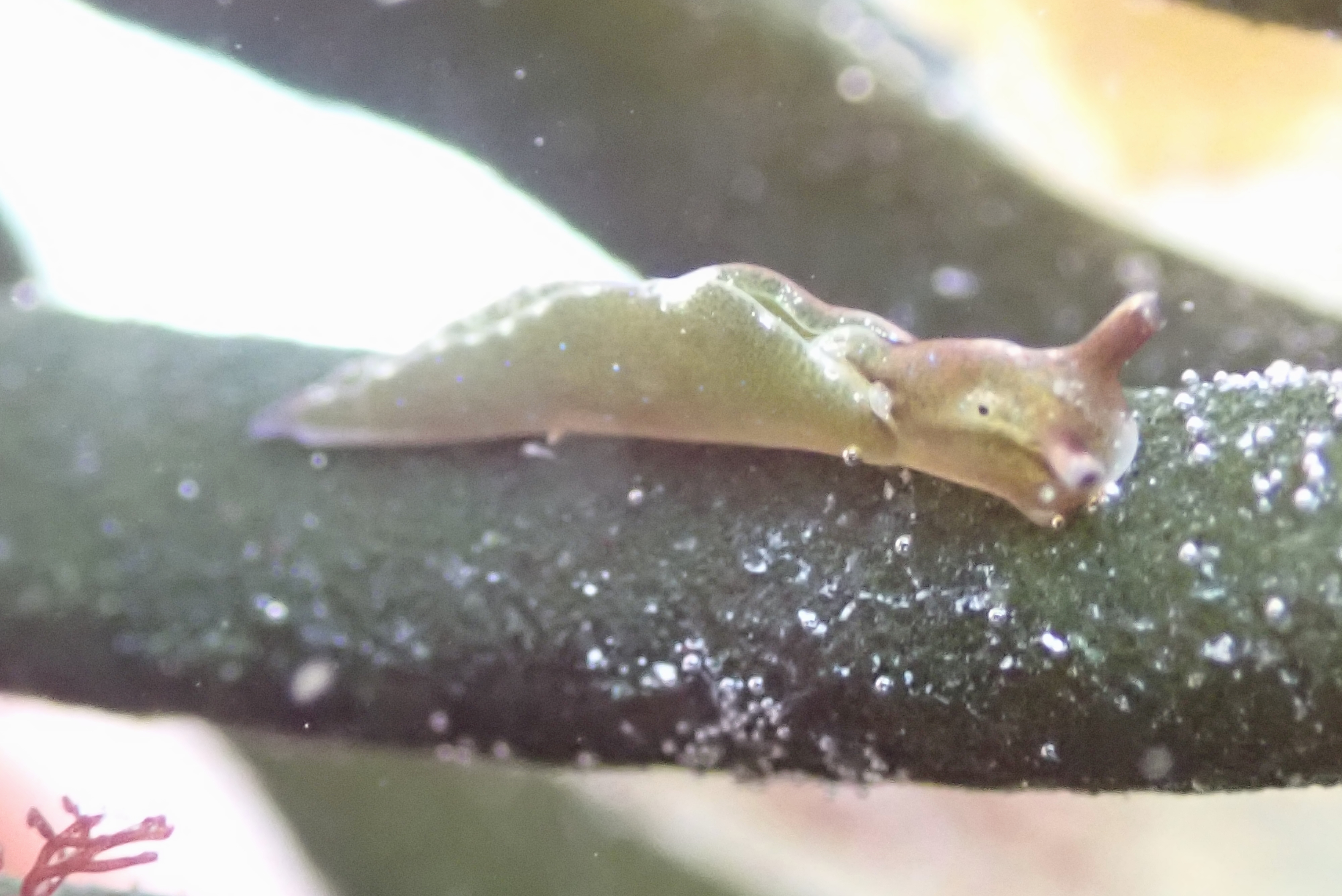
    Looking closer, we begin to notice other rock pool wildlife that is less keen to stand out, adopting the same bold colours as the seaweeds and encrusting animals to hide from predators. Tiny Elysia viridis sea slugs are everywhere, but they match the deep green of the codium seaweed perfectly.

    Elysia viridis on codium seaweed.

    These are the ‘solar powered’ sea slugs. They retain the seaweed’s chloroplasts, which carry on photosynthesizing in their bodies, making glucose to supplement the slugs’ diet.

    Elysia viridis sea slug stretching out to make the most of the sunlight. Spot the second slug!

    A variety of animals are resplendent in shocking pinks and oranges, which allow them to disappear among rocks adorned in pink paint seaweed and forests of other red seaweeds. A European 3-spot cowrie (Trivia monacha) is roaming the rocks looking for sea squirts to eat.

    Trivia monacha – the European 3-spot cowrie at Lizard Point. It feeds on sea squirts like the blue star ascidian to the left of the photo.

    With its sunset-orange proboscis fully extended and its spotty mantle draped over most of its shell like a (fake) fur cape, it has the air of a glamorous Dalek.

    European 3-spot cowrie (Trivia monacha) doing a Dalek impression

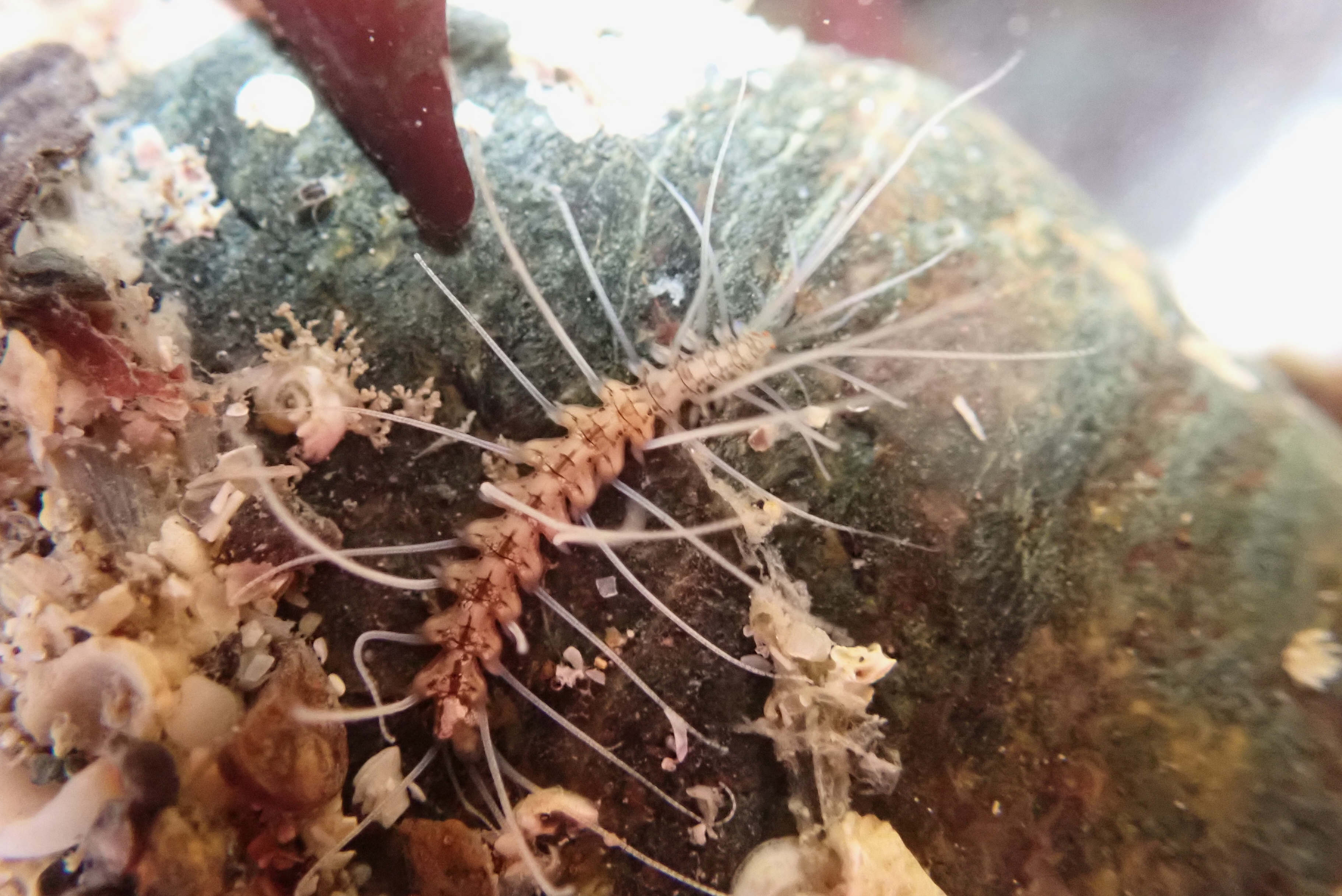
    Not to be outdone by the molluscs, there are some stunning worms in the pools. My favourite is this syllid worm, gliding across the rock with its enormously long, whisker-like appendages stretching and curling in all directions at once.

    Syllid worm. Amblyosyllis sp. looking spectacular. Lizard Point, Cornwall.

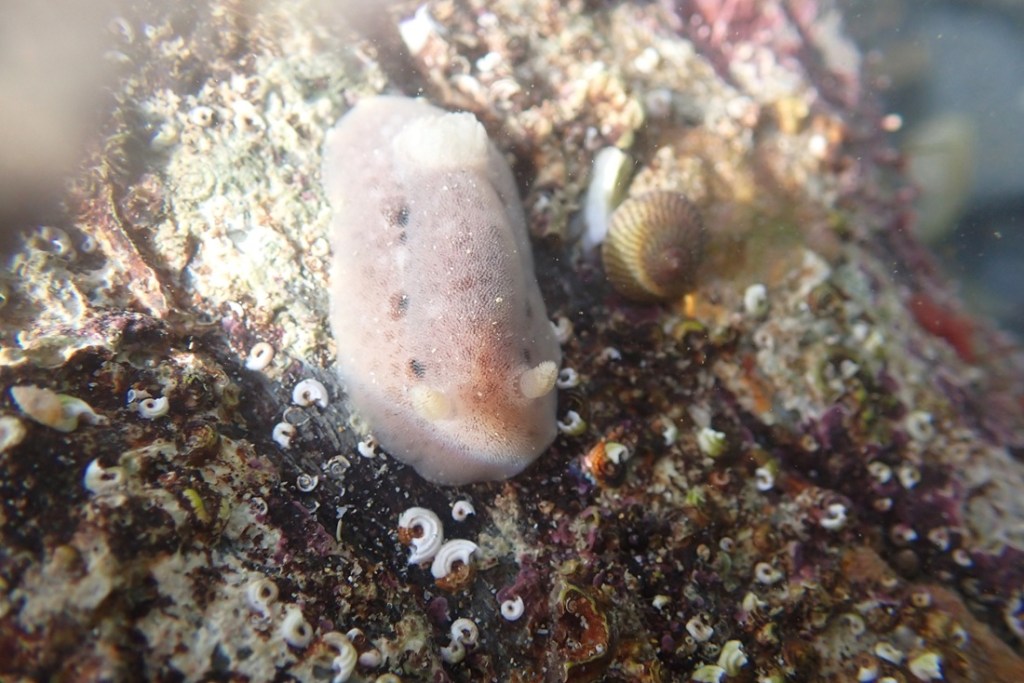
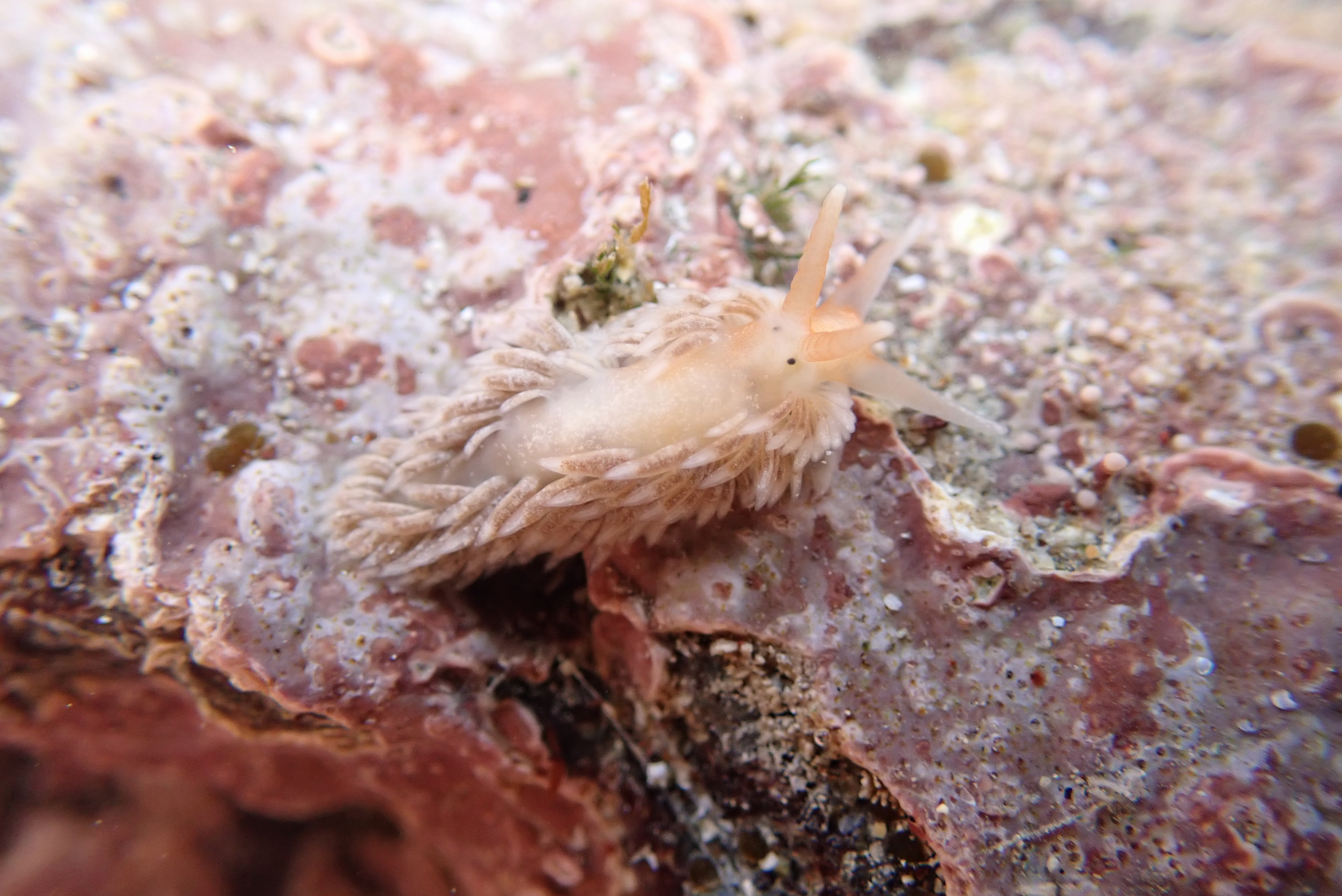
    This feels like a spot that sea slugs should like. There is a variety of food on offer and no shortage of hiding places among the pools and boulders. Sure enough, under one rock I find two species hanging out together. They look like friends, but they are on separate missions. The great grey sea slug (Aeolidia filomenae) feeds on anemones, while the Berthella plumula – or feathered Bertha as I like to call it – eats sea squirts or sponges.

    A quick hello in passing – Great grey sea slug (Aeolidia filomenae) and Berthella plumula sea slugs.

    Junior, who excels at gathering people to look at things, has collected up an excited young boy and his grandfather to show them the pools. We all find things to show them – solar powered sea slugs, hermit crabs and a stalked jellyfish. While Junior is explaining barnacles to his fascinated audience, I wander down the shore, thinking I might find a starfish for him to show his new friend.

    Stalked jellyfish (Haliclystus octoradiatus) on codium seaweed at Lizard, Cornwall. Photo by Cornish Rock Pools Junior

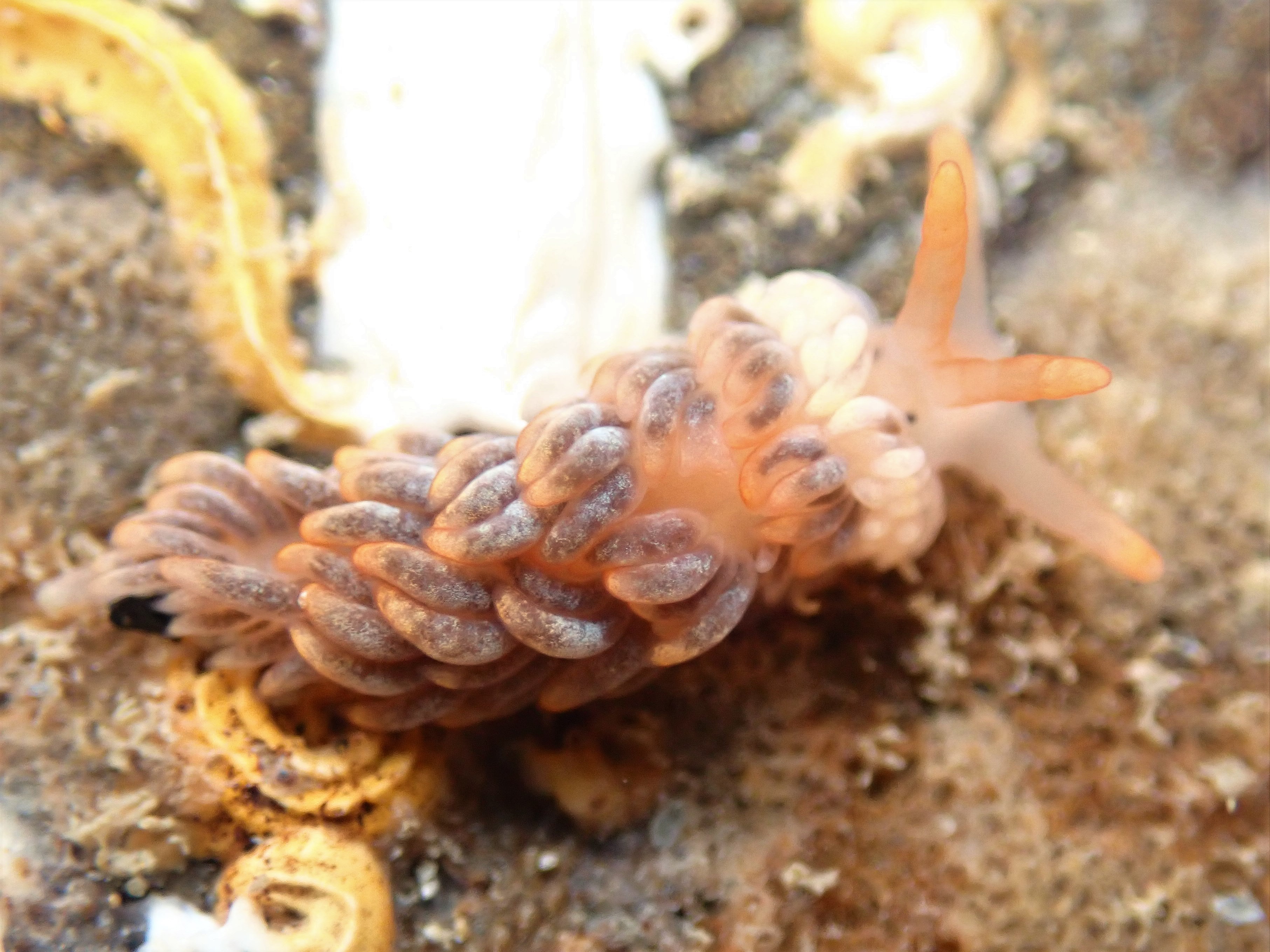
    Sheltering under a small stone is a neat five-armed cushion star, but close to it, even more excitingly, there is a slender little Aeolidiella sp. sea slug.

    This slug looked a little different: Aeolidiella glauca

    Aeolid slugs vary in colour depending on what they have eaten, but there is something unusual about this one that I can’t place. It has a bit of a white ruff behind its head, but I’m not convinced it is the white-ruffed sea slug (Aeolidiella alderi) that I frequently see.

    Aelolidiella alderi (pictured near Falmouth) is the more common species locally. It is often white or grey, but can take on bright colours like this after eating anemones.

    I take some photos. Zooming in, I soon ‘spot’ the difference; the difference is the spots! There are tiny white flecks on the slug’s body. I take photos in the pool before ensuring it is returned safely back under its stone.

    Aeolidiella glauca sea slug, Lizard, Cornwall

    Despite my rush to identify the slug (which I suspect is an Aeolidiella glauca) there are even more important things to do on the way home: like stopping for a saffron bun and ice creams at Roskilly’s, and visiting friends in Gweek.

    Thanks to the wonders of expert Facebook groups and also the brilliantly helpful David Fenwick of Aphotomarine, I have confirmation the same day. Aeolidiella glauca has occasionally been recorded in this area before, but it’s a first for me. It may be more common in northern waters, but marine creatures rarely follow the rules.  There are surprises everywhere and that is exactly what makes rock pooling so fabulous.

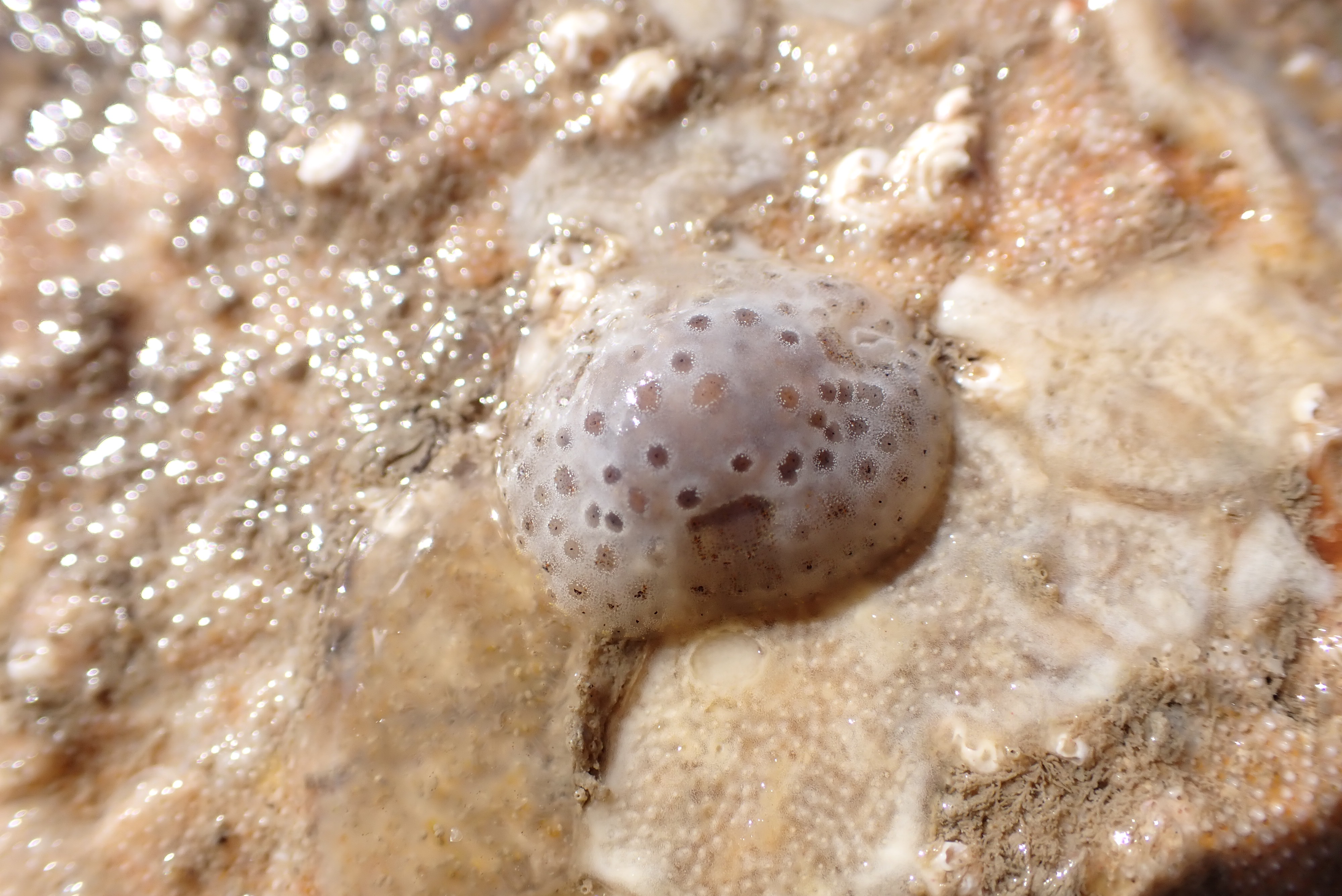
    Another lovely little find: Lamellaria latens (gastropod mollusc) at Lizard Point
    Dahlia anemone at Lizard Point, Cornwall
    Gem anemone. Lizard Point, Cornwall.

    Whatever the weather, always stay safe in the rock pools. Follow my rockpooling tips to look after yourself and the wildlife on the shore.

    This website is a labour of much love and the content is available for free to everyone. My wonderful readers often ask if there is a way to support my work. You can now ‘buy me a coffee’ through my Ko-fi.uk page. (Just click donate and you can set the amount to pay by PayPal). Thank you!

  • Beach Explorers at Filey Literature Festival

    Beach Explorers at Filey Literature Festival

    The empty shells of sea potatoes, masked crabs, swimming crabs, razor clams and limpets fill my arms, along with a rather battered piece of seaweed. We haven’t reached the rock pools yet, but the sharp-eyed kids at my Beach Explorer book event have done as instructed and brought me all of the strandline treasures they can find. That, it turns out, is a lot!

    Spotting signs of life in the sand at Filey: Photo by Filey Literature Festival

    The long, sandy beach here at Filey in Yorkshire provides a perfect environment for sea creatures that like to bury themselves in the sediment and the evidence is everywhere. The beach is covered in the tiny tubes of sand mason worms and we have no difficulty finding the coiled casts of lugworms that live in burrows beneath our feet.

    The habitat is perfect for sand mason worms.

    The cliffs of the headland at Filey Brigg are a fascinating mix of rock types, but look ominously unstable, so we trace a path along the sea’s edge, well clear of any danger. Fish, crabs, anemones and starfish are the top things the kids tell me they hope to see. The silty water among the boulders and pools at the base of the Brigg will make our search challenging, but the children are in good spirits and full of enthusiasm.

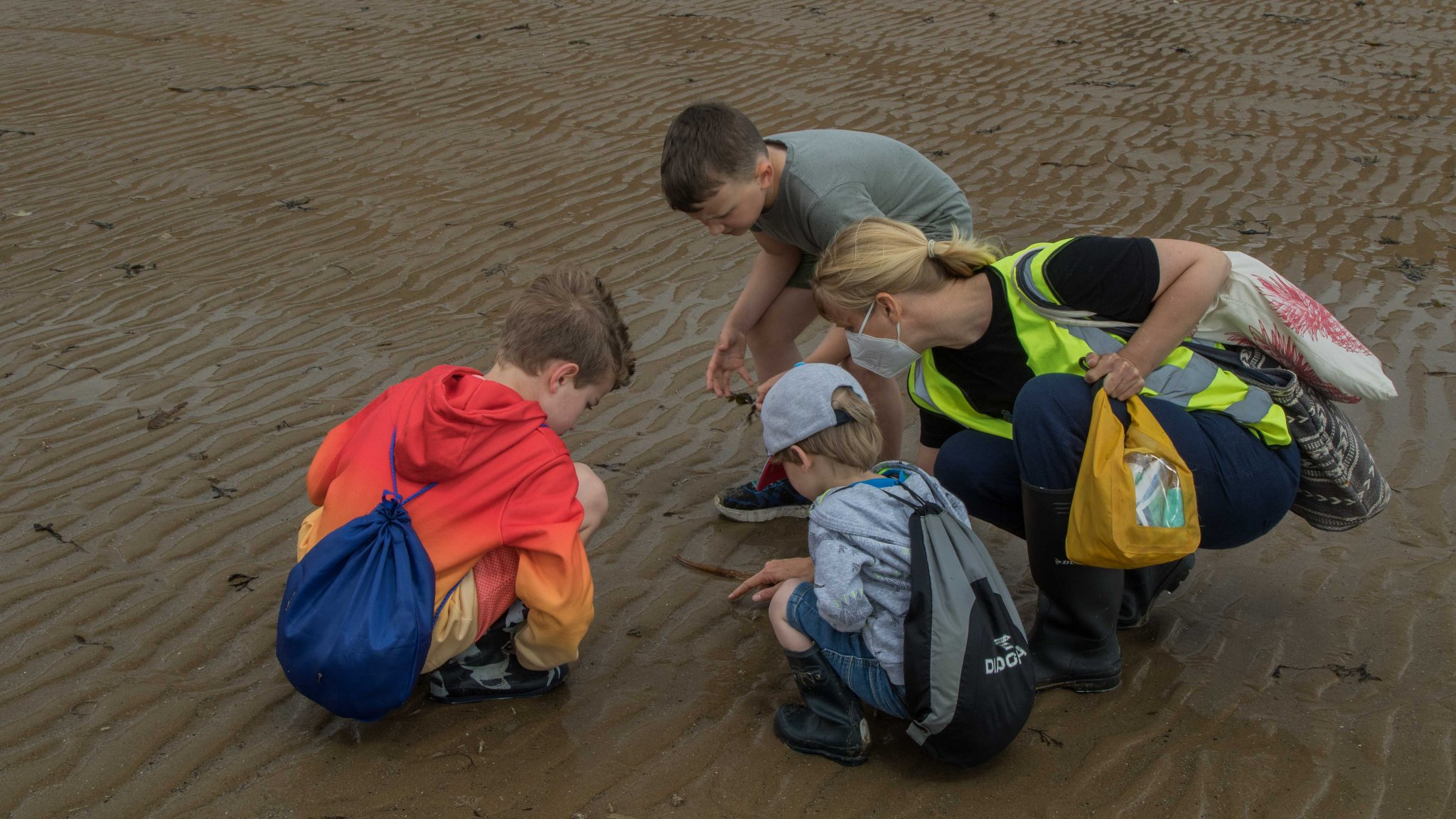
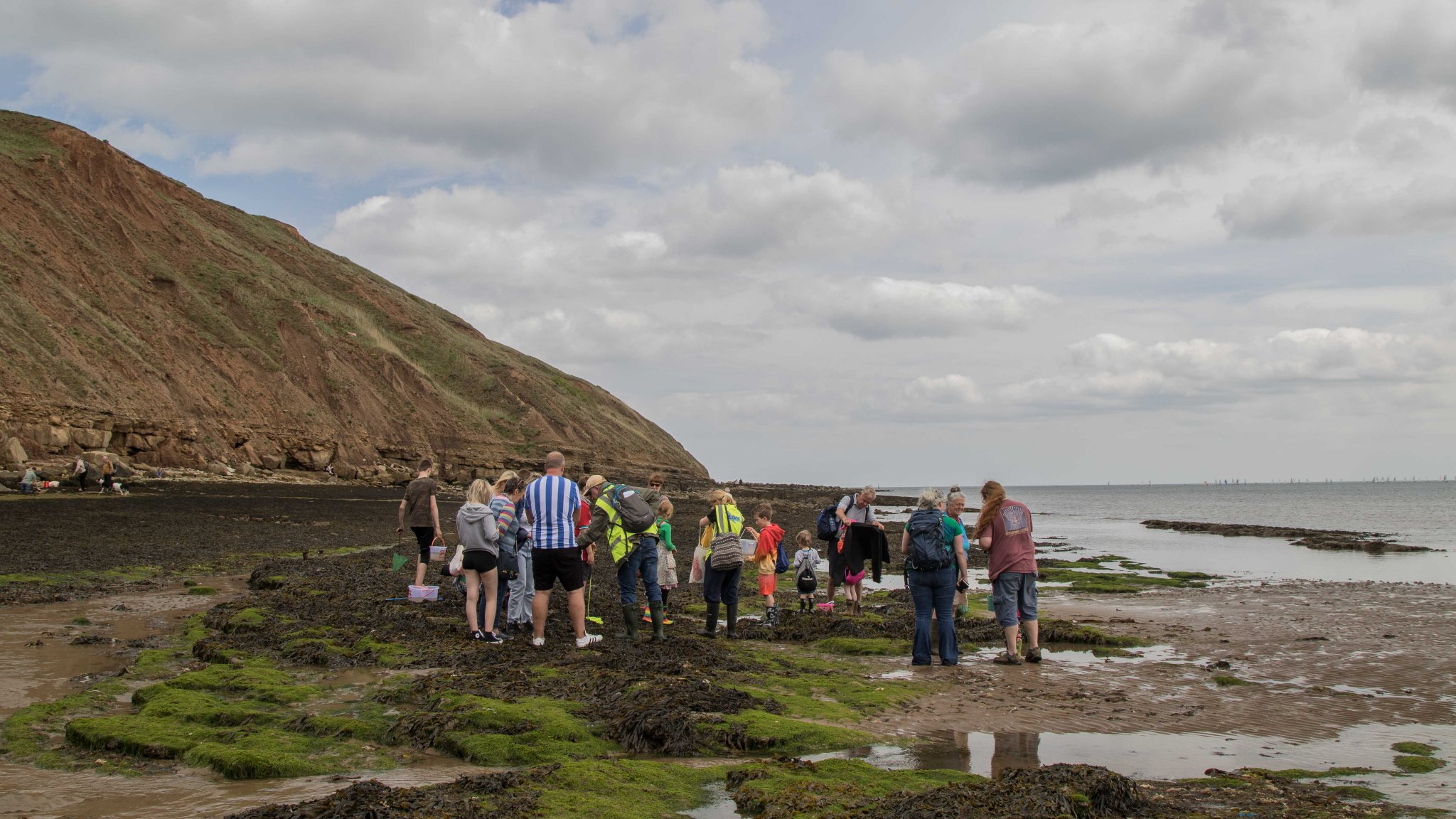
    Beach Explorer rock pooling event at Filey Brigg. Photo by Filey Literature Festival.

    On the rocks ahead of us, kittiwakes are swooping down and gathering clumpy beakfuls of seaweed to line their nests. On my walkover of the area yesterday before my evening book talk, I melted with joy at the unmistakeable calls of these pretty little gulls. Sadly, it’s a sound I rarely hear back in Cornwall these days.

    The clear limestone pools at the end of the Brigg also took me by surprise yesterday. The distance across slippery boulders made them unsuitable for today’s family event, but I couldn’t resist exploring and delighting in finding fat sea hares, oaten pipe hydroids and lots of busy hermit crabs.

    The rocky shore at Filey Brigg
    Sea hare, Filey, Yorkshire
    Tubularia hydroid. Filey.
    Elysia viridis – the solar powered sea slug. Filey, Yorkshire.

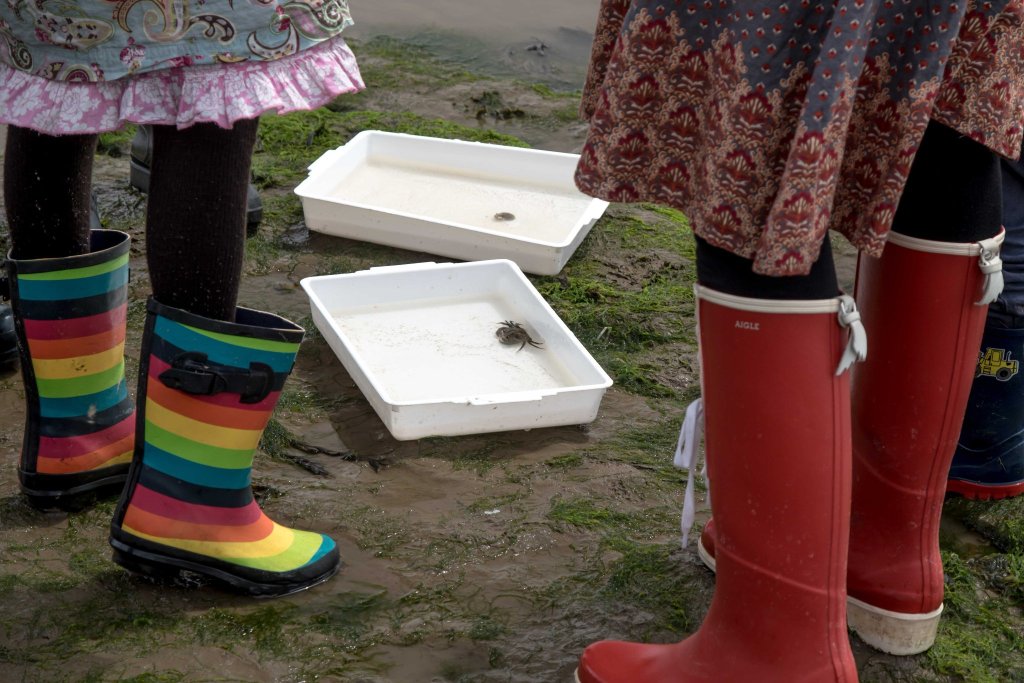
    Despite the challenges of our muddy site, the finds come rolling in to our ‘shore laboratory’ tray. We soon have a baby sea scorpion fish, tiny brittle stars, shore crabs, a hermit crab and more.

    A beautiful beadlet anemone with its tentacles out. Filey. Yorkshire.

    We even find a great grey sea slug and a large female shore crab with a spongey mass of eggs under her tail. With a bit of help and perseverance, everyone finds sea creatures and the children (and their adults) do a perfect job of looking after their finds – keeping them in plenty of sea water, handling them gently and returning them to their homes.

    An empty clotted cream pot is perfect for making a mini-aquarium for our sea snails so we can see their tentacles emerge. Photo by Filey Literature Festival.

    It’s a long way from Looe to Filey but seeing the faces of the children as they find their first crab moults, see their first open anemone and hold their first hermit crab, makes it all worth it.

    Hermit crab (Pagurus bernhardus) at Filey, Yorkshre

    My children’s book, Beach Explorer, is all about discovering the beach for yourself through hands-on activities and I couldn’t have asked for a better group of explorers. If these families are anything to go by, Yorkshire has some fine young naturalists in the making!

    Beach Explorer is available from your local bookshop and online.

    A huge thank you to Filey Literature Festival for hosting me, Hylands Care Home for kindly sponsoring the events and to everyone who came along for your warm welcome and enthusiasm. Also, thank you to the Hull University Marine Biology Department students and lecturer who generously shared their knowledge of the beach and to the pod of dolphins who treated me to a swim-past on my last morning walk in Filey.

    Filey Literature Festival – off to a great start!
    The rather wonderful crazy golf course on Filey seafront!

    Whatever the weather, always stay safe in the rock pools. Follow my rockpooling tips to look after yourself and the wildlife on the shore.

    This website is a labour of much love and the content is available for free to everyone. My wonderful readers often ask if there is a way to support my work. You can now ‘buy me a coffee’ through my Ko-fi.uk page. (Just click donate and you can set the amount to pay by PayPal). Thank you!

  • A Summer Splash with a New Friend

    A Summer Splash with a New Friend

    I know there are good reasons not to meet people you only know from the internet, but I often do. It has been brilliant every time because people who love the rock pools are the best! When an online acquaintance who is part of the Shores of South Devon group messaged me about meeting up, I knew we would have a great time.

    Junior and I grabbed our beach shoes and headed to the local rocks to meet her. The tide might not have been the lowest ever, but with three keen pairs of eyes on the job and warm water (by Cornish standards) to splash around in, we couldn’t fail to have fun.

    Our new friend especially wanted to see cowries and sea slugs, so we had fun looking.

    The summer seaweed was starting to die back and the water was cloudy with plankton and silt, but the sun breaking through the water made it easy to see. There are always plenty of interesting molluscs; the dusky-pink cowries and chitons caught our eye.

    A pretty chiton – Lepidochitona cinerea

    The mid-shore pools are extensive around Looe and are crammed with rock pool species, all jostling for space and food. This cushion star was out exploring a shallow pool.

    Cushion starfish in the rock pools

    Anemones know their place as the star of the show! They love plankton-rich water and come in every possible colour. The brightest of the day was this gorgeous dahlia anemone.

    Dahlia anemone
    This daisy anemone had a fabulous purple mouth
    Waving tentacles of snakelocks anemones catching the sunlight (and some plankton).

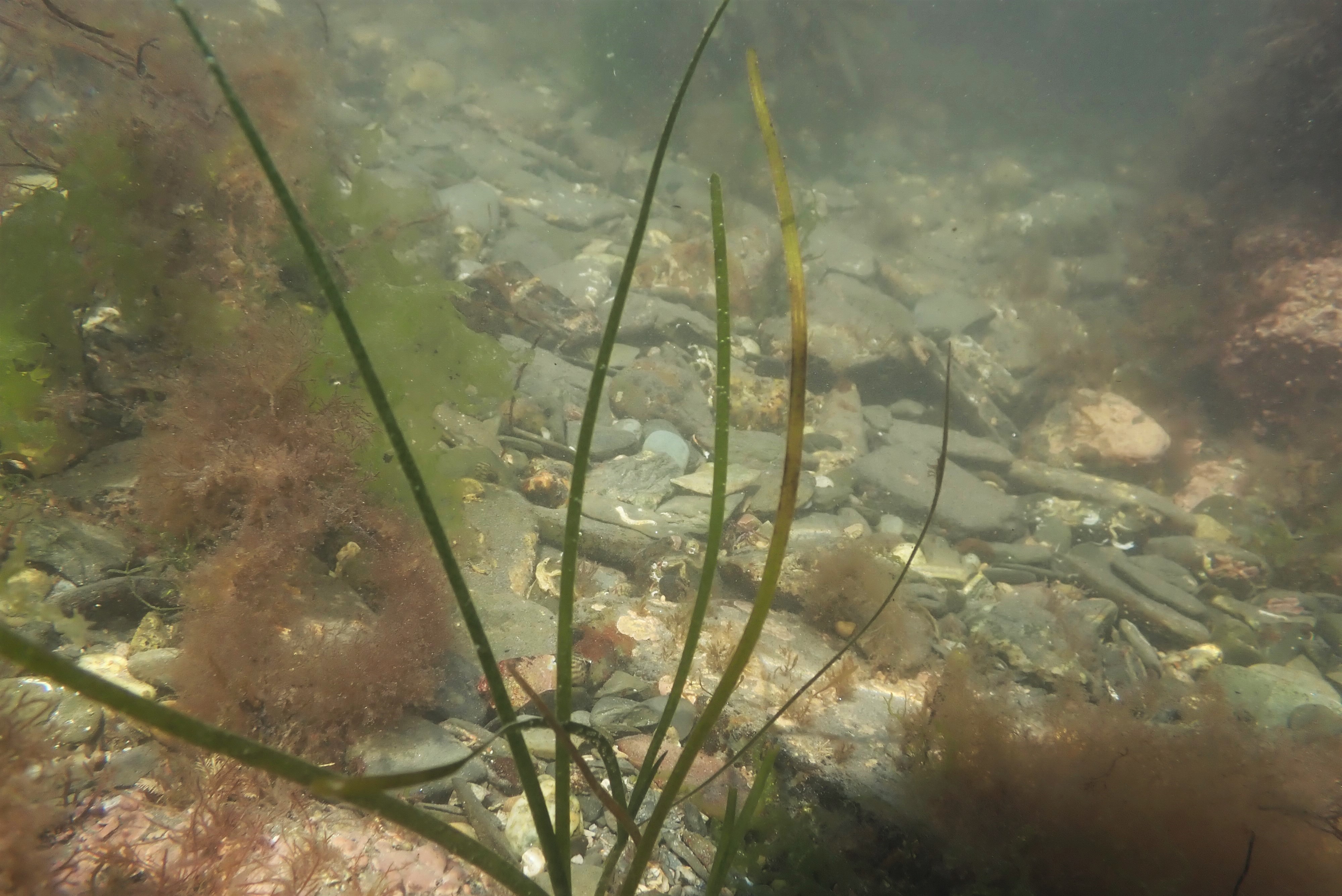
    One of the great benefits of summer rockpooling is that we can go as deep as we like in the pools. Junior was excited to show our new friend his favourite swimming pool. It’s unusual to find seagrass in the rock pools, but there are usually a few clumps of it here. Sure enough, Junior spotted it straight away.

    This deep pool often has some seagrass growing in it.

    Our new friend was wonderfully excited by everything we saw and the time flew by as we met urchins, crabs, variegated scallops and other incredible little creatures.

    A green shore urchin wearing a selection of this season’s seaweed.
    A St Piran’s hermit crab pops out to say hello.

    Many of the rocky overhangs and boulders were coated in animal life. Thick sponges, gelatinous sea squirts and mossy bryozoans crowded together with tube worms and spiral worms in a jumble of colours and shapes.

    This distinctive sea squirt has four crimson spots at the tip of each zooid.
    A collage of sponges and sea squirts.

    It almost goes without saying that we were looking for sea slugs. Our friend had found a few on other beaches and was keen to discover more. There are generally fewer about on the shore at the end of the summer, when the spawning season is coming to a close, but there was still a chance of seeing some.

    On a loose piece of seaweed floating in with the tide, I found the unmistakable pink spaghetti coils of sea hare spawn. Looking through my camera, I could see the developing eggs inside. These ones probably would not survive, but many others will have hatched successfully.

    Pink spaghetti! Sea hare spawn.
    Lots of baby sea hares developing!

    As we searched among the rocks in a shallow pool, an eel slid past my feet and promptly disappeared, tunneling effortlessly down among the pebbles.

    Common eel slinking away to hide under the stones.

    Just when we are leaving the pools, I checked under a stone and found a nudibranch sea slug. It was a beauty with long pink cerata and striking brown rhinophores. The slug might only have been a centimetre or two long, but it was speedy; every time I thought I had it in focus, it went gliding away across the rock. It didn’t matter. We were all happy just to enjoy watching it for a minute before returning the stone exactly as we found it.

    We found a sea slug! Favorinus branchialis.
    The brown rhinophores with a bulge near the top are typical of Favorinus branchialis.
    Favorinus branchialis. This little nudibranch likes to eat the eggs of other sea slugs.
    Look closely – the shining blue dots are the eyes of tiny baby fish!

    As always, it was great fun to explore the shore with someone else who takes delight in the little things. In a fast-moving world, it’s important to take the time to connect with nature and with each other.

    Social media certainly has its downsides, but I love how easy it is to find others who care about the natural world and to build real-world social connections with them. If we are going to find solutions to the problems facing our environment, those connections will be essential.

    Whatever the tide, always stay safe in the rock pools. Follow my rockpooling tips to look after yourself and the wildlife on the shore.

    This website is a labour of much love and the content is available for free to everyone. My wonderful readers often ask if there is a way to support my work. You can now ‘buy me a coffee’ through my Ko-fi.uk page. (Just click donate and you can set the amount to pay by PayPal). Thank you!

  • Summer Rock Pooling At Millendreath

    Summer Rock Pooling At Millendreath

    Irys and her mum are hoping to see a sea slug. As regular readers of this blog will know, I am more than a little slug obsessed, so we quickly hatch a plan to visit “Slug Alley”.

    The day is grey and mizzly, as is typical in Cornwall any time of year. These damp conditions are ideal for sea creatures that would hide away on sunnier days to avoid drying out. The tide is nothing special, but there is still a fair chance of finding slugs if it drops enough to allow us to access the deep rocky overhang.

    This flat periwinkle is happily searching for seaweeds among the damp sponges and sea squirts.

    Tiny blobs of jelly aren’t easy to see, especially when the whole of the rock is coated in an assortment of blobs already. As well as some blobby seaweed, there is a rich turf of sponges, sea squirts and bryozoans, all competing for space in this damp, shaded area.

    Star ascidian colonial sea squirts at Millendreath, Cornwall.

    Among the hydroids I find a few super-small blobs that might be Doto sea slugs, but out of the water it is impossible to tell. Junior finds a “huge” stalked jellyfish a few centimetres long, which can only be a Calvadosia campanulata.

    Calvadosia capanulata stalked jellyfish.

    This jelly is common in the summer and can be a few centimetres long. The tiny turquoise spots on the outside of the bell are unique to this species.

    Less obvious, but more numerous Haliclystus octoradiatus stalked jellies are everywhere at the moment.

    Haliclystus octoradiatus stalked jellyfish.

    I even find one under a stone. These stalked jellyfish normally only live on seaweed, so this one has probably been dislodged by something and will try to loop its way back to the seaweed when the tide comes in.

    Stalked jellyfish under a stone looking rather sorry for itself!

    Irys finds a blob and shows me. It is small, brown and jelly-like and I am pretty sure it is a slug. I try not to get excited until we are sure. Carefully, we remove it from the sponge and pop it in a pot of seawater. In true magic slug style, the little creature sticks itself to the bottom of the tub and begins to open up and move. This is not either of the species I first thought it might be.

    Irys’s fabulous find – Aegires punctilucens, a nudibranch sea slug.

    We transfer the slug to a shallow petri dish to get a better look. As soon as it is under the camera, it is obvious that this slug is indeed something different. It’s a species I have only seen before in my (many) books and it’s an absolute gem. It even looks like it is hewn out of rock with its bumpy, knobbly back, but between the bumps, the body is smooth, dark brown and decorated with spots of iridescent blue.

    Aegires punctilucens sea slug at Millendreath

    This is a fabulous find and I am in awe that Irys spotted it having never seen a sea slug before. I have to check the name in a book when we get home – Aegires punctilucens. Punctilucens means points of light shining through or dawning… a perfect description.

    Aegires punctilucens sea slug exploring the pool at Millendreath.

    We take a lot of photos  of the slug in a petri dish and in a shallow pool before returning it to the rock where we found it, where it will feed on the sponges. Ideally we would take photos of it in situ, but out of the water it really is featureless brown goo!

    The tide has dropped a little more, so we explore the pools further down the beach while we can.

    Among a forest (or salad garden?) of sea lettuce, I spot this beautiful Polycera sp. slug. It is fairly large for this species and has striking yellow lines.

    Polycera sp. nudibranch sea slug.

    It is likely Polycera quadralineata, the four-lined sea slug, but it can be difficult to distinguish from Polycera norvegica. This lovely slug likes to eat bryozoans – colonial animals that form mossy sheets on the seaweed and rock – so it can become quite numerous this time of year.

    Polycera sp. sea slug at Millendreath

    I hadn’t been sure of finding much today on such a small tide, but slug alley has done us proud. We are all delighted with our finds and we are already planning another expedition together next time Irys and her mum visit.

    Another creature in an unusual place – Aplidium turbinatum sea squirt on sea lettuce.

    If you are visiting the beach this summer, be sure to rock pool responsibly and safely. Check the tides and leave everything as you found it. Read my top tips for successful rock pooling.

    This website is a labour of much love and the content is available for free to everyone. My wonderful readers often ask if there is a way to support my work. You can now ‘buy me a coffee’ through my Ko-fi.uk page. (Just click donate and you can set the amount to pay by PayPal). Thank you!

  • Staycation Safari

    Staycation Safari

    After many days of getting drenched every time we step outside, Junior and I decide to make the most of the warmer weather and have a lazy day pootling about our local area. If everyone else is taking a holiday in Cornwall, so can we! The rocks between Plaidy and Millendreath are perfect for clambering and exploring, and I promise Junior a spot of wave jumping when we reach the sand beyond.

    ‘Slug alley’ at Millendreath

    “I’ve found a blob,” Junior calls over to me.

    I am kneeling among some seaweed at the top of a deep rocky gully. My head is almost pressed against the minute Dynamene pumila hydroids that grow on this seaweed, looking at what I’m sure is Doto sea slug spawn. “What kind of blob?” I ask.

    “I think it’s a slug,” he says, and I’m up and at his side in a second.

    The blob is bigger than I expect, almost like a small anemone on the rock. We stare at it closely, our heads touching. It looks as though it is tipped with blue.

    “Oh my word,” I say. “I think you’ve done it.”

    We hug and cheer and do a little slug dance, because every slug deserves a dance and this one is especially special. For weeks now, we have been looking for Antiopella cristata, a slug which ought to be found here but which I have never seen.

    Taking great care not to harm the slug, we transfer it to a pot of seawater and watch it floof up.

    The fully ‘floofed’ Antiopella cristata nudibranch sea slug.

    The slug’s body is yellowish, but its back is covered in large waving cerata, each tipped in pale, frosted blue. The effect is like opening a geode to find tall, pointed blue crystals inside.

    Close-up Antiopella cristata’s cerata remind me of peacock feathers.

    We call the slug ‘Aunty Crystal’ to help remember its scientific name.

    Antiopella cristata – or Aunty Crystal as we named this stunning sea slug.

    We have named this gully ‘slug alley’ for a reason and plenty more creatures, slugs and others, are hiding on the tall, shady rock face. I find several bright red Rostanga rubra slugs munching on the red sponges.

    The Rostranga rubra slug, which gets its incredible colour from the sponges it eats.

    A tiny ghost-white slug has been laying its eggs nearby. In the water it takes on a frilly appearance, making it look ever more spectral.

    Goniodoris nodosa, looking frilly and ghost-like.

    Sea cucumbers adore this area and are to be found everywhere, with their bodies hidden in holes in the rock and just their black and yellow mouths protruding. The two main species I see are Pawsonia saxicola and Aslia lefevrei.

    Sea cucumber at Millendreath.

    When submerged, they will open a wide fuzz of frilly tentacles to feed.

    We clamber over the rocks onto the sand, helping a stranded rockling back into a pool on the way, and splash in the waves for a while.

    This rockling had ended up out of the water at low tide, so we helped it back into a pool.

    A couple of shells roll past my feet, tumbled by the waves over the silty sand. I make a quick grab for them and, sure enough, they both contain hermit crabs. At low tide, I occasionally find this species here, easily recognised by its enormously long left claw. These crabs are both south-clawed hermit crabs, also known by their gladiatorial sounding scientific name, Diogenes pugilator.

    Diogenes pugilator, the south-clawed hermit crab.

    They are ready for battle, almost falling out their shells in their attempts to dislodge my grip, unaware that I am saving them from the herring gulls that are lurking at the water’s edge.

    The south-clawed hermit crab has long hairs on its antennae.

    Junior and I kneel at the edge of a sandy pool and pop the hermit crabs in. We watch one emerge without hesitation. The tips of its claws come first, then the stalked eyes and finally its long hairy antennae. The hermit crab hoists its shell up and runs a few paces.

    With a furtive glance about it, the crab swings its vast left claw inwards, shoveling sand into a pile while simultaneously flicking the sand over its back with its little right claw. Grains of sand are flung up through the water and by the time they have settled, only the back of the shell and the tops of the hermit crab’s eyes are visible. It is buried out of sight.

    We take the hermit crabs back to the sea, leave them as far out as possible – safe from predators – and carry on wave hopping until the tide turns, when we too must head for home.
    Here’s a little video of this week’s highlights from the Cornish rock pools. Sit back and enjoy!

    If you would like to find out more about rock pool wildlife or go on your own rock pooling adventures, be sure to pick up my books Rock Pool and Beach Explorer. Out now with September Publishing and available from all book shops and online.

  • Meeting up and staying apart in the rock pools

    Meeting up and staying apart in the rock pools

    When I’m sitting here writing my blog in the evening, with the cat snoring gently beside me, I find it hard to imagine that people anywhere in the world might be reading about my finds the next day. So, it’s always lovely to receive messages from people who follow the blog and share my passion for our rock pool wildlife. It’s especially surprising to me that these include many people I’ve never met and that some of my readers even live beyond the Tamar!

    With the days beginning to draw in and with all normal group activities off due to Covid, making connections with others is more important than ever. When I heard from a couple of keen naturalists and Shoresearchers planning a trip to Cornwall, I thought it could be fun to head out on the shore together with my family. I couldn’t have been more right!

    You know someone is a good person when they like finding slugs. Within minutes of meeting our new friends on Millendreath beach near Looe, we had established that slugs were top of their wishlist of things to find. I led the way to “slug alley”, a deep gully between the rocks where I often find sea slugs feeding on the sponges, squirts, bryozoans and hydroids that line the dripping overhangs.

    We advance in our family groups, keeping several metres apart, pointing at interesting creatures, giving directions then backing away. By this stage in the pandemic, we’re all confident in these new dance steps.

    Botryllus leachii colonial sea squirts

    Large patches of colonial sea squirts smooth over the rocky surfaces, providing not just striking colours and patterns but food for many animals that predate them. We find both the European three-spot cowrie and the Arctic cowrie happily gorging themselves on this beautiful feast.

    A cowrie on the search for sea squirts to eat.

    A brown spot among the squirts and barnacles catches my eye. Although the colours blend in perfectly, it looks different from its surrounds. I gently touch it and it comes away. In a seawater-filled petri dish it rapidly transforms itself, puffing up, elongating and sprouting feathery gills and tall rhinophores. There’s no doubt about it, we have our first slug. My excitement is as great as that of our new friends – this is a species I have never seen before.

    Goniodoris castanea exploring the petri dish.

    We take turns to examine the slug and take photos. As soon as it is under my camera, which shows far more detail than I can make out with the naked eye, I recognise it from my books (yes, I browse slug books for fun). It’s my first Goniodoris castanea. Castanea means chestnut and the slug’s autumnal mottling of red, brown and white hues make seems a perfect fit with the oncoming season.

    Goniodoris castanea showing off its beautiful autumnal colours.
    Goniodoris castanea

    While our friends marvel at the slug, Junior makes another exciting find. He knows what it is just by the purplish tips of the arms protruding from under the rock. “Spiny starfish!” he calls. We carefully move it out to take a look and it’s a monster. Our starfish has clearly found plenty to eat in this area. Although we regularly see them on the shore here, spiny starfish aren’t found in rockpools in some other parts of the country and this is another new species for our visitors.

    I forgot to take photos of the spiny starfish due to my excitement over the slugs – but here’s a pic of one we found on an earlier expedition to Millendreath.

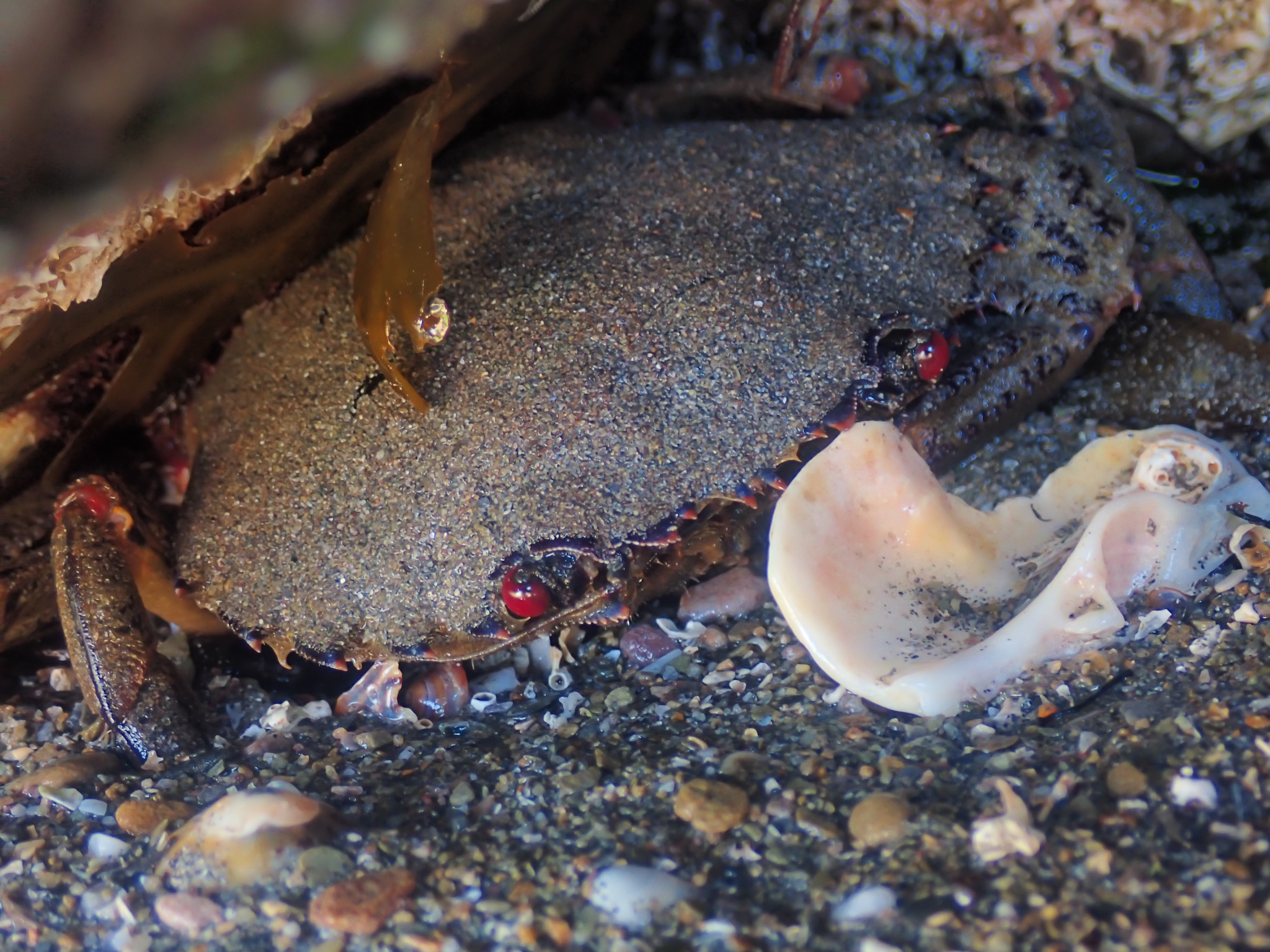
    We edge ever outwards with the tide. Although we can hear the shouts of holidaymakers playing in the waves on the beach beyond the rocks, no one else ventures into our magical gully where startled sand eels zip across the surface of the water like skimming stones and velvet swimming crabs scuttle across the seabed then bury themselves in the sand, leaving only their red eyes visible.

    A lurking velvet swimming crab.

    Some of the rocks are fringed with a dense covering of brown seaweeds. Toothed wrack and kelp compete for space here and clinging to this forest, mossy bryozoans and delicate hydroids thrive, creating a perfect habitat for isopods and slugs. Some of the seaweeds have crescents of white jelly scattered among their fronds. These are sea slug eggs but it takes me some time to find the slug itself, which is smaller than its spawn and decorated with bright yellow and black which somehow make it hard to see.

    Sea slug spawn…. now to find the slugs.

    These pretty little slugs were, until very recently, known as Polycera quadrilineata. Scientists have now discovered that there are two separate species and the ones we see here, which sometimes have black lines and spots, are now called Polycera norvegica.

    Polycera norvegica feeding on bryozoans.

    In the moving seaweed, it’s hard to take clear photos and the tide is, of course, coming in just as I’m trying to position the camera in water that’s already waist deep, but we are all content just to be here, together but apart, sharing this experience of encountering incredible creatures.

    Polycera norvegica.
    Pair of Polycera norvegica sea slugs with the edge of a fingernail in shot showing just how tiny these stunning little creatures are!

    These are strange times for everyone, but finding ways to come together and enjoy nature is what makes the world go round (for me at least). Thanks to our new friends for making it a fabulous day. Happy rock pooling!

    This time of year, the kelp is studded with blue-rayed limpets – always a joy to see.
    Brown sea cucumber – Aslia lefevrei.

  • A Rainbow in the Cornish Rock Pools – Andrà tutto bene!

    A Rainbow in the Cornish Rock Pools – Andrà tutto bene!

    In these strange and frightening times, I could not be more proud of the strength and courage I am seeing in my friends and the local community. Our world has changed, seemingly overnight, yet in Cornwall, as elsewhere, people are meeting the challenges head-on.

    While many people are risking their lives every day to look after others and deliver vital services, I can do little to help except support elderly neighbours and avoid contact. However, as long as a daily family walk from our home to our local shore is safe and permitted, I hope that I can lift someone’s mood by sharing what we see.

    It feels like a dream to step into nature, to experience how life carries on in all its colour, beauty and chaos when human lives are narrowing to the confines of four walls. The clear blue skies, arriving at last after months of storms, open out the horizon and lighten the sea, while the glittering reflection of the sun shines out of every pool.

    I feel like I could fish the sun out of this pool. A welcome change after a wet and stormy winter.

    New seaweeds are suddenly sprouting, reaching up through the clear water, among dense tufts of the pink coral weed that lines these pools all through the year. A little shanny watches me from its hiding place deep in the water, cradled by rocks on either side.

    The shanny – also known as the common blenny – has lovely eyes.

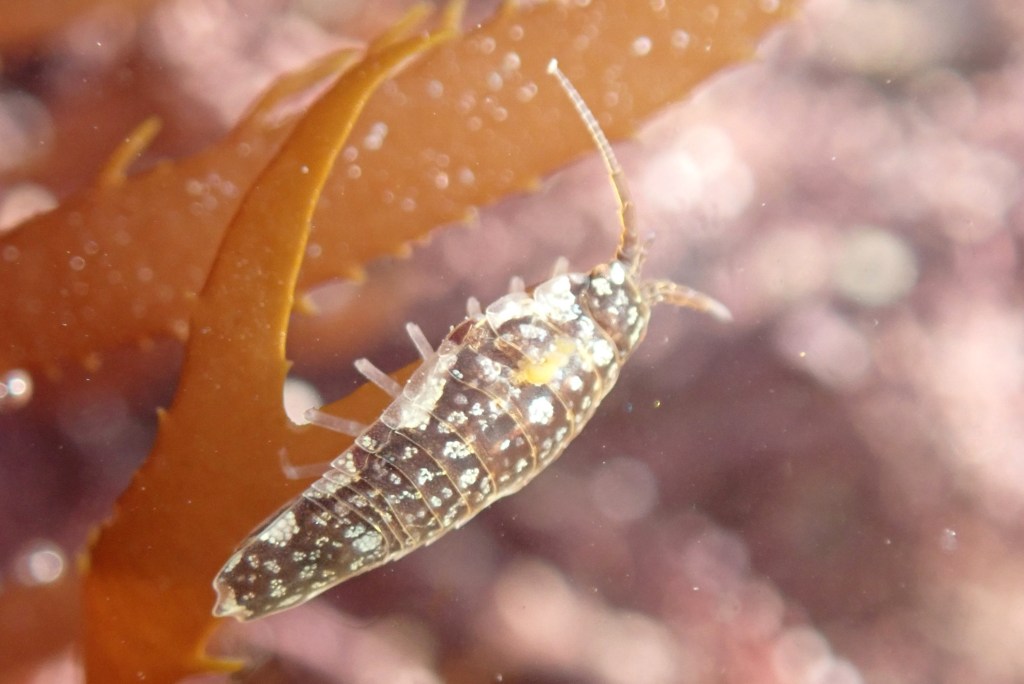
    As I try to photograph the fish’s bright clown-eyes, Junior spots another creature clinging to the weed. We kneel at the edge of the water, our heads touching as he points it out. His find is a slender woodlouse-like creature speckled with white spots, an isopod crustacean called Idotea balthica.

    Idotea balthica – an isopod crustacean.

    In a dark gully cut between the rocks by the water that rushes out between the tides, I see a flash of colour. For days now, I have been capturing images of spring flowers, breaking waves and open seascapes to send to a dear friend on lockdown with her partner and cat in her flat in Bergamo, Italy. As soon as I see this strawberry anemone, I know she will love it.

    It is one of the few unexpected positive effects of the enforced confinement that we are finding time to reach out and renew friendships. Now, she and I are sharing videos and inspiration daily, carrying each other through. She has turned her substantial abilities to creating stories and artwork to reassure those struggling with fear.

    Among other things, she has shared heartwarming images of paintings and balcony decorations depicting rainbows, the symbol of hope. The slogan of the community in Italy has become ‘Andrà tutto bene!” – Everything will be all right.

    The tide is turning and the anemone sways with the current, disappearing under seaweed and re-emerging again, in constant motion that makes photography difficult. I balance myself on a rock to stop the waves flooding my wellies and wait for an instant of stillness. The slant of the sun’s rays through the water makes the camera screen white-out. I take some snaps and hope for the best.

    I check my images when I get home and the strawberry anemone has come out as I hoped, its warm colour and flower-like tentacles are as lovely as I remember.

    It is only when I download the images onto my larger laptop screen that I notice the rainbows playing on the pink paint weed under the anemone. Rainbows of hope for my friend in Italy and for all those facing horrors and hardships. Rainbows for all of us wondering where this will end.

    Strawberry anemone on pink paint weed surrounded by little ‘rainbows’.

    All will be well.

    In the coming weeks and months, I hope to bring you more beauty from the Cornish rock pools. Even if we become completely locked down, I have a treasure trove of photos to go through so watch this space.

    More photos from my last rock pool walk below.

    Snakelocks anemone
    Painted top shell
    A great grey sea slug. The iridescent blue lines in the foreground near its head are a fragment of blue-rayed limpet shell. Another unexpected little rainbow in the rock pool!
    Great grey sea slug. The white tubes on the rocks are made by keel worms. You can see a keel worm’s circle of feathery feeding tentacles to the left of the slug.
    Broad-clawed porcelain crab.
  • Starfish and Blue-Rayed Limpets on a gloomy day

    Starfish and Blue-Rayed Limpets on a gloomy day

    The clocks have gone back, endless bands of rain are pushing in from the grey sea and the UK government has announced there will be a general election during the festive season. It might be easier to hide under a duvet and attempt hibernation, but Junior and I have other plans. We grab a camera each and race to the rock pools in search of brightness and sparkle.

    To the rock pools!

    Millendreath beach near Looe is cold enough to warrant silly winter hats – mine has big ear flaps and Junior’s is a Christmas pudding – we don’t care what we look like as long as we’re comfortable. We head out onto a rocky outcrop that gives us some shelter from the north-easterly winds and begin our search. When I find a spiny starfish twice the size of my hand in the first pool we come to, we know it’s going to be a good day.

    Junior takes a look at the tube feet on the underside of the spiny starfish.

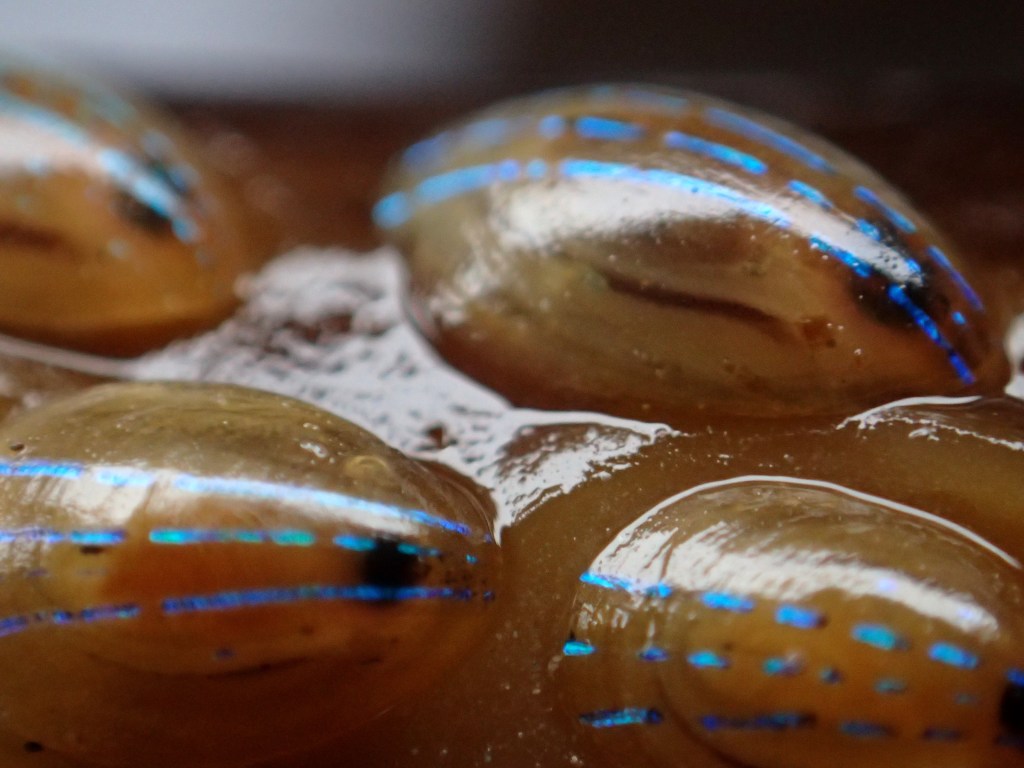
    Moving towards the sea, the gullies are full of leathery kelp and Junior knows just what to look for. The iridescent blue dashed lines on the shells of blue-rayed limpets are his favourite thing to photograph and at this time of year, some of the kelp is studded with these miniature jewels.

    Blue rayed limpets on kelp – photo by Cornish Rock Pools Junior.

    While Junior gets to work trying to capture these colours, I edge along the slippery rocks towards a tall overhang. Sponges and sea squirts coat the rocks in a huge range of hues from pinks and yellows to blues and greens. Among them are cowries, which feed on the sea squirts. One has abseiled down from the rock and is hanging by its mucous thread.

    This Arctic cowrie has abseiled from the top of the rock and is still holding on to its thread of mucus.
    A pair of Arctic cowries with their shells partly covered by their dark-striped mantles.

    Nearby, a common starfish is trying to hide in a crevice but its bright orange colour gives it away. In the dark behind it, a Xantho hydrophilus crab is doing a better job of blending in.

    A bright star on a gloomy day – common starfish at Millendreath.
    Xantho hydrophilus crab hiding in a crevice.

    For some reason the painted top shells here are paler than on those on our other local beaches and some are almost white. Another feature of this beach is the high population of sea cucumbers. We spot both the sea gherkin and the brown sea cucumber, but they are closed up today, hiding their frilly tentacles.

    A pale and beautifully marked painted top shell.
    Brown sea cucumber (centre) mostly hidden in a crevice, surrounded by sponges and other encrusting animals.

    Just before we move out of this isolated gully, Junior shouts in delight. He has taken his best ever photo of a blue-rayed limpet. All the practice and patience has paid off.

    Junior’s best blue-rayed limpet photo.
    He’s also captured me at work in my natural habitat!

    As the tide turns we take a quick look for stalked jellyfish. At this time of year, the seaweed is dying back making it easier to spot them, but the rushing currents from the stormy sea and the large amount of sediment that has been stirred up by the waves aren’t aiding our search. There are probably scores of stalked jellies here as the location is perfect for them, but we only see half a dozen. Among them are three different species: Calvadosia cruxmenlitensis, Haliclystus octoradiatus and a rather sorry-looking closed up specimen of Calvadosia campanulata.

    This Calvadosia campanulata stalked jellyfish has (hopefully) seen better days!
    The only Haliclystus octoradiatus stalked jellyfish we find is being thrown around in the current, but the white blobs of its primary tentacles can be clearly seen in this photo.
    Most of the stalked jellyfish we see today are the ‘Maltese cross’ stalked jelly – Calvadosia cruxmelitensis.
    Calvadosia cruxmelitensis stalked jelly with lots of white spots – these spots are clusters of the stinging cells (nematocysts).

    Junior spends a happy half hour watching the cracking cliffs of sand that have formed around the edges of the rain-swollen stream, until the incoming tide begins to send waves up the river, flooding the sand around us and forcing us back.

    The first spots of drizzle spatter down and will soon be followed by yet more heavy rain. There’s nothing we can do to prevent the arrival of even shorter days or colder weather, but whenever we need to find colour and inspiration during the dark winter, we will know where to find it.

    Berthella plumula sea slug
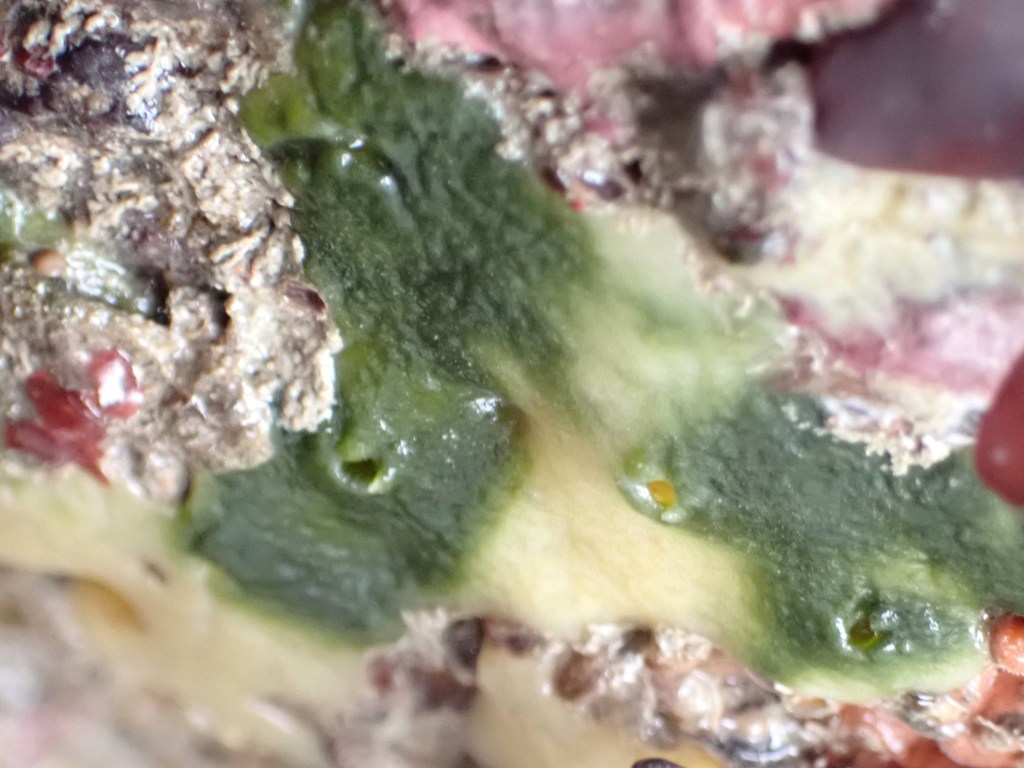
    A breadcrumb sponge with microalgae growing inside the green parts.
    Star ascidian
    A tortoiseshell limpet surrounded by pink encrusting seaweed.

    Happy rock pooling!

    Huge thanks to everyone who has shared their finds and photos with me. I love hearing about your rock pooling adventures through my contact page.